](https://deep-paper.org/en/paper/2406.19973/images/cover.png)
Introduction
In the rapidly evolving world of Artificial Intelligence, Large Vision-Language Models (LVLMs) are becoming increasingly adept at “seeing” the world and talking about it. From describing holiday photos to navigating robotics, these models are changing the landscape. However, when we apply this technology to medicine—analyzing X-rays, CT scans, or pathology slides—we hit a massive wall: Data Starvation.
To train a model to understand general images, we have billions of image-text pairs available on the internet. To train a model to diagnose a specific lung condition, we need high-quality data labeled by board-certified physicians. This process is incredibly expensive, time-consuming, and fraught with privacy concerns.
So, how do we build powerful medical AI assistants without spending millions on data collection?
The answer might lie in Self-Training. In a fascinating new paper, researchers introduce STLLaVA-Med (Self-Training Large Language and Vision Assistant for Medicine). Their approach is ingenious: instead of relying solely on scarce human-labeled data, they teach a model to generate its own training data and use a “teacher” model (GPT-4o) to grade it.
The result? A model that achieves competitive performance using only 9% of the medical data required by previous state-of-the-art models.
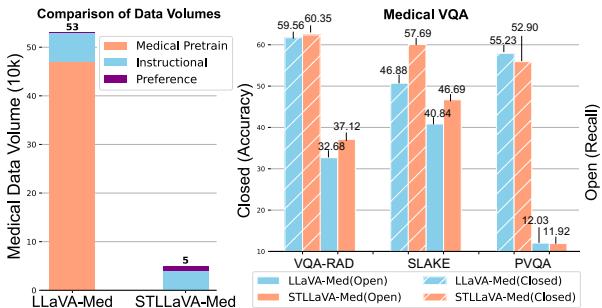
As shown in Figure 1 above, the difference in data volume is staggering. The purple bar (STLLaVA-Med) is a fraction of the size of the LLaVA-Med stack, yet the performance charts on the right show it keeping pace or even exceeding its data-hungry predecessor. In this post, we will break down exactly how this self-training pipeline works.
The Context: Why Medical VQA is Hard
Visual Question Answering (VQA) is the task where an AI looks at an image and answers a natural language question about it. In the medical domain, this might look like:
- Image: A chest X-ray.
- Question: “Is there any evidence of pleural effusion?”
- Answer: “Yes, there is blunting of the costophrenic angle…”
Standard approaches, like LLaVA-Med, rely on a two-step process:
- Alignment Pre-training: Analyzing hundreds of thousands of image-caption pairs to learn what medical concepts look like.
- Instruction Tuning: Fine-tuning on Q&A pairs to learn how to chat.
The proposed STLLaVA-Med challenges this paradigm. The researchers argue that you don’t necessarily need that massive first step of alignment pre-training on medical data if you have a smarter training strategy.
The Core Method: A Two-Stage Pipeline
The researchers propose a novel framework that splits training into two distinct stages. The goal is to take a general-purpose LVLM (which knows what a “cat” is but maybe not a “lymphoma”) and turn it into a medical expert.
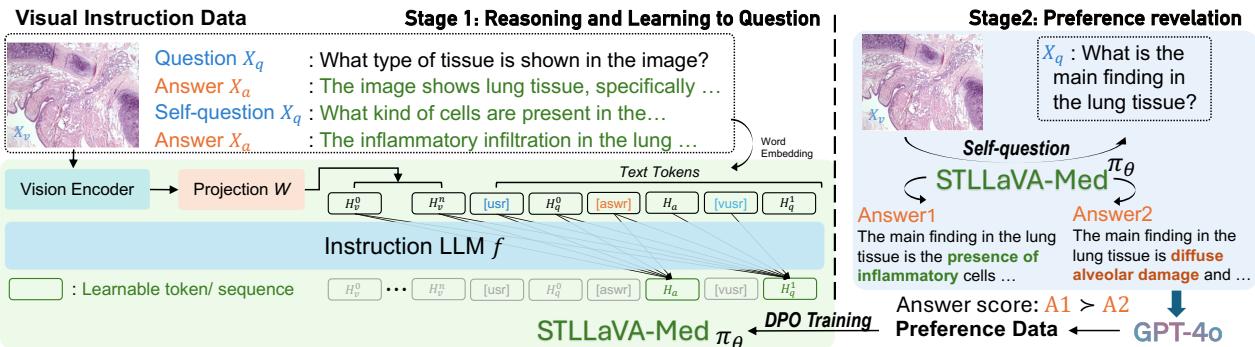
As illustrated in Figure 2, the process moves from “Reasoning and Questioning” (Stage 1) to “Preference Revelation” (Stage 2). Let’s dive deep into each.
Stage 1: Reasoning and Learning to Question
In most training pipelines, the model is passive—it just reads questions and tries to predict answers. In STLLaVA-Med, the model becomes active. The researchers modify the training objective so the model learns to ask questions about images, not just answer them.
They use a technique called Self-Questioning. By feeding the model an image (\(H_v\)) and a conversation history (\(H_c\)), the model is trained to predict the next question (\(H_q\)) and the subsequent answer (\(H_a\)).
This is achieved mathematically by minimizing two loss functions. First, the Visual Questioning Loss:

This equation ensures the model gets better at formulating relevant medical questions based on the visual features of the image.
Second, the Answering Loss:

This standard loss ensures the model can answer the questions correctly. By combining these, the model evolves from a simple answering machine into an inquisitive agent that can simulate a dialogue about medical imagery. After this stage, the model is capable of generating its own Question-Answer (QA) pairs.
Stage 2: Preference Revelation via DPO
At the end of Stage 1, we have a model that can generate medical Q&A pairs. But are they good answers? A model might hallucinate or give vague responses like “The image shows a scan.”
To fix this, the researchers use Direct Preference Optimization (DPO). This is a technique usually used to align Chatbots with human preferences (making them helpful and harmless). Here, it is used to make the medical assistant precise and detailed.
The “Teacher” in the Loop: GPT-4o
Collecting human preferences (e.g., asking a doctor “Is Answer A better than Answer B?”) is expensive. The researchers innovate by using GPT-4o as a simulated medical expert.
Here is the workflow for Stage 2:
- Generation: The model from Stage 1 looks at a medical image and generates a question, followed by two different answers.
- Grading: These answers are sent to GPT-4o. GPT-4o analyzes the image and the text, and selects the “winner” (better accuracy, more detail) and the “loser.”
- Optimization: The model is fine-tuned to maximize the probability of generating the “winning” answer while suppressing the “losing” one.
The prompt used to guide GPT-4o is crucial. It effectively tells the large model to act as a judge:
Once the “Win” (\(a_w\)) and “Loss” (\(a_l\)) answers are identified, the model is updated using the DPO loss function:
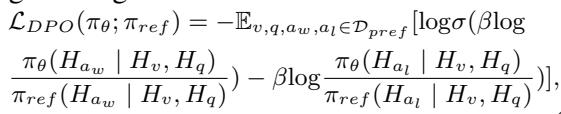
In this equation, the model (\(\pi_{\theta}\)) is penalized if it prefers the losing answer and rewarded if it aligns with the reference policy (the teacher’s preference). This effectively steers the model toward professional, detailed, and accurate medical reasoning without needing a human in the loop.
Data Efficiency: Doing More with Less
One of the most impressive aspects of this paper is the data statistics. The authors utilized a dataset known as Med-IM. Let’s look at the numbers.
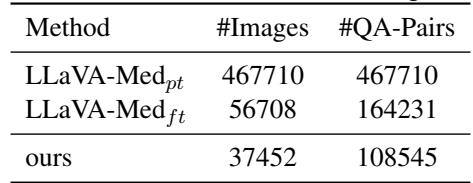
As seen in Table 1, the standard LLaVA-Med approach required pre-training on nearly 468,000 image-text pairs (\(LLaVA-Med_{pt}\)). In contrast, STLLaVA-Med (ours) skipped that massive pre-training step entirely. It used a smaller subset of images (approx 37k) to generate its own instruction data.
This represents a paradigm shift: Medical image-text alignment (pre-training) might be unnecessary if you have a strong enough general vision model and a smart self-training loop.
Experiments and Results
The researchers tested STLLaVA-Med against three major benchmarks:
- VQA-RAD: Radiology Q&A.
- SLAKE: English-Chinese bilingual medical VQA (English subset used).
- PVQA: Pathology Visual Question Answering.
The results were compared against heavyweights like GPT-4o (zero-shot), LLaVA-v1.5, and the fully trained LLaVA-Med.
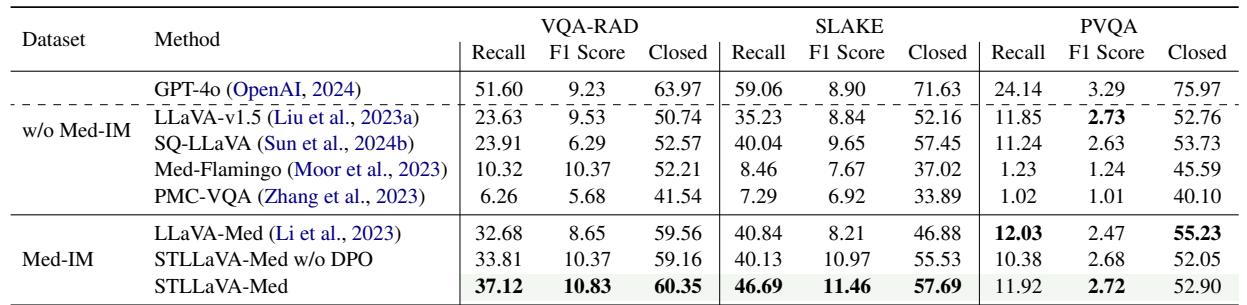
Table 2 highlights the “Zero-Shot” performance (where the model wasn’t explicitly trained on these specific benchmark datasets).
- Recall & F1 Score: STLLaVA-Med generally outperforms the standard LLaVA-v1.5 and comes very close to, or beats, the fully trained LLaVA-Med.
- The Impact of DPO: The table shows “STLLaVA-Med w/o DPO” vs. the final version. The DPO step consistently improves performance, particularly in “Open” questions where detailed explanations are required.
Qualitative Analysis: Seeing the Difference
Numbers are great, but in medicine, the quality of the explanation matters. Does the model sound like a doctor?
In Figure 5, we can see the evolution of the model’s “thought process.”
- The Question: “What kind of lesion is it?” (Bottom row).
- Without DPO: The model gives a brief, somewhat generic answer about a “soft tissue heterogeneously enhancing lesion.”
- With DPO (STLLaVA-Med): The answer becomes significantly richer. It identifies the lesion as a “multilocular, cystic retroperitoneal tumor,” explains the location (“behind the peritoneum”), and describes the internal structure (“multiple septations”).
This difference illustrates the power of the DPO stage guided by GPT-4o. The model didn’t just learn what to say; it learned the style and depth preferred by medical experts.
Fine-Tuning Performance
The authors also checked how the model performs when fine-tuned specifically on downstream tasks (Table 4).

Even when fine-tuned, the self-trained model maintains a lead over the baseline LLaVA-v1.5, proving that the foundation built during the self-training phase provides a robust “medical intuition” that carries over to specific tasks.
Conclusion & Implications
The STLLaVA-Med paper presents a compelling argument for the future of specialized AI. It addresses the “Data Starvation” issue not by finding more data, but by making better use of the models we already have.
Key Takeaways:
- Self-Training Works: You can teach a model to ask questions and then answer them to boost its own reasoning capabilities.
- GPT-4o as a Proxy: Using a powerful generalist model to grade a smaller specialist model effectively replaces expensive human annotation for preference learning.
- Efficiency: We can achieve state-of-the-art results with a fraction (9%) of the data previously thought necessary.
This approach has broad implications beyond medicine. Any field where data is scarce, expensive, or private—from law to engineering—could potentially benefit from this cycle of self-questioning and automated preference optimization. STLLaVA-Med demonstrates that sometimes, the best way to learn is to ask yourself the right questions.