](https://deep-paper.org/en/paper/2407.00402/images/cover.png)
In the rapidly evolving world of Large Language Models (LLMs), we are currently witnessing a “context window arms race.” Not long ago, a model that could remember 2,000 words was impressive. Today, we have models boasting context windows of 128k, 200k, or even 1 million tokens.
The promise is alluring: you can feed an entire novel, a codebase, or a legal archive into a model and ask questions about it. But this technical leap forces us to ask a critical question: Does a longer input capacity equal better understanding?
If a model can find a specific password hidden in a 1-million-token document, has it “understood” the document, or has it simply performed a very expensive “Command+F” search?
In the position paper “Is It Really Long Context if All You Need Is Retrieval?”, researchers from Bar-Ilan University argue that we are conflating “length” with “difficulty.” They propose that simply counting tokens is a bad way to measure progress. Instead, they introduce a new taxonomy to distinguish between simple retrieval tasks and genuine long-context reasoning.
The Problem with “Needles in Haystacks”
To understand the authors’ argument, we first need to look at how we currently test long-context models.
The industry standard has largely become the “Needle-in-a-Haystack” (NIAH) test. In this setup, you take a random fact (the needle), hide it somewhere in a massive amount of unrelated text (the haystack), and ask the model to find it.
While NIAH tests are useful for checking if a model’s attention mechanism breaks down over long distances, they are remarkably simple in terms of reasoning. They represent a specific type of difficulty: retrieval.
The authors argue that treating all “long” tasks as the same is unproductive. Summarizing a novel requires fundamentally different cognitive labor than finding a single date in a financial report, even if both documents have the exact same word count. To push the field forward, we need a vocabulary that describes why a task is hard, not just how long it is.
A New Taxonomy: Scope and Dispersion
The core contribution of this paper is a new framework for categorizing long-context tasks. The researchers propose two orthogonal axes of difficulty: Dispersion and Scope.
By plotting tasks on these two axes, we can separate simple retrieval from complex reasoning.
1. Dispersion: How hard is it to find?
Dispersion measures the difficulty of locating the necessary information within the text.
- Low Dispersion: The information is explicit, located in one place, and easy to identify. (Example: “What is the date listed in the header?”)
- High Dispersion: The information is scattered across the document, implicit, or requires connecting multiple clues that are far apart. (Example: “How did the protagonist’s relationship with her father influence her decision in the final chapter?”)
2. Scope: How much information is needed?
Scope measures the quantity of information required to answer the prompt.
- Low Scope: You only need a specific sentence or paragraph to solve the task.
- High Scope: You need to synthesize information from a large portion, or perhaps the entirety, of the text.
The authors visualize this taxonomy in a quadrant diagram, which is essential for understanding the landscape of current LLM capabilities.
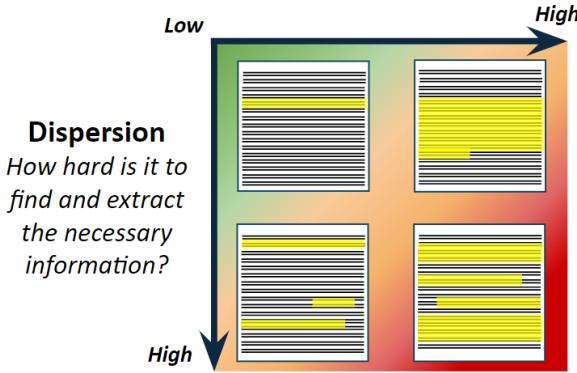
As shown in Figure 1, the tasks become progressively more “difficult” (indicated by the darker shading) as you move toward the bottom right.
- Quadrant I (Top-Left): Low Scope, Low Dispersion. This is simple retrieval. You need one piece of info, and it’s easy to find.
- Quadrant II (Top-Right): High Scope, Low Dispersion. You need a lot of info, but it’s all clumped together or easy to grab.
- Quadrant III (Bottom-Left): Low Scope, High Dispersion. You need a small amount of info, but it is buried, scattered, or tricky to identify (e.g., finding multiple specific “needles”).
- Quadrant IV (Bottom-Right): High Scope, High Dispersion. This is the holy grail. You need to read almost everything, and the information is interwoven in complex ways. This represents true reading comprehension.
Surveying the Landscape: Where Are We Now?
The authors conducted a comprehensive survey of existing long-context benchmarks (datasets used to test LLMs) to see where they fall on this map. The results expose a significant gap in current research.
Most of our current benchmarks, including the popular “Needle-in-a-Haystack” tests, fall firmly into the “easier” categories. They test the model’s ability to maintain a memory trace over long distances, but they don’t test the ability to synthesize dispersed information.
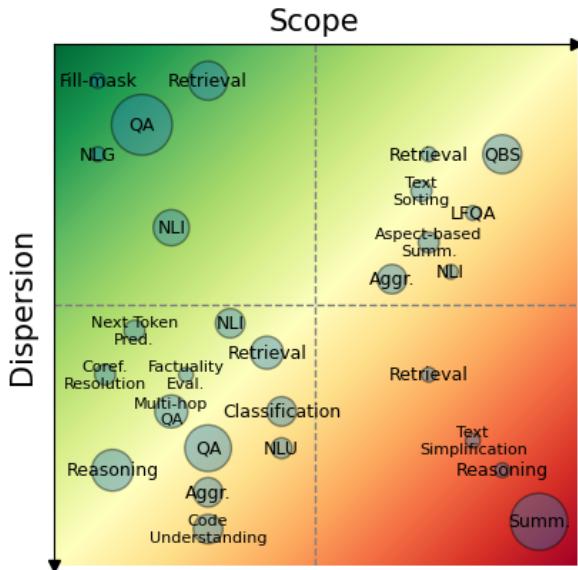
Figure 2 provides a “heat map” of current NLP tasks. Notice the concentration of tasks in the green and yellow zones:
- Retrieval & Simple QA (Green/Yellow): These dominate the landscape. They usually require finding a specific fact. Even if the document is long, the task is short-context in nature.
- Summarization (Orange): Summarization is often considered a “long-context” task. However, the authors note that many summarization datasets act mainly as High Scope/Low Dispersion. You need a lot of info, but you are usually just condensing explicit main points rather than hunting for subtle connections.
- The “Red” Zone Gap: There are very few benchmarks in the bottom-right corner (High Scope + High Dispersion). Tasks that require finding subtle, scattered clues and synthesizing them into a comprehensive whole are severely under-explored.
Concrete Examples
To make this concrete, the authors classified specific, well-known benchmarks into this table. This is incredibly useful for researchers trying to select the right dataset to test a model’s true reasoning limits.
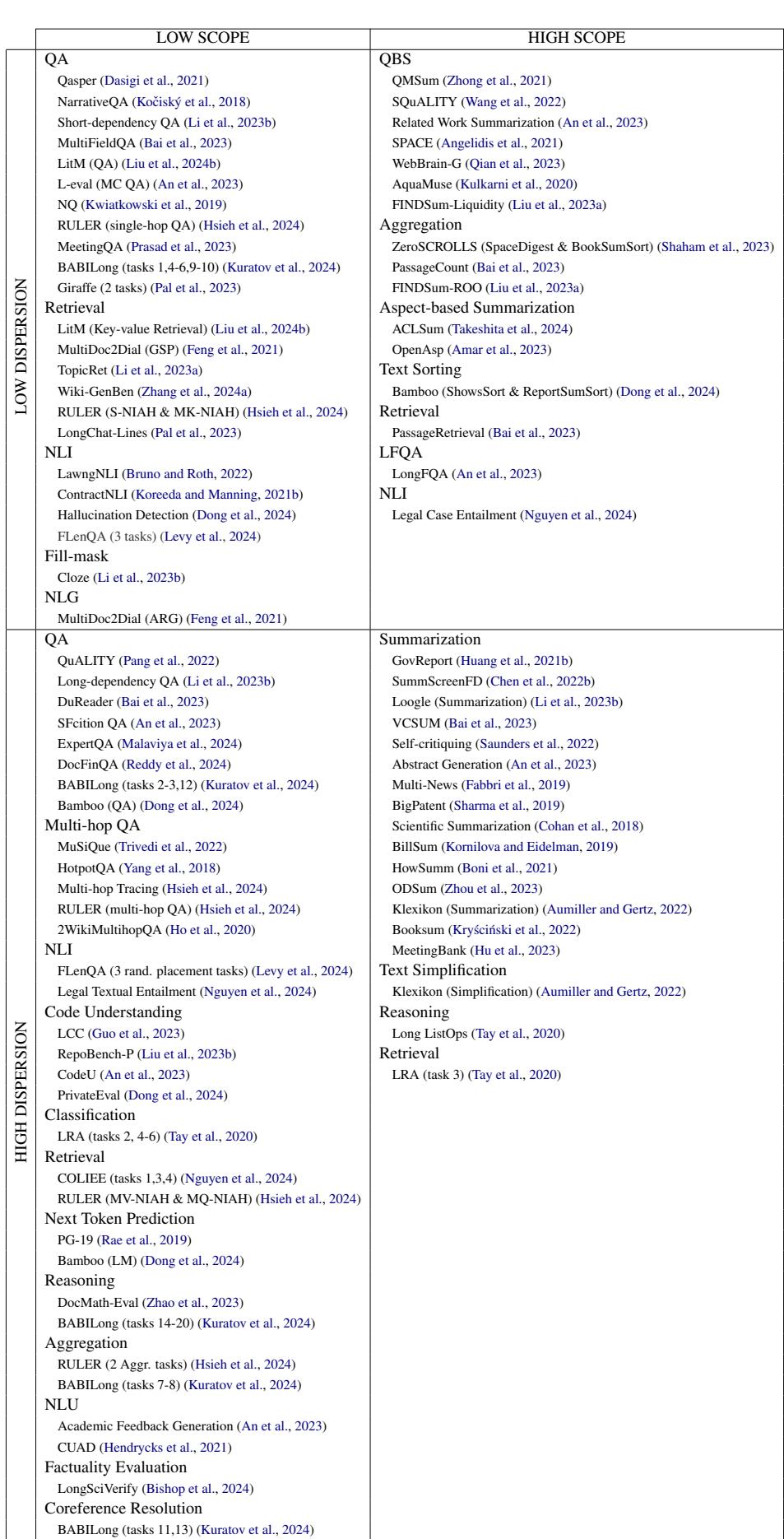
Looking at Table 1, we can see the disparity:
- Low Scope / Low Dispersion: This is where you find standard QA datasets like Qasper or NarrativeQA. These are essential but don’t push the “long-context reasoning” boundary.
- High Scope / High Dispersion: This section is sparse. It lists complex tasks like scientific summarization (BigPatent) or aggregating information across multiple documents (Multi-News). These are the tasks that actually prove an LLM can “think” over long contexts, not just recall.
Why This Matters
The distinction between “long input” and “long reasoning” is not just semantic. It dictates how we build and evaluate the next generation of AI.
If we continue to evaluate models primarily on Low Scope / Low Dispersion tasks (like finding a passkey in a book), we effectively encourage the development of models that are really good search engines but poor readers. We might end up with models that can process 10 million tokens but cannot summarize the subtle thematic shifts in a 50-page story.
The authors identify a “synthetic vs. natural” trap in current research. Researchers often try to make tasks harder by artificially increasing the length (adding “distractors”). However, a 100-page document where you only need one sentence is still a Low Scope task. To truly test intelligence, we must increase the Dispersion (making the info harder to find) and the Scope (requiring more of the info to be used).
Conclusion: Moving Beyond Retrieval
The paper “Is It Really Long Context if All You Need Is Retrieval?” serves as a necessary reality check for the AI community. As context windows grow exponentially, we must stop being impressed by the sheer volume of text a model can ingest.
Instead, we need to focus on what the model does with that text.
The authors call for a shift in benchmark design. We need more tasks that simulate real-world expert domains—like legal discovery, financial auditing, or comprehensive literature reviews—where the answers are not explicit “needles” waiting to be found, but complex insights that must be woven together from threads scattered across the entire “haystack.”
Only by targeting High Scope and High Dispersion can we move from models that simply retrieve to models that truly understand.