](https://deep-paper.org/en/paper/2407.01009/images/cover.png)
Introduction
In his seminal book Thinking, Fast and Slow, Nobel laureate Daniel Kahneman describes two primary modes of human thought: “System 1,” which is fast, instinctive, and emotional; and “System 2,” which is slower, more deliberative, and more logical. When someone asks you “What is 2 + 2?”, you engage System 1. You don’t calculate it; you just know it. However, if asked “What is 17 × 24?”, you engage System 2. You pause, retrieve a mental algorithm, and process the problem step-by-step.
Large Language Models (LLMs), despite their impressive capabilities, have historically lacked this dynamic ability to switch gears. Whether you ask an LLM a trivial trivia question or a complex calculus problem, the computational process—the “forward pass” through the neural network—remains largely static. This rigidity leads to two distinct problems:
- Inefficiency: We waste massive computational resources treating simple problems as if they were complex.
- Inaccuracy: For truly complex problems, standard decoding methods often fail to be “slow” enough to verify the result thoroughly.
Today, we are diving deep into a research paper that attempts to bridge this gap: DynaThink. The researchers behind DynaThink have proposed a dynamic decision-making framework that allows LLMs to autonomously categorize tasks into “Fast” (high-confidence, simple reasoning) and “Slow” (low-confidence, complex reasoning) pathways. By doing so, the model can optimize for both efficiency and accuracy, effectively mimicking the human cognitive balance between intuition and deliberation.
Background: The Evolution of Reasoning in LLMs
To understand why DynaThink is significant, we must first look at the tools we currently use to make LLMs “think.”
Chain-of-Thought (CoT)
The breakout moment for LLM reasoning was the introduction of Chain-of-Thought (CoT) prompting. Instead of asking a model for a direct answer, CoT encourages the model to generate intermediate reasoning steps (e.g., “Let’s think step by step”). This simple change dramatically improved performance on math and logic benchmarks. However, standard CoT is a “one-shot” attempt. If the model hallucinates a step early in the chain, the final answer is wrong.
Self-Consistency (SC)
To mitigate the fragility of a single chain of thought, researchers introduced Self-Consistency (SC). The idea is intuitive: instead of asking the model once, ask it \(k\) times (e.g., 10 times) and take a majority vote. If 7 out of 10 reasoning paths lead to the answer “42,” we can be fairly confident that “42” is correct.
While Self-Consistency is a powerful baseline, it is incredibly inefficient. It forces the model to generate multiple long chains of text for every problem, regardless of difficulty. Using SC on an easy question is like convening a jury of 12 people to decide what color the sky is. It works, but it’s a waste of resources.
The industry has been searching for a method that retains the accuracy of Self-Consistency without the massive computational overhead. This is where DynaThink enters the picture.
The DynaThink Framework
DynaThink is built on a dynamic feedback loop. Instead of deciding beforehand how many times to query the model, DynaThink starts small and only scales up “thinking time” (resources) when necessary.
The core of the framework revolves around categorizing questions into two buckets:
- Fast Thinking: Questions where the model quickly identifies a high-confidence solution that is also reasoned simply.
- Slow Thinking: Questions that are complex, exhibit low confidence, or require convoluted reasoning paths.
The researchers developed a rigorous workflow to perform this categorization automatically during inference.
The Workflow
Let’s visualize the process. The image below (Figure 1) illustrates the step-by-step decision flow of DynaThink.
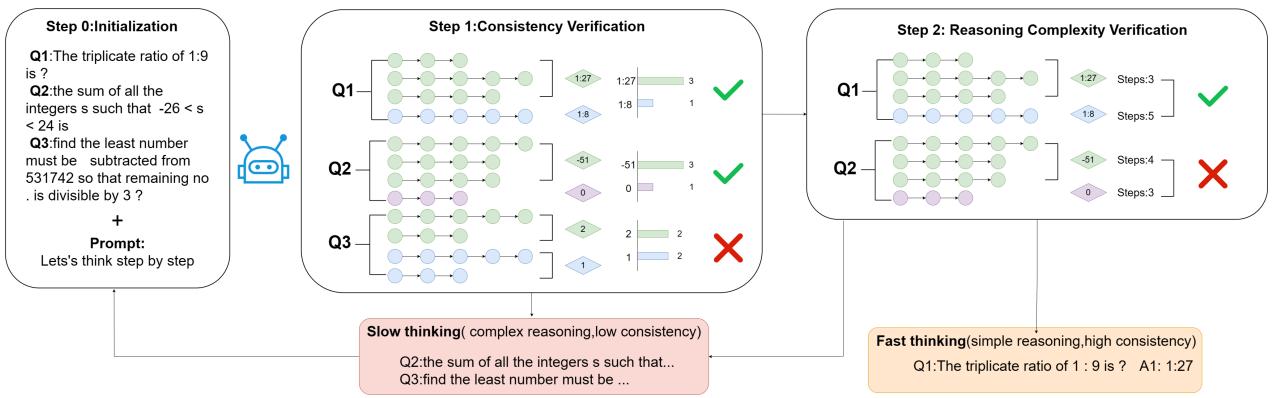
The process operates in cycles (iterations):
- Initialization: The system starts by querying the LLM a small number of times (e.g., 2 or 4 times).
- Consistency Verification: It checks if the answers generated so far agree with each other.
- Reasoning Complexity Verification: It checks how complicated the reasoning was for the agreed-upon answer.
- Categorization:
- If an answer passes both verification checks, it is deemed a “Fast” task. The system outputs the answer and stops.
- If an answer fails either check, it is deemed a “Slow” task. It is sent back to the pool, more queries are generated, and the cycle repeats.
This loop ensures that easy questions exit the system early (saving cost), while hard questions accumulate more reasoning paths until a confident solution is found.
Criterion 1: Consistency Verification
The first filter is based on the consensus of the generated answers. The researchers posit that if multiple distinct thought processes converge on a single answer, the confidence in that answer increases.
However, unlike standard Self-Consistency which just takes the simple majority (the “winner”), DynaThink applies a stricter rule: The answer must secure more than half of the total votes.
Why this specific threshold? The authors performed an ablation study to test different voting rules: “Majority Voting” (just picking the winner even if it’s 30% of votes), “More than Half” (>50%), and “All the Same” (100% consensus).
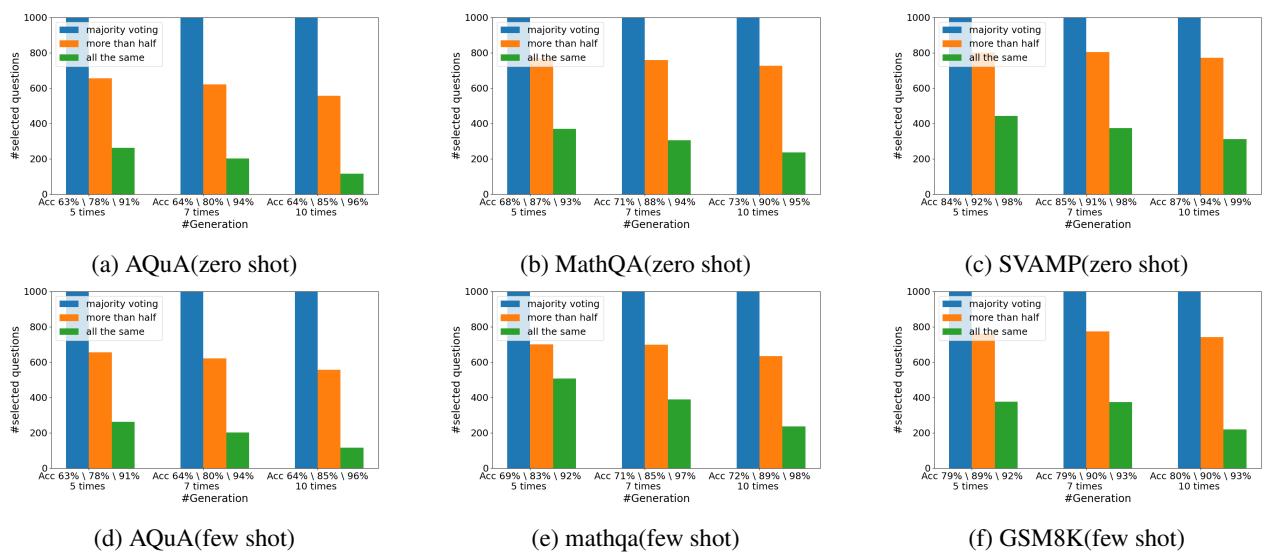
As shown in Figure 4 above, there is a trade-off. The “All the same” criterion (green bars) yields high accuracy but selects very few questions, leaving too many for the expensive “Slow” loop. “Majority voting” (blue bars) selects the most questions but sacrifices accuracy. The “More than Half” criterion (orange bars) hits the “Goldilocks” zone: it maintains high accuracy (only 4-6% lower than strict unanimity) while covering a much larger portion of questions (approx 80%).
Criterion 2: Reasoning Complexity Verification
This is the most novel contribution of the paper. Even if an answer has high consensus, is it the right answer? The researchers introduce a heuristic based on reasoning length.
The hypothesis is rooted in error propagation. An LLM’s reasoning process is a sequence of probabilistic decisions. If a model takes 20 steps to solve a problem that should take 5, each additional step introduces a chance for logic errors or hallucinations. Therefore, fewer reasoning steps often yield more reliable outcomes.
In the DynaThink framework, after an answer passes the consistency check (>50% votes), the system looks at the number of steps taken to reach that answer. It compares this to the minimum number of steps observed across all generated paths. Only if the consensus answer is also the one derived from the simplest (shortest) reasoning path is it accepted as a “Fast” solution.
To validate this “shorter is better” hypothesis, the authors analyzed the correlation between step count and accuracy.
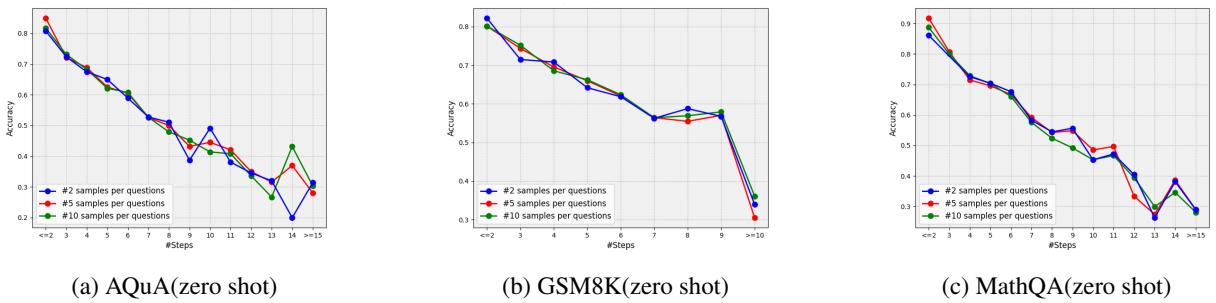
Figure 3 (above) provides compelling evidence. Across multiple datasets (AQuA, GSM8K, MathQA), there is a clear downward trend: as the number of reasoning steps increases, the model’s accuracy decreases. This confirms that brevity correlates with correctness in LLM reasoning. By filtering for answers that are both popular (consistency) and concise (complexity), DynaThink filters out “confident hallucinations” where the model might ramble its way to a wrong conclusion multiple times.
The Importance of Order
One might ask: Does the order of these checks matter? Should we check for short answers first, or consistent answers first?
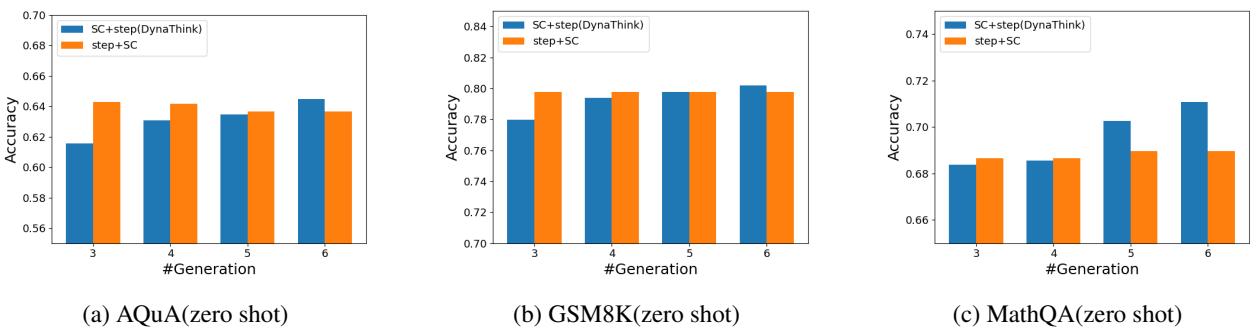
Figure 5 shows the result of checking complexity first (“step+SC”) versus checking consistency first (“SC+step”, which is DynaThink). The blue bars (DynaThink) generally show more stable and higher performance as generations increase. Prioritizing consistency ensures we have a pool of agreed-upon answers before we optimize for brevity, leading to a more robust selection process.
Experiments and Key Results
The researchers evaluated DynaThink on six diverse reasoning benchmarks, including mathematical reasoning (MATH, GSM8K) and commonsense reasoning (StrategyQA). They compared it against the standard Self-Consistency (SC) baseline using various models like GPT-3.5, GPT-4, and Mixtral.
The goal was to see if DynaThink could achieve better accuracy with fewer (or comparable) queries to the LLM.
Superior Accuracy and Efficiency
The main results are summarized in Figure 2 below. The charts compare DynaThink (blue) against standard Self-Consistency (orange). The X-axis represents the number of queries (cost), and the Y-axis represents accuracy.
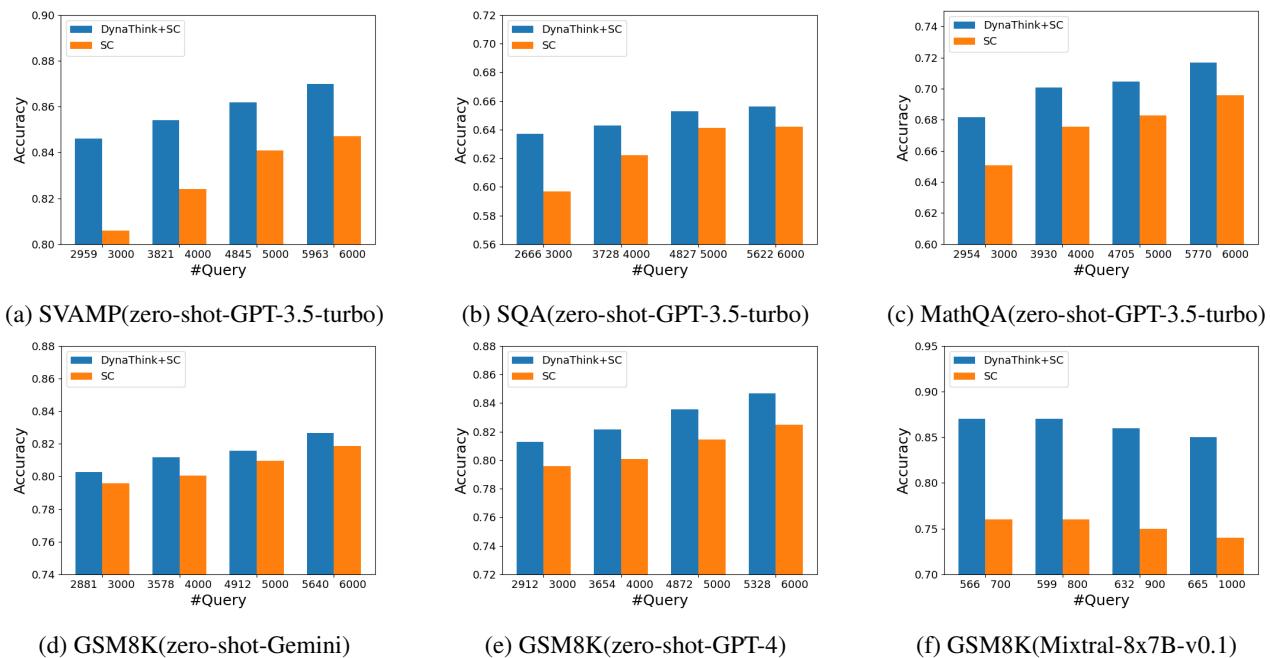
The results are consistent across datasets and models:
- DynaThink consistently outperforms standard SC. In almost every bar chart, the blue bar is higher than the orange one.
- Efficiency gains: Look at the chart for MATH (zero-shot) with GPT-3.5. DynaThink achieves 45% accuracy with ~2,750 queries, whereas standard SC only reaches 41.9% accuracy with the same number of queries.
- Scalability: The framework works for open-source models (Mixtral) and closed-source giants (GPT-4) alike. Even with GPT-4, which already has high baseline performance, DynaThink squeezes out extra accuracy.
Robustness Across Settings
The paper further breaks down results into zero-shot and few-shot settings. The trend holds: by dynamically allocating more resources to “Slow” questions and quickly resolving “Fast” ones, the aggregate performance of the system improves.
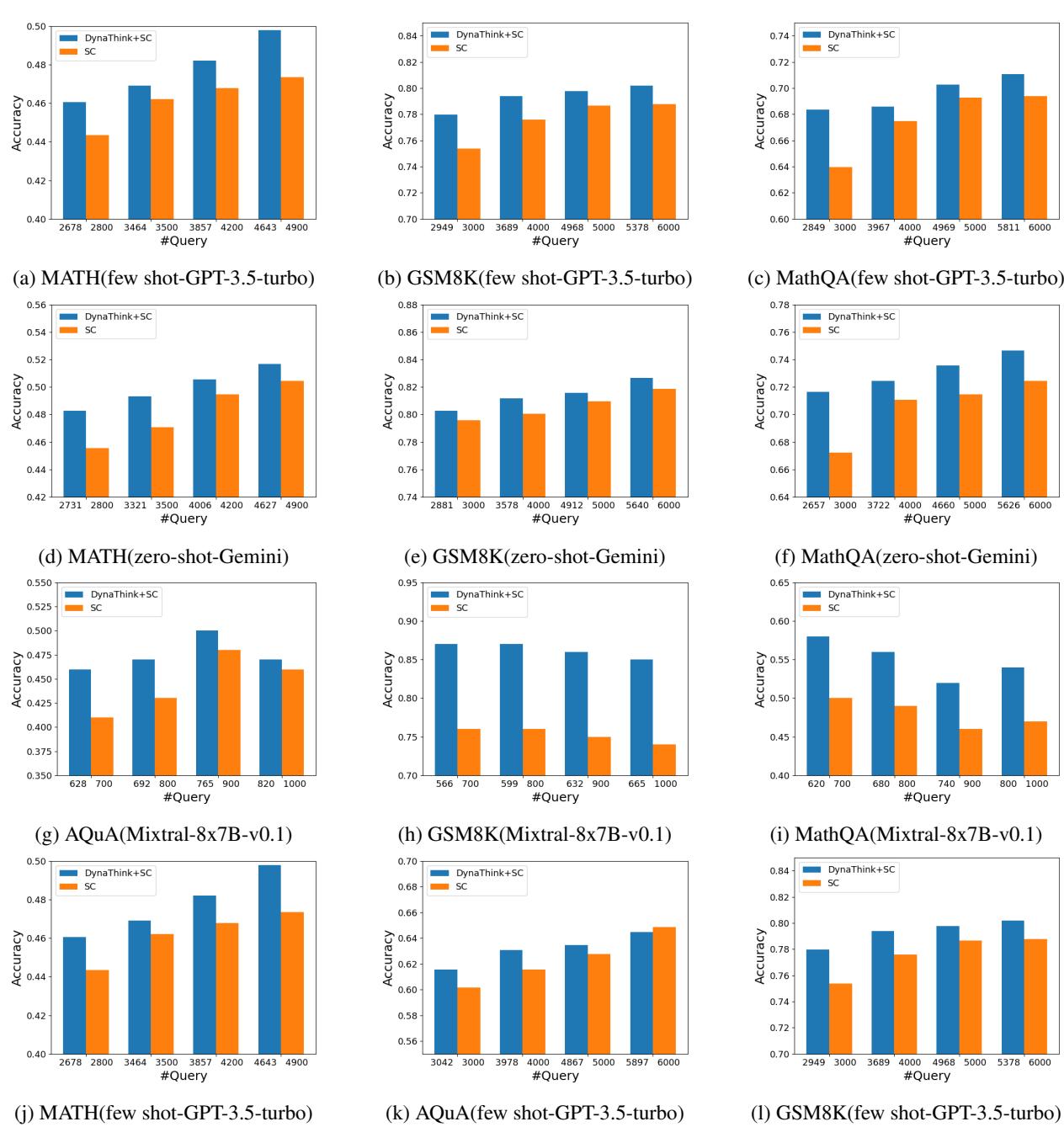
Figure 7 (above) expands on this, showing that as the query budget increases (moving right on the X-axis), DynaThink continues to scale better than the baseline. This indicates that the “Slow” thinking loop effectively utilizes the extra compute to solve the harder problems that standard SC misses.
Conclusion and Implications
The DynaThink framework represents a significant step toward “metacognition” in AI—giving models the ability to assess the quality of their own thinking. By implementing a system that distinguishes between tasks requiring “Fast” intuition and “Slow” deliberation, the researchers have created a method that is not only more accurate but also more resource-efficient.
Key Takeaways for Students:
- Dynamic > Static: Fixed computing budgets (like querying an LLM exactly 5 times for every prompt) are inefficient. Adaptive frameworks are the future of inference.
- Two Signals are Better than One: Relying solely on consistency (voting) helps, but adding a second signal—reasoning complexity (path length)—significantly cleans up the results.
- Complexity is a Proxy for Error: In Chain-of-Thought reasoning, longer paths often indicate the model is “struggling” or hallucinating. Simplicity often indicates truth.
The implications of this work extend beyond just getting better scores on math tests. As we integrate LLMs into real-world applications with latency and cost constraints, frameworks like DynaThink will be essential. They allow us to trust the model to spend “money” (compute tokens) only when the problem truly demands it, bringing us one step closer to AI that thinks as efficiently as it computes.