](https://deep-paper.org/en/paper/2407.01264/images/cover.png)
Introduction
In the landscape of modern Artificial Intelligence, we have witnessed a revolution in how machines understand human language. Large Language Models (LLMs) like GPT-4 allow us to converse with computers fluently, and multimodal models allow us to generate images from text descriptions. However, a significant digital divide remains: Sign Language Processing (SLP).
Sign languages are the primary means of communication for approximately 70 million deaf people worldwide. Unlike spoken languages, which are auditory and linear, sign languages are visual-gestural. They involve intricate manual articulations (hand shapes, movements) combined with non-manual markers (facial expressions, body posture). While Natural Language Processing (NLP) for spoken text has flourished due to the abundance of written data on the internet, SLP has lagged behind. Data is scarce, expensive to annotate, and often limited to specific domains (like weather forecasts) or specific languages (like American Sign Language).
How do we bridge this gap? How can we build models that understand sign language with the same versatility as models like CLIP understand images?
This is the core question addressed in SignCLIP, a research paper by Zifan Jiang et al. The researchers propose a method to project spoken language text and sign language videos into a shared “latent space”—a mathematical environment where concepts that mean the same thing are located close to each other, regardless of whether they are spoken or signed.
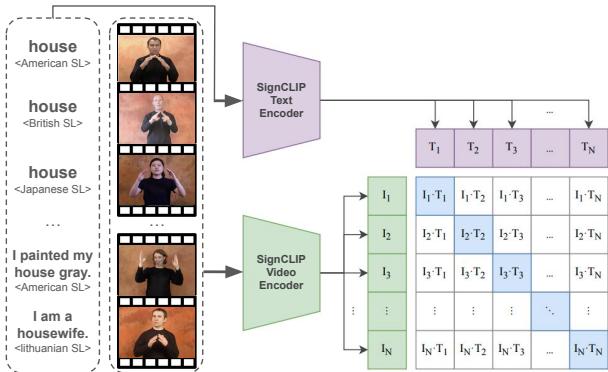
As shown in Figure 1, the goal is to create a model that can take a video of a person signing “house” and match it correctly to the text “house,” even if the model has never seen that specific video or signer before. This blog post will take you through the journey of SignCLIP, from its foundational concepts and architectural design to its performance on downstream tasks.
Background: The Challenge of Representation
Before diving into the architecture, we must address a fundamental hurdle in SLP: How do we represent a sign language video to a computer?
In text processing, we break sentences into tokens (words or sub-words). But a video is a dense, continuous stream of pixels. A 10-second video at 30 frames per second contains 300 images. Processing raw pixels is computationally expensive and noisy.
The researchers explored several representation strategies:
- 3D-CNN Video Encoders: These are deep learning networks (like S3D or I3D) trained on massive video datasets (like YouTube clips) to recognize general actions. They compress a video into a sequence of feature vectors.
- Pose Estimation: This involves using computer vision tools (like MediaPipe Holistic) to detect specific “keypoints” on the human body—joints, fingertips, and facial contours. Instead of processing pixels, the model processes the mathematical coordinates (X, Y, Z) of the signer’s body.
- Discrete Tokens: converting signs into written notations (like SignWriting or Glosses), though this requires intermediate translation steps.
SignCLIP specifically investigates the trade-off between using general video features versus pose estimation. As we will see, how the computer “sees” the signer makes a massive difference in how well it understands the sign.
Step 1: FingerCLIP — A Proof of Concept
Before attempting to solve the problem for full-fledged sign languages, the authors started with a “toy task”: Fingerspelling.
Fingerspelling is a subsystem of sign language where words from spoken languages (like names or technical terms) are spelled out letter-by-letter using hand configurations. It serves as a perfect testing ground because it has a limited vocabulary (the alphabet) but high visual variance.
The researchers created FingerCLIP, a miniature version of their proposed model, and tested it on the RWTH German Fingerspelling Database.
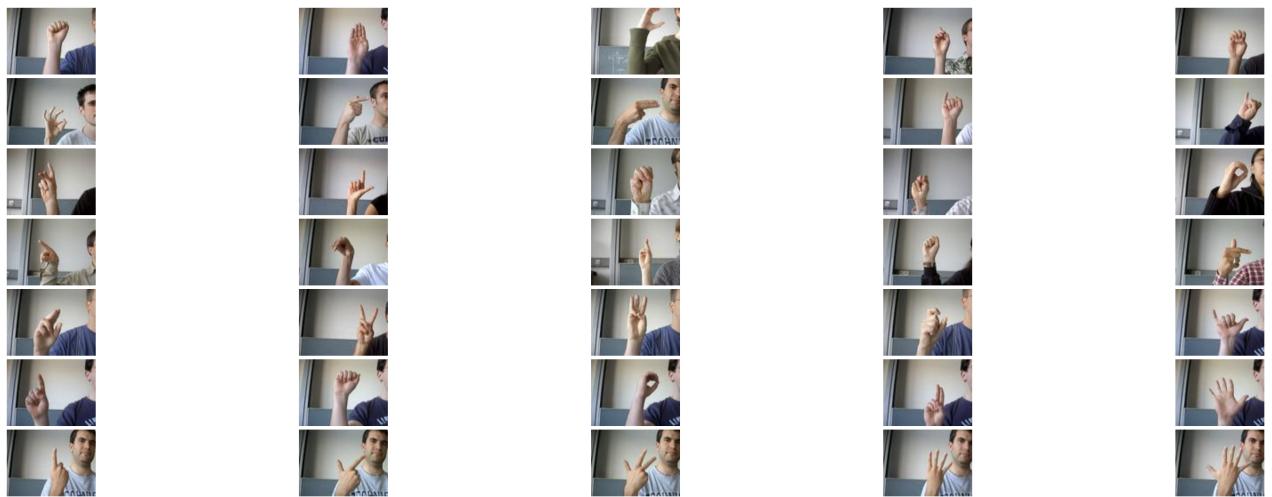
The Battle of Encoders
The primary experiment in FingerCLIP was determining which visual encoder yielded the best results. They compared:
- VideoCLIP (S3D): Pretrained on general instructional videos (HowTo100M).
- I3D: Pretrained specifically on British Sign Language (BSL-1K).
- MediaPipe Holistic: A pose estimation framework extracting body keypoints.
The results were telling. The researchers treated the task as a retrieval problem: given a text prompt (e.g., “Fingerspell the letter A”), can the model find the correct video from a list?
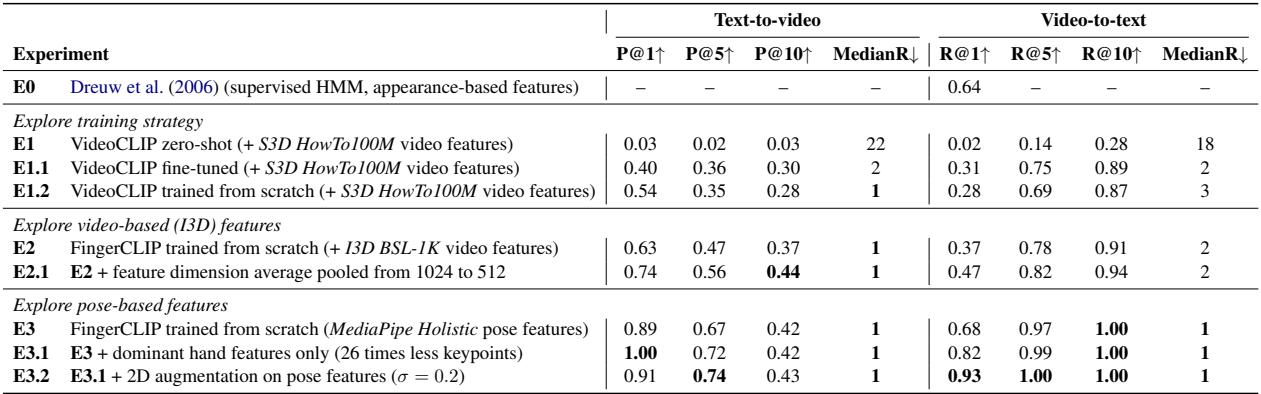
Key Takeaways from Table 2:
- General Video Features Fail (E1): The Zero-shot VideoCLIP model performed no better than random guessing. This proves that generic video models do not inherently understand the nuances of hand shapes.
- Specialized is Better (E2): The I3D model trained on British Sign Language performed significantly better.
- Pose Estimation Wins (E3): The model using MediaPipe Holistic pose features achieved the highest accuracy (Recall@1 of 0.68 vs 0.37 for I3D).
Why did pose estimation win? It strips away background noise, lighting conditions, and clothing, forcing the model to focus purely on the biomechanics of the hand and body. Consequently, the researchers decided to power SignCLIP using pose estimation features rather than raw video embeddings.
Core Method: The SignCLIP Architecture
With the lessons learned from FingerCLIP, the authors scaled up to SignCLIP. The objective remained the same: use contrastive learning to align text and video.
The Contrastive Objective
Contrastive learning is a training technique where the model learns by comparison.
- Positive Pairs: A video of someone signing “House” and the text “House”. The model pulls these representations closer together.
- Negative Pairs: A video of someone signing “House” and the text “Car”. The model pushes these representations apart.
By doing this over thousands of examples, the model learns a “map” (latent space) where similar concepts cluster together.
The Mathematics of Alignment
The architecture consists of two main streams: a Video Encoder and a Text Encoder.
1. The Video Stream First, the video is processed to extract pose keypoints \(c_v\). These are fed into a video encoder \(f_{\theta_{ve}}\). The output is then projected into a specific dimension size (\(d=768\)) to match the text embeddings.

Here, stopgrad indicates that parts of the feature extractor might be frozen (not updated) during the initial steps to maintain stability. The result is a sequence of vectors \(x_v\) representing the video frames.
2. The Text Stream Simultaneously, the text label (e.g., “Hello, can I help you?”) is tokenized and processed by a pre-trained BERT model. This produces text vectors \(x_t\).
3. Temporal Aggregation Both the video and text streams produce sequences of data. To compare them, they must be summarized into single vectors—one summary vector for the whole video (\(z_v\)) and one for the whole text string (\(z_t\)). This is done via average pooling.

Once \(z_v\) and \(z_t\) are obtained, the model calculates the similarity between them (usually a dot product). The training objective (InfoNCE loss) maximizes the similarity for correct pairs and minimizes it for incorrect ones.
The Data: Spreadthesign
A model is only as good as its data. The researchers utilized Spreadthesign, a massive, multilingual dictionary.
- Scale: ~500,000 video-text pairs.
- Diversity: Covers 41 different sign languages.
- Content: ~18,000 unique concepts (words/phrases).
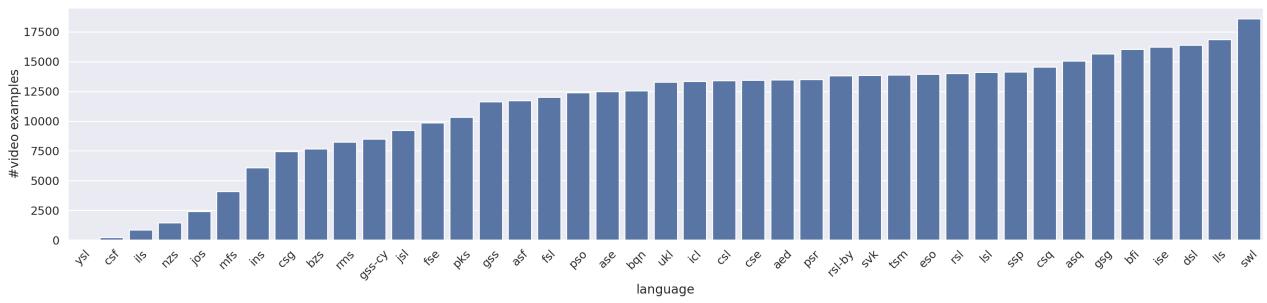
Figure 5 highlights the linguistic diversity. While some languages have fewer samples, the multilingual nature is a feature, not a bug. Because sign languages often share “iconicity” (signs that look like what they represent, like “drinking”), training on many languages can help the model generalize better.
Engineering Robustness: Augmentation
To prevent the model from simply memorizing the training data, the researchers applied several clever data augmentations to the pose keypoints:
- Spatial Augmentation: Randomly rotating or scaling the skeleton.
- Temporal Augmentation: Randomly speeding up or slowing down parts of the video (linear interpolation). This is crucial because different people sign at different speeds.
- Flipping: Mirroring the pose. This helps the model handle left-handed signers even if the training data is mostly right-handed.
Experiments and Results
The researchers evaluated SignCLIP on a variety of tasks, focusing heavily on Isolated Sign Language Recognition (ISLR). This task involves recognizing a single sign from a video clip.
In-Domain Performance
When tested on data from Spreadthesign (the same source it was trained on, but unseen clips), the model performed admirably.
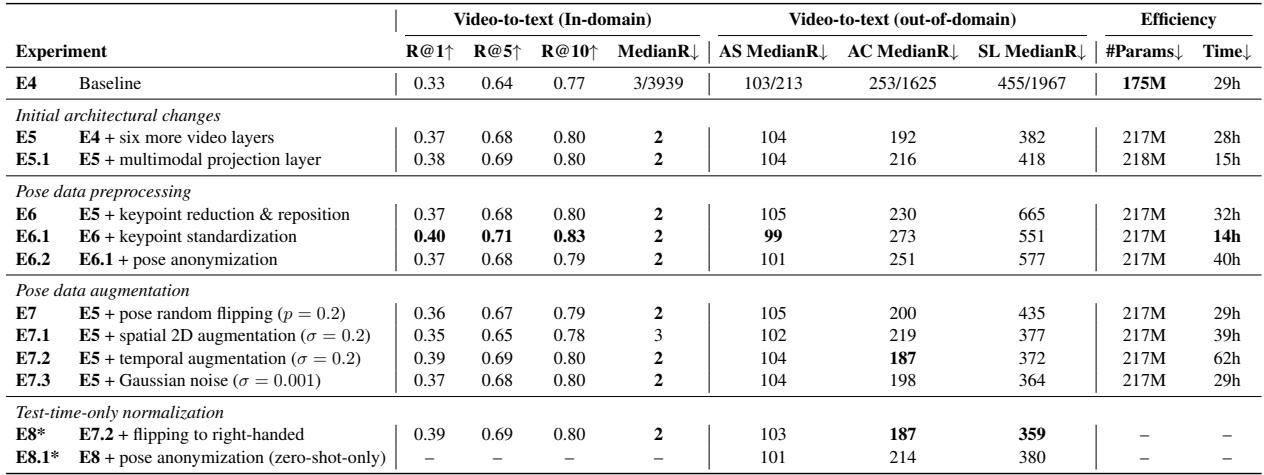
Table 4 shows the evolution of their experiments.
- E4 (Baseline): The starting point.
- E6.1 (Standardization): By standardizing the keypoints (subtracting the mean, dividing by standard deviation), performance jumped significantly (Recall@1 increased from 0.33 to 0.40).
- E7.2 (Temporal Augmentation): Adding speed variations improved robustness.
Out-of-Domain Generalization
The true test of a pre-trained model is Zero-Shot performance—applying it to a completely new dataset without any fine-tuning. The researchers tested SignCLIP on external datasets like ASL Citizen and Sem-Lex.
As seen in Table 3 below, these datasets vary significantly in size and scope compared to the training data.
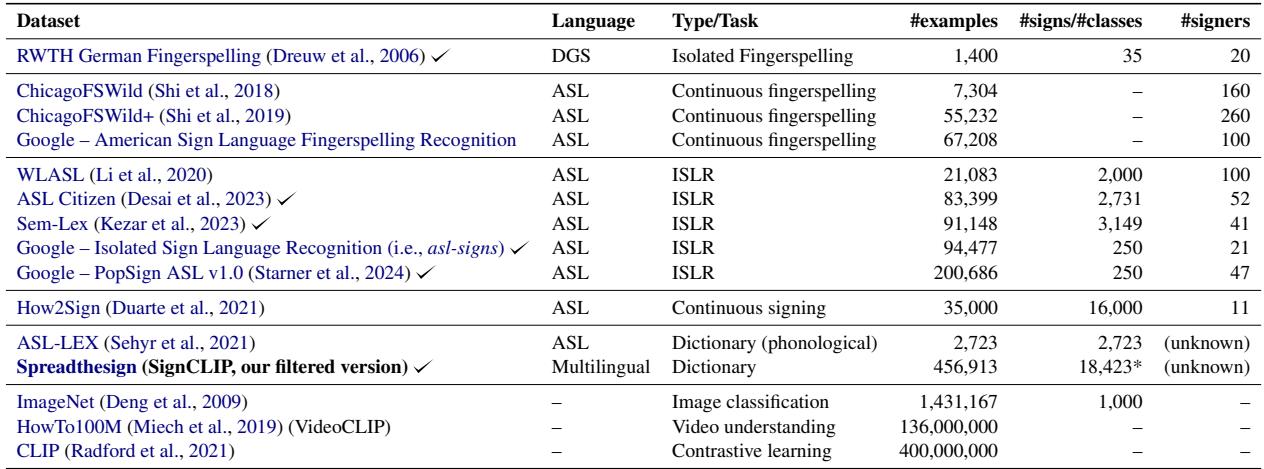
The Reality Check: Zero-shot performance was generally low. This is a common phenomenon in machine learning known as domain shift. The way people sign in Spreadthesign (dictionary style) is different from ASL Citizen (community-sourced). Furthermore, different datasets normalize their pose data differently.
However, the researchers found that Few-Shot Learning (showing the model just 10 examples of a new sign) or Fine-Tuning (updating the model slightly on the new data) yielded incredible results.
For example, on the PopSign dataset, a fine-tuned SignCLIP model achieved 94% Recall@10, and on ASL Citizen, it reached 99% Recall@10. This suggests that while SignCLIP isn’t a “magic bullet” out of the box, it learns a highly transferable representation of sign language that acts as a powerful foundation for specific tasks.
Analysis: Inside the Latent Space
One of the most fascinating aspects of contrastive models is the semantic structure of the latent space they create. In NLP, we often cite the famous vector arithmetic: “King” minus “Man” plus “Woman” equals “Queen.”
Does this hold for Sign Language?
The researchers extracted embeddings for the signs KING, QUEEN, MAN, and WOMAN from the ASL Citizen dataset and visualized them.
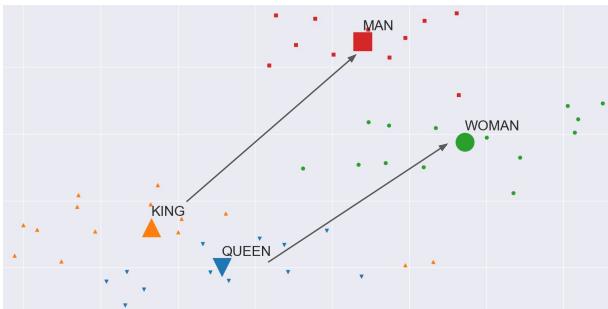
As Figure 2 illustrates, the spatial relationship between these concepts is preserved in the sign language vector space. The vector from Man to King is roughly parallel to the vector from Woman to Queen. This confirms that SignCLIP isn’t just memorizing hand shapes; it is capturing distributional semantics.
The Power of Iconicity
The researchers also asked the model: Which signs are the most universal? By analyzing the variance of embeddings across different languages, they found that signs with high iconicity (visual resemblance to the object) had the most consistent embeddings. The sign for “Scorpion” (often a hooked finger motion) ranked at the top. Conversely, abstract concepts like numbers ranked lower, as they vary significantly between sign languages.
Conclusion and Implications
SignCLIP represents a significant step forward in Sign Language Processing. By repurposing the CLIP architecture and leveraging the efficiency of pose estimation, the researchers demonstrated that it is possible to create a multilingual, multimodal bridge between signed and spoken languages.
Key Takeaways:
- Pose > Pixels: For current SLP tasks, skeletal pose estimation offers a cleaner, more robust signal than raw video features.
- Data is King: Large-scale, multilingual datasets like Spreadthesign are essential for pre-training, exploiting the shared iconicity of sign languages.
- Foundation Models: While zero-shot performance is still a hurdle, SignCLIP serves as an excellent “foundation model.” Fine-tuning it requires far less data to achieve state-of-the-art results than training a model from scratch.
This work paves the way for future applications, such as real-time sign language search engines, automated translation tools, and educational apps that can grade a student’s signing accuracy. As datasets grow and architectures refine, the gap between the digital world and the deaf community continues to narrow.