](https://deep-paper.org/en/paper/2407.01300/images/cover.png)
Introduction
In the rapidly evolving landscape of Artificial Intelligence, Large Language Models (LLMs) like GPT-4, Llama 3, and Claude have become the engines driving innovation. However, a significant bottleneck hampers the progress of researchers and engineers alike: the exorbitant cost of evaluation.
To truly understand a model’s capabilities, it must be tested against massive benchmarks—suites of tasks ranging from coding problems to complex reasoning and creative writing. Running a single LLM through a comprehensive benchmark can cost upwards of $10,000 and consume thousands of GPU hours. When you consider the sheer number of models being released and the variations in training configurations, the evaluation matrix becomes impossibly large and expensive to fill.
For years, the industry standard for predicting performance has been “Scaling Laws.” These are physics-like power laws that suggest a predictable relationship between compute (FLOPs), dataset size, and training loss. The logic is seductive: add more compute, and the loss goes down. However, training loss is a proxy metric; it doesn’t always correlate perfectly with how well a model solves a specific logic puzzle or summarizes a medical text. Furthermore, traditional scaling laws often treat every model family as a distinct island, failing to leverage the shared characteristics between different architectures.
This brings us to a groundbreaking paper: Collaborative Performance Prediction for Large Language Models. The researchers propose a shift in perspective. Instead of relying solely on rigid scaling equations, why not treat LLM evaluation as a recommendation problem? Just as Netflix predicts which movies you will like based on your viewing history and the preferences of similar users, we can predict how an LLM will perform on a specific task based on the performance of similar models on similar tasks.
In this post, we will dissect this novel framework, known as Collaborative Performance Prediction (CPP). We will explore how it utilizes Matrix Factorization and Neural Collaborative Filtering to outperform traditional scaling laws, saves computational resources, and provides deep interpretability into what actually makes an LLM effective.
Background: The Limitations of Scaling Laws
To understand why CPP is necessary, we must first look at the current status quo. The “Scaling Law” hypothesis (popularized by Kaplan et al.) posits that model performance (specifically test loss \(L\)) improves as a power-law function of the compute resources \(C\) used during training.

As shown in the equation above, \(\omega_f\) and \(b_f\) are coefficients specific to a model family \(f\). While this is incredibly useful for high-level capacity planning (e.g., “how many GPUs do I need to beat GPT-3?”), it has three major limitations when applied to downstream tasks:
- High Training Cost: Fitting these curves requires training multiple models of varying sizes to “find the line.”
- Opacity: It often relies on transparent design factors like FLOPs. If you are evaluating a closed-source proprietary model where these numbers aren’t public, the scaling law is useless.
- Isolation: It overlooks the similarities between model families. A Llama model and a Mistral model might share underlying behaviors that scaling laws ignore because they fit a curve only to a specific family.
The researchers behind CPP noticed two things: distinct model families (like Llama and GPT) often share distributional similarities, and different tasks (like coding and math) rely on correlated underlying abilities. This observation sparked the idea to use Collaborative Filtering—the same technology powering recommendation systems.
The Core Method: Collaborative Performance Prediction (CPP)
The central thesis of CPP is that we can construct a massive “Score Matrix” where rows represent different LLMs and columns represent different tasks. This matrix is sparse—meaning most cells are empty because not every model has been tested on every task. The goal is to fill in the blanks.
The Framework
The CPP framework integrates data from diverse sources—academic papers, leaderboards, technical reports, and model cards—to build a repository of “Collaborative Data.”
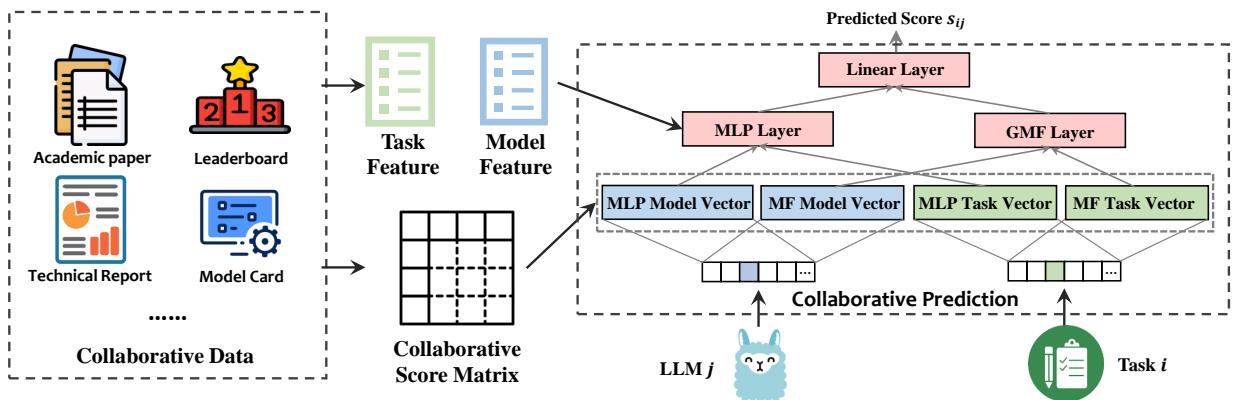
As illustrated in Figure 1, the system is composed of two main inputs:
- Collaborative Data: This includes the raw performance scores (the matrix) and descriptive factors for both the models (e.g., parameter size, context window) and the tasks (e.g., few-shot setting, required ability).
- Collaborative Prediction Method: This is the algorithmic engine that processes the data to output a predicted score.
The Mathematical Engine
At its heart, this approach utilizes Matrix Factorization (MF). The intuition is that any specific score \(r_{ui}\) (performance of model \(u\) on task \(i\)) can be approximated by the dot product of a “latent” vector representing the model and a “latent” vector representing the task.
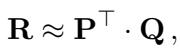
Here, \(\mathbf{P}\) represents the latent features of the models, and \(\mathbf{Q}\) represents the latent features of the tasks. These latent features are not necessarily human-readable properties; they are mathematical abstractions learned by the algorithm that capture the “essence” of a model or task.
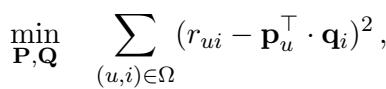
The system learns these vectors by minimizing the difference between the predicted scores and the actual observed scores in the training set:
Neural Collaborative Filtering (NCF)
While simple Matrix Factorization is powerful, it assumes a linear relationship (a dot product). The researchers took this a step further by employing Neural Collaborative Filtering (NCF).
NCF replaces the simple dot product with a Multi-Layer Perceptron (MLP)—a type of neural network. This allows the system to capture complex, non-linear interactions between models and tasks. Furthermore, the researchers enhanced NCF by feeding it not just the ID of the model and task, but also their explicit design factors.
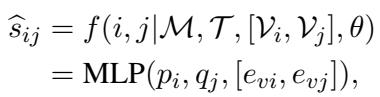
In the equation above:
- \(p_i\) and \(q_j\) are the learned latent vectors (ID embeddings).
- \(e_{vi}\) and \(e_{vj}\) are the embeddings of the explicit design factors (e.g., embedding the concept that a model has “70B parameters” or a task is “0-shot”).
This “Factor Enhanced” approach is critical. It allows the model to generalize to completely new models or tasks where no historical performance data exists, simply by looking at their descriptions.
The Data
One of the significant contributions of this work is the curation of the data itself. The researchers collected a matrix involving 72 models and 29 tasks. However, as is common in the real world, the data is uneven.
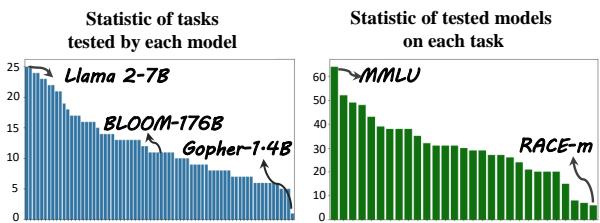
Figure 3 reveals a “long-tail” distribution. Some popular models (like the Llama series) are tested on almost every task, while others have very sparse data. Similarly, benchmarks like MMLU are ubiquitous, while niche tasks have few data points. This sparsity makes traditional regression difficult but is exactly the type of environment where collaborative filtering thrives.
To make the factor-enhanced prediction work, the authors standardized the metadata for models and tasks.
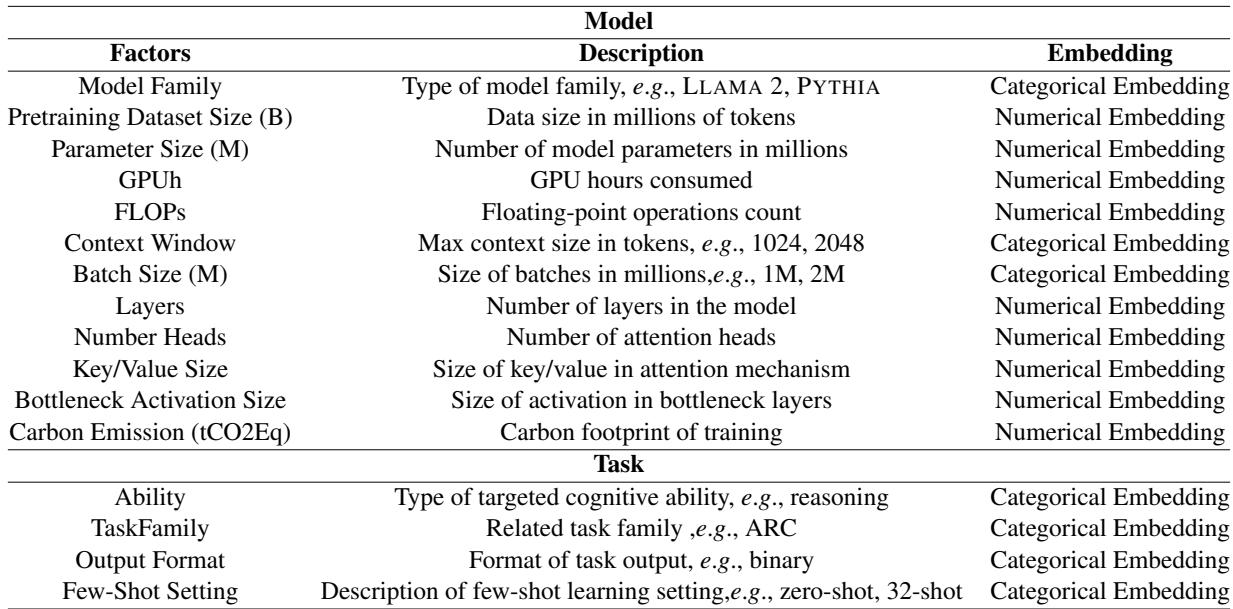
Table 3 lists the explicit factors used. Notice that for models, they consider not just parameter size, but also architecture-specific details like Context Window, Batch Size, and Carbon Emissions. For tasks, they categorize by Ability (e.g., reasoning), Output Format, and Few-Shot Setting.
Experiments and Results
The researchers validated CPP using their collected dataset and the HELM leaderboard. They compared their method against traditional Matrix Factorization and strictly factor-based predictions.
Accuracy Comparison
The primary question is: How well does CPP predict the actual score of a model on a task it has never seen?
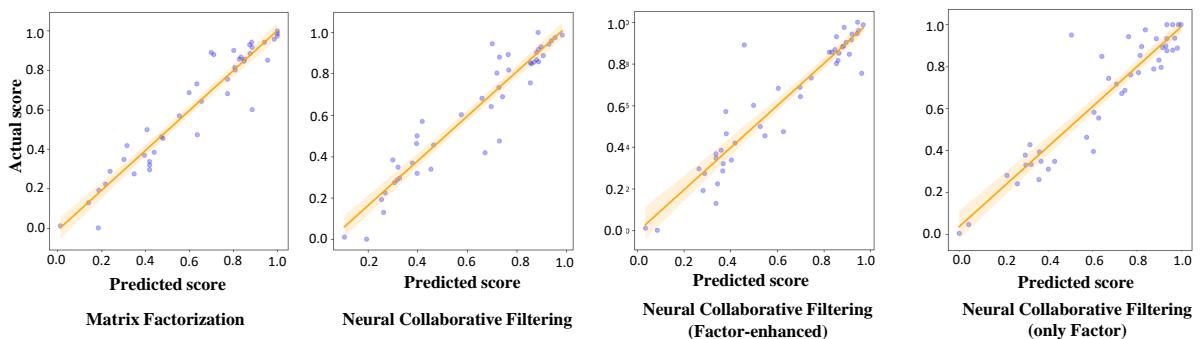
Figure 4 visualizes the correlation between Predicted Scores (X-axis) and Actual Scores (Y-axis). A perfect prediction would land exactly on the diagonal line.
- Matrix Factorization (Left): Shows decent clustering but some variance.
- Neural Collaborative Filtering (Center): Shows tighter clustering.
- Factor-Enhanced NCF (Right): Offers robust performance.
The results show that integrating explicit design factors into the NCF framework significantly boosts prediction accuracy. It combines the best of both worlds: the specificity of ID-based learning and the generalizability of feature-based learning.
Comparing Against Scaling Laws
The ultimate test is comparing CPP against the industry-standard Scaling Laws (SL). The researchers set up two scenarios:
- CPP-0: Predicting performance with zero prior testing information for the specific model (cold start).
- CPP-2: Predicting performance after observing the model’s score on just two random tasks.
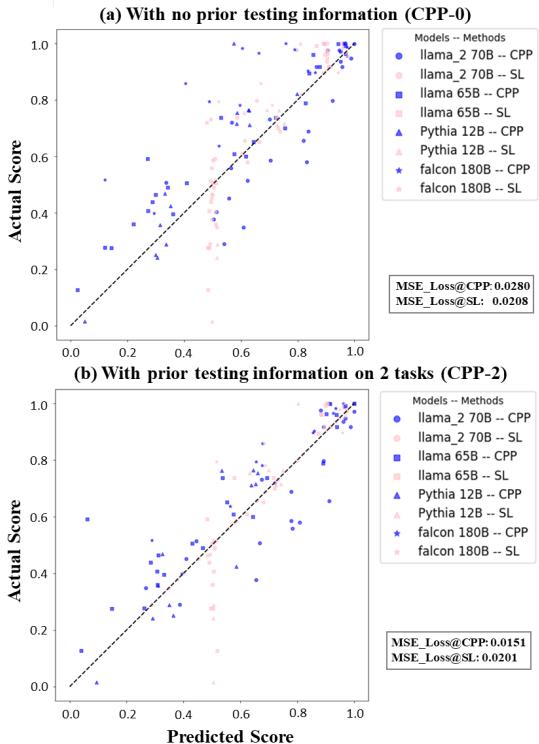
Figure 5 presents a compelling victory for CPP.
- In CPP-0 (a), the predictions are well-distributed along the diagonal, whereas Scaling Laws (SL) tend to cluster predictions around 0.5, failing to capture the dynamic range of true performance.
- In CPP-2 (b), once the model is “anchored” with just two data points, CPP’s accuracy improves dramatically, achieving a significantly lower Mean Squared Error (MSE) than Scaling Laws.
This demonstrates that we don’t need to burn thousands of GPU hours to know how a model will perform. Testing it on a couple of cheap tasks and using CPP can yield a highly accurate forecast for expensive benchmarks.
Predicting Emergent Abilities
A major criticism of scaling laws is their struggle to predict “emergent” abilities—sudden jumps in capability (like complex reasoning) that appear only after a model reaches a certain size. Can a recommendation system predict these jumps?
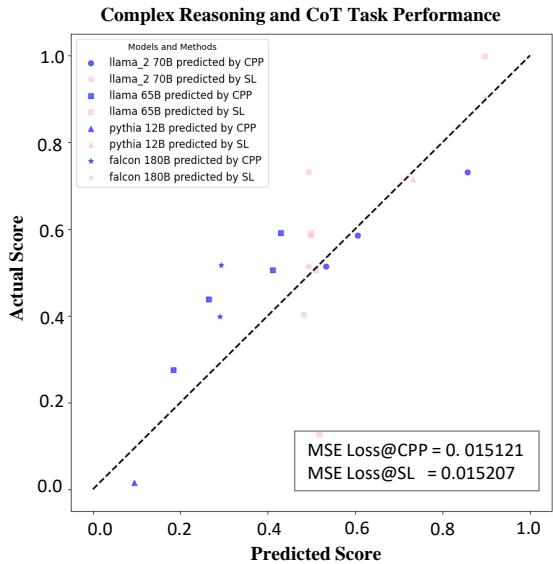
The answer, as shown in Figure 10, is yes. When applied to complex reasoning and Chain-of-Thought (CoT) tasks (like GSM8K or MATH), CPP follows the “perfect prediction” line much more closely than scaling laws. Because CPP leverages the history of other large models that have already exhibited emergence, it can infer that the current model, sharing similar characteristics, will likely exhibit them too.
Interpretability: What Actually Matters?
One of the most fascinating aspects of using a feature-based neural network is that we can analyze which features contribute most to the prediction. The researchers used Shapley values—a method from cooperative game theory—to quantify the importance of each factor.
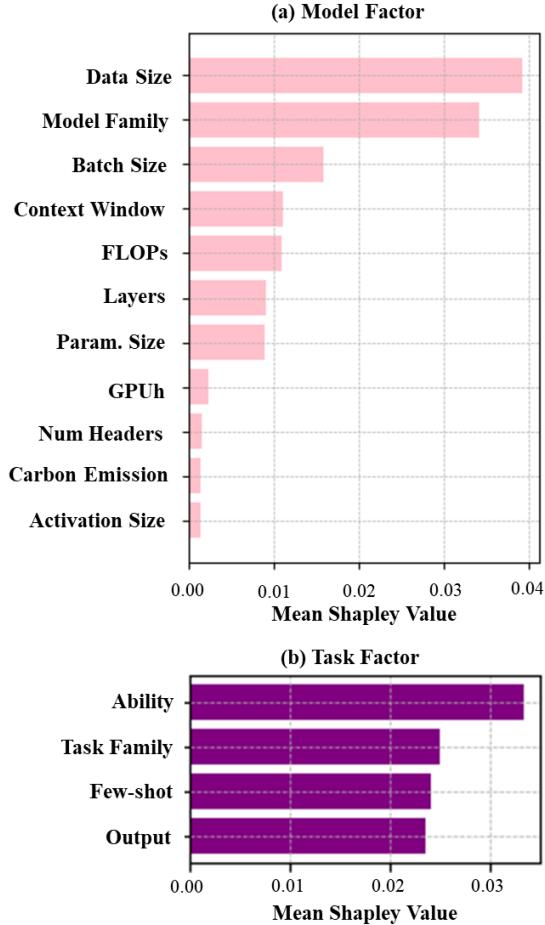
Figure 6 challenges the conventional wisdom that “Parameter Size is King.”
- Model Factors: While Data Size is the top factor, Model Family is a close second. This implies that architectural “DNA” (optimization tricks, activation functions, proprietary data recipes) is almost as important as the raw amount of data used. Interestingly, Context Window and Batch Size also play significant roles, appearing more influential than FLOPs in this analysis.
- Task Factors: The specific Ability being tested (e.g., reasoning vs. recall) is the dominant factor. This validates the intuition that models perform inconsistently across different cognitive domains.
Correlation Analysis
The researchers also performed a correlation analysis to see which models behave similarly.
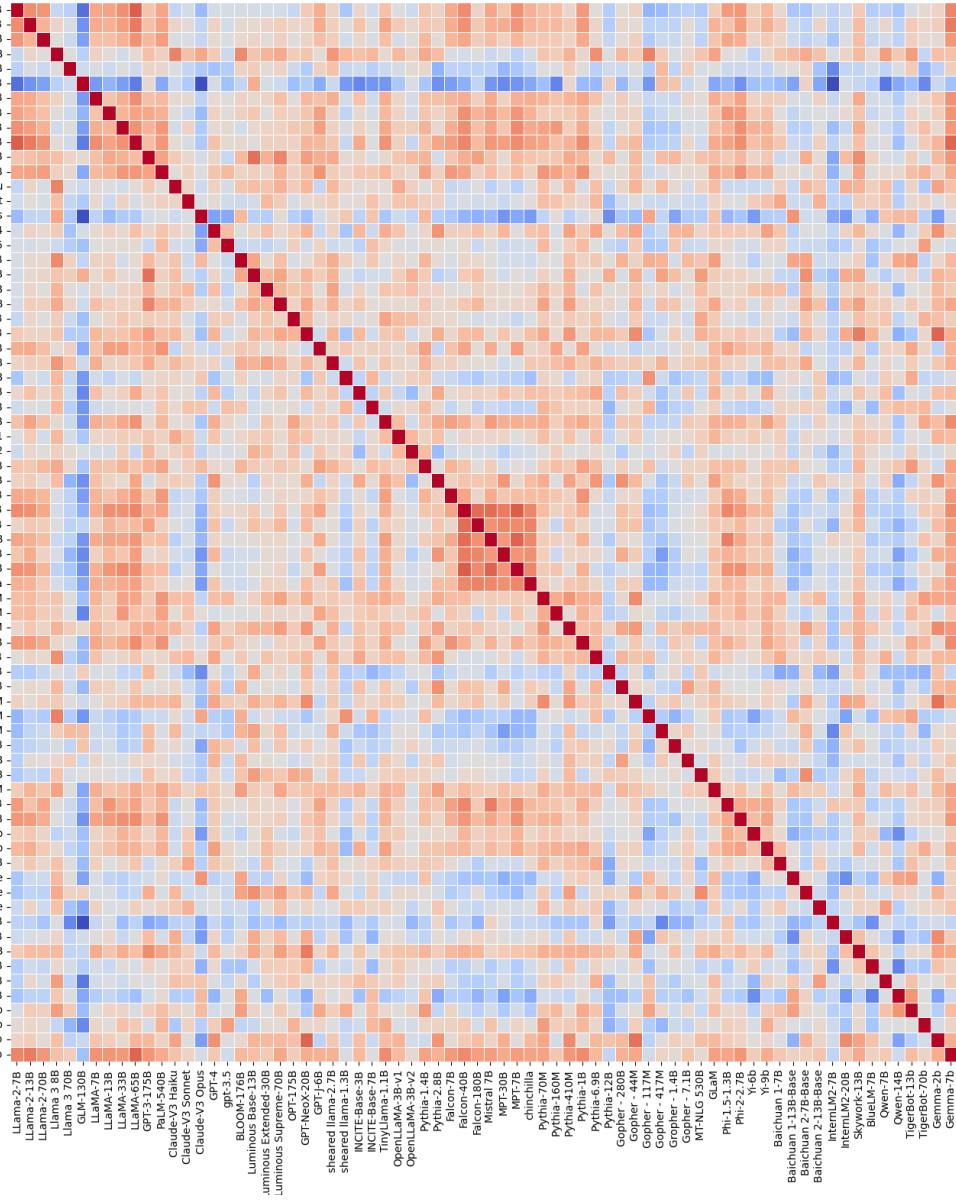
The heatmap in Figure 13 (and the accompanying hierarchical clustering) reveals that models from the same family (e.g., the Llama cluster) have highly correlated impacts on prediction. This confirms that “Model Family” is a strong predictor of behavior, likely due to shared pre-training data and tokenization strategies.
Conclusion and Implications
The “Collaborative Performance Prediction” framework marks a maturation point in LLM evaluation. It moves us away from the brute-force mentality of “train and test everything” toward a smarter, data-driven approach.
Key Takeaways:
- Efficiency: We can accurately predict model performance on expensive benchmarks using historical data and minimal new testing (as few as 2 tasks).
- Flexibility: Unlike scaling laws which require parameter counts and FLOPs, CPP can work with “black box” proprietary models by relying on collaborative filtering of observed scores.
- Interpretability: Factors like Model Family and Context Window are critical drivers of downstream performance, a nuance often lost in pure compute-scaling equations.
As the number of open-source and proprietary models explodes, the matrix of Models \(\times\) Tasks will only get sparser. Techniques like CPP will become essential tools for researchers to navigate this space, allowing them to identify promising models and focus their computational resources where they matter most. Rather than testing every model on every task, the future of AI evaluation looks a lot like your Netflix homepage: highly personalized, surprisingly accurate, and powered by the collective history of the community.