](https://deep-paper.org/en/paper/2407.02345/images/cover.png)
Imagine chatting with a sophisticated AI. You ask, “What did you do this weekend?” and it replies, “I went hiking with my dog.” Ten minutes later, you mention you love nature, and it replies, “I hate the outdoors, I prefer video games.”
The illusion breaks. The personality—or persona—is inconsistent.
Building chatbots that maintain a consistent, engaging personality is one of the “holy grails” of Natural Language Processing (NLP). traditionally, this is done by explicitly feeding the model a “role profile” (e.g., Name: Alex, Hobby: Hiking, Pet: Dog) every time it generates a response. But in the real world, we often don’t have access to these explicit profiles due to data scarcity or privacy concerns. We only have the dialogue history—the breadcrumbs of personality left behind in previous conversations.
How can a model look at a conversation history and not just understand what was said, but who is saying it, especially if it has never encountered this specific person before?
In this post, we are diving deep into a paper titled “MORPHEUS: Modeling Role from Personalized Dialogue History by Exploring and Utilizing Latent Space.” This research proposes a fascinating solution: instead of treating every user as a unique, isolated island, the model learns a “codebook” of personality archetypes in a latent space. This allows it to infer roles from history and generalize to new, unseen personalities.
Let’s unpack how MORPHEUS works, the mathematics behind its “persona codebook,” and why this approach might be the future of parameter-efficient, personalized AI.
The Problem: The “Blank Slate” Chatbot
To understand why MORPHEUS is necessary, we first need to look at the limitations of current Personalized Dialogue Generation (PDG).
There are two main ways to give a chatbot a personality:
- Explicit Modeling: You provide a text description (e.g., “I am a nurse who loves jazz”). The model keeps this in its context window. This works well but requires you to have that data, which is rare in the wild and risky to store (privacy).
- Implicit Modeling: The model looks at past dialogue (e.g., “I treated a patient today” + “Miles Davis is playing”) and infers the persona.
The industry is moving toward Implicit Modeling because it’s scalable and private. However, current implicit models (like MSP or CLV) have a major flaw: they struggle to generalize. They treat Role A and Role B as completely separate entities. They fail to realize that if Role A likes “nature and horses” and Role B likes “nature and dogs,” they share a structural similarity in their preferences.
If a model encounters a dialogue history it hasn’t seen during training, it often reverts to generic, safe responses.
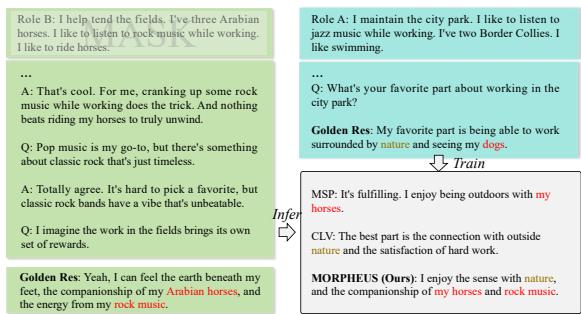
As shown in Figure 1, consider Role A (who likes parks and collies) and Role B (who likes fields and horses). A human understands these are similar “outdoor/animal lover” archetypes. Existing models (MSP, CLV) often fail to make this connection when role data is masked, generating irrelevant responses about “pop music” or “running.” MORPHEUS, however, leverages the latent structure of Role A to correctly infer how Role B should respond.
The Solution: The MORPHEUS Framework
The researchers introduce a framework called MORPHEUS (MOdels Roles from Personalized Dialogue History by Exploring and Utilizing Latent Space).
The core idea is simple yet powerful: Personality traits are not infinite. They can be clustered into archetypes. By learning a “Codebook” of these archetypes (in a vector space), the model can map a messy dialogue history to a crisp, compact personality code, and then use that code to generate a consistent response.
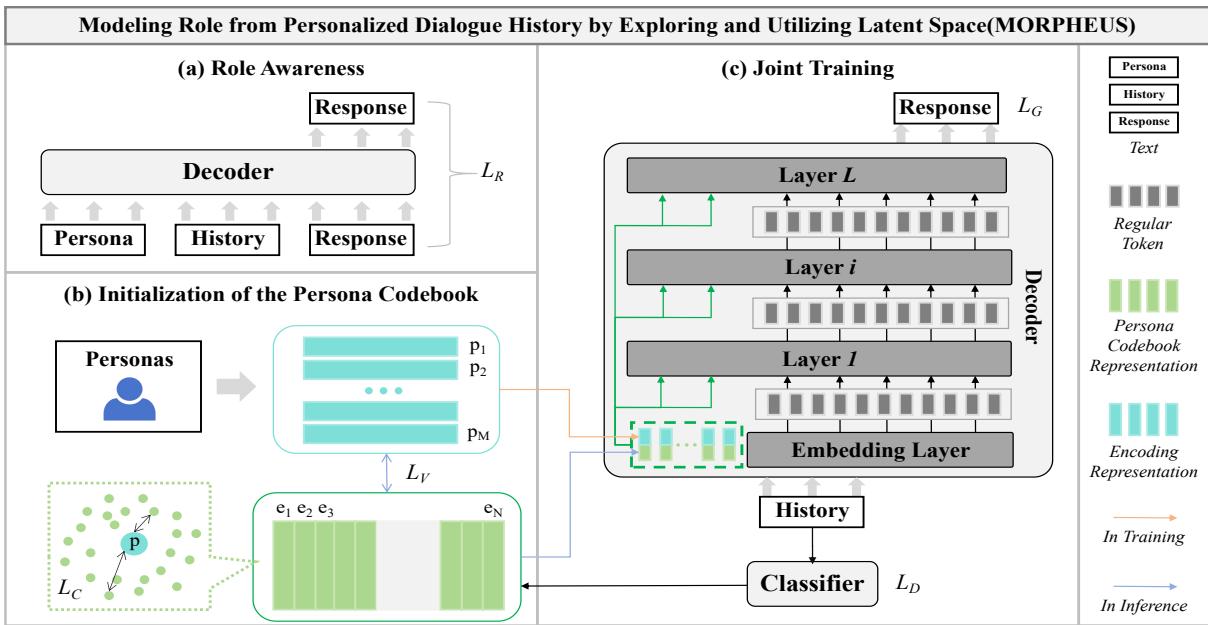
As illustrated in Figure 2, the architecture isn’t just a single neural network; it’s a three-stage training process designed to progressively teach the model what a “role” is.
Let’s break down these three stages: Role Awareness, Persona Codebook Initialization, and Joint Training.
Stage 1: Role Awareness
Before the model can use a sophisticated codebook, it first needs to understand the basic relationship between a persona description and a dialogue.
Standard Large Language Models (LLMs) like GPT-2 are trained on massive generic text. They don’t inherently know that “I have a dog” in the prompt should strictly control the personality of the output.
In this stage, the authors fine-tune a decoder-only model (like GPT-2) using explicit persona data. They take the persona text \(\mathcal{P}\), encode it into a representation \(p_i\), and concatenate it with the dialogue history \(\mathcal{C}\) as “past keys and values” (a technique to inject memory into Transformers).
The loss function for this stage is a standard Negative Log-Likelihood (NLL) objective, ensuring the generated response \(\mathcal{R}\) matches the ground truth:
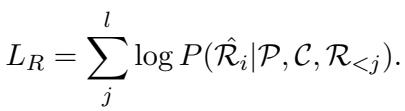
This stage transforms a generic LLM into a “Role-Aware” LLM. It’s a warm-up. The model now knows how to use persona data if it’s given, but we still haven’t solved the problem of inferring personas when the data is missing.
Stage 2: Initialization of the Persona Codebook
This is where the magic begins. We want to create a Persona Codebook (PC). Think of this as a library of vectors \(e \in \mathbb{R}^{N \times d}\), where \(N\) is the number of distinct personality archetypes (e.g., 100 or 500) and \(d\) is the vector dimension.
If we initialize these vectors randomly, the model struggles to converge. The “meanings” of the codes become messy. The authors discovered that using a statistical method called Expectation-Maximization (EM) to initialize this codebook yields vastly superior results.
The EM Algorithm for Personas
The goal is to find the best starting positions for our \(N\) codebook vectors so that they cover the distribution of real-world personas effectively.
Step 1: The Expectation (E) Step First, the model looks at all the explicit persona data available in the training set. For every persona encoding \(p_i\), we calculate the probability that it belongs to a specific cluster (code) \(k\). This is the posterior probability:

Here, \(z_i=k\) means “persona \(i\) belongs to archetype \(k\).”
Step 2: The Maximization (M) Step Once we have the probabilities, we update the center (mean \(\mu_k\)) and spread (variance \(\sigma_k\)) of each cluster to better fit the data assigned to it.
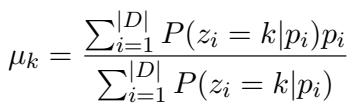
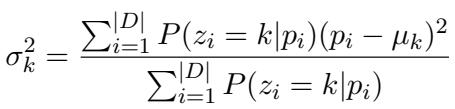
By iterating through these steps, the “Persona Codebook” is initialized not with random noise, but with vectors that represent the actual centers of personality clusters found in the training data. This gives the model a massive head start.
Stage 3: Joint Training
Now that the model understands roles (Stage 1) and has a well-organized library of archetypes (Stage 2), we combine everything in Joint Training.
This stage addresses the core challenge: Mapping Dialogue History \(\rightarrow\) Persona Code \(\rightarrow\) Response.
The training is split into two simultaneous tasks:
- Code Index Prediction: Can the model look at the history and guess which codebook index \(k\) applies?
- Response Generation: Can the model use that codebook vector \(e_k\) to generate the right text?
The VQ-VAE Mechanism
To connect the continuous vector space of the encoder to the discrete codebook, the authors use a mechanism inspired by VQ-VAE (Vector Quantized Variational AutoEncoders).
First, for a given persona representation \(p_i\), the model finds the “nearest neighbor” vector \(e_k\) in the codebook:
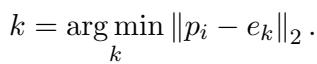
To ensure the encoder (which produces \(p_i\)) and the codebook (which contains \(e_k\)) stay close to each other, a specific loss function \(L_V\) is used. It pulls the codebook vectors toward the encoded personas and vice-versa. Note the use of sg (stop gradient), which stabilizes training by freezing one side of the equation while updating the other.

Dialogue Generation
Once the correct code \(e_k\) is retrieved, it is treated as the persona definition. The decoder uses this vector (concatenated with the history) to generate the response.
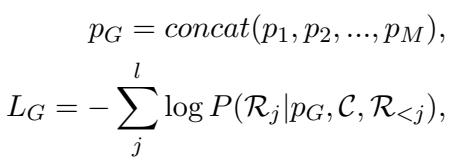
History-to-Code Classification
Crucially, during inference, we won’t have the persona text. We only have dialogue history. So, the model includes a classifier (a multi-layer perceptron or MLP) that takes the dialogue history representation \(c\) and tries to predict the correct code index \(k\).
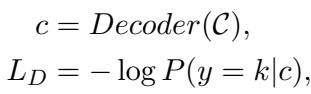
Contrastive Learning for Diversity
Finally, to prevent the “mode collapse” problem—where the model just uses one or two safe personality codes for everyone—the authors add a Contrastive Learning loss (\(L_C\)). This forces the different codes in the codebook to remain distinct from one another, ensuring a diverse range of personalities are available.
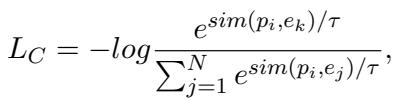
By optimizing all these objectives together, MORPHEUS learns to look at a conversation history, pinpoint the specific “archetype” vector from its codebook, and use that vector to drive the personality of the response.
Experiments and Results
The researchers tested MORPHEUS on two major datasets: ConvAI2 (English) and Baidu PersonaChat (Chinese). They compared it against several baselines, including:
- Seq2Seq / GPT-2: Standard non-personalized models.
- MSP & DHAP: Retrieval-based systems.
- CLV: A latent variable model (the closest competitor).
Automatic Evaluation
The results were impressive. Let’s look at the metrics. The authors measured Coherence (BLEU/ROUGE), Diversity (Distinct-1/2), and Consistency (how well the response matches the persona).
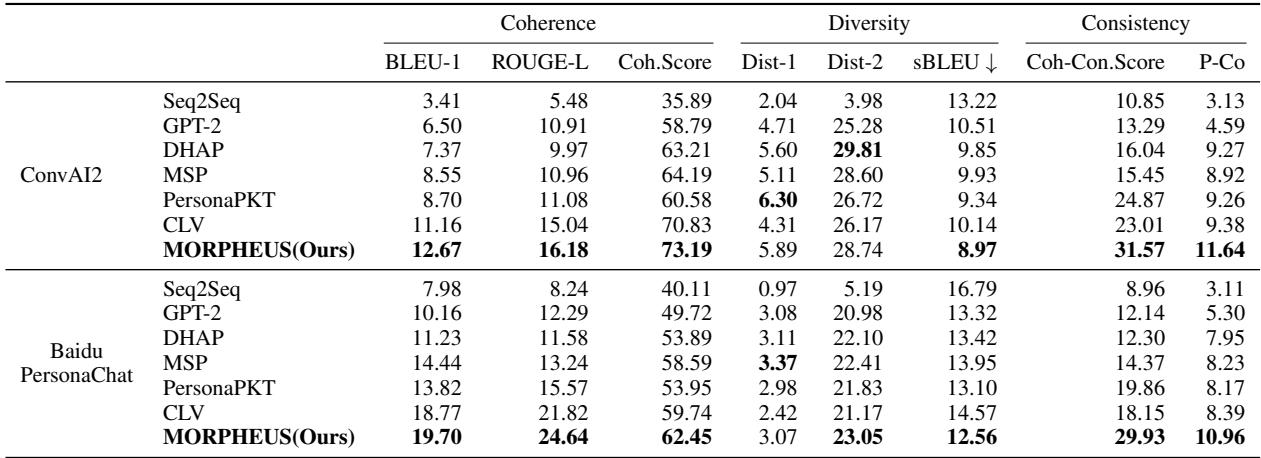
As shown in Table 2, MORPHEUS (bolded) outperforms the baselines across almost every metric.
- Consistency (Coh-Con.Score & P-Co): MORPHEUS scores significantly higher here. This proves that the “Codebook” approach effectively captures the persona even without explicit data.
- Diversity (Dist-1/2): A common issue with latent variable models (like CLV) is that they sacrifice diversity to be safe. MORPHEUS actually increases diversity. The contrastive learning loss ensures the model doesn’t just sound like a generic robot.
Human Evaluation
Automatic metrics in NLP can sometimes be misleading, so the authors also employed human annotators to rank responses based on Readability, Diversity, Consistency, and Coherence.
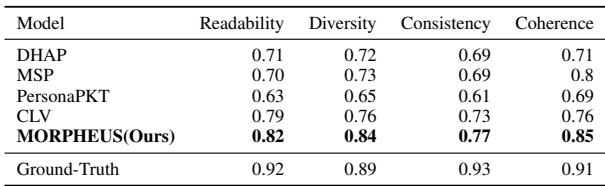
Table 3 confirms the automatic results. Human evaluators consistently rated MORPHEUS higher than competitors like MSP and CLV. It achieved a score of 0.85 on Coherence and 0.77 on Consistency, approaching the scores of the Ground Truth (human-written) responses.
Why does the Codebook size matter?
One interesting analysis in the paper is the size of the codebook (\(N\)). How many personality archetypes do you need?
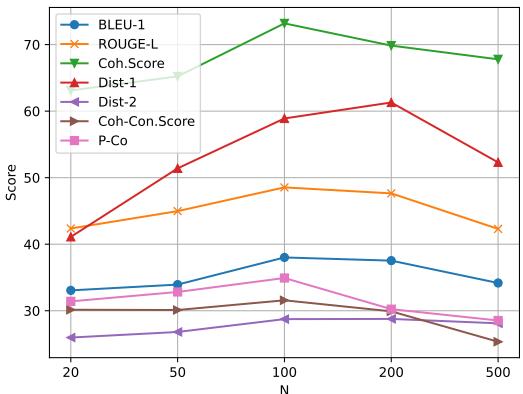
Figure 3 shows that performance peaks around \(N=100\).
- Too small (\(N=20\)): The codebook is too generic. Everyone sounds the same.
- Too large (\(N=500\)): The codebook becomes sparse and noisy. It’s too hard for the model to pick the right specific code from history, leading to confusion.
This suggests that for this dataset, there are roughly 100 distinct “personality archetypes” that cover the majority of user interactions.
A Case Study: Seeing is Believing
To truly understand the improvement, let’s look at a specific conversation example provided in the paper.
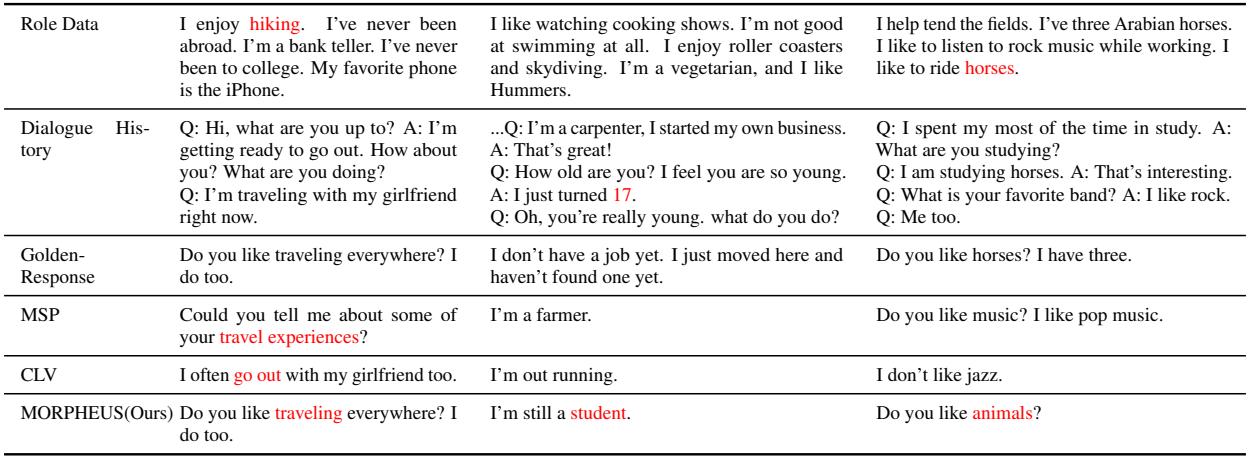
In Table 5, look at the third column (Role Data: “I help tend the fields… three Arabian horses”).
- The History: The user asks about favorite bands. The persona says “I like rock.”
- The MSP Model: Asks “Do you like music? I like pop music.” (Generic, ignores the “rock” context).
- The CLV Model: Says “I don’t like jazz.” (A bit random).
- MORPHEUS: Asks “Do you like animals?”
Why is this result significant? The immediate context was about music, but the deeper persona (which the model inferred from history) is about horses and fields. MORPHEUS recognized the archetype of this “outdoorsy/animal-loving” person and generated a response that pivots the conversation back to their core interests. It aligns perfectly with the hidden Ground Truth: “Do you like horses? I have three.”
This demonstrates the power of the Latent Space. Even if the exact word “horse” wasn’t in the immediate previous sentence, the code selected by MORPHEUS contained the semantic concept of “animal lover.”
Conclusion & Implications
The MORPHEUS paper presents a significant step forward for personalized AI. By moving away from explicit, privacy-risking profiles and towards a generalized, latent “Codebook” of personalities, the model achieves three things:
- Better Generalization: It can handle users it has never seen before by mapping them to known archetypes.
- Privacy: It doesn’t need to store a database of user facts (names, addresses) at inference time; it just needs to know the “code.”
- Efficiency: As noted in the paper, this method acts as a form of Parameter-Efficient Fine-Tuning (PEFT). By freezing the main LLM and only training the codebook and lightweight adapters, it achieves results comparable to full-parameter fine-tuning with a fraction of the computational cost.
For students and researchers in NLP, MORPHEUS highlights the utility of Discrete Latent Representations. When we force a neural network to choose from a finite set of options (the codebook) rather than a continuous blur of numbers, we often get structure, consistency, and interpretability that continuous models lack.
As AI assistants become more ubiquitous, techniques like MORPHEUS will be essential in making them feel less like calculators and more like distinct, consistent characters—without compromising our data privacy.