](https://deep-paper.org/en/paper/2407.04528/images/cover.png)
Introduction: The Quest for Efficient Adaptation
In the current landscape of Artificial Intelligence, we are witnessing a massive collision of two dominant trends. On one side, we have Retrieval-Augmented Generation (RAG), a technique that allows Large Language Models (LLMs) to access external data (like your company’s wiki or a library of books) to answer questions accurately. On the other side, we have Parameter-Efficient Fine-Tuning (PEFT), a suite of methods designed to adapt these massive models to specific tasks without the exorbitant cost of retraining them from scratch.
But here lies a critical question that hasn’t been fully answered: Which model architecture is actually better suited for this new world?
Should we stick with the standard, popular GPT (Generative Pre-trained Transformer) architecture, which relies on its internal memory? Or should we switch to RETRO (Retrieval-Enhanced Transformer), an architecture specifically designed from the ground up to handle external data?
A recent paper by researchers from NVIDIA, titled “GPT vs RETRO: Exploring the Intersection of Retrieval and Parameter-Efficient Fine-Tuning,” dives deep into this comparison. They ran extensive experiments across model sizes ranging from 823 million to 48 billion parameters. The results are surprising, nuanced, and offer a practical roadmap for students and engineers looking to build the next generation of AI applications.
In this post, we will break down their methodology, explain the architectures involved, and analyze the results to understand which model reigns supreme when efficiency and retrieval meet.
Background: Setting the Stage
To appreciate the findings of this paper, we first need to understand the three pillars supporting this research: The Architectures (GPT vs. RETRO), RAG, and PEFT.
1. The Contenders: GPT vs. RETRO
GPT (Generative Pre-trained Transformer) models are the standard “dense” models we are all familiar with. They are trained on massive datasets to predict the next token in a sequence. Their knowledge is “parametric”—meaning it is stored inside the billions of weights within the model. If a GPT model doesn’t know a fact, it often hallucinates.
RETRO (Retrieval-Enhanced Transformer) takes a different approach. It is an architecture explicitly designed to interact with an external database during the generation process.
- How it works: RETRO doesn’t just read the prompt. It splits the input into chunks, retrieves similar chunks from a database, and uses a mechanism called Chunked Cross-Attention to integrate that retrieved information directly into the model’s processing layers.
- The Theory: Because RETRO is pre-trained to look up information, it theoretically should be much better at tasks requiring external knowledge (like answering questions about current events or specific documents).
2. Retrieval-Augmented Generation (RAG)
Both models in this study are used in a RAG setting. This means that before the model answers a question, a retrieval system (in this case, a model called Dragon+) searches a database for relevant text. This text is then fed to the LLM to help it generate the correct answer.
3. Parameter-Efficient Fine-Tuning (PEFT)
Fine-tuning a 48-billion parameter model is incredibly expensive because you usually have to update every single weight. PEFT solves this by freezing the main model and only training a tiny number of extra parameters. This paper focuses on three popular PEFT methods:
- P-Tuning: This method adds trainable “virtual tokens” to the input prompt. The model parameters aren’t touched; we just optimize the prompt vectors to guide the model.
- Adapters: This involves inserting small, fully connected layers inside the transformer blocks. We only train these small layers.
- LoRA (Low-Rank Adaptation): This is a mathematical trick that decomposes the weight updates into smaller, lower-rank matrices. It’s highly efficient and widely used in the open-source community.
The Experiment: A Head-to-Head Comparison
The researchers set up a rigorous “battle royale” between GPT and RETRO.
- Model Sizes: They tested five different sizes for both architectures: Extra Small (~800M), Small (~2B), Medium (~8B), Large (~22B), and Extra Large (~43B/48B).
- The Tasks: They used six challenging datasets requiring external knowledge, including Natural Questions (NQ), TriviaQA, and QMSum (summarization).
- The Setup: For every model size and dataset, they tested four configurations:
- Zero-Shot: The model tries to answer with no specific fine-tuning.
- P-Tuning
- Adapters
- LoRA
To illustrate just how “efficient” these PEFT methods are, look at the table below. While the base models have billions of parameters, the added PEFT parameters are only in the millions.

As you can see in Table 2, fine-tuning an “Extra Large” 43B GPT model using LoRA only requires training about 50 million parameters. This is roughly 0.1% of the total model size, making fine-tuning feasible on much smaller hardware.
Analysis of Results
The results of this study paint a fascinating picture of the trade-offs between model architecture and training strategies. Let’s break down the key findings.
Finding 1: RETRO Wins the Zero-Shot Battle
When we don’t fine-tune the models (the Zero-Shot setting), RETRO generally outperforms GPT.
This makes intuitive sense. RETRO was pre-trained with retrieval in mind. Its architecture includes an encoder specifically designed to process retrieved neighbors and integrate them via cross-attention. It “knows” how to use a cheat sheet.
In contrast, GPT was trained simply to predict the next word. When you paste retrieved documents into a GPT prompt, the model has to figure out on the fly that it should rely on that text. It does an okay job, but it lacks the structural advantage of RETRO.
However, the story changes dramatically once we start fine-tuning.
Finding 2: The PEFT Reversal – GPT Takes the Lead
The most surprising finding of the paper is that GPT models have a higher performance potential with PEFT than RETRO models.
Once the researchers applied P-tuning, Adapters, or LoRA, the GPT models often leaped ahead of their RETRO counterparts. We can verify this by looking at the performance of the Extra Large models.
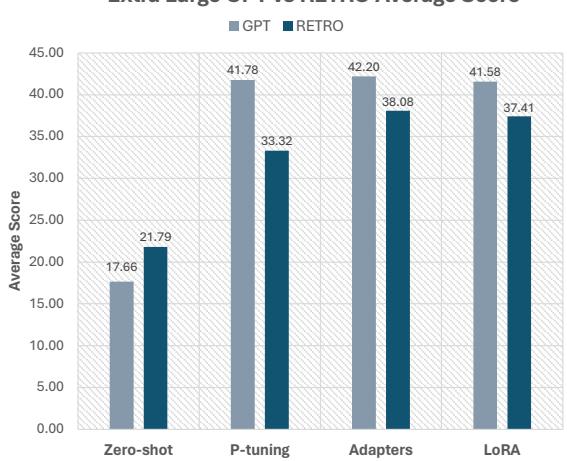
In Figure 3 above, observe the gray bars (GPT) versus the blue bars (RETRO):
- Zero-shot (Left): RETRO (21.79) beats GPT (17.66).
- PEFT Methods (Right three groups): GPT consistently scores higher, reaching over 42 points with Adapters, while RETRO tops out around 38.
Why does this happen? The authors hypothesize that because GPT is not pre-trained with retrieval, it is effectively a “blank slate” for this specific capability. When you fine-tune it with RAG data, it has a large room for improvement and quickly learns to utilize the context. RETRO, on the other hand, is already specialized. Its pre-training objective was already similar to the fine-tuning task, so the marginal gain from PEFT is smaller. It hits a “saturation point” earlier.
Finding 3: The 8 Billion Parameter “Sweet Spot”
For students and practitioners operating on a budget, this might be the most valuable insight. The researchers analyzed how performance scales with model size.
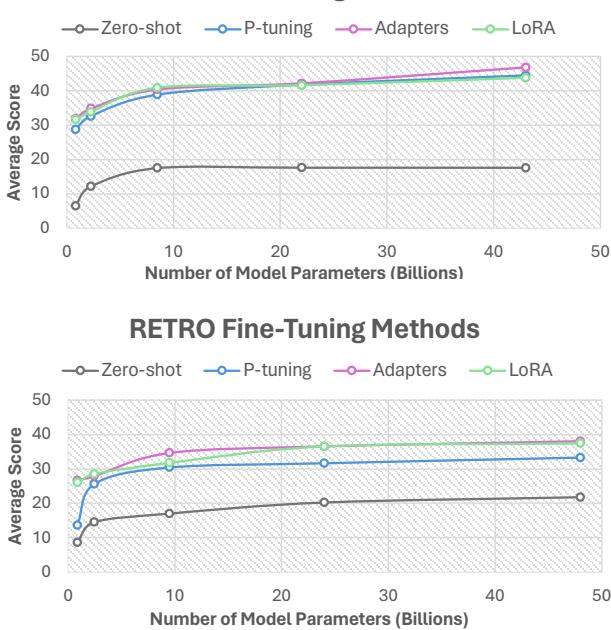
In Figure 1, look at the curves. Both GPT (top) and RETRO (bottom) show a steep increase in performance as you move from 800M to 8B parameters. However, after the 8B (Medium) mark, the curve starts to flatten out.
While the 43B/48B models are technically the best, the 8B models offer an optimal balance between computational cost and performance accuracy. If you are building a RAG system, an 8B model fine-tuned with LoRA or Adapters gives you the most “bang for your buck.”
Finding 4: Not All PEFT Methods Are Created Equal
The study conclusively shows that P-tuning lags behind Adapters and LoRA.
If you look back at Figure 1 or Figure 3, the “P-tuning” bars and lines are consistently lower than Adapters and LoRA.
- Adapters and LoRA modify the internal behavior of the model by injecting trainable parameters into the attention layers (and for RETRO, into the retrieval encoder as well).
- P-tuning only changes the input prompt.
The authors suggest that P-tuning’s weakness, particularly in RETRO, stems from architectural limitations. In RETRO, the virtual tokens from P-tuning are added to the decoder but aren’t included in the retrieval encoder. This means the prompt tuning mechanism has less direct influence over how the model processes the retrieved data.
We can see a visual breakdown of the different methods across all sizes below:

In Figure 5 (bottom right “LoRA”), you can see how closely GPT tracks with RETRO at smaller sizes, but GPT (dashed line) maintains a slight edge or parity, whereas in the Zero-Shot graph (top left), RETRO is the clear winner at most sizes.
Finding 5: A Qualitative Look at Success and Failure
Numbers are great, but what does this look like in practice? The researchers provided a failure case analysis using the Natural Questions dataset.
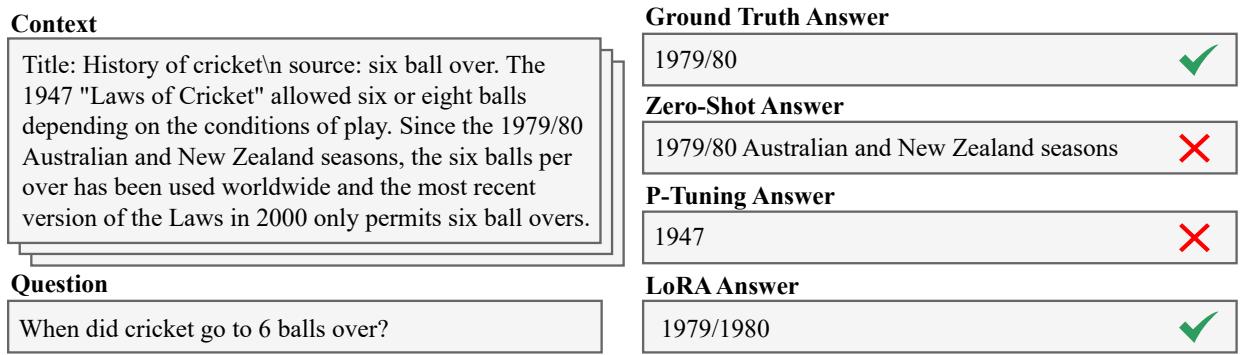
In Figure 2, the model is asked: “When did cricket go to 6 balls over?”
- The Context: Contains the correct answer (“1979/80”).
- Zero-Shot RETRO: Finds the right information but simply copies a long phrase. It hasn’t learned the specific “short answer” format required by the dataset.
- P-Tuning: Hallucinates “1947” (a date present in the text, but the wrong one). This highlights P-tuning’s struggle to control the model’s reasoning.
- LoRA: Correctly identifies the date and formats it perfectly. This demonstrates how LoRA effectively aligns the model’s retrieval capabilities with the desired output format.
What About Instruction Tuning?
The researchers added one final twist. They took a RETRO model that had already been “Instruction-Tuned” (trained to follow commands) and then applied PEFT.
The hypothesis: An instruction-tuned model should be smarter, so fine-tuning it further should yield a super-model. The reality: Diminishing returns.
While the Instruction-tuned RETRO was better at Zero-shot tasks than the base RETRO, applying PEFT didn’t provide a massive boost. In fact, the average scores for the fine-tuned Instruction-RETRO were significantly lower than the fine-tuned Base-RETRO. This suggests there is a “performance ceiling.” If a model has already been heavily tuned for instructions, applying parameter-efficient tuning on top of it for RAG tasks might over-constrain the model or offer little additional benefit compared to tuning a base model.
Conclusion and Key Takeaways
This research provides a comprehensive map for navigating the intersection of LLMs, Retrieval, and Fine-Tuning. Here are the core takeaways for students and developers:
- If you cannot fine-tune: Use RETRO. Its retrieval-native architecture makes it superior in Zero-shot settings where you need the model to use external data “out of the box.”
- If you can fine-tune: Use GPT + LoRA/Adapters. A standard dense model, when equipped with efficient fine-tuning, adapts better to RAG tasks and achieves a higher performance ceiling than RETRO.
- Size Matters (to a point): The 8B parameter range is the sweet spot. Going larger yields diminishing returns for significantly higher compute costs.
- Avoid P-Tuning for RAG: It consistently underperforms compared to Adapters and LoRA, which modify the model’s internal processing of retrieved data.
As we move toward more efficient AI systems, this paper highlights a crucial reality: specialized architectures (like RETRO) have a head start, but generalist architectures (like GPT) are incredibly adaptable fast learners. With tools like LoRA, we can teach generalist models to become retrieval experts, often surpassing the models built for that very purpose.