](https://deep-paper.org/en/paper/2407.05609/images/cover.png)
Imagine you are handed a massive library of books. Your job is to organize them into categories. But there’s a catch: you don’t know what the categories are yet, and many books belong to multiple categories simultaneously (e.g., a book could be about “History,” “War,” and “Biography”). You have no list of genres, no Dewey Decimal System, and no labeled examples. All you have is a vague instruction: “Organize these by topic.”
This is the problem of Open-world Multi-label Text Classification (MLTC). In the world of machine learning, this is a notoriously difficult task. Traditional classifiers need a fixed list of labels (classes) to learn from. Even unsupervised methods like topic modeling usually assign just one topic to a document, failing to capture the nuance of multi-label data.
In this post, we are going to dive deep into a paper titled “Open-world Multi-label Text Classification with Extremely Weak Supervision” by researchers from UC San Diego and Cisco. They propose a novel framework called X-MLClass. It’s a clever system that uses Large Language Models (LLMs) to discover labels from scratch and build a robust classifier, all with “extremely weak supervision”—meaning just a brief description of the goal.
Whether you are a student of NLP or just curious about how AI handles unstructured data, this paper offers a masterclass in combining clustering, LLMs, and iterative algorithms.
The Problem: Why is this so hard?
To appreciate X-MLClass, we first need to understand the limitations of current approaches.
1. The “Closed World” Assumption Most text classification models operate in a “closed world.” You train them on a dataset where every document has labels from a pre-defined list (e.g., Sports, Politics, Finance). If a document comes in about “Cooking,” the model forces it into one of the known buckets or fails. In the “open world,” we don’t know the labels beforehand.
2. The Multi-Label Challenge Single-label classification is like sorting fruit: an apple is an apple. Multi-label classification is like tagging a movie: it can be Action, Comedy, and Sci-Fi. Existing unsupervised methods (like LDA or BERTopic) are great at finding the main topic of a document, but they struggle to find the secondary, tertiary, or “long-tail” topics.
3. The Annotation Bottleneck Getting humans to label thousands of documents to train a model is expensive and slow. X-MLClass aims to bypass this entirely, requiring only a tiny bit of human input (a prompt description).
The Core Insight: Dominant Classes and Long-Tails
The researchers built their solution on two crucial observations regarding text data:
- The Dominant Class Theory: Most documents have one “dominant” class that covers the majority (over 50%) of the content.
- The Long-Tail Distribution: Labels that are rare (long-tail) in the overall dataset often appear as the dominant class in at least a few specific documents.
This gives us a strategy. Instead of trying to find every label at once, we can:
- Find the dominant labels first (which is easier).
- Build a rough classifier.
- Look for documents where our classifier does a bad job.
- Assume those documents contain the missing “long-tail” labels and extract them.
Let’s break down how X-MLClass executes this strategy.
The X-MLClass Framework
The framework is a pipeline that moves from raw text to a fully functioning multi-label classifier. It leverages the reasoning power of LLMs (like Llama-2) without needing to fine-tune them, which keeps costs manageable.
Below is the high-level architecture of the system. Take a moment to look at the flow from left to right.
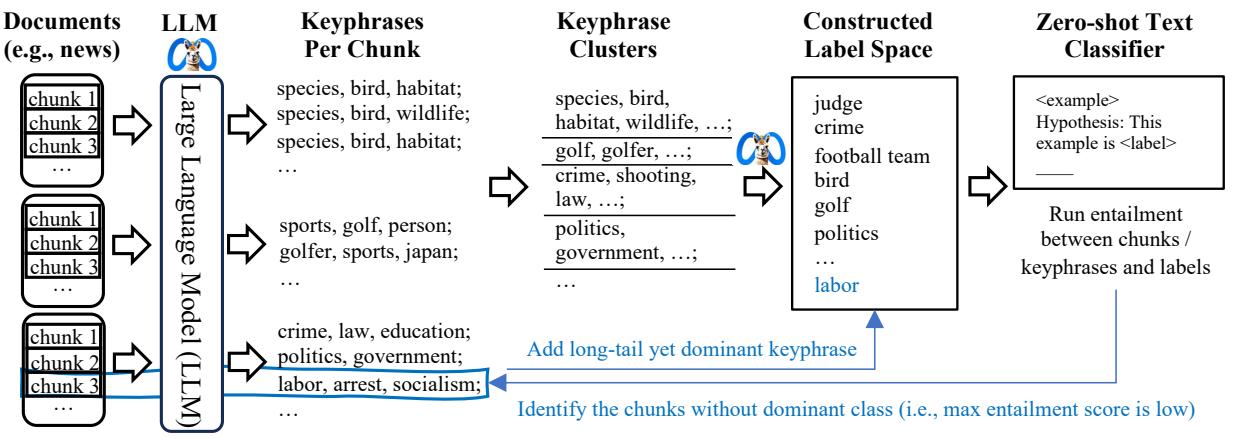
As shown in Figure 1, the process is divided into three distinct phases: Chunking & Keyphrase Extraction, Label Space Construction, and Iterative Refinement.
Step 1: Generating the Initial Label Space
The process starts with a subset of the raw documents. The goal here isn’t to classify everything yet, but to figure out what the labels should be.
Chunking: Notice in the image above that the “News Document” is split into “Chunk 1, Chunk 2, Chunk 3.” Why chop up the text?
- Context Window: LLMs have limits on how much text they can process.
- Focus: A long document might cover “Politics” and “Economics.” By splitting it, one chunk might be purely “Politics” and another purely “Economics,” making it easier for the model to identify the specific topics.
Prompting for Keyphrases: The system feeds these chunks into an LLM with a prompt based on the user’s brief description (e.g., “Classify these news articles by topic”). The LLM outputs “Keyphrases Per Chunk.”
- Chunk 1 Output: “species, bird, habitat”
- Chunk 2 Output: “sports, golf, person”
Clustering: Now we have a massive pile of keyphrases. Many are synonyms or closely related (e.g., “bird” and “wildlife”). To organize this, X-MLClass uses semantic embeddings.
- Embeddings: Convert keyphrases into vectors using a model like
instructor-large. - Dimensionality Reduction: Use UMAP to simplify the data structure.
- Clustering: Use Gaussian Mixture Models (GMM) to group similar keyphrases together.
Label Generation: Once the clusters are formed (as seen in the middle of Figure 1), the system goes back to the LLM. It asks the LLM to look at the center of a cluster and generate a single, clean label name (e.g., “Environment” or “Sports”). After cleaning up redundancy (ensuring we don’t have both “Movies” and “Films”), we have our Initial Label Space.
Step 2: Zero-Shot Classification
Now that we have a list of potential labels (e.g., Politics, Sports, Environment), how do we apply them to the documents?
The researchers use a technique called Textual Entailment. Instead of training a standard classifier, they use a pre-trained Natural Language Inference (NLI) model. They treat the document text as a “premise” and the label as a “hypothesis.”
- Premise: “The Senator voted against the bill…”
- Hypothesis: “This text is about Politics.”
The model outputs a score: How likely is the hypothesis true given the premise? This allows the system to classify text using labels it has never seen before (Zero-Shot).
Step 3: Iterative Refinement (Finding the Hidden Labels)
This is the most innovative part of X-MLClass. The initial label space usually captures the popular topics but misses the niche ones.
The system runs the classifier on the documents. It then looks for low-confidence predictions. If the classifier looks at a document and says, “I’m only 20% sure this is Sports, and 10% sure it’s Politics,” that document likely belongs to a category we haven’t discovered yet (perhaps “Esports” or “Chess”).
The system revisits these “confusing” chunks, extracts new keyphrases, and adds them to the label space. This process repeats, peeling back layers of the dataset to find the “long-tail” labels.
Measuring Success
How do we know if this actually works? The researchers used two primary metrics to evaluate X-MLClass against baselines like LDA (Topic Modeling) and standard Keyword Extraction.
Metric 1: Label Space Coverage
First, did the model find the right labels? This is measured by Coverage. Since the model generates its own label names, we can’t just do a string match (the model might say “Cinema” while the ground truth is “Movies”).
The paper uses semantic similarity to match generated labels (\(C^{pred}\)) to ground truth labels (\(C^{GT}\)).

In this equation:
- \(N\) is the total number of ground truth labels.
- \(\mathbb{I}\) is an indicator function that checks if a predicted label semantically matches a ground truth label (using embeddings or GPT-4 verification).
- \(\mathbb{G}\) represents a bipartite matching algorithm (pairing them up optimally).
Basically, it asks: What percentage of the real concepts did the machine discover?
Metric 2: Classification Accuracy
Finding labels is great, but can the model actually tag the documents correctly? For this, they use Precision at k (P@k).
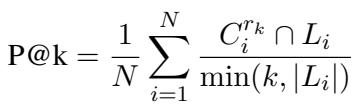
This measures the percentage of correct labels found in the top-\(k\) predictions for each document. It’s a standard metric for multi-label problems where the order of predictions matters.
Experimental Results
The researchers tested X-MLClass on 5 benchmark datasets, including AAPD (Computer Science papers), Reuters (News), and Amazon (Product reviews).
Does Iteration Help?
One of the key claims of the paper is that iteratively looking for “low confidence” chunks helps find more labels. Let’s look at the data.
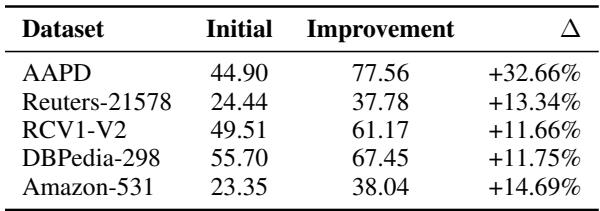
Table 4 shows the “Initial” coverage (after Step 1) and the final coverage after the iterative refinement.
- Look at AAPD: It started with ~45% coverage and jumped to 77.56%. That is a massive improvement.
- Reuters and Amazon also saw significant gains.
This validates the “Long-Tail” hypothesis: the initial pass finds the big topics, but the iterative loop hunts down the rare ones.
We can visualize this growth over time.
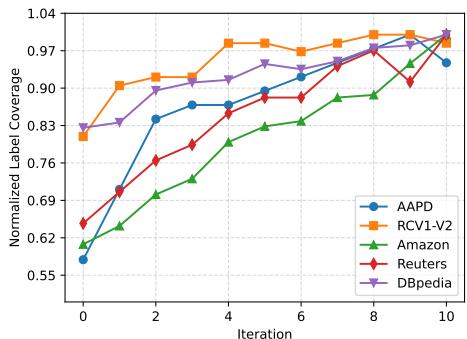
Figure 2 plots the coverage against the number of iterations. You can see a sharp rise in the first few iterations across all datasets (represented by the different colored lines) before it plateaus. This proves the method efficiently converges on a good label set quickly.
For massive datasets like Amazon (which has 531 different labels!), the process takes a bit longer but continues to climb, as seen below:
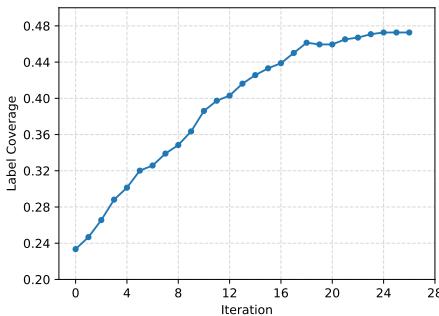
The graph shows that even after 20 iterations, the model is still discovering new valid product categories in the Amazon dataset.
The Human Touch
While X-MLClass is designed to be automated, the researchers acknowledge that AI isn’t perfect. Sometimes the clustering creates redundant labels (e.g., “Health” vs “Personal Health”).
They experimented with a “Human in the Loop” approach, where a human briefly reviews borderline label pairs.
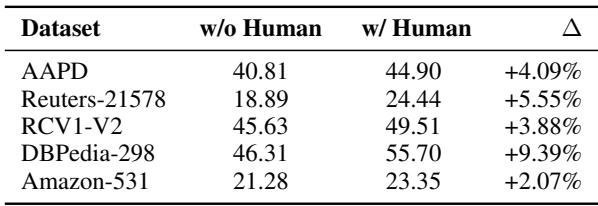
Table 5 shows that with just a tiny bit of human effort (reviewing about 30 pairs), coverage improves by anywhere from 2% to 9%. This suggests the framework is flexible: it works fully automatically, but can also act as a powerful “copilot” for a human taxonomist.
Key Takeaways
The X-MLClass paper presents a significant step forward for handling messy, unlabeled, real-world data.
- No Labels, No Problem: It successfully performs multi-label classification without a pre-defined label set, a scenario previously thought to be too difficult for standard classifiers.
- The Power of Iteration: It proves that you don’t need to find everything at once. By identifying what the model doesn’t know (low confidence chunks), you can discover hidden, long-tail categories.
- Superior Performance: It outperformed traditional Topic Modeling (like BERTopic) and Keyword Extraction methods by margins of up to 40% in label coverage.
Why does this matter? Think about e-commerce platforms tagging millions of new products, or customer support systems trying to categorize incoming tickets into evolving issues. These are “open worlds.” They change constantly, and labels are never static. X-MLClass offers a blueprint for building AI systems that adapt and discover structure in the chaos of unstructured text.
For students and researchers, this paper highlights that how you structure your pipeline (chunking, iterative feedback loops) is just as important as the strength of the underlying LLM.