](https://deep-paper.org/en/paper/2407.07071/images/cover.png)
Introduction
In the current landscape of Large Language Models (LLMs), we often rely on a technique called Retrieval-Augmented Generation (RAG). The premise is simple: LLMs can’t know everything, especially private data or recent news, so we provide them with relevant documents (the context) and ask them to answer questions or summarize that information.
We assume that if we give the model the correct facts, it will use them. Unfortunately, that is not always true.
Models frequently suffer from contextual hallucination. This occurs when the model is provided with the correct answer in the input context but ignores it, instead fabricating details or relying on its own pre-trained memory to produce an unsubstantiated answer. For students and researchers working with NLP, this is a critical reliability bottleneck. If an automated summary includes a number or a name that appears nowhere in the source document, the system’s trust is broken.
This post explores a fascinating paper titled “Lookback Lens”, which proposes a lightweight, intuitive solution to this problem. Instead of analyzing complex hidden states or training massive external verification models, the researchers ask a simple question: Is the model paying attention to the context, or is it just listening to itself?
By analyzing the attention maps of a Transformer—specifically, the ratio of attention paid to the context versus the generated text—we can detect and even mitigate hallucinations with surprising accuracy.
Background: The Nature of Hallucination
To understand the contribution of this paper, we first need to distinguish between two types of hallucinations:
- Closed-book Hallucination: The model is asked a question without any external context (e.g., “Who won the Super Bowl in 2030?”) and invents an answer.
- Open-book (Contextual) Hallucination: The model is given a specific text (e.g., a news article) and asked to summarize it. It generates a summary that sounds fluent but contains details that contradict or do not exist in the source text.
Most prior research has focused on the first type, often using the model’s internal hidden states (the dense vector representations of tokens) to predict if the model is lying. The intuition there is that the model’s “brain activity” looks different when it’s fabricating information versus recalling facts.
However, for contextual hallucination, the authors of the Lookback Lens argue that hidden states are not the most direct signal. In a Transformer architecture, the Attention Mechanism explicitly dictates how information flows. If a model is supposed to be summarizing a document, it should be attending to that document. If the attention weights show the model is ignoring the document and attending heavily to the tokens it just generated, that is a strong signal of potential hallucination.
The Core Method: The Lookback Lens
The core contribution of this paper is a method to quantify this behavior, which the authors call the Lookback Lens. The method is grounded in the hypothesis that contextual hallucinations are directly related to the extent to which an LLM attends to the provided context.
1. The Lookback Ratio
The fundamental building block of this method is the Lookback Ratio.
In a standard Transformer, during the generation of a new token \(y_t\), the model attends to two sources of information:
- The Context (\(X\)): The input prompt or documents provided (length \(N\)).
- The New Tokens (\(Y\)): The tokens the model has already generated in the current response (length \(t-1\)).
For every single attention head \(h\) in every layer \(l\), the researchers calculate how much “mass” the attention mechanism places on the context versus the newly generated tokens.
First, they calculate the average attention weight on the context tokens:
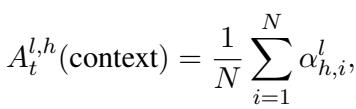
Here, \(\alpha_{h,i}^l\) represents the attention weight the head assigns to the \(i\)-th token in the context.
Next, they calculate the average attention weight on the newly generated tokens:
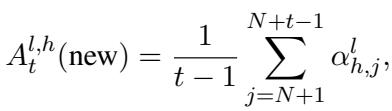
With these two values, they compute the Lookback Ratio (\(LR\)). This ratio represents the proportion of attention directed at the context relative to the total attention mass (context + new tokens):
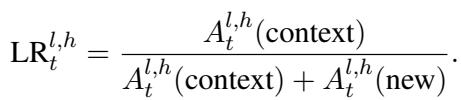
If this ratio is high (close to 1), the head is looking back at the source document. If it is low (close to 0), the head is focusing primarily on what the model has just written.
2. Constructing the Feature Vector
A single attention head might not tell the whole story. Some heads are designed to look at local syntax (previous words), while others look for global context. To capture the full picture, the Lookback Lens aggregates the ratios from all attention heads across all layers.
For a specific time step \(t\), the feature vector \(\mathbf{v}_t\) is simply the concatenation of the Lookback Ratios for every head in the model:

For a model like LLaMA-2-7B, which has many layers and heads, this results in a feature vector that captures the “attention signature” of the model at that specific moment.
3. The Classifier
To determine if a specific span of text is a hallucination, the researchers take the average of these feature vectors over the tokens in that span (denoted as \(\bar{\mathbf{v}}\)).
They then train a simple Logistic Regression classifier (a linear classifier) to predict the probability of the span being factual (\(y=1\)) or a hallucination (\(y=0\)).

This is a key advantage of the Lookback Lens: simplicity. The classifier is not a massive neural network; it is a linear model trained on interpretable features (attention ratios).
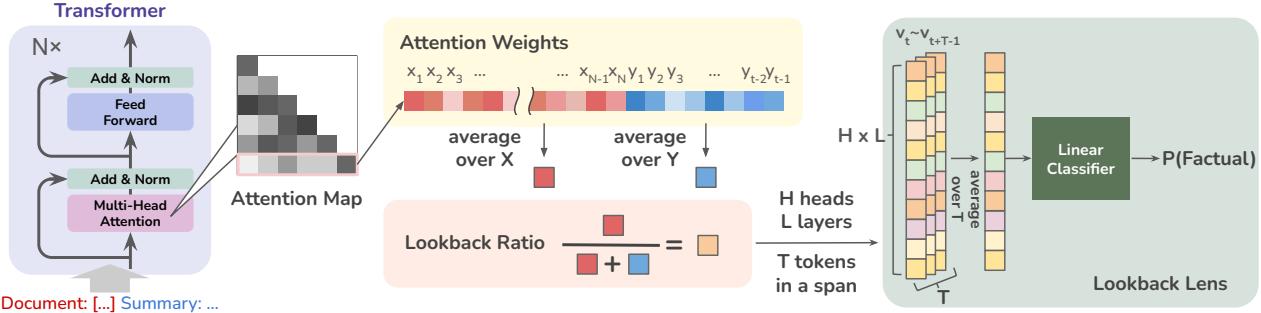
The complete architecture is illustrated below. You can see the flow from the Transformer’s attention weights, into the Lookback Ratio calculation, and finally into the linear classifier.
Experimental Setup: Detecting Hallucinations
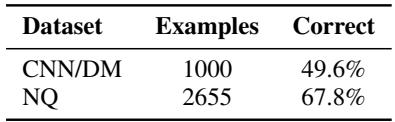
To test this method, the researchers created a dataset using the CNN/DailyMail (summarization) and Natural Questions (QA) datasets. They prompted a LLaMA-2-7B-Chat model to generate responses and then used GPT-4 to act as a judge, annotating which specific spans of text were hallucinations.
This is a crucial step because standard datasets often don’t have span-level labels for “this specific sentence is a hallucination.”
The statistics of the dataset are shown below. Note that even powerful models like LLaMA-2-7B generate hallucinations roughly 50% of the time on summarization tasks (CNN/DM) when greedy decoding is used.
Results on Detection
The researchers compared the Lookback Lens against two strong baselines:
- Text-based NLI: Using a separate DeBERTa model trained to detect entailment (whether the summary logically follows from the text).
- Hidden States-based Classifier: A similar logistic regression trained on the internal hidden states of the LLM (specifically layer 28, which previous work identified as rich in truthfulness information), rather than attention maps.
The results, measured in AUROC (Area Under the Receiver Operating Characteristic Curve), are impressive. A higher AUROC means better detection capability.
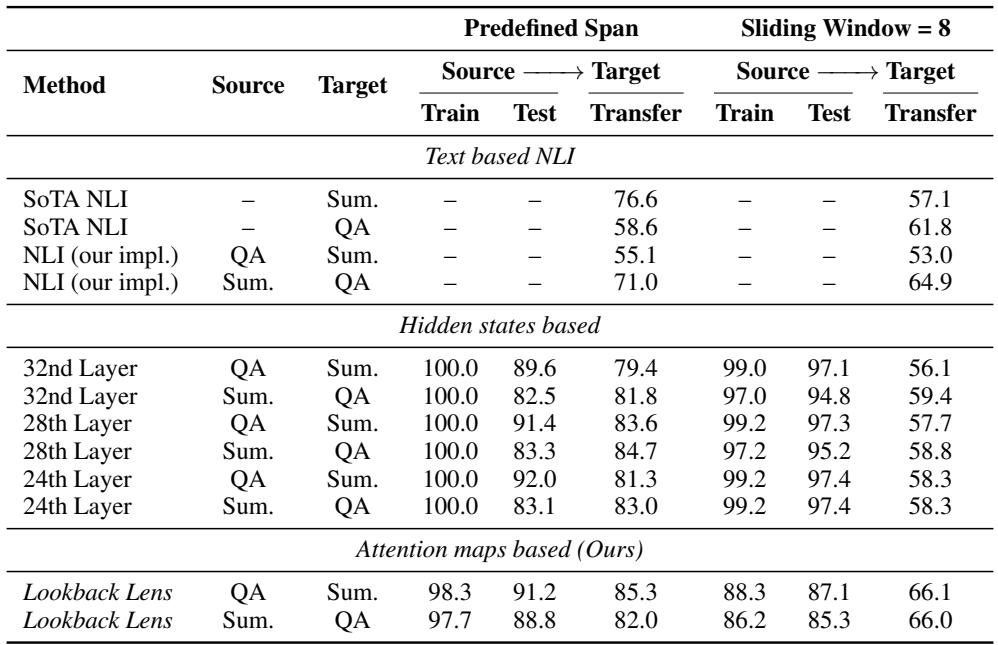
Key Takeaways from the Detection Results:
- Outperformance: The Lookback Lens (bottom rows) generally outperforms the NLI models and is on par with or better than the Hidden States classifier.
- Transferability: The most significant advantage is seen in the “Transfer” columns. When the detector is trained on one task (e.g., QA) and tested on another (e.g., Summarization), the Hidden States classifier’s performance drops significantly (likely overfitting to the specific semantics of the training task). The Lookback Lens, however, maintains high performance. This suggests that the pattern of attention associated with truthfulness is universal across different types of tasks, whereas the hidden representations are task-specific.
Mitigating Hallucinations: Lookback Lens Guided Decoding
Detecting a hallucination is useful, but preventing one is better. The authors propose a method called Lookback Lens Guided Decoding to actively fix hallucinations during the generation process.
The Problem with Token-Level Intervention
You might think we could just use the classifier to select the next word. However, attention patterns often emerge over a sequence of tokens, not just one. A single token might not carry enough “attention signature” to be judged accurately.
The Solution: Chunk-Based Decoding
The proposed solution is to generate text in small chunks (e.g., 8 tokens at a time).
- Sample: The model generates \(k\) different candidate chunks for the next few words.
- Score: For each candidate chunk, we calculate the average Lookback Ratios and pass them through the Lookback Lens classifier.
- Select: We choose the chunk that the classifier predicts is most likely to be factual (highest score).
- Repeat: Append the chosen chunk and repeat the process.
This process is visualized below:

Mathematically, the selection of the best chunk \(C^*\) is an argmax operation over the classifier scores:

Mitigation Results
The researchers tested this decoding strategy on the XSum dataset (summarization) and Natural Questions.
The results showed a significant reduction in hallucinations. For example, on the XSum task, using Lookback Lens Guided Decoding reduced the hallucination rate by 9.6% compared to standard greedy decoding.
Crucially, this method worked well even when transferring the detector across tasks (training on CNN/DM and testing on XSum). Hidden-state baselines struggled here, confirming that Lookback Lens captures a more generalizable signal of factuality.
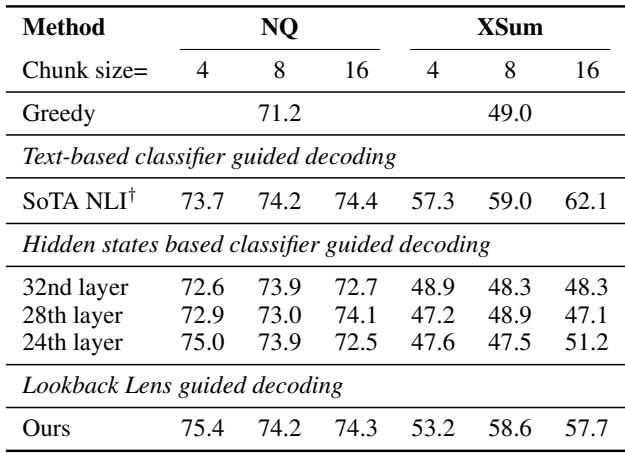
We can see the impact of chunk size on performance in the table below. While there is some variation, the method consistently improves over the baselines (Text-based NLI and Hidden States) across different chunk sizes (4, 8, 16).
A Qualitative Example
To visualize what this looks like in practice, consider the example below from the XSum dataset.
The model is summarizing an article about Beyoncé’s earnings.
- Greedy Decoding (Standard): The model claims Beyoncé earned “£64m”. This number appears in the text, but it is associated with Taylor Swift, not Beyoncé. This is a classic “mix-up” hallucination.
- Lookback Lens: The detector assigns a very low score (0.05) to the chunk containing the “£64m” claim. It identifies that the model wasn’t attending to the correct part of the context when generating that number.
- Guided Decoding: By rejecting that low-scoring chunk, the model is guided toward a factual summary that correctly states she earned an average of $2.4m per city.

Advanced Analysis: Cross-Model Transfer
One of the most surprising findings in the paper is the ability to transfer the detector between different models without retraining.
The researchers trained the Lookback Lens on LLaMA-2-7B and applied it to LLaMA-2-13B.
Since the two models have a different number of attention heads (1024 vs. 1600), you cannot simply copy the weights. However, the authors found that there is a linear relationship between the attention patterns of the two models. By training a simple linear regression to map the 13B heads to the 7B heads, they could use the 7B classifier on the 13B model.
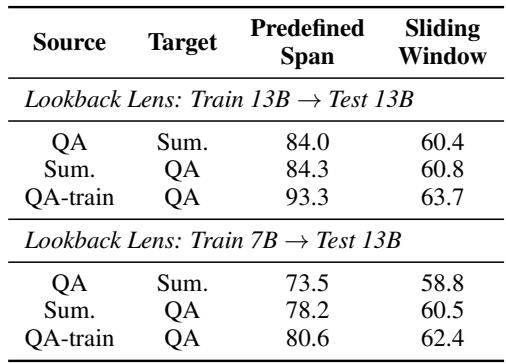
As shown in the table, the transferred detector (Train 7B \(\to\) Test 13B) performs remarkably well, almost matching the performance of a detector trained directly on the 13B model. This has huge implications for efficiency: you can train a lightweight detector on a smaller, cheaper model and deploy it on a larger, more expensive one.
Understanding the “Why”: Positive vs. Negative Heads
Finally, the authors dig into which heads are actually doing the work. Are all heads equally important?
They analyzed the coefficients of the logistic regression classifier to find:
- Positive Heads: High Lookback Ratio = Factual. (Looking at context is good).
- Negative Heads: Low Lookback Ratio = Factual. (Looking at self is good).
Wait, why would looking at yourself be good for factuality?
The visualization below helps explain.
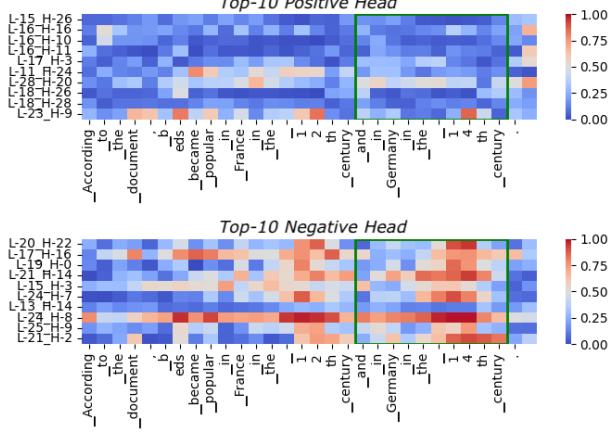
The Top-10 Positive Heads (top heatmap) show high activity (red) on the context words. These heads are responsible for grounding—fetching facts from the document.
The Top-10 Negative Heads (bottom heatmap) show low activity on the context (blue/green) and high activity on the generated tokens. The authors hypothesize that these heads are responsible for consistency. Once the model has fetched a fact (e.g., “Germany”), it needs to attend to its own generation to ensure the sentence structure and grammar remain coherent. Both types of heads are necessary for a truthful, fluent response.
Interestingly, ablation studies showed that you cannot just use the “Positive” heads. You need the combination of both signals to accurately detect hallucinations.
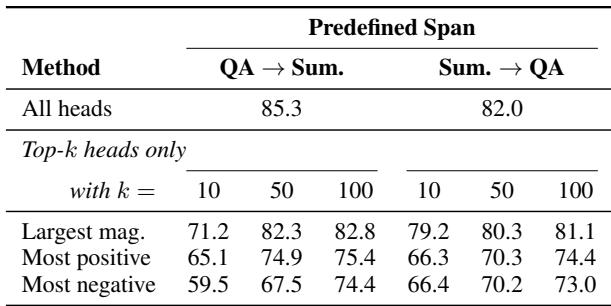
As the table above shows, using the top-100 heads (by magnitude of coefficient) recovers almost all the performance of using all heads. This confirms that a subset of heads specializes in monitoring truthfulness.
Conclusion
The “Lookback Lens” paper offers a refreshing perspective on LLM interpretability. Rather than treating the model as a black box or getting lost in the high-dimensional noise of hidden states, it leverages a human-interpretable mechanic: Attention.
The logic holds up: if you ask a student to summarize a book, and they never look at the book while speaking, they are probably making it up. The Lookback Lens operationalizes this intuition for LLMs.
Key Takeaways:
- Simplicity Wins: A linear classifier on attention ratios outperforms complex NLI models.
- Generalizability: Attention patterns for truthfulness transfer across tasks (QA to Summarization) and models (7B to 13B).
- Actionability: We can use these signals during decoding to actively steer the model away from hallucinations.
As we continue to build applications relying on RAG and automated summarization, lightweight, transferable, and interpretable methods like the Lookback Lens will be essential for building trust in AI systems.