](https://deep-paper.org/en/paper/2407.07099/images/cover.png)
In the rapidly evolving landscape of Large Language Models (LLMs), a recurring challenge persists: how do we make models “think” better without breaking the bank?
We know that LLMs are capable of impressive feats, but they often stumble on complex reasoning tasks involving math, logic, or symbolic manipulation. To counter this, researchers developed Chain-of-Thought (CoT) prompting—asking the model to “think step by step.” To make this even more robust, we often use Self-Consistency, where we ask the model the same question multiple times (multi-path inference) and vote for the most common answer.
While effective, Self-Consistency is computationally expensive. It usually requires running the model 20, 40, or even more times for a single question.
What if there were a way to get the same high accuracy with half the effort? Enter Nash Chain-of-Thought (Nash CoT). This new approach, proposed by researchers from Westlake University and the University of Cambridge, combines the power of persona-based prompting with Game Theory.
In this post, we will dissect how Nash CoT creates a “game” between different modes of an LLM to find the most optimal answer efficiently.
The Problem: The Cost of Accuracy
To understand why Nash CoT is necessary, we first need to look at the limitations of current state-of-the-art methods.
Multi-Path Inference
The gold standard for complex reasoning has been Self-Consistency. It works on a simple premise: LLMs are probabilistic. If you ask a question once, you might get a hallucination. If you ask it 20 times, the “correct” reasoning path usually appears most frequently.
However, the researchers note a critical flaw: There is no theoretical limit to how many paths you need. To get better results, you just keep adding paths, which linearly increases your inference cost (time and money).
The Role-Playing Dilemma
Another way to boost performance is Role-Playing. Prompting an LLM with “You are a mathematician” tends to yield better math answers than a generic prompt.
But this comes with a trade-off:
- Immersion: The model gets better at the specific task (e.g., math).
- Narrowing: The model loses diversity. If the role is too specific, the model might overfit or fail on questions that require broad common sense.
The researchers behind Nash CoT asked: Can we combine the precision of role-playing with the diversity of a general model, while reducing the number of paths needed?
The Solution: Nash CoT
The core idea of Nash CoT is to treat the inference process as a game between two players:
- Player 1: The LLM immersed in a specific role (e.g., a Mathematician).
- Player 2: The LLM in its normal, general state.
The goal is to find a Nash Equilibrium (NE)—a state where the preferences of the role-specific model align with the general model. When these two “players” agree, the answer is likely to be both accurate (thanks to the role) and robust (thanks to the general model).
The Architecture Breakdown
The Nash CoT process is divided into three distinct steps. Let’s break them down visually.
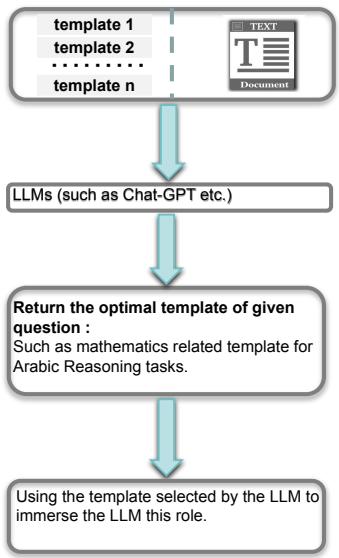
Step 1: Role Identification
As shown in the image above, the system first needs to decide who should answer the question. The researchers utilize a “Preference Model” (which can just be the LLM itself) to select the best template from a list.
For example, if the question is about algebra, the model selects the “Mathematician” template. If it’s about literature, it selects a “Literary Scholar” template. This brings the LLM into a “template-related role.”
Step 2: The Game (Mini-Batch Inference)
This is where the magic happens. Instead of just generating 20 answers blindly, the system runs a comparison loop.
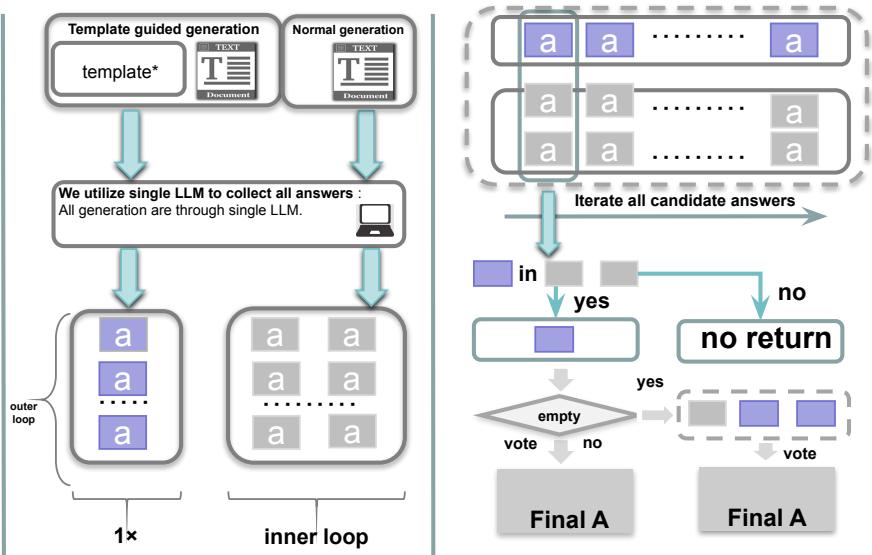
As illustrated in Step 2 above, the system generates predictions using two methods:
- Normal Generation: The LLM answers the question without the specific role template (general state).
- Role-Immersed Generation: The LLM answers using the selected persona.
The algorithm looks for an answer that satisfies the Preference Equilibrium. In simple terms, it checks if the specific, role-based answer (\(y^*\)) is present within the set of general answers (\(y_1, y_2\)).
If the role-based answer aligns with one of the general answers, it suggests a balance between specific expertise and general robustness—a “unique Nash Equilibrium.”
Step 3: Answer Filtering
Finally, as shown in the Step 3 diagram, the system collects all the candidate answers that achieved equilibrium. It then performs a voting process similar to Self-Consistency, but on a much higher-quality set of candidates. If no equilibrium is found (which is rare), it falls back to standard frequency voting.
The Theoretical Foundation: Why “Nash” Equilibrium?
You might be wondering why this is called “Nash” CoT. The researchers provide a mathematical proof to justify this “game.”
They define a Preference Model where one output is preferred over another.

This equation defines the probability that answer \(y_1\) is better than \(y_2\) based on a reward model \(r\).
However, simply maximizing reward isn’t enough; we need stability. The authors introduce a Kullback-Leibler (KL) divergence constraint.

This equation might look intimidating, but its purpose is elegant. The KL term acts as an anchor. It penalizes the “Role-Immersed” player if it deviates too wildly from the “Safe Policy” (the general model, \(\mu\)).
- If the role-player goes too far into its persona and starts hallucinating, the KL term penalizes it.
- If the role-player stays too generic, it doesn’t add value.
The Nash Equilibrium occurs when the strategy of the role-player balances perfectly against the general player. The authors prove that under these constraints, a unique equilibrium exists.
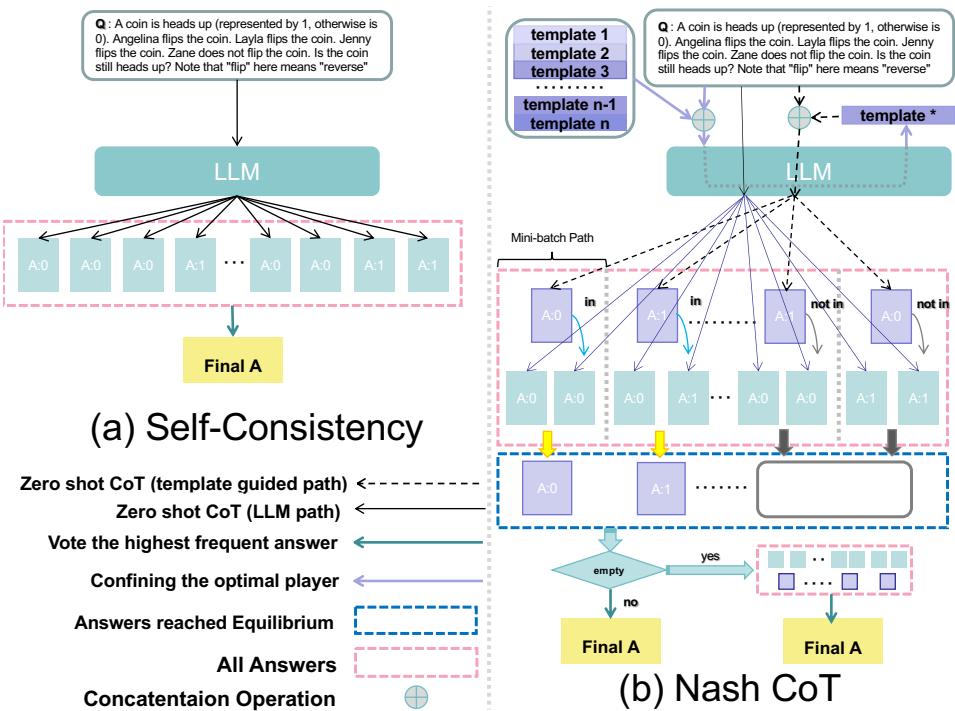
The figure above contrasts the two approaches. On the left, Self-Consistency blindly generates path after path. On the right, Nash CoT uses a “mini-batch” loop to check for equilibrium (“in” or “not in”) before finalizing an answer. This “check” creates a higher quality filter for answers.
Experimental Results
So, does this game-theoretic approach actually work? The researchers tested Nash CoT on a variety of benchmarks, including Arabic Reasoning (Math), Symbolic Reasoning, and Commonsense QA.
Performance vs. Self-Consistency
The headline result is that Nash CoT achieves comparable or better performance than Self-Consistency with half the number of paths.
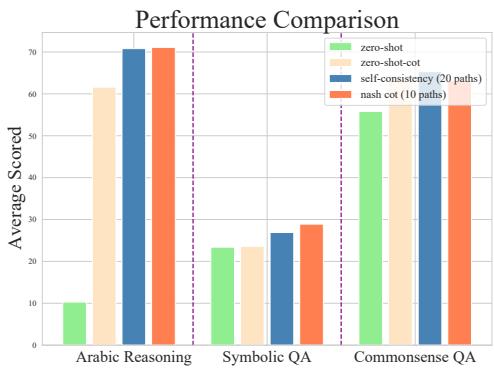
In the chart above (Figure 2), we see the average performance across different domains. Nash CoT (using 10 paths) rivals Self-Consistency (using 20 paths).
Let’s look at specific numbers for Symbolic Inference:
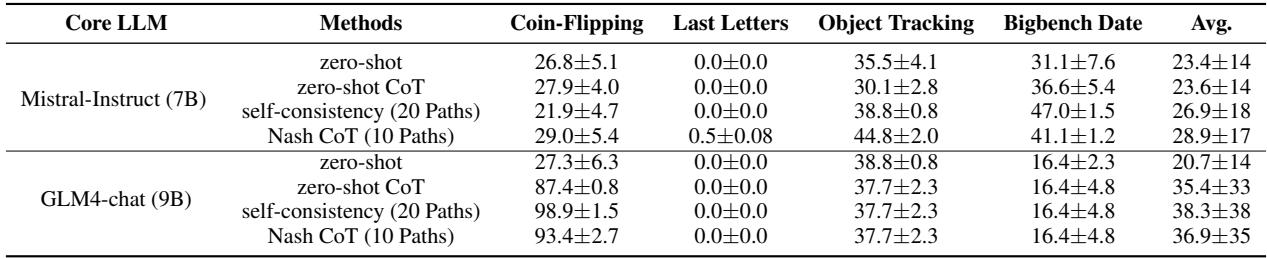
In tasks like “Object Tracking,” Nash CoT (10 paths) scores 44.8, significantly outperforming Zero-Shot CoT (30.1) and beating Self-Consistency (38.8) which used double the paths.
For Commonsense Reasoning:
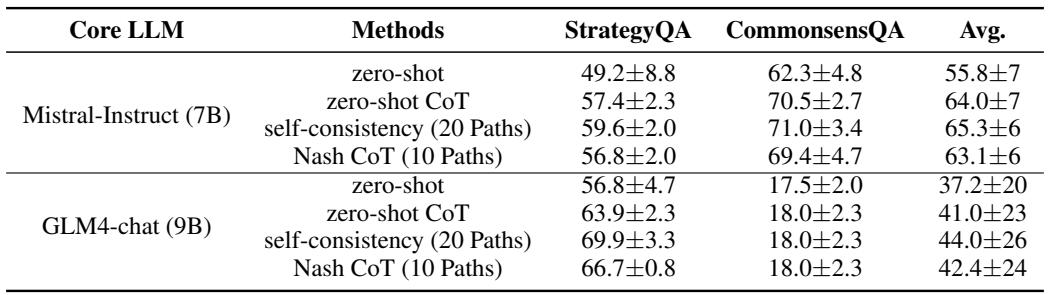
Here, the results are more mixed. Nash CoT performs similarly to Self-Consistency. The authors note that Commonsense tasks are highly diverse, and sometimes the pre-defined role templates (like “Mathematician”) don’t cover the nuance required for general commonsense questions.
The Efficiency Gain
The most practical advantage of Nash CoT is speed. Because it requires fewer reasoning paths to reach a high-confidence answer, it drastically reduces inference time.
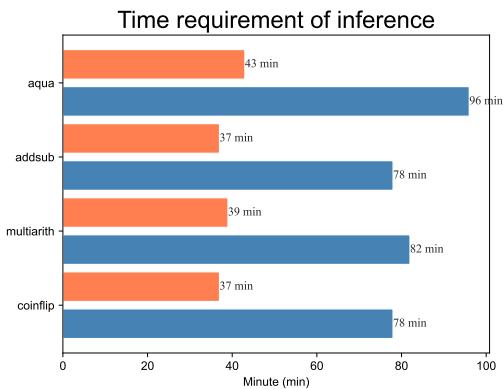
This bar chart is striking. Across datasets like AQuA and AddSub, Nash CoT (orange bars) cuts the inference time roughly in half compared to Self-Consistency (blue bars). For researchers and companies running LLMs at scale, a 50% reduction in compute cost is a massive improvement.
Ablation Studies: Do the Loops Matter?
The researchers also investigated whether the structure of the “game” matters. Nash CoT uses “Outer Loops” and “Mini-batch Loops.”
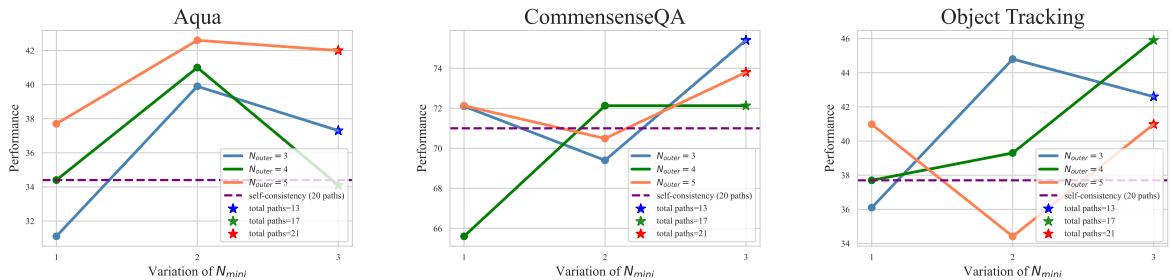
The graphs above show that as you increase the number of loops (\(N_{mini}\)), performance generally improves, eventually surpassing the dashed line (Self-Consistency). This confirms that the iterative process of finding equilibrium effectively filters out bad answers.
The Impact of Role Templates
Does the specific role really matter? The authors ran an experiment removing the “Mathematician” template from math tasks.
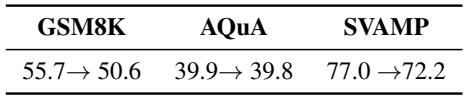
As shown in Table 5, performance dropped significantly (e.g., from 55.7 to 50.6 on GSM8K) when the relevant role was removed. This confirms that the “Role-Immersed Player” is contributing crucial domain expertise to the game.
Conclusion
Nash CoT represents a fascinating step forward in “Prompt Engineering 2.0.” Rather than just asking the model to think harder, it structures the thinking process into a comparative game.
By forcing the Large Language Model to align its role-specific knowledge with its general intuition (finding the Nash Equilibrium), we get the best of both worlds: high accuracy and robust reasoning.
Key Takeaways:
- Efficiency: Nash CoT matches standard methods with roughly 50% of the computational cost.
- Theory-Backed: It isn’t just a heuristic; it’s based on proving the existence of a unique equilibrium in preference models.
- Application: It excels particularly in logic and mathematics, where adopting a specific persona (like a mathematician) yields tangible benefits.
As LLMs continue to grow in size and cost, methods like Nash CoT that optimize how we ask questions—rather than just what we ask—will be essential for scalable AI.