](https://deep-paper.org/en/paper/2407.08582/images/cover.png)
Large Language Models (LLMs) like GPT-4 and LLaMA-2 have revolutionized how we interact with information. They can write code, summarize novels, and answer complex queries. Yet, they have a notorious flaw: hallucination. An LLM can confidently state that the Eiffel Tower is in Berlin or invent court cases that never happened.
This raises a fascinating, almost philosophical question for AI researchers: Does the model know it is lying?
When an LLM outputs a falsehood, is it because the model truly believes that information is correct? Or does the model contain the correct information deep within its internal representations, but somehow fails to output it?
Recent research suggests the latter. By using a technique called “probing,” researchers have found directions in the model’s mathematical space that seem to separate “true” from “false.” However, previous attempts had a major limitation: they often worked only on the specific type of data they were trained on. A “truth detector” trained on trivia questions might fail miserably when checking a summary of a news article.
In this post, we are diving into a paper titled “On the Universal Truthfulness Hyperplane Inside LLMs”, which attempts to solve this generalization problem. The researchers explore whether there is a single, universal geometry—a “Truthfulness Hyperplane”—that exists across different tasks, domains, and datasets.
The Problem: Detecting Lies in High Dimensions
To understand this paper, we first need to understand Linear Probing.
As an LLM processes text, it converts tokens (words or parts of words) into vectors—long lists of numbers representing the “hidden states” of the model. These hidden states contain semantic information. A “probe” is essentially a simple classifier (usually a linear classifier) trained to look at these hidden states and predict a property, such as “Is this sentence true or false?”
The “Overfitting” Trap
Prior to this work, researchers would typically train a truthfulness probe on a single dataset, such as TruthfulQA (a dataset designed to trick models into mimicking human misconceptions). They would find a pattern in the hidden states that distinguished true answers from false ones with high accuracy.
However, there was a catch.
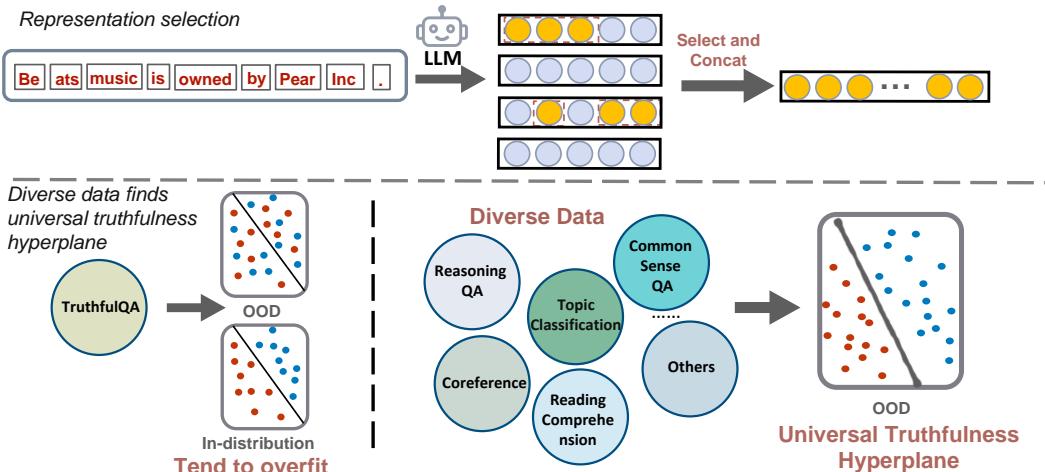
As illustrated in the bottom half of Figure 1, when you train a probe on just one type of data (like TruthfulQA), the probe often learns “spurious correlations.” It might not be learning “truth”; it might just be learning the specific writing style of valid answers in that specific dataset.
When researchers tested these TruthfulQA-trained probes on Out-Of-Distribution (OOD) data—like asking the model to check facts in a news summary—the performance plummeted, often dropping to near-random guessing (around 50%).
This leads to the core hypothesis of the paper: If we scale up the diversity of the training data, can we find a “Universal Truthfulness Hyperplane” that works everywhere?
The Method: Diversity is Key
The authors argue that to find a universal definition of truth within the model’s weights, we cannot rely on a single task. We need to overwhelm the probe with diversity.
1. Curating Massive Data
The researchers constructed a massive collection of datasets for hallucination detection. They didn’t just use Q&A; they included 17 distinct task categories covering over 40 datasets.
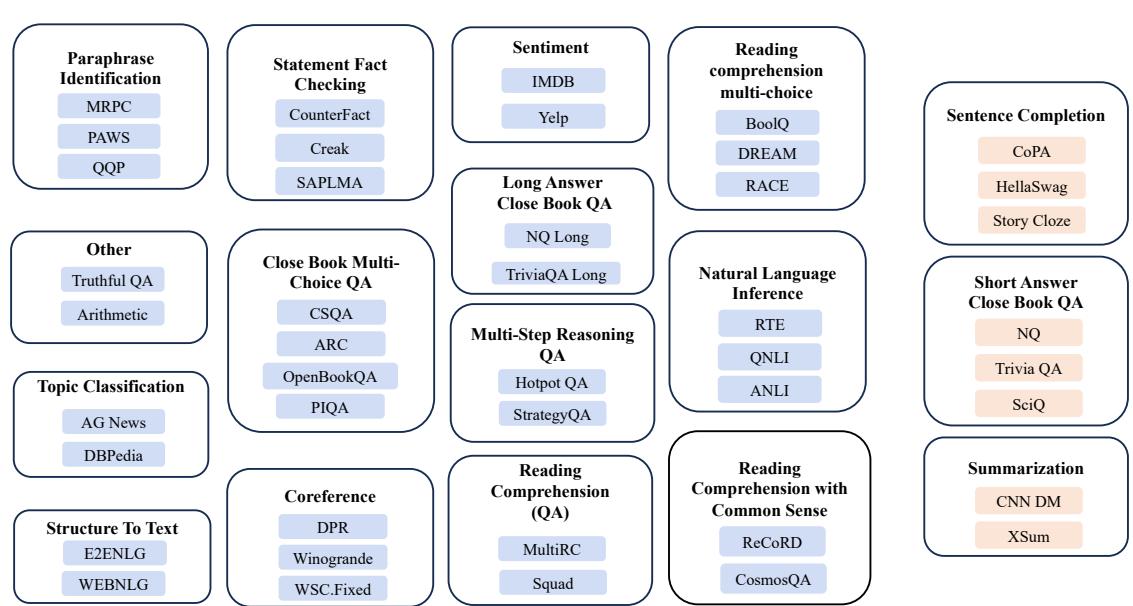
As shown in Figure 2, the variety is impressive:
- Training Tasks (Blue): These include Paraphrase Identification, Fact Checking, Sentiment Analysis, Reasoning, and Topic Classification.
- Test Tasks (Orange): To ensure they are truly testing generalization, they held out completely different categories for testing, such as Summarization and Sentence Completion.
For each dataset, they generated both correct and incorrect samples. For example, in a summarization task, they might use GPT-4 to generate a plausible but factually incorrect summary to serve as a negative example.
2. Designing the Probe
The goal is to find a linear boundary (a hyperplane) that separates the hidden states of truthful outputs (\(H^+\)) from untruthful ones (\(H^-\)). The authors tested two primary methods for this.
Method A: Logistic Regression (LR) This is a standard supervised learning technique. The probe learns a vector \(\theta\) that minimizes the classification error between true and false samples.
\[ \begin{array} { r } { \theta _ { \mathrm { l r } } = \arg \underset { \theta } { \operatorname* { m i n } } \sum _ { i } \left[ y _ { i } \log \left( \boldsymbol { \sigma } ( \boldsymbol { \theta } ^ { T } h _ { i } ) \right) + \right. } \\ { \left. ( 1 - y _ { i } ) \log \left( 1 - \boldsymbol { \sigma } ( \boldsymbol { \theta } ^ { T } h _ { i } ) \right) \right] , } \end{array} \]Method B: Mass Mean (MM) This method is computationally simpler. It calculates the average “center of gravity” for all true representations and all false representations. The “truth direction” is simply the vector connecting these two centers.
\[ \theta _ { \mathrm { m m } } = \overline { { H ^ { + } } } - \overline { { H ^ { - } } } , \]Interestingly, while Logistic Regression usually performs better on training data, the authors found that Mass Mean often generalizes better to unseen tasks because it is less prone to overfitting specific nuances of the training set.
3. Representation Selection
Modern LLMs have dozens of layers and thousands of dimensions. Using all of them is inefficient and noisy.
Referring back to the top of Figure 1, the authors employed a “Representation Selection” strategy. Instead of using the raw residual stream of the model, they looked at the outputs of Attention Heads.
They trained mini-probes on every single attention head in the model to see which ones were best at detecting truth. They selected the top performing heads (often just 1 or 2 per validation split) and concatenated them to form the input for the final probe. This effectively filters out the noise and focuses on the parts of the “brain” responsible for factuality.
Experiments & Key Results
The researchers tested their “Universal” probe against several baselines, including a standard probability check (does the model assign high probability to the answer?) and “Self-Eval” (asking the model via a prompt “Is this correct?”).
Here is what they found.
1. Generalization Achieved
Unlike previous attempts, the probes trained on the diverse dataset collection achieved high accuracy (~70%) on the held-out test tasks. This significantly outperformed the baselines.
This confirms the paper’s main contribution: There is a shared representation of truthfulness across different domains. The geometry that defines “truth” in a movie review sentiment analysis is mathematically related to the geometry that defines “truth” in a medical Q&A.
2. Attention Heads vs. Layer Activations
When probing LLMs, you can look at the residual stream (the main highway of information) or the attention heads (modules that relate tokens to each other).
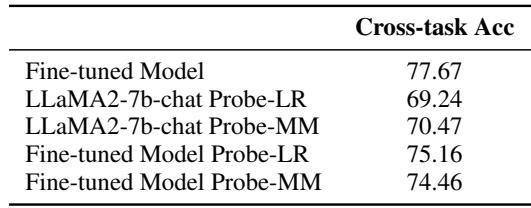
In Chart (a) of Figure 4 above, the researchers compared probes trained on attention heads versus layer activations. The results are clear: Attention head outputs (the top two lines) consistently outperform layer activations. This suggests that the model’s factual processing is concentrated in specific attention mechanisms rather than being smeared across the general layer state.
3. Quantity vs. Diversity
Perhaps the most surprising finding relates to how much data you actually need.
- Chart (b) in Figure 4 shows that as you increase the number of datasets (diversity), the accuracy climbs steadily.
- Chart (c) in Figure 4 shows what happens when you increase the number of samples per dataset. Astonishingly, the performance plateaus almost immediately.
The takeaway: To find the universal truth hyperplane, you don’t need millions of examples. You only need about 10 examples per dataset, provided you have a wide variety of datasets. The “direction” of truth is strong and easy to find; you just need to make sure you aren’t distracted by the “direction” of the specific dataset style.
4. Sparsity and Efficiency
The researchers also investigated “sparsity.” Do we need the entire high-dimensional vector to detect truth, or just a few key neurons?
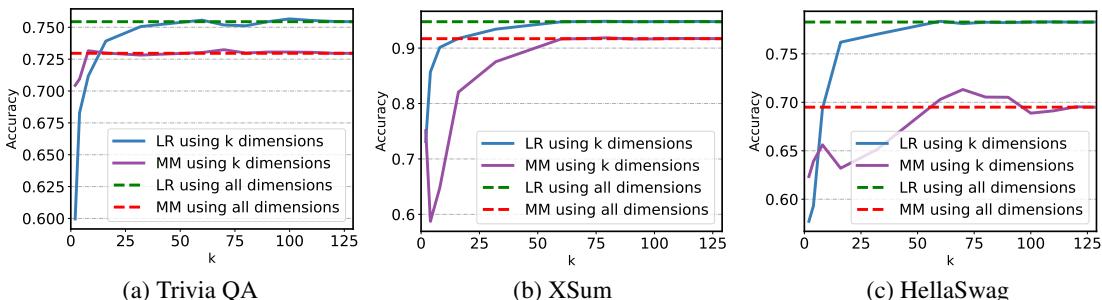
Figure 3 illustrates the performance as the number of dimensions (\(k\)) is reduced. While using all dimensions (dashed lines) is generally best, the solid lines show that you can strip away a massive amount of information and still maintain decent accuracy. In some cases (like Trivia QA), the performance remains robust even with heavily compressed features. This implies that the “truth signal” is not a subtle, complex feature—it is a dominant, primary feature of the representation.
Conclusion: The Truth is in There
This paper provides compelling evidence for the “optimistic hypothesis” regarding Large Language Models. It suggests that LLMs generally do know the difference between fact and hallucination, and this knowledge is encoded geometrically in a way that is consistent across different tasks.
By scaling up the diversity of training data, the authors successfully identified a Universal Truthfulness Hyperplane.
Why does this matter?
- Trust: We can potentially build “lie detectors” for LLMs that are more reliable than the model’s own text output.
- Control: If we can identify the direction of truth, future research could focus on “steering” the model—forcing its hidden states to stay on the “true” side of the hyperplane during generation, thereby reducing hallucinations.
While we aren’t at the point of having a perfect hallucination-free model, this research lights a path forward. The model knows more than it says; we just have to know where (and how) to look.