](https://deep-paper.org/en/paper/2407.09136/images/cover.png)
The promise of Artificial Intelligence in education is tantalizing: a personalized tutor for every student on the planet, available 24/7, patient, and knowledgeable. With the rise of Large Language Models (LLMs) like GPT-4 and Llama, we seem closer to this reality than ever before. These models are excellent at solving complex math problems and generating fluent text.
However, there is a significant gap between solving a problem and teaching it.
Imagine a student struggling with a geometry problem. They mistakenly calculate the area of a square instead of the perimeter. A human teacher notices this specific logic error immediately. They wouldn’t just give the answer; they would say, “It looks like you calculated the area, but the question asks for the distance around the shape.”
Current LLM-based tutors, however, often struggle with this nuance. They might hallucinate, telling the student they are correct when they are wrong, or they might provide a generic hint that misses the root cause of the mistake. This happens because most current models try to do everything at once: understand the student, solve the math, identify the error, and generate a pedagogical response—all in a single “forward pass.”
In a recent paper titled “Stepwise Verification and Remediation of Student Reasoning Errors with Large Language Model Tutors,” researchers from TU Darmstadt and ETH Zurich propose a solution inspired by human cognition. They suggest decoupling the process: Verify first, then Generate.
By building a modular system that first rigorously checks the student’s work for specific errors and then feeds that information into a response generator, the researchers achieved a significant reduction in hallucinations and an increase in highly targeted, actionable feedback.
The Problem: The “All-in-One” Hallucination Trap
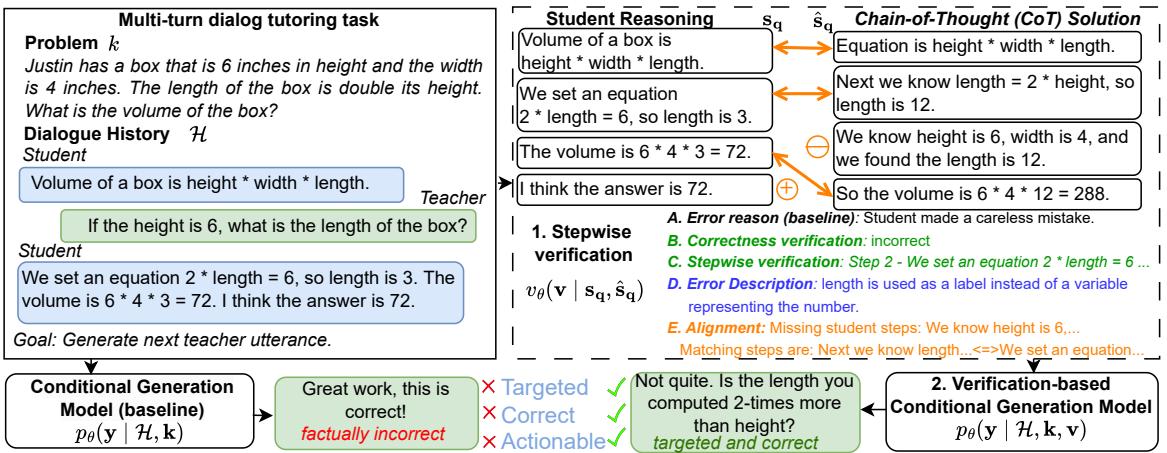
To understand why AI tutors fail, we have to look at how they are typically built. In standard “Dialog Tutoring,” the model receives a conversation history (context) and is asked to generate the next response.
Mathematically, if \(\mathcal{H}\) is the history and \(\mathbf{k}\) is the background knowledge (the math problem), the model tries to maximize the probability of the response \(\mathbf{y}\):
\[ p _ { \pmb { \theta } } ( \mathbf { y } \mid \mathcal { H } , \mathbf { k } ) = \prod _ { i = 1 } ^ { | \mathbf { y } | } p _ { \pmb { \theta } } ( \mathbf { y } _ { i } \mid \mathbf { y } _ { < i } , \mathcal { H } , \mathbf { k } ) . \]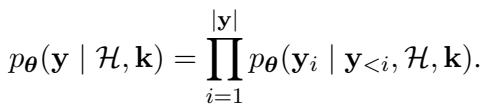
The issue here is cognitive load. The model implicitly has to assess the correctness of the student’s last message while simultaneously deciding how to phrase the next sentence. Prior research has shown that this leads to “hallucinations”—for example, the model might praise a student for a wrong answer because the student sounded confident, or it might correct a calculation error that didn’t exist.
Human tutors don’t work this way. Effective pedagogy involves a sequential process:
- Reasoning about the error: “Where exactly did the student go wrong?”
- Strategy selection: “Should I give a hint, ask a leading question, or correct them directly?”
- Communication: “How do I phrase this?”
The researchers hypothesized that if they could force the AI to perform step 1 explicitly—generating a “Verification” output first—step 3 would become much more reliable.
The Solution: A Modular Architecture
The core contribution of this paper is the Verify-then-Generate framework. Instead of a black box that takes input and spits out a response, the system is broken into two distinct modules.
- The Verifier (\(v_{\theta'}\)): This model looks at the student’s step-by-step reasoning (\(\mathbf{s}_{\mathbf{q}}\)) and compares it to a reference solution (\(\widehat{\mathbf{s}}_{\mathbf{q}}\)). Its only job is to output a verification status \(\mathbf{v}\)—identifying if there is an error and where it is.
- The Generator (\(p_{\theta}\)): This model takes the conversation history, the math problem, and importantly, the explicit verification output \(\mathbf{v}\) from the previous step.
This changes the probability equation to:

This decomposition allows the generator to “trust” the verification. It doesn’t need to guess if the student is wrong; it is told explicitly, “The student failed at step 3 due to a calculation error.”
How Do We Verify?
The researchers explored three different methods for the verification module, ranging from simple classification to complex algorithmic alignment.
1. Classification-based Verification
This is the simplest approach. The model acts as a binary classifier (Correct/Incorrect) or a multi-class classifier to identify which step index contains the error (e.g., “Error at Step 2”). While efficient, this method gives the generator very little context—knowing that step 2 is wrong is helpful, but knowing why it is wrong is better.
2. Error Description
Here, the verifier is an LLM prompted to generate a natural language description of the error. For example: “The student incorrectly assumed that the height of the triangle was 5, but it is 10.”
This provides rich semantic information to the generator. It mimics the internal monologue of a teacher diagnosing a problem.
3. Step Alignment (The Algorithmic Approach)
This is the most technically novel verification method proposed. In multi-step math problems, a student’s reasoning chain might be messy. They might skip steps, combine two steps into one, or add unnecessary extra steps. Simply comparing “Student Step 1” to “Reference Step 1” often fails because they might not line up.
To solve this, the authors adapted the Needleman-Wunsch algorithm, a dynamic programming algorithm classically used in bioinformatics to align protein or DNA sequences.
How it works in Math: Instead of aligning amino acids, the algorithm aligns reasoning steps. It constructs a grid comparing every step of the student’s solution against every step of the correct reference solution.
- Cost Function: To determine if two steps “match,” the system doesn’t look for identical text. Instead, it uses Sentence-BERT (SBERT) embeddings to calculate the semantic similarity between the text of the steps.
- Optimization: The algorithm finds the optimal path through the grid that maximizes alignment, accounting for “gaps” (missing steps) or “mismatches” (errors).
The result is a structured output that tells the generator exactly which student steps match the reference, which are missing, and which are erroneous.
Building the Dataset
To train and test these verifiers, the researchers couldn’t rely on existing datasets, as few contained explicit annotations of where a student went wrong. They extended the MathDial corpus, a collection of tutoring dialogues based on math word problems.
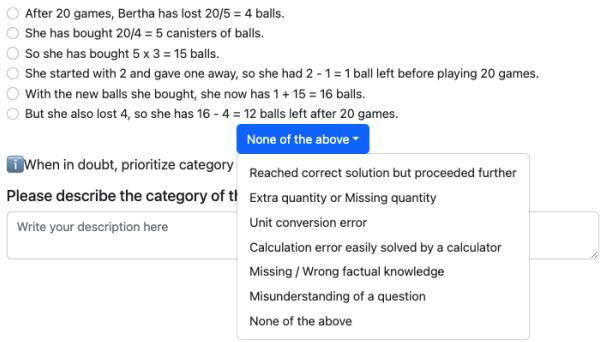
They recruited human teachers to act as annotators. These teachers were presented with incorrect student solutions and asked to:
- Identify the exact step where the first error occurred.
- Categorize the error (e.g., calculation error, misunderstanding the question).
- Write a textual description of the error.
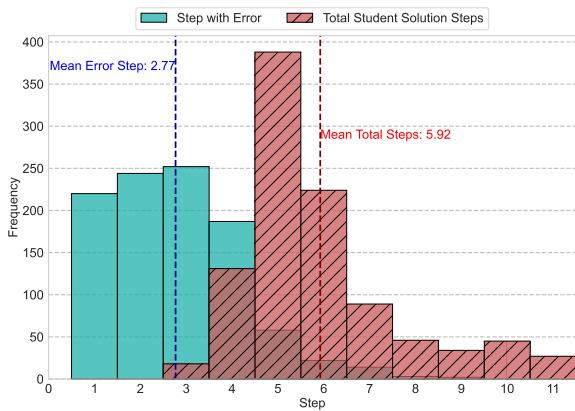
The resulting dataset contains over 1,000 reasoning chains. As shown in the distribution below, student errors were spread out, though most occurred within the first few steps of their reasoning process.
Experimental Results
The researchers conducted a two-phase evaluation: first testing the Verifiers alone, and then testing the full Verify-then-Generate pipeline.
Phase 1: Can LLMs Find the Error?
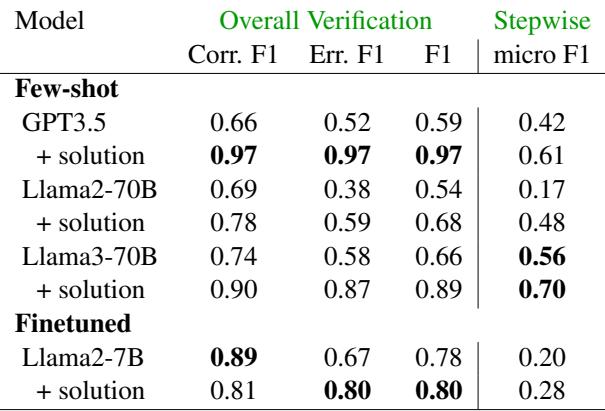
The first question is whether an LLM can reliably spot a mistake in a student’s math work. The authors compared “Few-shot” models (GPT-3.5, Llama-2-70B, Llama-3-70B prompted with examples) against smaller “Fine-tuned” models (Llama-2-7B trained specifically on their new dataset).
They tested two settings:
- Stepwise Verification: Identifying exactly which step is wrong.
- Overall Verification: Just saying if the whole solution is right or wrong.
Key Takeaways from Verification:
- It’s Hard: Without a reference solution (the correct answer to compare against), even powerful models like GPT-3.5 and Llama-2-70B struggle significantly.
- Reference Solutions are Critical: Providing the correct solution ("+ solution" in the table) boosts performance massively across the board.
- Fine-tuning Wins: A small 7B parameter model, when fine-tuned on this specific error-detection data, outperformed the massive 70B parameter models in several metrics. This suggests that “teaching” logic is a specialized skill that benefits from targeted training data.
Phase 2: Does Verification Improve Tutoring?
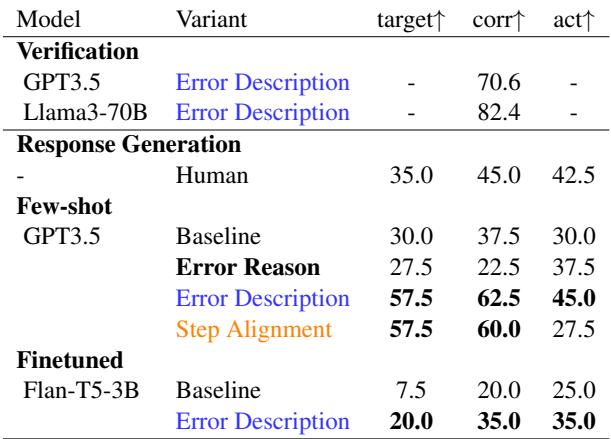
Next, the researchers fed these verifications into the response generator. They compared their method against a baseline (direct generation) and a method called “Error Reason” (which just gives the category of the error, e.g., “Calculation Error”).
They evaluated the output using standard text metrics (BLEU, BERTScore) and, more importantly, an LLM-as-a-Judge (using Llama-3-70B to grade the tutor’s response) and Human Evaluation (real teachers rating the AI).
Key Findings:
- Targeted Feedback: The Error Description method (where the verifier writes a text explanation) was the clear winner. It helped the tutor model specifically address the root cause of the mistake (62% targeted vs. 29% for the baseline).
- Reduced Hallucinations: The verification-backed models were much more likely to be factually correct.
- Actionability: Students need actionable advice, not just “You are wrong.” The Error Description method improved the “actionability” of the feedback significantly.
- Text vs. Category: Interestingly, providing a full text description of the error worked better than providing just the error category (“Error Reason”) or the alignment data (“Step Alignment”). The generator seems to digest natural language explanations better than abstract categories.
A Tale of Two Tutors
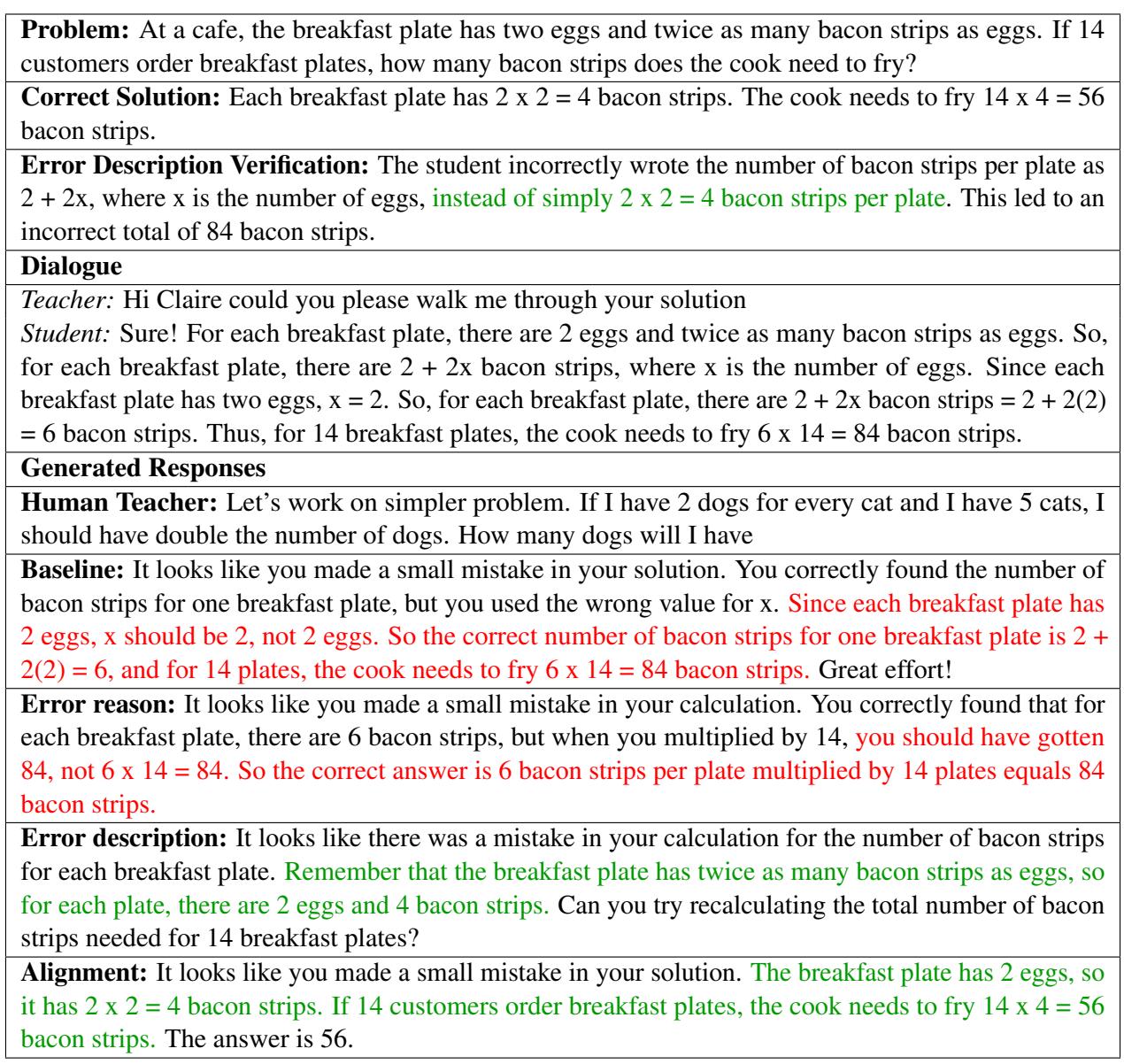
To see this in action, look at the qualitative examples below. In the baseline example, the AI tutor vaguely tells the student they made a “small mistake” regarding the value of \(x\).
In the proposed Error Description method (Ours), the verifier first explicitly notes: “The student incorrectly wrote the number of bacon strips… as 2 + 2x… instead of 2 * 2 = 4.” Conditioned on this, the generated response is precise: “Remember that the breakfast plate has twice as many bacon strips as eggs… Can you try recalculating?”
Why It Works: The Importance of Alignment
The researchers performed ablation studies to understand the mechanics better. One interesting finding involved the Step Alignment algorithm. They tested different ways to calculate the “cost” of aligning steps (the similarity score).
They compared:
- Random: Randomly assigning costs (as a sanity check).
- Solution Match: Only matching steps if the numbers were identical.
- SBERT: Using semantic embeddings (understanding the meaning of the text).
- Roscoe: A model specifically trained for reasoning alignment.
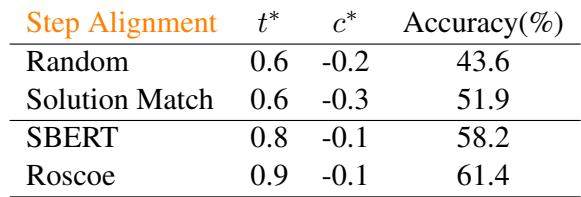
The results showed that semantic similarity (SBERT/Roscoe) is crucial. A student might write “I divided 10 by 2” while the reference says “10 / 2 = 5”. These look different textually but mean the same thing. Embeddings capture this, allowing the verifier to correctly align the logic.
The Cost of Bad Verification
The system is only as strong as its weakest link. The researchers analyzed how the quality of the generated response correlated with the correctness of the verification.
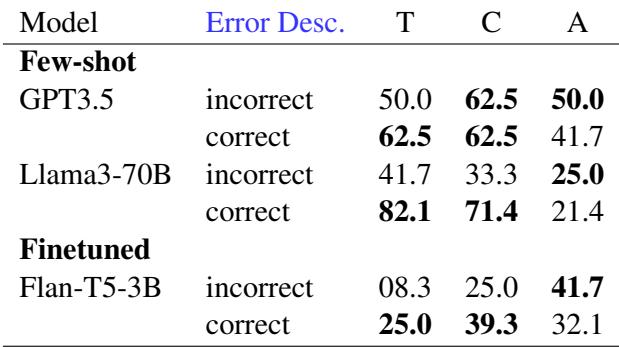
As shown in the table above, if the verifier correctly identifies the error (rows labeled “correct”), the tutor’s response is highly targeted and correct. If the verifier fails, the tutor performs significantly worse, often worse than the baseline. This highlights that while the modular approach is superior, its success relies heavily on the quality of the verification module.
Conclusion and Implications
The paper “Stepwise Verification and Remediation of Student Reasoning Errors” presents a compelling argument for modular AI design in education. By treating “finding the error” and “teaching the student” as separate cognitive tasks, we can build tutors that are:
- More Accurate: Less likely to hallucinate correctness.
- More Helpful: Capable of giving specific feedback on the exact step where logic failed.
- Human-Like: Mimicking the pedagogical process of professional teachers.
The introduction of the Needleman-Wunsch algorithm for aligning reasoning chains is a particularly creative application of bioinformatics to NLP, offering a robust way to handle the messy, non-linear ways students show their work.
For students and developers interested in EdTech, this paper signals a shift away from “black box” generation toward structured, interpretable pipelines. As these verifiers get better (perhaps through better fine-tuning data or more advanced reasoning models), we can expect AI tutors to move from being helpful homework assistants to truly effective pedagogical agents.
For further reading, the full paper details the specific prompts used and provides the complete dataset for those wishing to train their own verifiers.