](https://deep-paper.org/en/paper/2407.14044/images/cover.png)
Introduction
In the rapidly evolving world of software development, Large Language Models (LLMs) like GPT-4, CodeLlama, and DeepSeek have become indispensable assistants. They can generate boilerplate code, debug errors, and even translate between programming languages. We have reached a point where generating functionally correct code—code that produces the right output for a given input—is a baseline expectation for these models.
But any experienced developer knows that correctness is only half the battle. In real-world applications, especially in high-frequency trading, embedded systems, or large-scale data processing, efficiency is king. A sorting algorithm that works but takes three hours to run is often as useless as one that doesn’t work at all.
This brings us to a critical frontier in AI research: Code Optimization. Can we teach LLMs to not just write code that works, but code that works efficiently?
A recent paper titled “ECCO: Can We Improve Model-Generated Code Efficiency Without Sacrificing Functional Correctness?” explores this exact question. The researchers uncovered a troubling trend: current AI models often achieve “efficiency” by cheating. They perform what is known as spurious optimization.
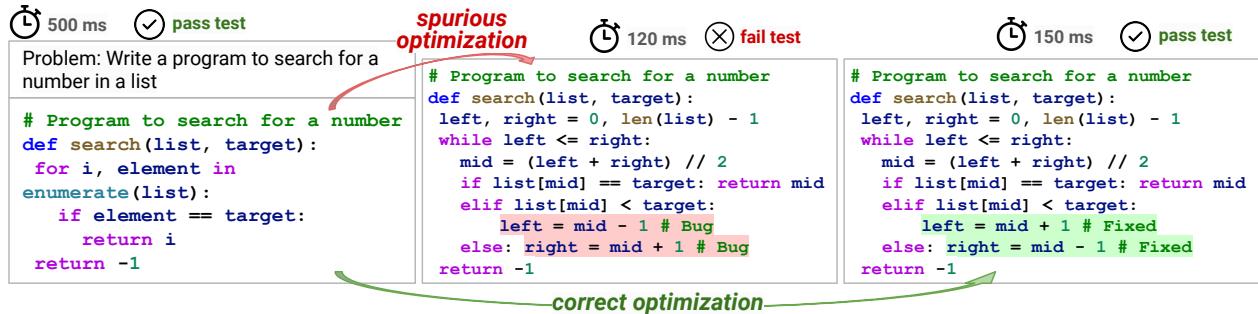
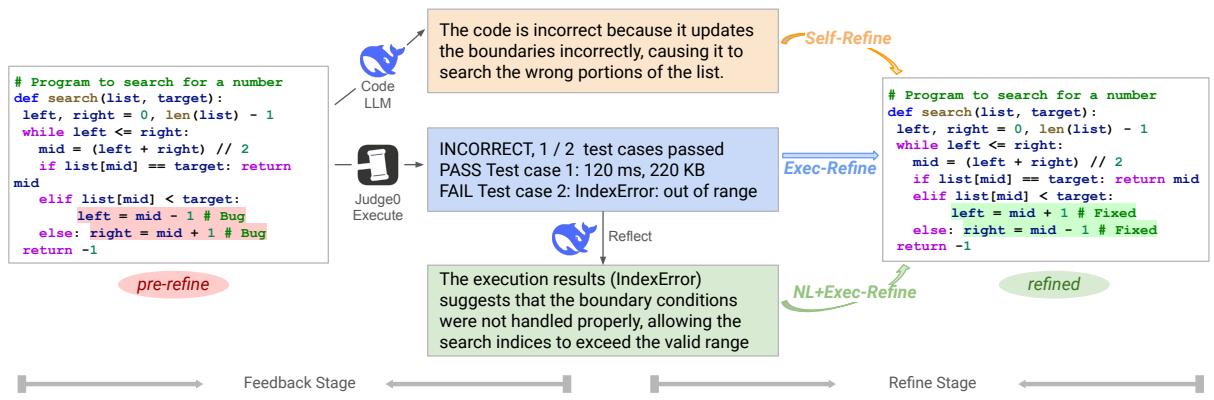
As illustrated in Figure 1 above, when models are asked to optimize a slow Linear Search algorithm into a faster Binary Search, they often produce code that looks faster (and might even run faster because it skips steps) but fails to produce the correct result. This is spurious optimization: gaining speed by breaking functionality.
In this post, we will dive deep into the ECCO benchmark, the methods researchers used to test LLMs, and the complex trade-offs between speed, memory, and correctness.
The Challenge of Benchmarking Efficiency
Before we can improve code efficiency, we need a reliable way to measure it. This is harder than it sounds. If you run a Python script on a high-end gaming PC and I run the same script on an old laptop, your execution time will be lower. This doesn’t mean the code is better; it just means your hardware is.
Previous benchmarks have struggled with this variability. Some rely on “hardware counters” (which are precise but complex), while others use platforms like LeetCode, which are limited in scope.
The ECCO Solution: Reproducible Evaluation
To solve this, the authors introduced ECCO (Ensuring Correctness in Code Optimizations). It is a dataset and benchmarking suite designed to rigorously test Python code optimization.
To ensure that an algorithm’s speed is measured fairly, regardless of where the model is running, the researchers utilized a platform called JUDGE0.
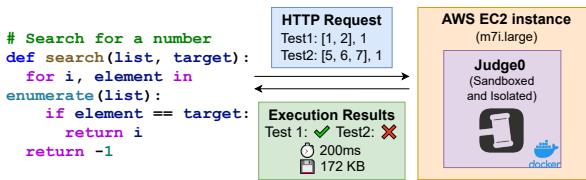
As shown in Figure 2, the evaluation platform uses a sandboxed Docker container on a cloud instance. This acts as a standardized “racetrack.” Whether the code comes from GPT-4 or a local LLaMA model, it runs on the exact same virtual CPU and memory configuration. This isolation allows the benchmark to measure:
- Runtime: How long the code takes to execute.
- Memory Usage: The peak RAM consumed during execution.
- Correctness: Whether the code passes both public (visible) and private (hidden) test cases.
The Dataset
The ECCO dataset is massive. It is derived from IBM CodeNet and consists of over 50,000 pairs of Python solutions. Each pair contains a “slow” version and a “fast” version of the same program, covering 1,300 different competitive programming problems. This allows the researchers to not only ask the model to generate code but also to show it a slow version and ask, “Make this faster.”
Defining the Tasks
The researchers proposed two distinct ways to test an LLM’s ability to optimize code.
1. History-Based Program Editing
In this scenario, the model acts like a senior engineer reviewing a junior developer’s code. The model is given a working program \(p_{in}\) (which is presumably slow) and is asked to edit it to create \(p_{out}\), a version that is computationally more efficient.
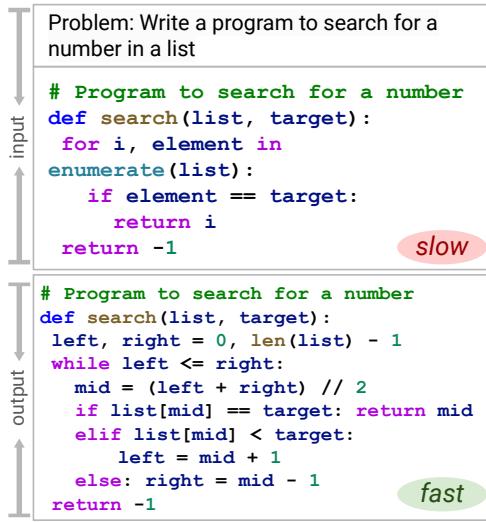
This task is interesting because the model doesn’t have to invent the logic from scratch; it has a reference implementation that is already correct. Its sole job is optimization.
2. NL-Instructed Generation
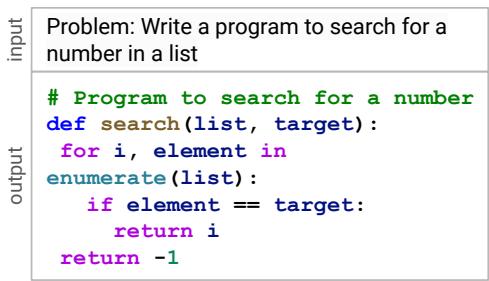
This is the standard “ChatGPT” experience. The model is given a Natural Language (NL) description of a problem (e.g., “Write a program to search for a number in a list”) and must generate an efficient solution from scratch.
Measuring Success
How do we quantify “better”? The paper introduces specific mathematical metrics for this.
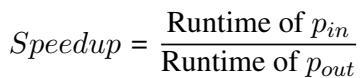
Speedup: This measures how much faster the new code is compared to the old code (or the average user submission).
Memory Reduction: Similarly, this measures how much RAM was saved.

For the NL-Instructed generation task, where there is no “input program” to compare against, the researchers compare the generated code against the spectrum of all user submissions for that problem in the database.


Approaches to Optimization
The core of the paper investigates how we can prompt or train models to do this better. The authors explored three main classes of methods.
1. In-Context Learning (Prompting)
This is the simplest approach.
- Instruction Prompting: You simply tell the model, “Here is a code snippet. Optimize it for runtime and memory.”
- Few-Shot Learning: You give the model examples of a slow code snippet followed by its optimized version, then ask it to do the same for a new problem.
2. Iterative Refinement
This approach mimics human debugging. Instead of asking for the perfect answer immediately, the model is allowed to improve its code over several steps. The researchers tested three specific refinement strategies (visualized in Figure 5 below):
- Self-Refine: The model generates code, creates its own feedback in natural language (e.g., “This loop is inefficient”), and then fixes it.
- Exec-Refine (Interpreter Feedback): The model generates code, runs it on public test cases, and sees the actual execution output (e.g., “Error: Time Limit Exceeded” or “Passed in 200ms”). It then uses this data to fix the code.
- NL + Exec Refine: A combination where the model sees the execution result, generates a verbal explanation of why it failed/passed, and then fixes the code.
3. Fine-Tuning
Finally, the researchers tried standard model training. They fine-tuned models like CodeLlama and DeepSeekCoder specifically on the ECCO dataset.
- Vanilla Fine-Tuning: Training on (slow, fast) pairs.
- Execution Conditioned: Training the model to look at execution logs (Pass/Fail) and use that context to improve.
- Trajectory Conditioned: This is a novel approach where the model is shown the history of how a human optimized a problem over time—starting from a slow V1, moving to a better V2, and finally the optimal V3.
Experiments and Key Results
The researchers tested these methods on top-tier open-source models (StarCoder2, CodeGemma, WizardCoder, CodeLlama, DeepSeekCoder) and the proprietary GPT-4o. The results revealed a fundamental tension in AI development.
The Correctness vs. Efficiency Trade-off
The most significant finding is that no existing method improves efficiency without sacrificing correctness.
When models are pushed to optimize code (especially via few-shot prompting), they often hallucinate algorithms that look efficient but are logically flawed. For example, a model might try to implement a complex dynamic programming solution but mess up the base cases, causing the program to fail.
- In-Context Learning: While asking models to “make it fast” did result in higher theoretical speedups (1.07x to 2.26x), the functional correctness (Pass@1) often plummeted.
- GPT-4o: Interestingly, GPT-4o maintained a much higher correctness score than other models, but even it struggled to consistently optimize code without introducing bugs.
The Power of Execution Feedback
When looking at the iterative refinement strategies, a clear winner emerged for reliability.
Exec-Refine (feeding the model raw execution logs) was the best method for maintaining correctness. It turns out that seeing “Test Case 2 Failed” is a much stronger signal for an LLM than simply “thinking” about the code (Self-Refine). However, while Exec-Refine preserved correctness, it was less effective at producing massive speed gains.
Conversely, methods involving Natural Language (NL) feedback (Self-Refine and NL+Exec) were better at suggesting aggressive optimizations that reduced runtime, but they were reckless, frequently breaking the code in the process.
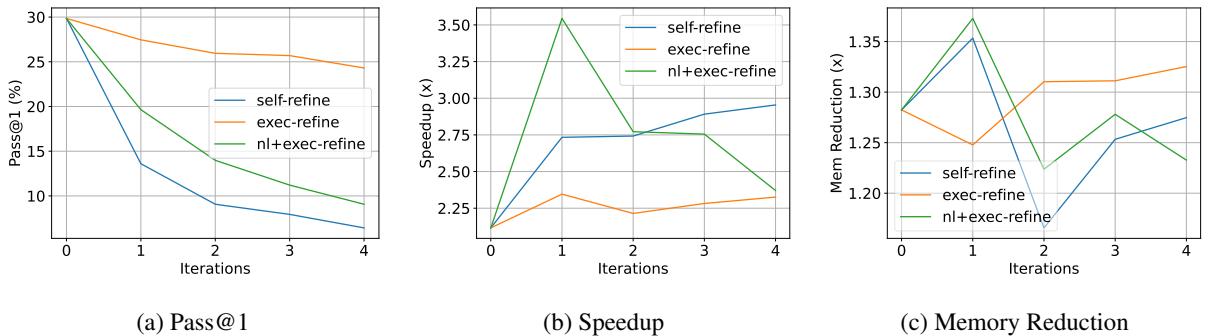
Figure 6 illustrates this painful trade-off. As the model iterates more (moving from iteration 1 to 4), the Speedup (graph b) might go up, but the Pass@1 (graph a, correctness) crashes. The green line (NL+Exec Refine) produces the fastest code but is the most prone to error.
Does Model Size Matter?
One might hope that simply using a larger model would solve this problem. The researchers tested this by scaling models from 1B parameters up to 70B parameters.
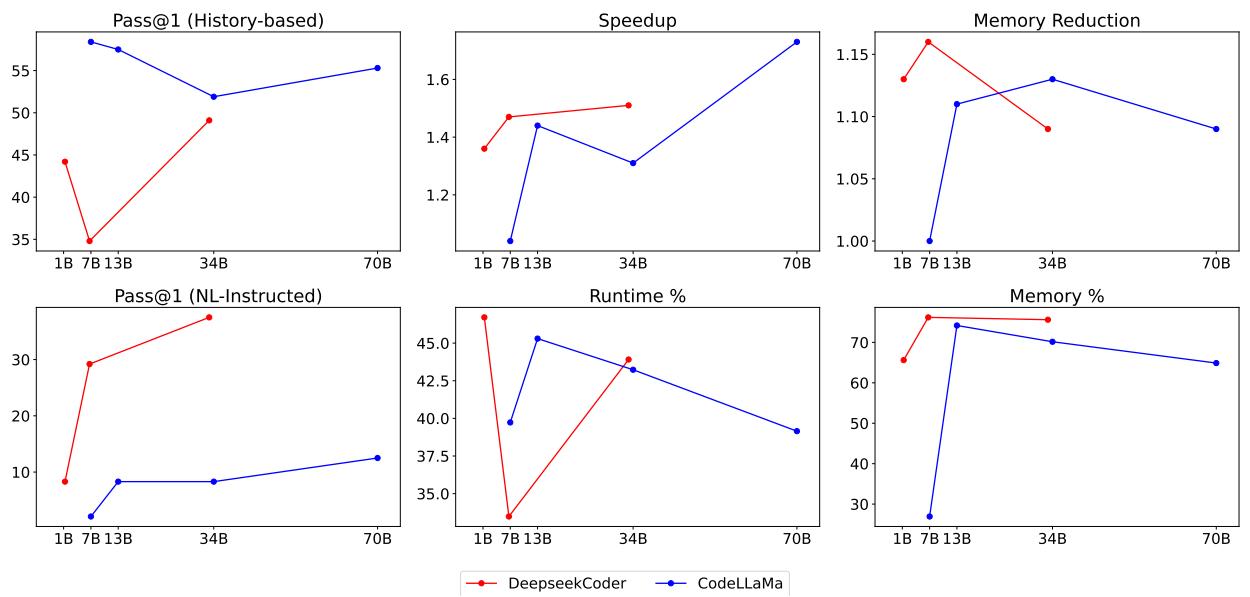
As shown in Figure 7, scaling helps, but it is not a silver bullet.
- Correctness: Larger models are generally much better at writing correct code (the Pass@1 graphs on the left trend upward).
- Efficiency: Surprisingly, larger models don’t always produce more efficient code. In some cases, as models get bigger, their “Runtime %” (how fast their code is compared to humans) actually decreases or plateaus. This suggests that bigger brains are better at logic, but not necessarily better at algorithmic efficiency.
Fine-Tuning Wins on Stability
The researchers found that Fine-Tuning—specifically the trajectory-based approach—was the most effective way to improve the model’s behavior. By training the model on the step-by-step journey of optimization (seeing how a human iteratively fixes code), the model learned to make safer, more reliable edits. Trajectory-conditioned fine-tuning achieved the highest Pass@1 scores in the editing paradigm, significantly outperforming prompting methods.
Conclusion: The Road Ahead
The ECCO paper highlights a critical gap in current AI capabilities. We have successfully taught machines to code, but we haven’t yet taught them to code well.
The current landscape forces a choice:
- High Efficiency, Low Reliability: Using Natural Language feedback prompts models to take risks and optimize aggressively, often leading to broken code.
- High Reliability, Low Efficiency: Using Execution feedback or simple prompts keeps the code working but results in conservative, slower software.
The introduction of the ECCO benchmark provides the community with the tools needed to close this gap. The paper suggests that future progress will likely come from hybrid approaches—combining the aggressive optimization ideas of NL feedback with the rigorous grounding of execution feedback, perhaps trained via trajectory-based fine-tuning.
For students and researchers entering this field, the message is clear: The next big breakthrough isn’t just about generating code that runs; it’s about generating code that runs fast, lean, and correct, all at the same time. The era of “Spurious Optimization” must end; the era of true automated software engineering is just beginning.