](https://deep-paper.org/en/paper/2407.14767/images/cover.png)
The current generation of Large Language Models (LLMs) is nothing short of impressive. They can write poetry, debug code, and summarize complex historical events. However, anyone who has used tools like ChatGPT or Claude extensively knows they suffer from a specific, persistent flaw: overconfidence.
When an LLM faces an ambiguous instruction or lacks the necessary context to solve a problem, it rarely pauses to say, “I’m not sure, can you clarify?” Instead, it often guesses, producing a confident but incorrect answer—a phenomenon often linked to hallucination.
This behavior is particularly problematic in high-precision tasks like Text-to-SQL, where a business user might ask a database a question in natural language. If the model misunderstands the database schema or the user’s intent, it generates a valid-looking SQL query that returns the wrong data. The user, trusting the AI, might make critical business decisions based on false numbers.
So, how do we fix this? One approach is to simply make the models smarter. But a recent research paper titled “I Need Help! Evaluating LLM’s Ability to Ask for Users’ Support” proposes a more agentic approach: What if we teach the model to recognize its own uncertainty and ask the user for help?
This article explores how researchers are evaluating the “proactive support-seeking” abilities of LLMs, the metrics used to measure success, and the surprising findings about which models are actually self-aware enough to admit they don’t know the answer.
The Core Problem: The Trade-off Between Accuracy and Annoyance
The researchers formulate the problem around a fundamental trade-off.
- Performance Improvement: If the model asks for help (e.g., “Did you mean revenue for Q1 or Q2?”), it is more likely to generate the correct answer.
- User Burden: If the model asks for help too often, it becomes annoying and inefficient. A system that questions every single prompt is useless.
The goal is to find the “Goldilocks zone”: the model should only ask for help when it is likely to be wrong and when that help will actually fix the problem.
The Case Study: Text-to-SQL
The researchers chose Text-to-SQL generation as their testing ground. This is an ideal domain for three reasons:
- Real-world utility: Non-technical users often want to query databases.
- Ambiguity: Natural language queries are often vague (e.g., “Show me the top customers” could mean top by sales, volume, or frequency).
- Ground Truth: Using the BIRD dataset, the researchers had access to “gold standard” external knowledge (human annotations) that acts as the “support” the model requests.
Three Strategies for Seeking Help
How does an LLM decide when to interrupt the user? The paper investigates three distinct strategies, differing in how much information the model processes before making that decision.
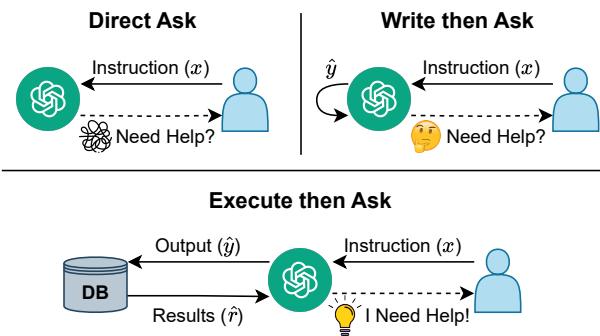
As illustrated in Figure 1, the three methods are:
- Direct Ask (DA): The model looks at the database schema and the user’s question (\(x\)). Based solely on these inputs, it tries to predict if it needs help.
- Write then Ask (WA): The model attempts to write the SQL query first (\(\hat{y}\)). It then reviews the question, the schema, and its own generated code to decide if it’s confident.
- Execute then Ask (EA): This is the most comprehensive method. The model generates the SQL query and executes it against the database. It then reviews the execution results (\(\hat{r}\))—which might be an error message or a suspiciously empty table—along with the original inputs to determine if it needs assistance.
Measuring the Trade-off: The Delta-Burden Curve
To evaluate these strategies scientifically, the authors developed a rigorous mathematical framework. They needed to measure the relationship between how often the model asks for help and how much better it performs when it does.
1. Measuring User Burden (\(B\))
First, they defined User Burden. This is simply the percentage of total queries where the model stopped to ask for help.
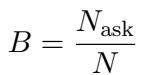
Here, \(N_{ask}\) is the number of times the model requested support, and \(N\) is the total number of test instances. A burden of 1.0 means the model asks for help on every single question.
2. Measuring Performance Improvement (\(\Delta\))
Next, they defined the performance gain, denoted as Delta (\(\Delta\)). This measures the net increase in accuracy achieved by asking for help.
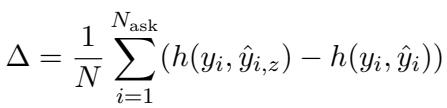
In this equation:
- \(h\) is the evaluation function (did the SQL execute correctly?).
- \(\hat{y}_{i,z}\) is the model’s output after receiving help (\(z\)).
- \(\hat{y}_i\) is the model’s output without help.
Essentially, this calculates: (Accuracy with Help) - (Accuracy without Help).
3. The Delta-Burden Curve (DBC)
By varying the “confidence threshold” (how unsure the model needs to be before it asks), the researchers plotted a Delta-Burden Curve.
This curve is similar to an ROC curve in machine learning.
- X-axis: User Burden (Cost).
- Y-axis: Delta (Benefit).
A perfect model would have a steep curve: it would achieve maximum performance gains with very low user burden, meaning it only asks for help on the specific hard questions where it would have otherwise failed.
Experimental Results: Who Knows They Need Help?
The researchers tested various open-source models (like Llama-3, WizardCoder) and closed-source models (GPT-3.5, GPT-4) using this framework. The results were illuminating.
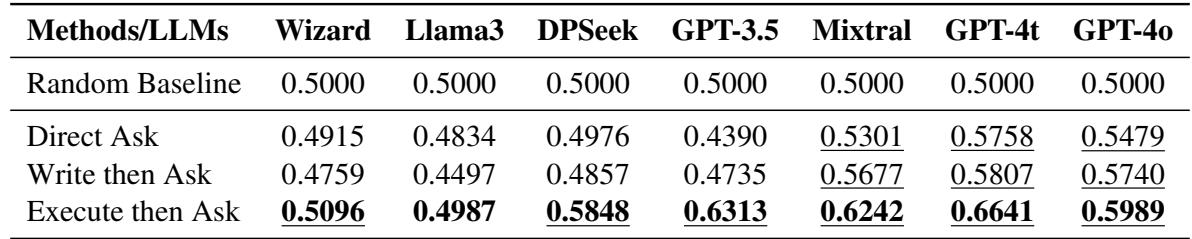
Below is the Area Under Delta-Burden Curve (AUDBC) table. A higher number indicates a better trade-off strategy.
Key Finding 1: Most LLMs are blind without execution
Look at the columns for WizardCoder, Llama3, and DeepSeek. In the “Direct Ask” and “Write then Ask” rows, their scores are often below 0.5000.
Since 0.5000 represents a random baseline (asking for help randomly), this implies that most LLMs are worse than random at predicting their own failure based on text alone. They are confidently wrong. They write a piece of SQL, look at it, and think, “Yes, this looks perfect,” even when it is incorrect.
Key Finding 2: “Execute then Ask” is the game changer
The rows for Execute then Ask (EA) show the highest scores across almost every model.
Why? Because the execution result (\(\hat{r}\)) acts as a reality check. If the generated SQL crashes the database or returns NULL, the model receives a strong signal that something is wrong. This external feedback allows the model to “realize” it needs help.
Key Finding 3: GPT-4 is more self-aware
The larger, closed-source models (GPT-4 Turbo, GPT-4o) performed significantly better. Notably, they were able to achieve better-than-random results even with the “Direct Ask” or “Write then Ask” methods. This suggests that as models scale, they develop a better internal representation of their own limitations—a nascent form of “uncertainty calibration.”
Analyzing the Behavior: Precision, Recall, and Flipping
To understand why some methods work better than others, the researchers broke the process down into two distinct capabilities:
- Identification: Knowing you are wrong.
- Utilization: Using the help to fix the error.
They proposed three additional metrics to analyze these capabilities.
Precision of Asking (\(P_{ask}\))
When the model asks for help, was it actually wrong? If the model asks for help on a question it would have answered correctly anyway, it is wasting the user’s time.

Recall of Asking (\(R_{ask}\))
When the model is wrong, does it remember to ask for help? High recall means the model catches most of its potential errors.

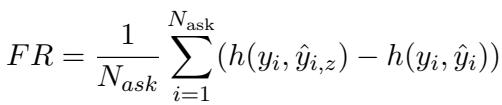
Flip Rate (\(FR\))
This is a critical metric. It measures the efficiency of the help. If the model asks for help, receives it, but still gets the answer wrong, the request was futile. The Flip Rate measures how often the model successfully “flips” a wrong answer to a right one after support.
Visualizing the Behavior
Let’s look at the performance curves for GPT-3.5-Turbo to see these dynamics in action.

- Left Graph (DBC): The green line (Execute then Ask) towers above the others. It provides the highest accuracy gain for any given level of user burden.
- Middle Graph (Precision-Recall): The “Write then Ask” (orange) and “Direct Ask” (blue) methods struggle. Their precision drops quickly. However, the “Execute then Ask” method maintains high precision.
- Right Graph (Flip Rate): This is fascinating. The “Random” baseline (dashed line) actually has a decent flip rate—meaning if you randomly give the model help, it often improves. However, the “Direct Ask” method (blue line) has a very low flip rate. This suggests that when the model is confused enough to ask for help using DA, it is often so confused that even the help doesn’t solve the problem.
What About “Black Box” Models?
A technical challenge in this research is that calculating these curves requires access to the model’s “log probabilities”—the raw mathematical confidence scores the model assigns to its tokens.
Open-source models provide this. But what about models like Claude (Anthropic) or Gemini (Google), which are often accessible only via API without log-probs?
The researchers tested a “Verbalized” approach. They simply asked the model to output a number between 0 and 1 representing its confidence (e.g., “Confidence: 0.85”).
The results (Table 3 in the paper) showed that verbalized confidence is generally worse than using internal log probabilities. Models are not very good at explicitly stating how confident they are. However, for black-box models, this remains the only viable strategy, and it still performed better than random guessing for models like Gemini.
Conclusion: The Future of Agentic AI
This research highlights a critical step in the evolution of AI agents. For an LLM to be a truly reliable assistant, it cannot just be a “know-it-all.” It must be humble.
The study proves that:
- Context is King: Models struggle to self-diagnose errors based on text alone. They need external signals—like seeing code fail to execute—to trigger support-seeking behavior.
- Execution Matters: The “Execute then Ask” strategy is superior because it grounds the model’s confidence in reality, not just linguistic probability.
- Cost vs. Benefit: We can mathematically model the “annoyance” of an AI. Future systems can be tuned using the Delta-Burden Curve to match a specific user’s tolerance for interruptions.
As we integrate LLMs into more complex workflows, mechanisms like “Execute then Ask” will likely become standard. Instead of blindly trusting AI output, we will move toward systems that verify their own work, recognize failures, and know exactly when to raise their hand and say, “I need help.”