](https://deep-paper.org/en/paper/2407.15161/images/cover.png)
Imagine you are reaching into a dark cupboard to grab a coffee mug. You can’t see the handle, but your brain makes a reasonable guess about where it is. If you touch something unexpected, you adjust. You don’t just grab blindly; you have an internal sense of uncertainty.
For robots, specifically those with multi-fingered (dexterous) hands, this scenario is a nightmare. Most robotic systems struggle to grasp objects when they can only see part of them (partial observation). They either stick to very safe, repetitive grasping motions that might fail in cluttered spaces, or they try to generate complex grasps but lack the speed to do so in real-time.
In this deep dive, we are exploring a fascinating research paper titled “FFHFlow: Diverse and Uncertainty-Aware Dexterous Grasp Generation via Flow Variational Inference.” This work proposes a new deep learning framework that not only helps robots generate a wide variety of grasping styles but also gives them the ability to “introspect”—to know how uncertain they are about the object’s shape and their own grasp stability.
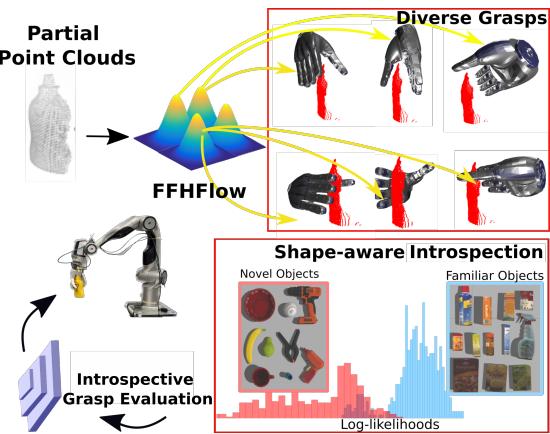
As shown in Figure 1, the system takes a partial point cloud (a 3D scan from a single angle), generates diverse potential grasps, and then evaluates them based on “shape-aware introspection.”
The Core Problem: Why is Dexterous Grasping So Hard?
To understand the contribution of FFHFlow, we first need to understand the limitations of current robotic learning.
- High Dimensionality: Unlike a simple pincer gripper (which just opens and closes), a multi-fingered hand has many joints (degrees of freedom). The “configuration space”—the set of all possible hand poses—is massive.
- Partial Observation: In the real world, a robot camera usually sees only the front of an object. The back is a mystery. The robot has to hallucinate (predict) the back of the object to grasp it securely.
- Mode Collapse: Many current generative models, like Conditional Variational Autoencoders (cVAEs), suffer from “mode collapse.” They tend to learn an “average” grasp that is safe but not very useful. They struggle to propose diverse solutions. If the average grasp fails, the robot is stuck.
- Lack of Self-Awareness: Most models generate a grasp but provide no metric of confidence regarding the unseen parts of the object.
Recent attempts using Diffusion Models have solved the diversity issue but are often too slow for real-time robotics. FFHFlow aims to solve all these problems simultaneously: high diversity, high accuracy, uncertainty awareness, and real-time speed.
Background: The Building Blocks
Before diving into the architecture, let’s establish a few concepts used in this paper.
Variational Autoencoders (VAEs) and the “Prior” Problem
A standard VAE tries to compress data (like a grasp pose) into a “latent code” (z) and then reconstruct it. To generate new grasps, we sample z from a “prior distribution,” usually a simple Gaussian (bell curve).
The problem? A simple Gaussian prior is often too rigid. It forces the complex reality of robotic grasping into a simple mathematical box. This leads to the over-regularization of the latent space, which is a fancy way of saying the model ignores fine details to fit the bell curve, causing mode collapse.
Normalizing Flows (NFs)
Normalizing Flows are a powerful class of generative models. Imagine you have a simple ball of clay (a simple probability distribution, like a Gaussian). A Normalizing Flow is a series of mathematical transformations that stretch, twist, and reshape that clay into a complex sculpture (the complex distribution of valid grasps).
Crucially, these transformations are invertible. This means:
- We can generate samples easily (go from clay to sculpture).
- We can calculate the exact likelihood of a sample (go from sculpture back to clay and measure density).
This “exact likelihood” capability is the superpower that FFHFlow leverages for uncertainty estimation.
The FFHFlow Architecture
The researchers propose a Flow-based Deep Latent Variable Model (DLVM). This is a hybrid beast that combines the structure of a VAE with the flexibility of Normalizing Flows.
Let’s look at the evolution of the idea:
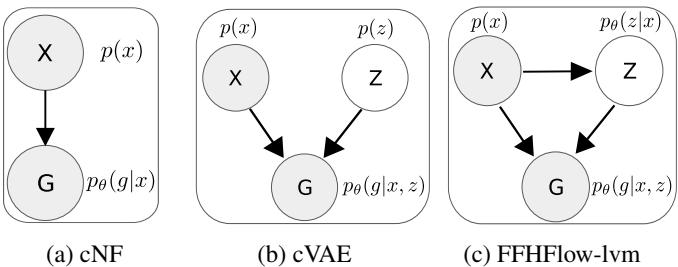
- (a) cNF: You could just use a Conditional Normalizing Flow directly. It maps observation \(x\) to grasp \(g\). However, the authors found this struggled to learn meaningful features from partial point clouds.
- (b) cVAE: This is the standard approach. It uses a latent variable \(z\). But as discussed, the prior \(p(z)\) is a boring Gaussian.
- (c) FFHFlow-lvm (Ours): This model introduces a latent variable \(z\), but with a twist. The prior \(p_\theta(z|x)\) is input-dependent and modeled by a Normalizing Flow. The likelihood (decoder) \(p_\theta(g|x,z)\) is also a Normalizing Flow.
The Architecture in Detail
The model consists of three main networks. Let’s break down the training and inference process using the architecture diagram below.
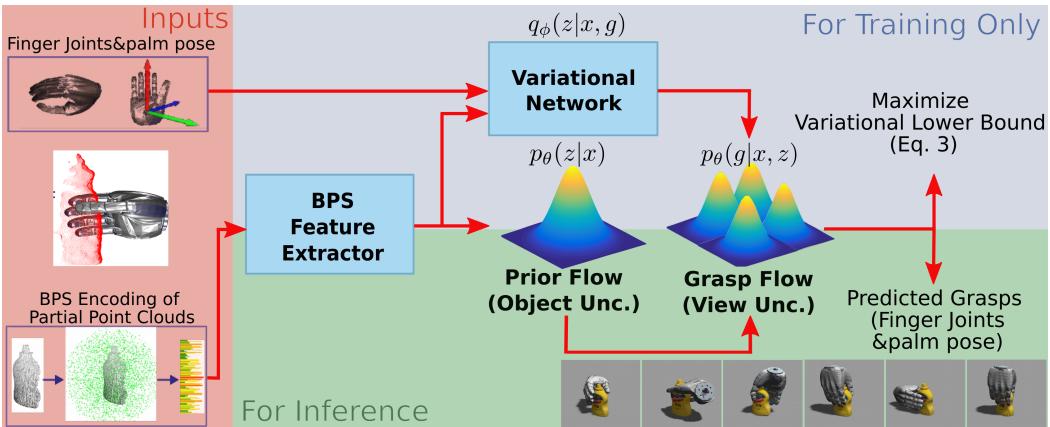
- Prior Flow (The Shape Expert): Instead of assuming the latent code comes from a standard Gaussian, this network learns a complex distribution based on the input point cloud.
- Function: \(p_{\theta}(\mathbf{z}|\mathbf{x})\)
- Role: It captures the “Object Uncertainty.” If the model sees an object shape it has never encountered (Out-of-Distribution), this flow will assign it a low probability (low likelihood).
- Grasp Flow (The Grasp Generator): This replaces the standard decoder. It takes the latent code \(z\) (which contains shape info) and transforms it into a grasp configuration \(g\).
- Function: \(p_{\theta}(\mathbf{g}|\mathbf{z})\) (simplified notation)
- Role: It captures “View Uncertainty.” It learns to map grasps to the visible and invisible parts of the object. Because it is a flow, it can assign a likelihood score to a generated grasp. A grasp reaching for the unseen back of an object might have a lower likelihood than one grasping the visible front.
- Variational Network (The Teacher): Used only during training, this network approximates the posterior distribution to help train the other two flows.
- Function: \(q_{\phi}(\mathbf{z}|\mathbf{x}, \mathbf{g})\)
The Mathematical Magic
To train this system, the authors maximize the Variational Lower Bound (ELBO). However, because they are using Flows, the terms in the equation are more expressive than in standard VAEs.
The objective function looks like this:

The equation tries to balance two things:
- Reconstruction: Make sure the generated grasps explain the data (the first term).
- Regularization: Make sure the approximate posterior (what the teacher thinks) matches the Prior Flow (what the student thinks) (the KL term). The parameter \(\beta\) controls how much “shape-aware” information is forced into the latent variable.
Because they use Normalizing Flows, they can calculate the exact likelihoods using the change-of-variable formula:

This formula includes the determinant of the Jacobian matrix (\(det(J)\)), which tracks how much the volume of the probability space expands or contracts during the flow transformations. This is what allows for exact uncertainty quantification.
Shape-Aware Introspection
One of the most significant contributions of this paper is how it handles uncertainty. In robotics, knowing that you don’t know something is just as important as knowing the answer.
1. Object Uncertainty (Prior Flow)
The Prior Flow conditions purely on the object’s point cloud. If the robot sees a familiar object (like a bottle), the flow yields a high likelihood. If it sees a strange, novel object (like a specialized power tool it wasn’t trained on), the likelihood drops.
This effectively acts as an Out-of-Distribution (OOD) Detector.
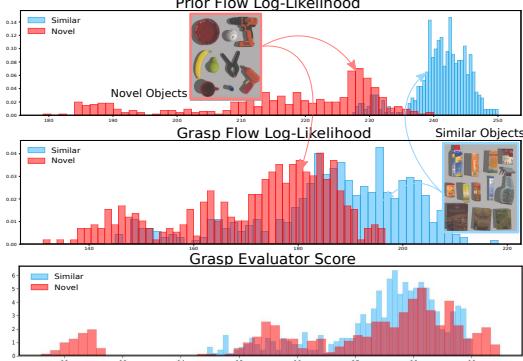
In the graph above, notice the Prior Flow Log-Likelihood (top chart). The blue bars (familiar objects) and red bars (novel objects) are well separated. This means the robot can detect if it’s looking at something weird before it even tries to grasp it.
2. View Uncertainty (Grasp Flow)
The Grasp Flow conditions on the latent variable. It implicitly learns which parts of the object are visible and which are occluded.
Look at the visualization above. The input is a partial point cloud (red).
- Yellow Grasps: High likelihood. These are generally on the visible, certain geometry.
- Purple Grasps: Low likelihood. These are attempting to grasp the back or occluded sides of the object.
Because the shape is incomplete, grasping the back is risky—the object might not extend as far as the robot thinks. The FFHFlow model naturally assigns lower confidence to these risky regions without explicit supervision.
3. The Introspective Evaluator
To select the best grasp, the authors propose a hybrid scoring strategy. They don’t just rely on a binary “success/fail” classifier. They combine a discriminative grasp evaluator (\(f_{\psi}\)) with the introspective likelihood from the Grasp Flow.

Here, \(\epsilon\) balances the raw grasp quality with the uncertainty. This strategy prioritizes grasps that are both physically stable and located in regions where the robot is confident about the geometry.
Experiments and Results
The authors tested FFHFlow in both simulation (Gazebo) and the real world using a robotic arm with a multi-fingered hand.
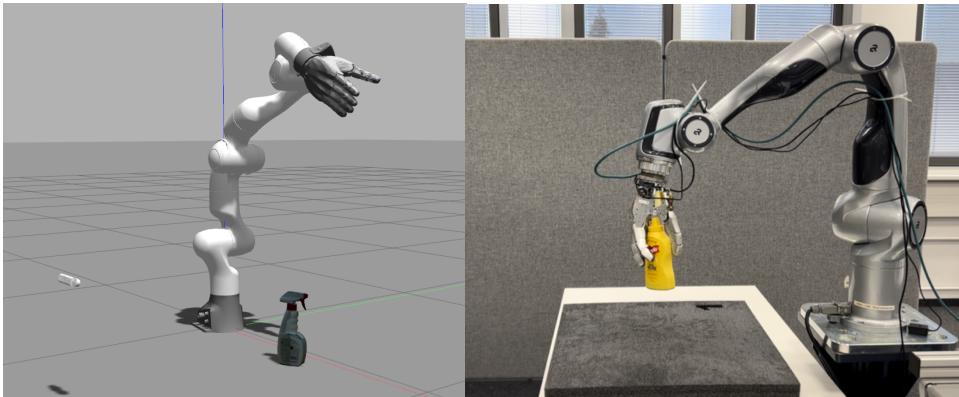
Dataset
They trained on a dataset of 77 objects from the KIT dataset and tested on “Similar” (familiar shapes) and “Novel” (completely new shapes) objects.


Simulation Results
The results, presented in Table 1, are compelling.

- Success Rate: FFHFlow-lvm achieves 94.6% success on similar objects and 52.7% on novel objects. This significantly outperforms the heuristic baseline (20.9%) and the standard cVAE (84.6%).
- Comparison to Diffusion: While the Diffusion-based method (DexDiffuser) performs well (88.2%), it is incredibly slow.
- Run-Time: Look at the speed difference. FFHFlow runs in 130ms. The Diffusion model takes 1610ms. In robotics, that 1.5-second difference is an eternity when reacting to moving objects.
Diversity Analysis
One of the main claims is that FFHFlow generates more “diverse” grasps, avoiding mode collapse.
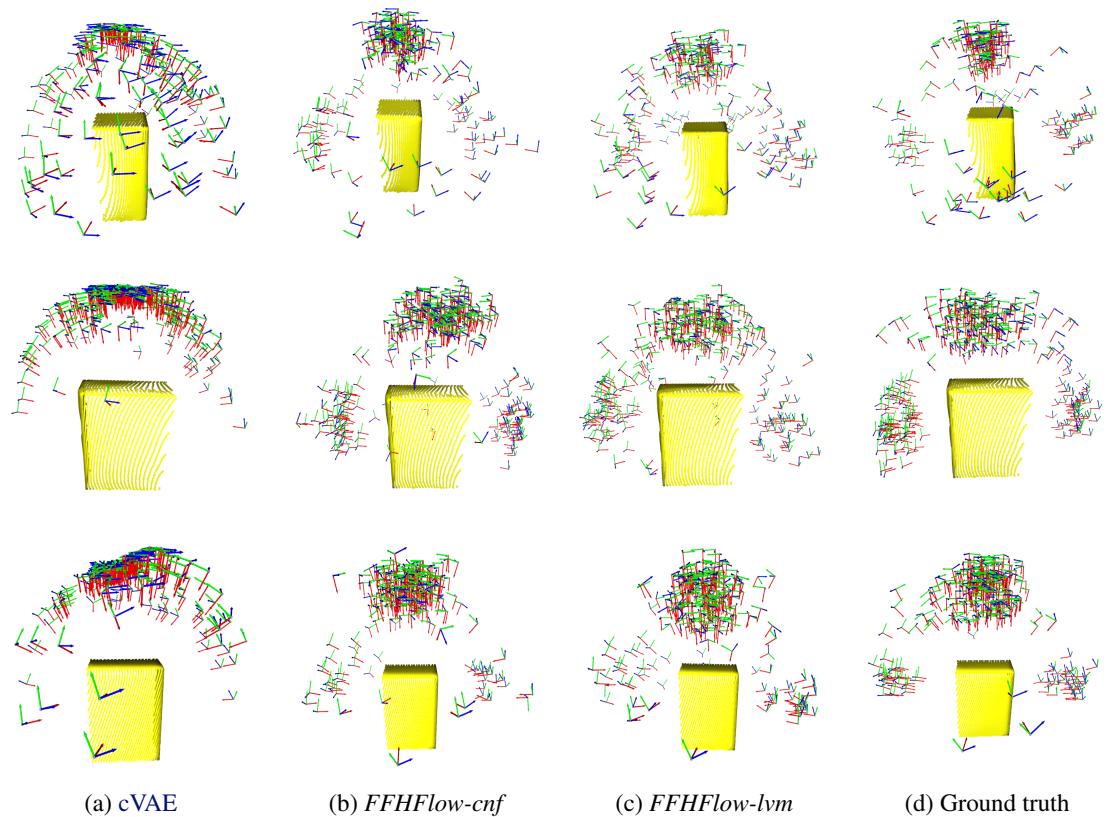
- (a) cVAE: Notice how the grasps are clumped together at the top of the object? This is mode collapse. If that top grasp fails, the robot has no backup plan.
- (c) FFHFlow-lvm: The grasps are spread around the object, covering sides and corners. This closely resembles the (d) Ground Truth distribution. This diversity is crucial for grasping in cluttered environments where the “favorite” spot might be blocked.
Real-World & Cluttered Environments
The true test of any robotic theory is the real world. The authors tested the system in “confined” spaces (like a shelf) and “cluttered” scenes (messy tables).
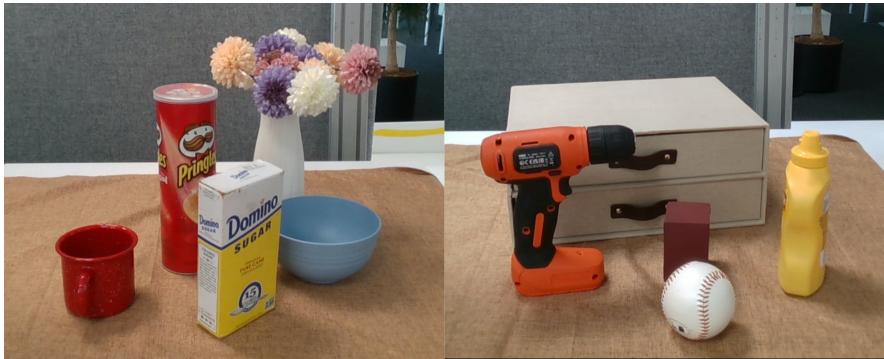
In these scenarios, diversity is key. If a shelf blocks the top approach, the robot must be able to generate a side grasp.

In confined spaces, the standard cVAE failed catastrophically (10% success rate) because it kept suggesting grasps that collided with the shelf. FFHFlow-lvm achieved 65% success, demonstrating that its diverse grasp generation allowed it to find alternative, collision-free approaches.
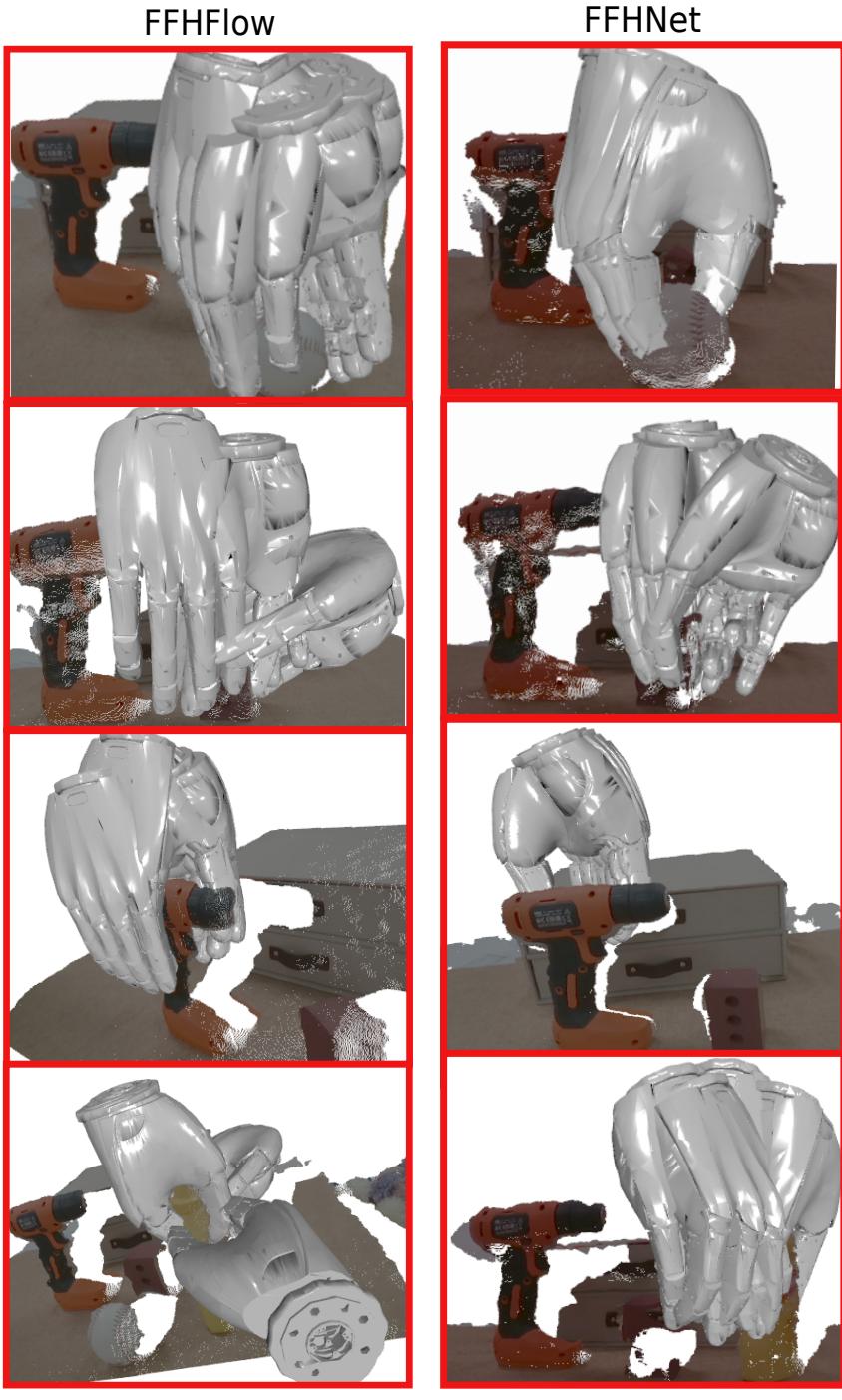
In the image above, you can see the FFHFlow model (left) proposing grasps on the handle of the drill, while the baseline (right) struggles to cover the object as effectively.
Uncertainty-Awareness in Action
Does the “introspective” scoring actually help?

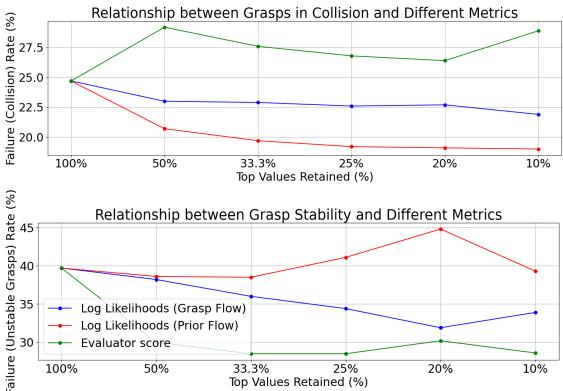
This graph shows what happens as we filter grasps based on their likelihood scores.
- Top Graph (Collision): As we keep only the high-likelihood grasps (moving to the right on the x-axis), the collision rate drops. The Prior Flow (Red line) is particularly good at filtering out collisions, likely because it detects when a grasp doesn’t match the object’s global shape.
- Bottom Graph (Stability): The Grasp Flow (Blue line) helps filter out unstable grasps better than the Prior Flow.
This confirms that the two flows capture different, complementary types of uncertainty.
Conclusion and Takeaways
FFHFlow represents a significant step forward in robotic manipulation. By moving away from rigid Gaussian priors and embracing the flexibility of Normalizing Flows, the researchers achieved three major wins:
- Diversity: The model doesn’t just learn one way to grab an object; it learns the entire “manifold” of possible grasps.
- Speed: It is over 10x faster than competing diffusion-based methods, making it viable for real-time control.
- Introspection: It provides a built-in “BS detector.” The robot knows when it is looking at a new object or when a grasp is risky because it’s in a blind spot.
For students of robotics and machine learning, this paper is a masterclass in how Deep Latent Variable Models can be engineered to solve specific physical constraints. It shows that we don’t always need massive transformers or slow diffusion models; sometimes, a well-structured flow model offers the perfect balance of expressivity and efficiency.
As robots move out of factories and into our messy, unpredictable homes, this kind of uncertainty-aware introspection will be the difference between a robot that successfully hands you a cup of coffee and one that spills it on your lap.