](https://deep-paper.org/en/paper/2407.17467/images/cover.png)
Introduction
Large Language Models (LLMs) like Llama or GPT-4 are the polymaths of the digital age. They can write poetry, debug code, and summarize history with impressive fluency. However, their broad knowledge often comes at the expense of depth. When faced with highly specialized tasks—such as interpreting complex financial regulations or analyzing dense academic papers—these generalist models often struggle. They simply haven’t seen enough of that specific data during their initial training.
To fix this, researchers and engineers turn to Continual Pre-Training (CPT). The idea is intuitive: take a pre-trained model and train it a bit more, this time focusing on a specific domain (like Finance).
But here lies the trap. If you train the model only on financial data, it suffers from catastrophic forgetting. It becomes a finance expert but forgets how to speak basic English or reason logically. To prevent this, we mix the new domain data with the old general data.
This leads to the “Goldilocks” problem of LLM training:
- Too much general data? The model learns the new domain inefficiently or too slowly.
- Too much domain data? The model forgets its general capabilities.
For years, finding the right ratio—the Mixture Ratio—has been a guessing game. Engineers rely on heuristics or gut feelings, often wasting massive amounts of compute resources on suboptimal training runs.
In this post, we are deep-diving into a fascinating paper titled “CMR Scaling Law: Predicting Critical Mixture Ratios for Continual Pre-training of Language Models.” The researchers have formalized this trade-off and discovered a Critical Mixture Ratio (CMR). Even more impressively, they found that this ratio follows a predictable scaling law, allowing us to calculate the perfect data mix before we commit to expensive large-scale training.
The Core Conflict: Plasticity vs. Stability
Before we define the solution, let’s rigorously define the problem.
In Continual Pre-Training (CPT), we have two datasets:
- General Data (\(D_{gen}\)): The broad corpus (Wikipedia, books, common crawl) the model was originally trained on.
- Domain Data (\(D_{dom}\)): The specialized new material (e.g., Finance reports).
We create a mixed dataset \(D_R\) where \(R\) is the mixture ratio of the domain data. If \(R=0.2\), then 20% of the training batch is Finance data, and 80% is General data.
The Objective
The researchers formalized the goal of CPT mathematically. We want to achieve two things simultaneously:
- Minimize Domain Loss: We want the model to get much better at the new task.
- Constrain General Loss: We want the model’s general ability to stay roughly the same (or at least not degrade beyond a tiny tolerance, \(\epsilon\)).
This can be expressed as an optimization problem where we try to minimize the domain loss subject to a constraint on the general loss. Using Lagrange multipliers (a mathematical method for finding local maxima/minima subject to equality constraints), the authors define the objective function \(F\):
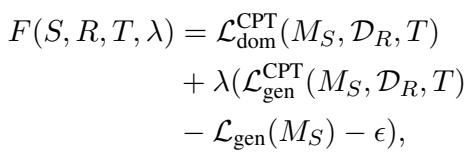
Here, \(\lambda\) acts as a balancing knob. It dictates how strictly we enforce the constraint on maintaining general knowledge.
Visualizing the Trade-off
One of the most compelling contributions of this paper is the visualization of this trade-off. The researchers trained models of various sizes (from 460M to 3.1B parameters) and plotted their “training trajectories.”
In the visualization below, look at the 3D surface plot on the left.
- The X-axis is the change in Domain Loss (we want this to be negative, i.e., improving).
- The Z-axis (vertical) is the change in General Loss (we want this to stay near zero).
- The lines represent the training path over time.

The yellow dashed arrows are crucial here. They point to the “sweet spots”—trajectories where the domain loss decreases significantly while the general loss remains bounded.
If you look at the inset graph on the right (zoomed in on the 940M model), you can see the behavior more clearly. As the training progresses (moving right along the curve), the domain loss drops. However, if the mixture ratio is too high (the curves that shoot upward), the general loss spikes, violating our objective.
Defining the Critical Mixture Ratio (CMR)
This visualization leads us to the central concept of the paper: the Critical Mixture Ratio (CMR).
For a specific model size and a specific amount of training compute (tokens), there is a range of mixture ratios that are “feasible.” A feasible ratio is one where the general loss doesn’t explode.
- If you use a ratio lower than the CMR, you are being too conservative. You are wasting compute re-learning things the model already knows, and the domain adaptation is slow.
- If you use a ratio higher than the CMR, you break the model’s general intelligence.
- The CMR is the maximum possible ratio that stays within the safety limits. It is the optimal point of efficiency.
Mathematically, the set of feasible ratios \(\mathbb{F}\) is defined by finding points where the trade-off slope satisfies the condition derived from the Lagrangian multiplier \(\lambda\):
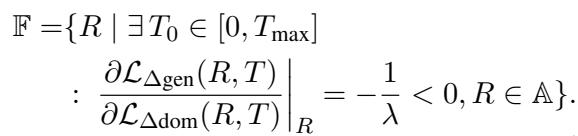
Essentially, this equation looks for the point where the rate of gaining domain knowledge justifies the tiny cost in general knowledge stability.
Is the CMR Predictable?
Defining CMR is useful, but calculating it requires training the model to find out if it fails. That defeats the purpose of saving resources. The “Holy Grail” is to predict the CMR without running the full training.
The researchers discovered that CPT adheres to strict Scaling Laws. By training small models for short periods, we can extrapolate the behavior of larger models over longer training runs.
Step 1: Predicting Loss by Mixture Ratio
First, the researchers found that for a fixed amount of training, the relationship between the mixture ratio (\(R\)) and the loss follows a power law.

Let’s look at the fit of this law against the actual experimental data:
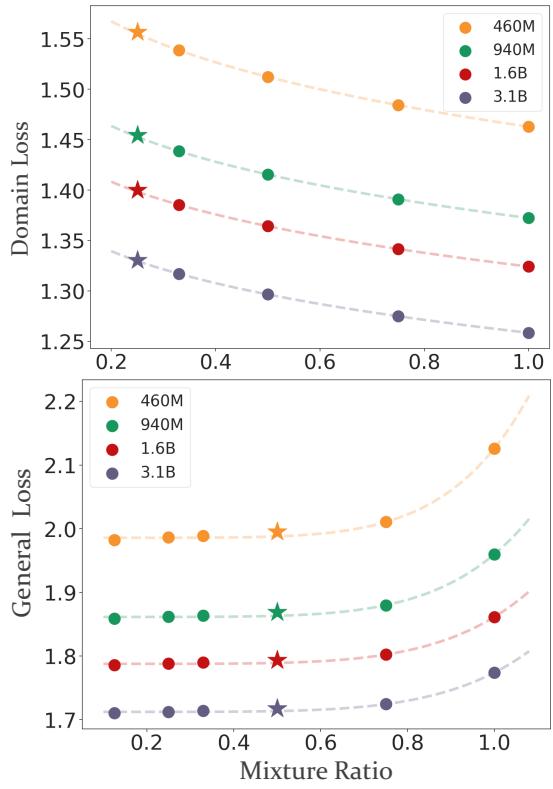
- Top Graph (Domain Loss): As the mixture ratio increases (more domain data), the domain loss drops smoothly.
- Bottom Graph (General Loss): As the mixture ratio increases, the general loss stays flat for a while and then begins to rise.
The stars (\(\star\)) represent the predicted values, and the circles (\(\bullet\)) are the real values. The fit is almost perfect. This means if we train with just a few ratios (e.g., 10%, 25%, 50%), we can accurately predict what would happen at 75% or 90%.
Step 2: Predicting Loss by Training Tokens
Next, we need to predict how loss changes over time (training tokens, \(T\)).
This is trickier. In standard pre-training, loss just goes down. But in Continual Pre-Training, the general loss often exhibits a “bump.” When you start training on new data, the model initially gets confused (loss goes up), and then it stabilizes and potentially improves or plateaus (loss goes down).
To capture this “up-then-down” behavior, the researchers used a modified power law with two terms for the general loss:
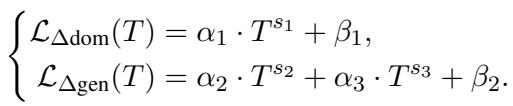
Visualizing this helps explain the phenomenon:
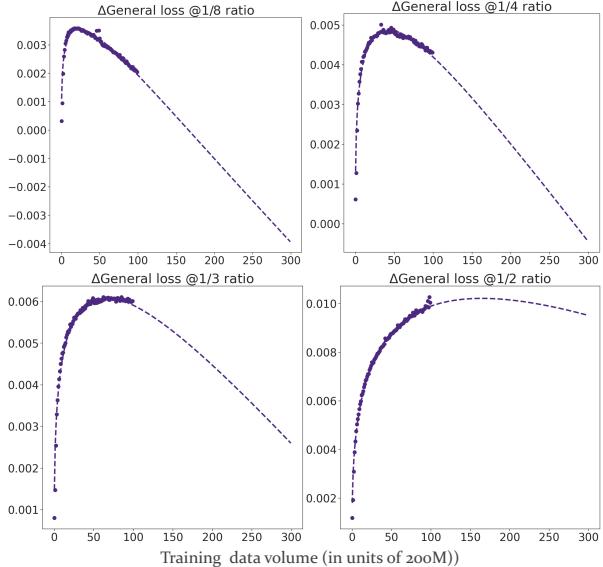
In Figure 4 (the four grid plots), look at the curves. At a low ratio (1/8), the general loss is flat. At a high ratio (1/2), the general loss spikes significantly as training starts. This “spike” is the danger zone. The scaling law allows us to predict the height and shape of this spike for any amount of training tokens \(T\).
Step 3: The CMR Scaling Law
By combining the prediction of loss-vs-ratio and loss-vs-tokens, the researchers derived a closed-form solution to find the transition point \(T_0\)—the moment a specific ratio becomes “critical.”
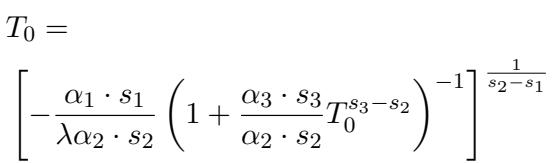
If this looks complex, don’t worry. The implication is simple: We can now plot the Critical Mixture Ratio as a function of training tokens.
This leads to the CMR Scaling Law:

Key Findings: Size and Similarity Matter
Now that we have a predictive law, what does it tell us about how LLMs learn? The experiments revealed two major insights that reshape how we should approach domain adaptation.
1. Larger Models Can Handle More Domain Data
The researchers applied their scaling law to models ranging from 460M to 3.1B parameters.
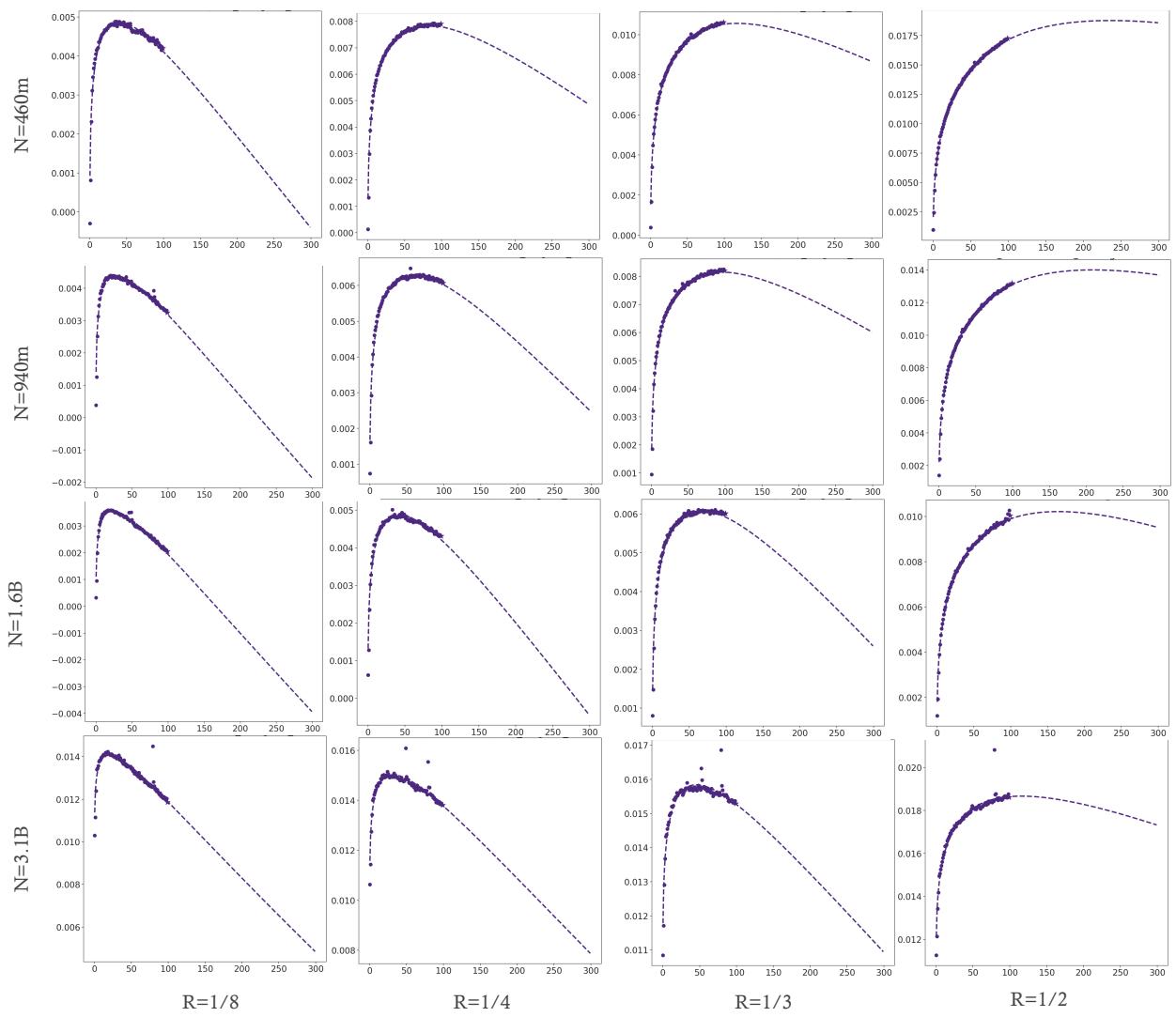
Note: While the provided image deck labels this Figure 9/10, the trend is consistent with the paper’s findings on model size scaling.
The results show a clear trend: As model size (\(S\)) increases, the CMR increases.
- The 460M model had a CMR of roughly 29.8%.
- The 940M model had a CMR of 34.9%.
- The 3.1B model could handle nearly 47.8% domain data.
Interpretation: Larger models have more capacity (parameters). They are more “plastic.” They can absorb a higher volume of new, specialized knowledge without overwriting their existing general knowledge. This suggests that for massive models (like 70B or 400B parameters), we might be able to use very aggressive mixture ratios (perhaps >50%) that would destroy a smaller model.
2. Similar Domains Allow Higher CMR
The researchers validated their law on two different domains: Finance and Academic Papers.
- Finance: Distinct vocabulary, numbers, specific style.
- Academic Papers: Formal English, argumentative structure, closer to Wikipedia/Book data.
They found that for the same model size (460M), the CMR for Academic Papers (36.7%) was significantly higher than for Finance (29.8%).
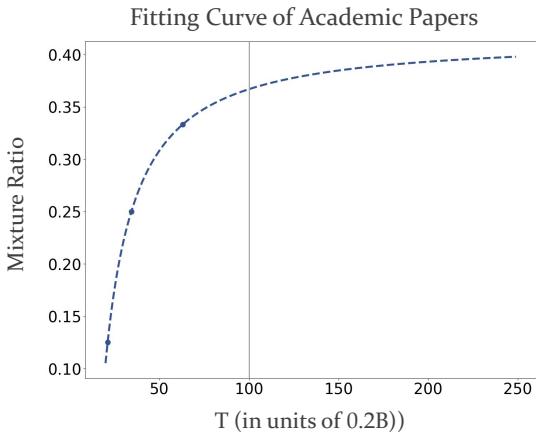
Interpretation: The closer the new domain is to the original training data distribution, the easier it is for the model to adapt. If the domain is very distinct (distribution shift is large), you must be more careful and use more general data to anchor the model. If the domain is similar, you can accelerate training with a higher ratio.
Conclusion
The era of “vibes-based” parameter tuning in AI is slowly coming to an end. Papers like this move us toward a disciplined engineering science.
The CMR Scaling Law provides a principled way to answer one of the most expensive questions in LLM training: “How much data should I use?”
- CMR Exists: There is a mathematical limit to how much domain data a model can absorb efficiently.
- It is Predictable: Using power laws, we can estimate this limit without full-scale training runs.
- It Scales: Larger models allow for more aggressive domain adaptation.
For students and practitioners, this implies a new workflow for specialized LLM creation. Instead of guessing a 10% or 20% mix, one can run small-scale probes, fit the CMR scaling law, and solve for the optimal ratio that maximizes learning while protecting the model’s general intelligence.