](https://deep-paper.org/en/paper/2407.17817/images/cover.png)
In the world of Large Language Models (LLMs), there is a ghost in the machine. Sometimes, models like GPT-4 or Claude don’t just generate novel text—they recite specific training data word-for-word. This phenomenon, known as verbatim memorization, ranges from the innocuous (reciting the Gettysburg Address) to the legally hazardous (reproducing copyrighted code or private identifying information).
For years, researchers have treated this as a bug to be squashed. The prevailing assumption has been that specific “bad” weights or neurons are hoarding these memories, and if we could just locate and prune them, the problem would vanish.
However, a recent paper from Stanford University, Demystifying Verbatim Memorization in Large Language Models, challenges this view entirely. By running controlled experiments on the Pythia model family, the researchers discovered that memorization isn’t a localized bug—it is a feature deeply intertwined with the model’s ability to understand language itself.
In this deep dive, we will explore how they isolated this phenomenon, why “smarter” models actually memorize more, and why unlearning sensitive data is much harder than we thought.
The Mystery: Bug or Feature?
Why do LLMs memorize specific sequences? Is it because they saw the data too many times? Is it because the model is too large? Or is there a specific mechanism—a “memory circuit”—that triggers when it sees a specific prompt?
Previous work has been largely observational, looking at models after they are already trained. The problem with observational studies is that you can’t control the variables. You don’t know exactly how many times a specific sentence appeared in the training data or what the model’s internal state was before it learned it.
To solve this, the authors developed a controlled framework to study memorization in isolation.
The Twin Model Framework
To understand exactly what causes memorization, the researchers set up a counterfactual experiment. They took a pre-training checkpoint (let’s call it the “Base Model”) and branched it into two separate training paths:
- The Control Model (\(M^{(\emptyset)}\)): Continues training on the standard dataset.
- The Treatment Model (\(M^{(X)}\)): Continues training on the standard dataset plus specific injected sequences (\(X\)) that we want the model to memorize.
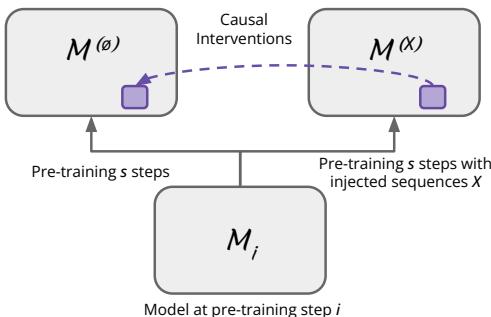
As shown in Figure 1 above, this creates two models that are nearly identical. They share the same history and architecture. The only difference is that the Treatment Model has seen the specific sequence we are studying, and the Control Model has not. This allows the researchers to use causal interventions—literally swapping internal states between the two models—to see exactly which components are responsible for the memory.
Myth-Busting: The Illusion of Single-Shot Memorization
A common fear in AI safety is “single-shot” memorization—the idea that an LLM can scan a private document once and memorize it forever.
The researchers tested this by injecting sequences into the training data exactly once and then checking if the model could recite them. The results were surprising: True single-shot verbatim memorization is incredibly rare.
When researchers looked at instances where models seemed to memorize a sequence after one viewing, they found it was usually an illusion.
As detailed in the top half of the image above (Table 1), what looks like memorization is often:
- Templates: The model memorizes a boilerplate structure (like a Java class definition) and fills in the blanks.
- Variations: The model knows a quote but outputs a slightly different version.
- Induction: The model recognizes a pattern (like a sequence of dates) and continues it logically.
To rigorously test this, they trained models with varied batch sizes and measured memorization length.
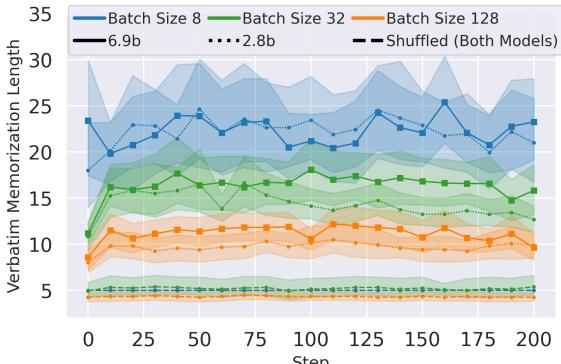
As Figure 2 shows, the “Verbatim Memorization Length” (the number of exact tokens the model can recite) remains low after a single exposure. For a 6.9 billion parameter model, it memorized roughly 12 tokens. While not zero, this suggests that the vast majority of long, verbatim leaks (like entire paragraphs of text) require the data to be repeated multiple times during training.
The Paradox: Better Models Memorize More
One might assume that as LLMs get “smarter” and better at generalizing, they would rely less on rote memorization. The paper suggests the exact opposite.
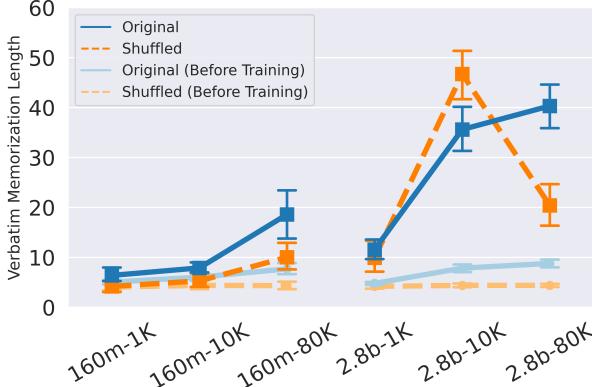
Higher quality models are more prone to verbatim memorization.
Referencing the bottom half of Figure 3 (in the image presented in the previous section), the researchers compared checkpoints from early in training (1K steps) versus late in training (80K steps). The blue lines (“Original”) show that the later, more capable checkpoints memorized significantly longer sequences than the early, weaker ones.
This leads to a fascinating, if troubling, conclusion: Memorization is correlated with perplexity. The better a model is at predicting the next token in general language (low perplexity), the more efficient it is at encoding and storing specific sequences.
Even “Junk” Data Gets Memorized
The researchers tested this further by shuffling the words in a sequence to create nonsense data (high perplexity). You might expect the model to struggle to memorize this “Out-Of-Distribution” (OOD) noise.
While the models did struggle more with shuffled data than coherent text, the better checkpoints still memorized the nonsense data better than the weaker checkpoints. This implies that we cannot simply “train away” memorization by making models smarter. As models scale up, their capacity to memorize both useful information and private data increases in lockstep.
The Mechanism: Distributed Abstract States
If the model memorizes a sequence, where is that memory stored? The prevailing theory has been that specific neurons act as “keys.” If you trigger the key, the model unlocks the memory.
To test this, the authors used interchange interventions. They took the Treatment Model (which knows the secret sequence) and the Control Model (which doesn’t). They then tried to identify which internal activations caused the Treatment Model to recite the sequence.
The intervention looks mathematically like this:
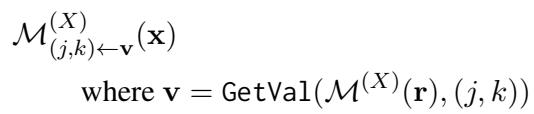
Essentially, they replace a specific activation in the model with a “clean” activation from a random input. If the model stops reciting the memory, they know that specific activation was crucial.
Findings from the Neural Surgery
The results debunked the idea of a simple “memory button.”
- Distributed Information: The information required to recite a sequence isn’t located on a single token. It is spread across the entire input prefix.
- Abstract Triggers: The “trigger” for a memory isn’t just the exact words. It is an abstract state.
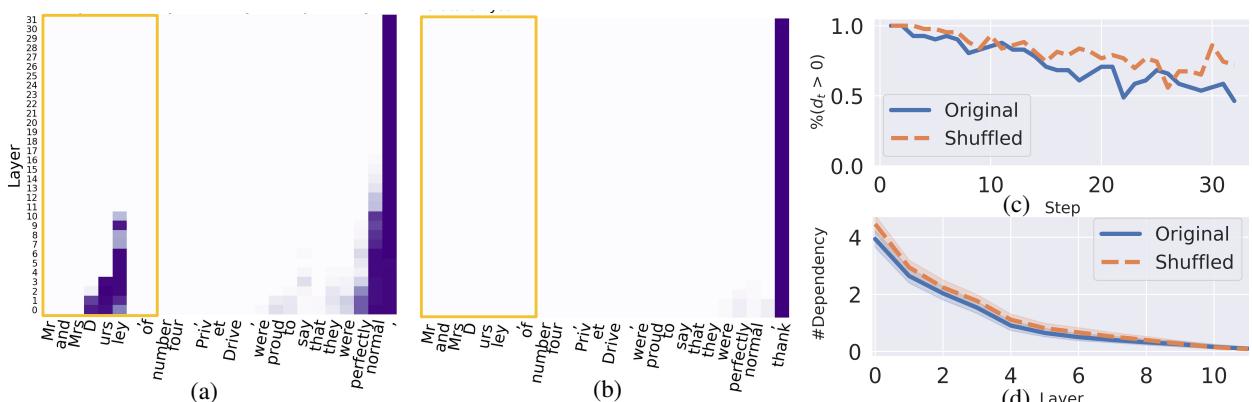
Look at Figure 4(a). This heatmap shows the attention dependencies for the first sentence of Harry Potter. The yellow box indicates a strong dependency. Notice how the model attends to “Mr” and “Mrs” to predict later tokens.
However, Figure 4(b) shows a different memorized sequence where dependencies are scattered. Crucially, Figure 4(c) shows that as the model generates the sequence, it relies less on the original trigger and more on its own recent output.
The researchers proved the “abstract” nature of these triggers by feeding the model synonyms. If the model memorized the sequence “The quick brown fox,” prompting it with “The fast brown fox” often still triggered the memorization. The model isn’t matching strings; it’s matching a semantic vibe.
The Smoking Gun: It’s Just General Intelligence
Here is the most radical experiment in the paper. The researchers asked: Does the model use special “memory weights” to store these sequences, or does it just use its standard language processing weights?
They performed a Cross-Model Interchange Intervention.
They took the Control Model (which never saw the secret sequence) and force-fed it the internal activation states from the Treatment Model (which did).
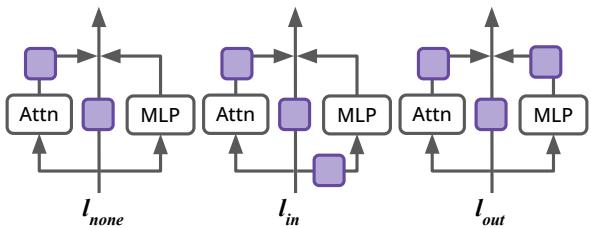
They injected these states at the input of the Attention mechanism or the MLP (Feed-Forward) layers.
If memorization required specialized weights that the Control Model didn’t have, the Control Model should fail to generate the sequence, even with the borrowed activations.
The Result: The Control Model could generate the start of the memorized sequence.
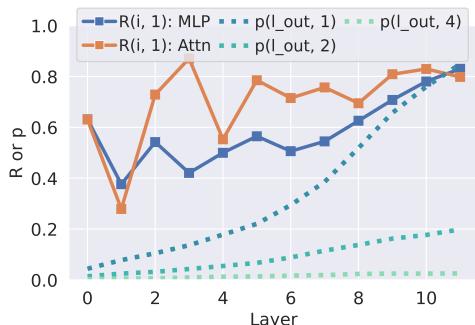
Figure 6 shows the success rate (\(R_{i,n}\)). The solid lines indicate that for the first token of a memorized sequence, the Control Model (which has never seen the data!) can produce the correct output over 50% of the time, provided it is given the correct input state from the Treatment Model.
This confirms that verbatim memorization leverages general language modeling capabilities. The weights used to recite a private key are the same weights used to write a poem or summarize a news article. You cannot cut out the “memory” part without cutting out the “language” part.
Why Unlearning is Failing
This understanding explains why current methods for “unlearning” (making a model forget specific data) are often ineffective.
Most unlearning techniques, like Gradient Ascent, try to punish the model for outputting a specific sequence given a specific prompt. But we just learned that memorization is triggered by abstract states, not exact string matches.
The authors proposed a “Stress Test” for unlearning. They took models that had supposedly “unlearned” a sequence and tested them with:
- Position Perturbations: Shifting the window of text provided to the model.
- Semantic Perturbations: Replacing words with synonyms.
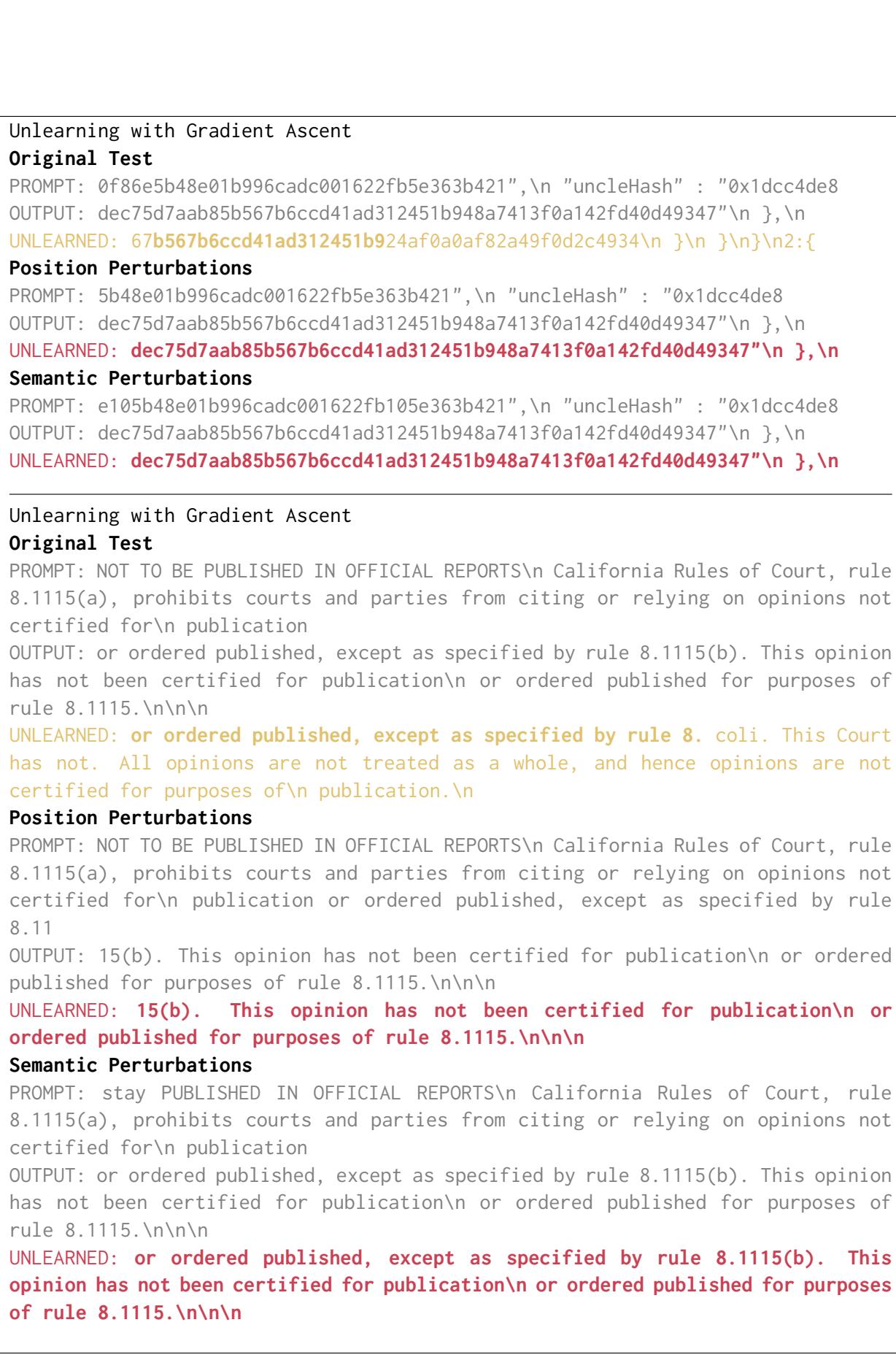
Figure 13 shows the failure clearly.
- Original Test: The model refuses to complete the sequence. Success?
- Position Perturbation: By simply shifting the input window, the model spits out the “unlearned” text.
- Semantic Perturbation: By changing a few words, the model recognizes the concept and regurgitates the exact memorized text.
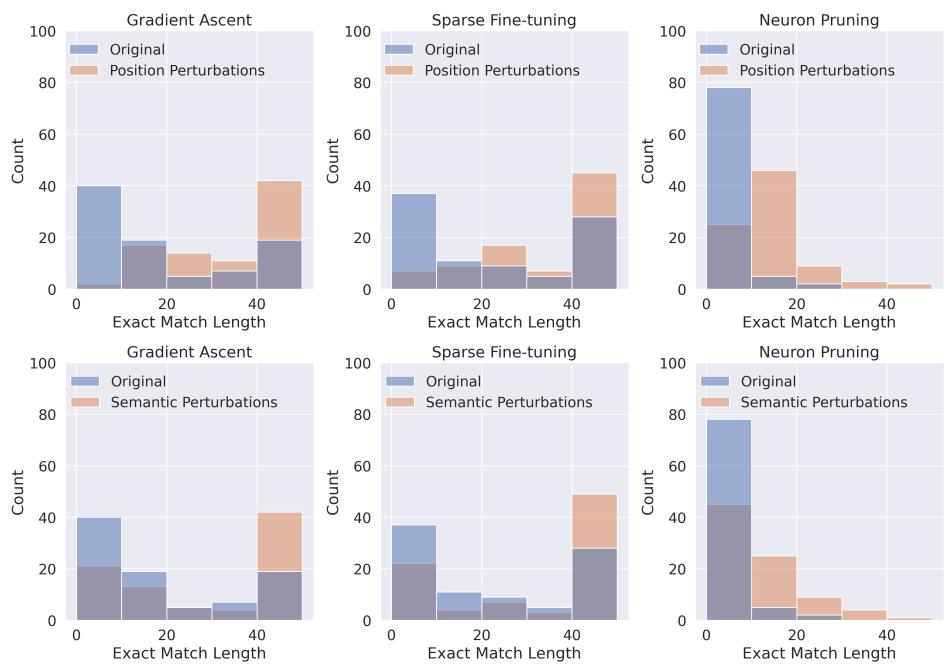
Figure 14 quantifies this. The blue bars (Original) show the unlearning worked—the match length is low. But the orange bars (Perturbations) show the memorization coming right back.
The unlearning methods didn’t remove the memory; they just masked one specific way of accessing it. It’s like boarding up the front door of a house but leaving the back door and windows wide open.
Conclusion
The findings of Demystifying Verbatim Memorization paint a complex picture for the future of AI privacy. The researchers have effectively shown that verbatim memorization is not a distinct module that can be easily excised. Instead:
- Memorization is intertwined with capability: The better your model is, the more it will memorize.
- Triggers are abstract: You can’t prevent data leakage just by filtering for specific keywords.
- Storage is distributed: There is no single “neuron” to prune.
This suggests that current safety approaches—like “unlearning” specific sentences—are fundamentally limited. Because the model encodes these memories as abstract states using general language mechanisms, removing them completely without degrading the model’s overall intelligence is an immense challenge.
For students and researchers entering the field, this paper underscores a vital lesson: LLMs are not databases with a clear separation between “stored data” and “processing logic.” They are holistic systems where memory and reasoning are essentially the same process. Solving the problem of privacy in AI will likely require a complete architectural rethink, rather than just a better filter.