](https://deep-paper.org/en/paper/2407.18940/images/cover.png)
Introduction: The Needle in the Academic Haystack
If you are a student or a researcher, you know the struggle. You have a specific concept in mind—perhaps a vague memory of a paper that “uses structured pruning to scale down language models”—but you don’t remember the title, the authors, or the year. You turn to Google Scholar or a similar academic search engine, type in your query, and … nothing. Or rather, pages and pages of tangentially related results that rely on keyword matching but fail to capture the concept you are looking for.
This disconnect represents a significant gap in modern information retrieval. While search engines have become incredibly adept at finding recipes or historical facts, scientific literature search remains a stubborn challenge. The questions researchers ask often require deep domain expertise and the ability to reason across the entire text of an article, not just match keywords in a title.
In this post, we will dive deep into a paper titled “LitSearch: A Retrieval Benchmark for Scientific Literature Search,” coming out of Princeton University. The researchers behind this work identified that existing benchmarks were not testing what actually matters: realistic, complex, concept-based queries.
We will explore how they built a new, rigorous dataset to test retrieval systems, how modern AI models perform on it compared to traditional search engines, and what this means for the future of scientific discovery.
The Problem with Existing Benchmarks
Before we look at the solution, we need to understand why previous attempts to measure search performance were falling short.
Historically, the task of “citation recommendation” was formalized in a somewhat lazy way. Researchers would take an existing paper, find a sentence with a citation (e.g., “Recent work has applied Transformers to computer vision [1]”), and use that sentence as the search query. The goal was to see if the search engine could retrieve the cited paper ([1]).
While this generates a lot of data easily, it has major flaws:
- Noise: Inline citations are often messy or lack context.
- Broadness: A query like “Large Language Models [citation]” is too generic to be useful.
- Context Dependence: Often, the sentence only makes sense if you read the whole paragraph, which users rarely type into a search bar.
Real researchers don’t search like that. They ask natural language questions. They ask about methods, datasets, and specific findings. To build a better search engine, we first need a better test. Enter LitSearch.
LitSearch: Constructing a Realistic Benchmark
The core contribution of this paper is the creation of a high-quality dataset consisting of 597 realistic literature search queries. To ensure these questions reflected reality, the researchers didn’t just scrape data; they used a hybrid approach combining the reasoning power of GPT-4 with the domain expertise of actual human authors.
Let’s break down the two main pipelines they used to generate these questions.
1. The Inline-Citation Pipeline (Automation with AI)
The first method leverages the vast amount of existing scientific literature but refines it to be usable. The researchers utilized the S2ORC (Semantic Scholar Open Research Corpus), specifically targeting papers from the ACL Anthology (a major repository for NLP research).
The process, illustrated below, transforms a raw citation into a coherent question.

Here is the step-by-step breakdown of this pipeline:
- Sampling: The system pulls a paragraph containing a citation (e.g., “Unlike Devlin et al…”).
- Generation: They prompt GPT-4 to act as a researcher. The model is given the paragraph and the cited paper’s title and is asked to rewrite the context into a standalone search question.
- Word Overlap Filtering: This is a crucial quality control step. If the generated question looks too much like the target paper’s title (sharing too many words), it’s too easy. It becomes a simple keyword match rather than a semantic search. The researchers filtered out questions with high word overlap to ensure the benchmark tests understanding, not just matching.
- Manual Inspection: Finally, human experts reviewed the questions to ensure they made sense.
2. The Author-Written Pipeline (Human Expertise)
The second method is arguably even more robust. Who knows a paper better than the people who wrote it?
The researchers reached out to the authors of papers published in ACL 2023 and ICLR 2024—two top-tier AI conferences. They asked these authors to write a search query that their own paper would answer. This ensures the questions are grounded in the actual contributions of the research.
The difference between these two types of questions is fascinating. As shown in the figure below, both methods produce challenging queries, but they have different “flavors.”
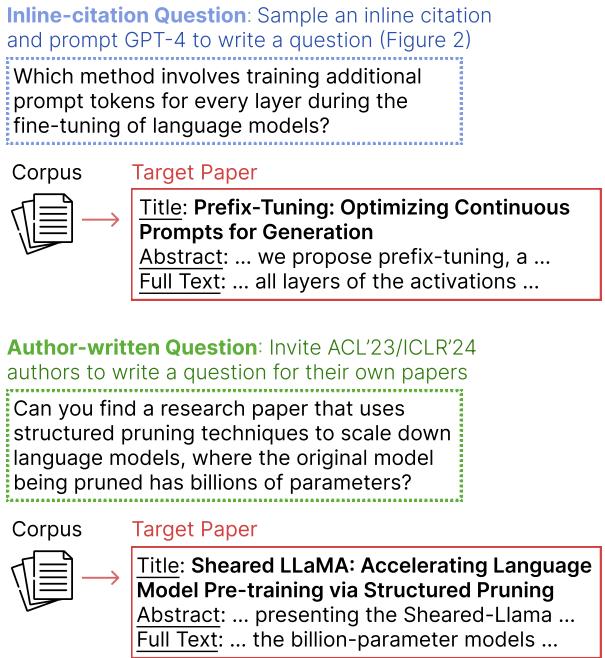
In the author-written example (bottom of Figure 1), notice the specificity: “Can you find a research paper that uses structured pruning techniques… where the original model being pruned has billions of parameters?” This is exactly the kind of “needle in a haystack” query that breaks traditional search engines.
Quality Control: The Human Element
Data quantity is easy; data quality is hard. To ensure LitSearch wasn’t filled with junk data, the authors of the LitSearch paper manually annotated every single question based on two criteria: Specificity and Quality.
They established a strict rubric to categorize questions. This allows the benchmark to report results separately for “Broad” questions (where many papers might fit) and “Specific” questions (where only a few papers fit).
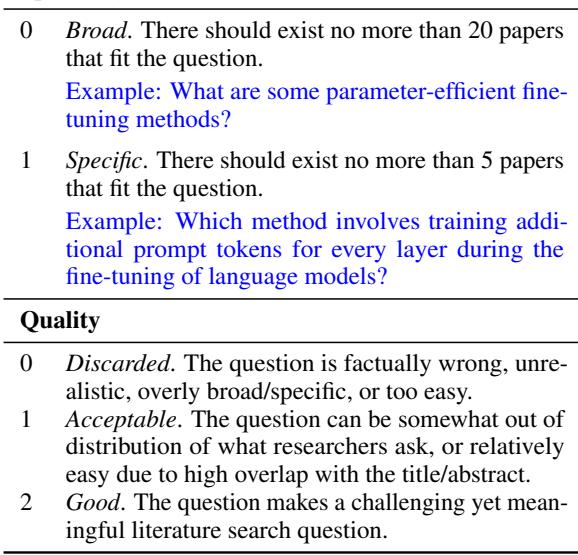
As you can see in the table above, a question is considered “Specific” if roughly 5 or fewer papers fit the criteria. If a question is too broad (e.g., “What are some parameter-efficient finetuning methods?”), it acts differently in a retrieval system than a specific query about a unique method.
After all this filtering and annotation, the final dataset statistics look like this:

The dataset contains 597 total questions. Interestingly, the author-written questions tended to have higher word overlap with their target papers (0.43) compared to inline-citation questions (0.33). This suggests that when authors write questions, they tend to use the exact terminology present in their titles and abstracts, whereas GPT-4 (used for inline citations) might paraphrase more aggressively.
The Retrieval Experiment
With the benchmark built, the researchers proceeded to the “Battle of the Retrievers.” They wanted to see which systems could actually find the right papers given these complex questions.
The Setup
- The Corpus: A collection of over 64,000 papers from ACL and ICLR.
- The Input: The LitSearch questions.
- The Goal: Retrieve the correct target paper(s) from the corpus.
They tested three main categories of systems:
- BM25 (Sparse Retrieval): This is the traditional standard. It relies on keyword matching (TF-IDF). It’s fast and robust but lacks “understanding” of synonyms or context.
- Dense Retrieval Models: These are modern, neural network-based models (like GTR, Instructor, E5, and GritLM). They convert text into vector embeddings, allowing them to match queries and documents based on semantic meaning, even if they don’t share exact words.
- LLM-based Reranking: This is the cutting edge. First, a standard retriever fetches the top 100 results. Then, a powerful Large Language Model (GPT-4o) reads those 100 candidates and re-orders them based on how well they answer the question.
The Results
The results highlighted a massive gap between old and new technologies.
Dense Retrievers vs. BM25
The findings were clear: dense retrievers significantly outperform keyword-based search.
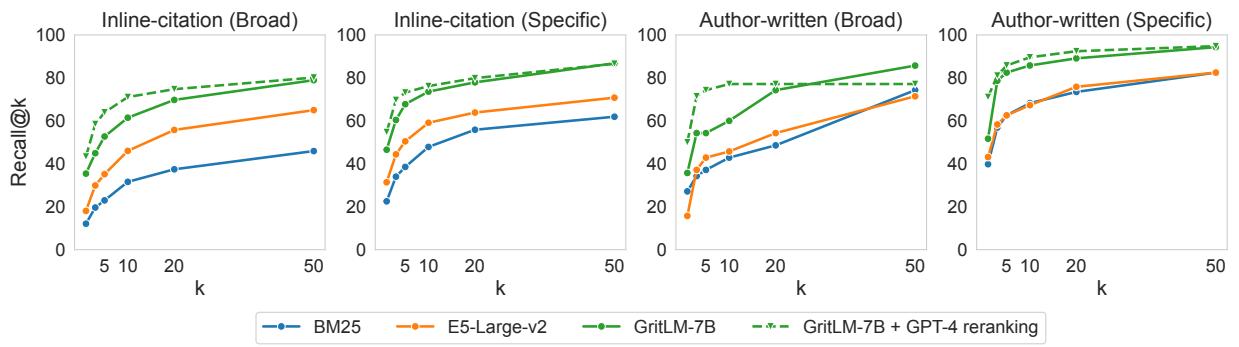
Look at the charts in Figure 3. The y-axis represents Recall, which measures the percentage of relevant documents found. The x-axis (k) represents how many documents the system retrieved.
- BM25 (Blue Line): consistently performs the worst across all categories. It struggles because scientific concepts can be described in many ways that don’t always overlap in keywords.
- GritLM (Red Line): This model, a state-of-the-art dense retriever, dominates. It achieves a recall@5 (finding the right paper in the top 5 results) of 74.8%, compared to BM25’s 50%. That is a massive 24.8% gap.
The Power of Reranking
The purple line in Figure 3 represents GritLM + GPT-4o Reranking. Notice how it consistently hugs the top of the chart.
By adding a “reasoning” step—where GPT-4o looks at the retrieved candidates and decides which ones actually answer the user’s specific question—performance improves even further (about 4.4% better than GritLM alone). This confirms that while embeddings are great at finding general semantic matches, an LLM is better at understanding the nuance of a specific question.
Difficulty by Question Type
The researchers also broke down performance by the quality of the questions. Recall the manual annotation step where questions were graded as “Acceptable” (Quality=1) or “Good/Challenging” (Quality=2).
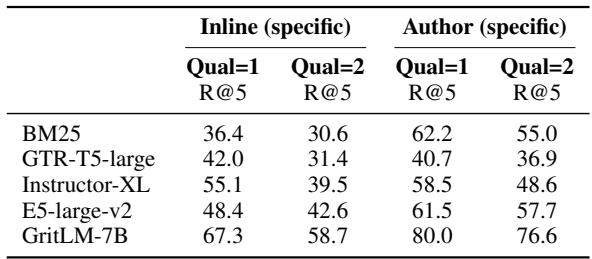
Table 4 shows a validation of the benchmark’s difficulty. All retrievers performed worse on Quality=2 questions. For example, GritLM’s performance drops from 67.3% on easier questions to 58.7% on harder ones. This confirms that the manual filtering succeeded in identifying truly difficult queries that require deeper reasoning.
Analysis: Surprises and Reality Checks
The experiments revealed two particularly interesting insights that challenge common assumptions about search engines.
1. More Text \(\neq\) Better Search
You might assume that feeding the retriever the full text of a paper (thousands of words) would help it find matches better than just using the title and abstract (a few hundred words). After all, the answer might be buried in the methodology section.
However, the results suggest otherwise.
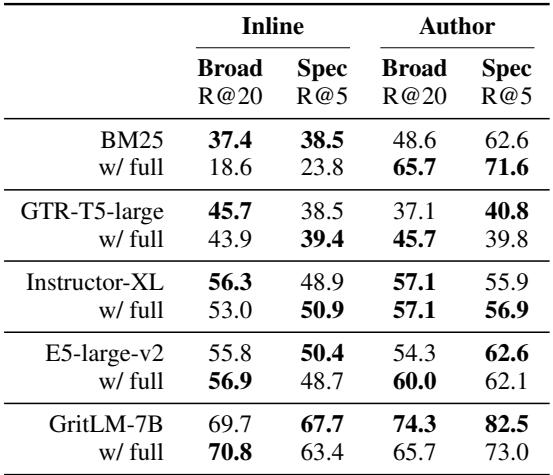
As shown in Table 5, adding full text rarely improved performance and often hurt it. For the dense retrievers (GTR, Instructor, E5, GritLM), performance generally stayed the same or dropped when using full text.
Why? Likely because scientific papers are long and contain a lot of information irrelevant to the core contribution. Embedding a 6,000-word document into a fixed-size vector dilutes the signal of the main idea, making it harder to match with a concise query. This suggests that for retrieval purposes, a well-written abstract is gold.
2. Commercial Search Engines are Lagging
Perhaps the most damning result for our daily workflows is how commercial tools performed. The researchers took a random subset of 80 specific questions and manually fed them into Google Search, Google Scholar, and Elicit.
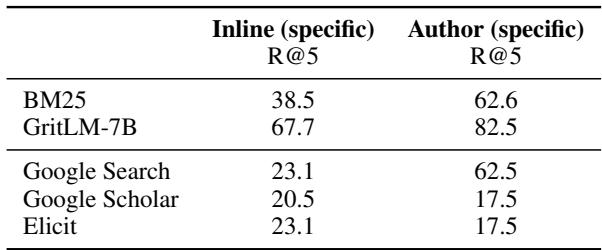
The results in Table 7 are stark. On “Inline-citation” questions (which require connecting concepts), Google Scholar only achieved a 20.5% recall. Google Search managed 23.1%.
Compare this to GritLM, which achieved roughly 67.7% on similar questions (from Table 3 in the text).
While this isn’t a perfectly fair apples-to-apples comparison (Google searches the entire web, which is a much harder task than searching a closed corpus of 64k papers), it highlights a functional reality for users: if you have a complex, conceptual query, current commercial search engines are likely to fail you. They are optimized for keywords and navigational queries, not deep semantic retrieval.
Conclusion
LitSearch serves as a wake-up call and a roadmap for the field of Information Retrieval. It demonstrates that the difficulty of scientific search has been underestimated by previous benchmarks.
The key takeaways from this work are:
- Realistic Data Matters: We need benchmarks that mimic how humans actually ask questions—using natural language and reasoning, not just keyword soup.
- Dense Retrieval is Essential: The era of keyword-only search (BM25) for science should be ending. Semantic embedding models like GritLM are vastly superior for this domain.
- Abstracts are Powerful: For retrieval, the title and abstract contain the most concentrated signal. Processing full text remains an open challenge.
For the students and researchers reading this, LitSearch offers hope. It provides the testbed necessary to build the next generation of research assistants—systems that don’t just find strings of text, but actually understand what you’re looking for. Until then, we might have to keep struggling with Google Scholar, but at least now we know exactly why it’s so hard to find that one paper.