](https://deep-paper.org/en/paper/2407.21121/images/cover.png)
If you have been following the cutting edge of computer vision and signal processing, you have likely encountered Implicit Neural Representations (INRs). Unlike satisfyingly discrete grids of pixels or voxels, INRs represent data (like images, 3D shapes, or audio) as a continuous mathematical function, usually approximated by a neural network.
The current superstar of INRs is the Sinusoidal Neural Network, popularized by the SIREN architecture. Instead of standard ReLU activations, these networks use sine waves. They are mathematically elegant and capable of capturing incredible high-frequency details.
But there is a catch: they are notoriously difficult to train.
Initializing them feels like black magic. If you pick the wrong random weights, your output is static noise. If you train them too long, they hallucinate high-frequency artifacts. Until now, fixing this has been largely empirical—trial and error.
In this post, we are breaking down a new paper, “Tuning the Frequencies: Robust Training for Sinusoidal Neural Networks,” (or TUNER). This research peels back the black box of sinusoidal networks, using Fourier theory to explain exactly how they learn and providing a mathematically grounded method to stabilize them.
The Problem: The Chaos of Coordinates
To understand why TUNER is necessary, we first need to look at how sinusoidal MLPs work. You feed coordinate data (like an \((x, y)\) position) into the network, and it outputs a signal (like an RGB color).
The network consists of layers of sine functions:
\[ \mathbf{S}(\mathbf{x}) = \sin(\mathbf{W}\mathbf{x} + \mathbf{b}) \]When you compose these layers (feed the output of one sine into another), you are essentially creating a function that looks like \(\sin(a \sin(x))\). As you add layers, the complexity of the signal grows exponentially.
The problem is Control.
- Initialization: Standard random initialization often creates a spectrum of frequencies that doesn’t match the signal you are trying to learn.
- Bandlimit: As training progresses, the network generates higher and higher frequencies. Without a “speed limit” (bandlimit), the network starts fitting noise rather than the signal, leading to grainy reconstructions.
Existing solutions like SIREN try to fix this with clever initialization ranges, but they lack explicit control during training. Other methods like BACON apply hard filters, which can cause “ringing” artifacts (ripples near sharp edges).
The Breakthrough: Networks as Fourier Series
The authors of TUNER moved away from treating the network as a black box and instead analyzed it through the lens of Fourier Series.
They derived a new trigonometric identity that changes how we view these networks. They proved that a hidden neuron in a sinusoidal MLP is actually just a massive sum of sine waves.
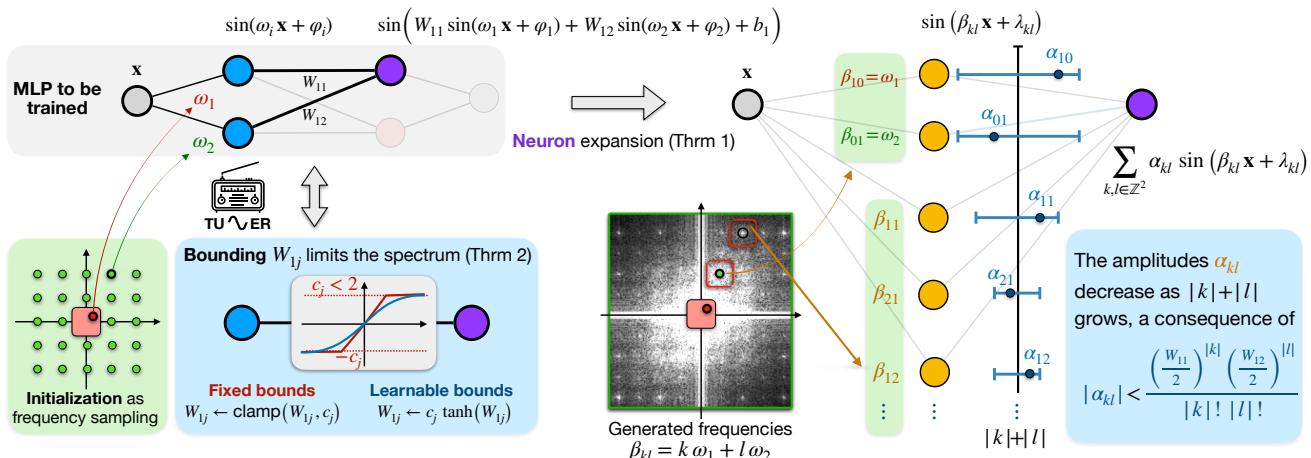 Figure 1: An overview of the TUNER framework. Notice how input frequencies (green) are combined to create new frequencies (yellow/purple) based on the network depth.
The Amplitude-Phase Expansion
The core theoretical contribution is Theorem 1. It states that any hidden neuron \(h_i(x)\) can be expanded into a sum of sines:

Here is the plain English translation of what this equation implies:
- Frequencies (\(\beta_k\)): The frequencies inside the network are not random. They are integer linear combinations of the input frequencies. If your input layer has frequency 5 and 10, deeper layers will generate frequencies like \(15 (10+5)\), \(5 (10-5)\), \(20 (2\times10)\), etc.
- Amplitudes (\(\alpha_k\)): The strength (amplitude) of these frequencies is determined entirely by the weights of the hidden layers.
This is a massive insight. It means that layer composition creates new frequencies, but those frequencies are strictly derived from the first layer.
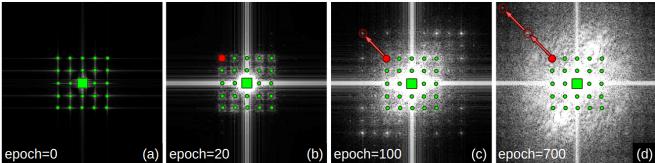 Figure 2: Visualizing the spectrum. The green dots are the input frequencies. The red arrows show how the network generates new frequencies in the neighborhood of the inputs during training.
The Solution: TUNER
Armed with this theoretical understanding, the authors propose TUNER, a two-pronged approach to training: Initialization and Bounding.
1. Initialization as Spectral Sampling
Since the deeper layers only create combinations of the input frequencies, the initialization of the first layer (\(\omega\)) is critical.
If you initialize \(\omega\) randomly (as is standard), you get a messy spread of frequencies. TUNER instead initializes \(\omega\) using a grid of integers. This ensures the network behaves like a discrete Fourier series.
The authors split the initialization into two zones:
- Low Frequencies (Dense): They sample heavily near zero. This gives the network a strong “base” to generate local frequency combinations.
- High Frequencies (Sparse): They scatter fewer frequencies further out to cover the full range of the signal (up to the Nyquist limit).
This “Spectral Sampling” ensures the network has the capacity to learn the signal without starting with chaotic noise.
2. Bounding: The “Soft” Filter
The second innovation addresses the “noise” problem. How do we stop the network from creating infinitely high frequencies that ruin the image?
The authors looked at the amplitude term from their expansion theorem. They found that the amplitude \(\alpha_k\) is governed by Bessel functions. Without getting bogged down in calculus, the key takeaway is captured in Theorem 2:
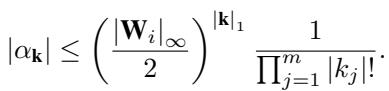
This inequality reveals a direct relationship: If the weights (\(W\)) are small, the amplitudes of high frequencies decay rapidly.
This allows the authors to implement a Bandlimit Control mechanism. By simply “clamping” (limiting) the maximum value of the weights in the hidden matrices during training, they can mathematically guarantee that high-frequency noise is suppressed.
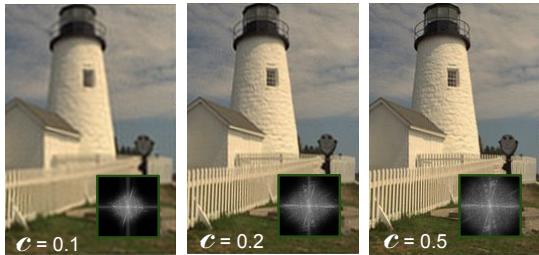 Figure 3: The effect of bounding weights. With a tight bound (c=0.1), the network is very smooth. As the bound relaxes (c=0.5), higher frequencies are allowed to emerge. This gives us a “knob” to tune the sharpness vs. smoothness of the output.
This acts as a soft filter. Unlike hard filters that chop off frequencies (causing ringing artifacts), TUNER gently suppresses them based on the weight magnitude, resulting in cleaner signals.
Experimental Results
So, does the math hold up in practice? The results are compelling.
Convergence and Stability
When compared to SIREN (the previous state-of-the-art), TUNER converges significantly faster and reaches a lower loss.
 Figure 4: The Hero Shot. Look at the graph in the bottom left. The Blue line (TUNER) drops immediately and stays low. The Orange line (SIREN) struggles to converge. Visually (top), TUNER produces sharper images with fewer artifacts at epoch 100.
In the comparison above, you can see that SIREN (orange) starts with a high error and takes a long time to settle. This is because SIREN initializes with a broad range of frequencies that fight against each other. TUNER (blue) starts with an organized set of integer frequencies and simply adjusts their amplitudes, leading to rapid learning.
Artifact Removal
One of the most interesting comparisons is against BACON, a method that uses explicit band-limiting filters.
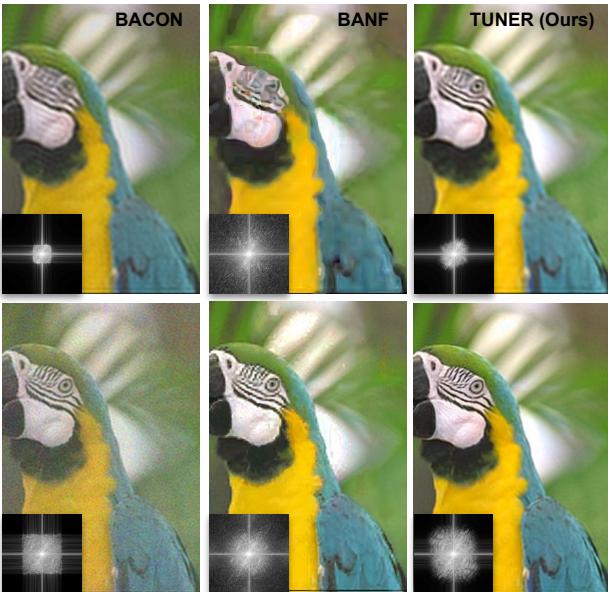 Figure 5: Artifact analysis. Look at the “BACON” inset (left). You can see ripples or “ringing” around the edges—a classic symptom of a hard box filter. TUNER (right) acts as a soft filter, preserving edges without the ripples.
Because TUNER uses the natural decay of Bessel functions (via weight bounding) rather than a hard cutoff, it avoids the ringing artifacts that plague other band-limited methods.
Gradient Reconstruction
An often-overlooked property of INRs is how well they model the derivative of the signal (e.g., the edges in an image).
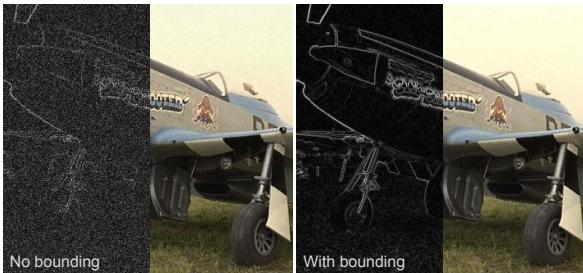 Figure 6: Left: Standard training (No bound). Right: TUNER (With bound). Notice the gradient images (grayscale). The bounded version captures clean, sharp edges, while the unbounded version is filled with speckle noise.
The experiment in Figure 6 shows that while standard training might get the color pixels roughly right (signal), it fails completely at learning the structure (gradient), resulting in noisy derivatives. TUNER’s bounding scheme preserves the high-order structural information.
Conclusion
TUNER represents a maturation of Implicit Neural Representations. By moving away from empirical “hacks” and grounding the network architecture in Fourier theory, the authors provided a way to control these powerful networks.
The key takeaways for students and practitioners are:
- Don’t trust random initialization: For sinusoidal networks, structured integer initialization (Spectral Sampling) provides a much better starting point.
- Weights control Frequency: The magnitude of your hidden weights directly correlates to the high-frequency content of your output. Controlling weights means controlling noise.
- Soft over Hard: Soft constraints (like weight bounding) often yield better visual results than hard constraints (like frequency cutoffs) because they avoid ringing artifacts.
This work paves the way for high-fidelity representations of complex signals—from gigapixel images to detailed 3D SDFs—without the headache of unstable training.