](https://deep-paper.org/en/paper/2408.03617/images/cover.png)
The Data Gap: Can Language Models Learn Like Children?
If you have ever watched a toddler learn to speak, it feels nothing short of miraculous. By the time a child is 10 years old, they have likely heard somewhere between 10 million and 100 million words. From this relatively small dataset, they achieve fluency, understand complex grammar, and grasp nuance.
Contrast this with the Large Language Models (LLMs) we use today, like GPT-4 or Llama. These models are typically trained on hundreds of billions, sometimes trillions, of words. They require a dataset several orders of magnitude larger than a human child to achieve comparable (or sometimes still inferior) linguistic competence.
This massive discrepancy is known as the “Data Gap.”
It forces us to ask a fundamental question in Artificial Intelligence and Cognitive Science: Why are children so much more data-efficient than our best algorithms?
Is it the learning algorithm (the human brain vs. the Transformer architecture)? Or is it the data itself? Perhaps the “curriculum” of childhood—starting with simple words from parents and slowly graduating to complex sentences—is the secret sauce that machines are missing.
In this post, we will deep dive into a fascinating research paper, “Is Child-Directed Speech Effective Training Data for Language Models?”, which attempts to answer this question through a series of “controlled rearing” experiments. The researchers train language models on real and synthetic child data to see if mimicking the human data diet bridges the gap.
The Hypothesis: It’s All in the Curriculum
Developmental psychologists have long argued that the input children receive is special. It’s not just random text scraped from the internet; it is Child-Directed Speech (CDS). This speech is often simplified, repetitive, and interactive. Furthermore, it follows a natural curriculum: you talk to a 2-year-old differently than you talk to a 10-year-old.
The researchers tested two specific hypotheses regarding this data:
- Global Developmental Ordering: Does training a model on data ordered by age (simplest to most complex) improve learning compared to random data?
- Local Discourse Coherence: Does the back-and-forth nature of conversation (dialogue) help models learn better than disconnected text?
To test this, they didn’t just use existing datasets; they created a massive synthetic dataset to simulate the perfect child-rearing environment.
The Setup: Simulated Learners
The researchers used two standard architectures to act as “simulated learners”:
- GPT-2 (Small): An autoregressive model that predicts the next word.
- RoBERTa (Base): A masked language model that fills in the blanks.
They trained these models from scratch. However, instead of using the massive web-crawled datasets typical in AI, they restricted the data to approximately 29 million words—a scale roughly equivalent to what a human child might hear.
The Datasets: Real vs. Synthetic Childhoods
The core of this paper lies in the data used. The authors compared five distinct datasets.
1. CHILDES (Real Child-Directed Speech)
The Child Language Data Exchange System (CHILDES) is the gold standard in psychology. It consists of transcribed conversations between children and their caregivers.
However, CHILDES has a limitation: it is heavily skewed toward very young children. As shown in the figure below, the vast majority of the word counts come from children aged 2 to 5.
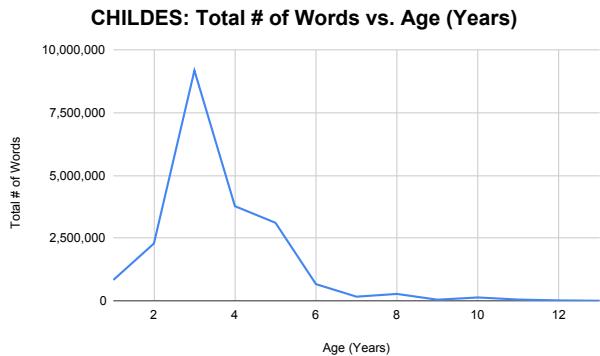
As you can see, the data volume drops off precipitously after age 5. This makes it difficult to simulate the “teenager” phase of learning using real-world transcripts.
2. TinyDialogues (Synthetic Child-Directed Speech)
To address the limitations of CHILDES (like the age skew and transcription noise), the authors generated a new dataset called TinyDialogues (TD).
They used GPT-4 to generate realistic, multi-turn conversations featuring children of specific ages (2, 5, 10, and 15 years old). This allowed them to control the vocabulary and complexity perfectly, creating a balanced “synthetic childhood.”
Here is what that data looks like. Notice how the complexity scales from the 2-year-old example to the 15-year-old example:
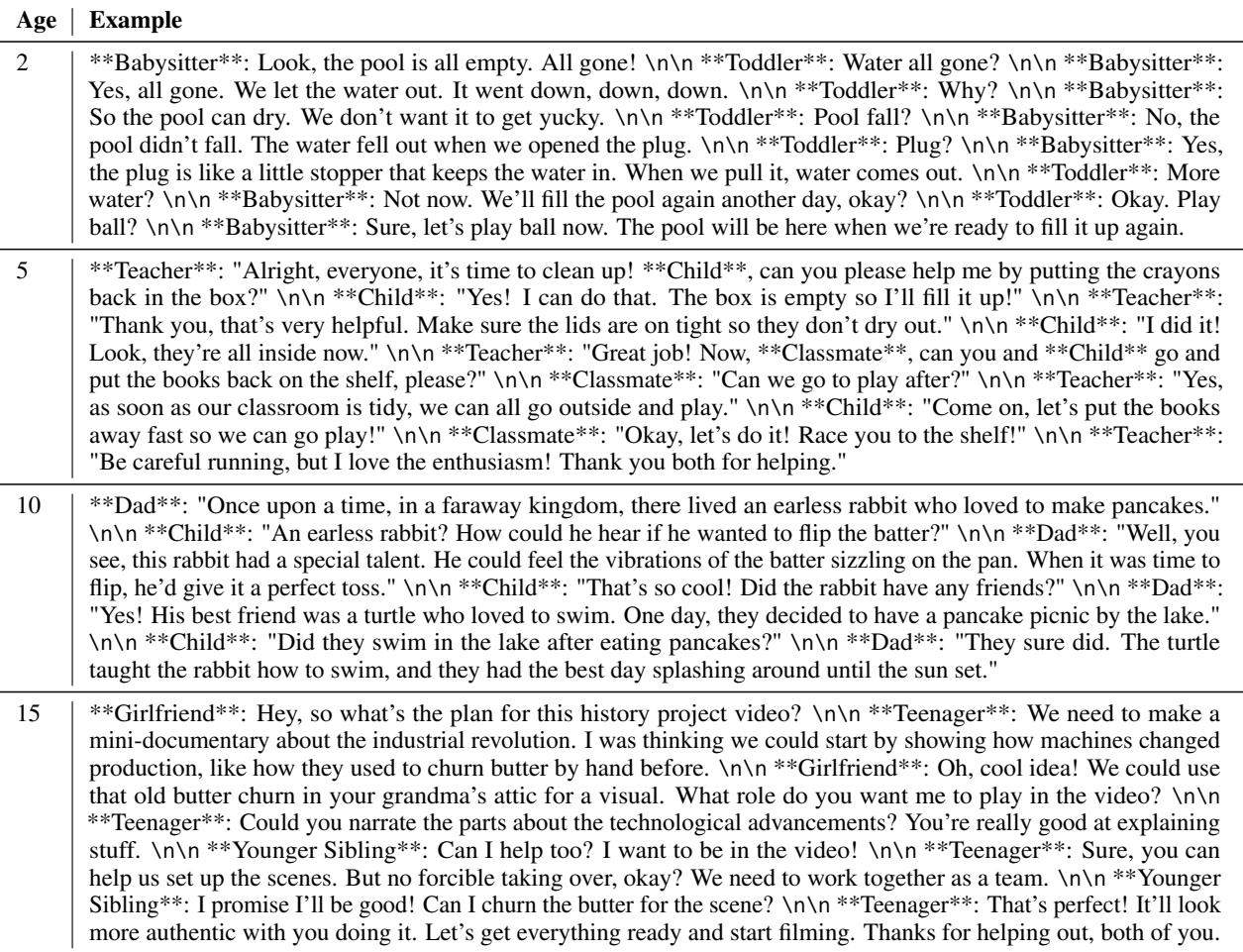
The TinyDialogues dataset was designed to be diverse. It didn’t just include parents; it included teachers, siblings, and friends, simulating the widening social circle of a growing child.

As shown in the statistics above, the complexity (words per utterance) grows linearly with the target age, providing a clear curriculum for the models.
3. The Control Groups
To benchmark these child-specific datasets, they compared them against:
- BabyLM: A mixture of child-directed speech, storybooks, and Wikipedia (designed for the BabyLM challenge).
- Wikipedia: Encyclopedic, formal text.
- OpenSubtitles: General conversation from movies and TV (not specifically for children).
Experiment 1: Who Wins the Syntax and Semantics War?
The first major experiment was simply finding out which dataset trains the best model. They evaluated the models on two metrics:
- Zorro: A benchmark for checking grammatical and syntactic correctness (e.g., subject-verb agreement).
- Word Similarity (WS): A benchmark for checking semantic understanding (do the model’s word embeddings understand that “dog” and “cat” are related?).
GPT-2 Results
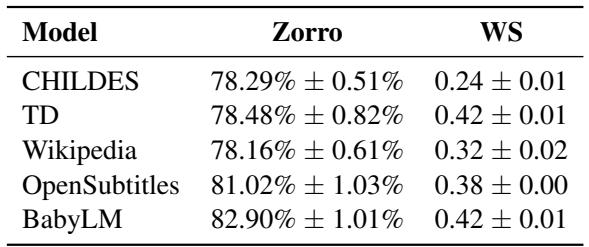
Here is how the autoregressive GPT-2 models performed after training on 29M words:
Key Takeaways:
- Diversity Wins: The BabyLM dataset (a mixture) performed the best overall.
- Synthetic Beats Real: The synthetic TinyDialogues (TD) dataset outperformed the real CHILDES dataset on both syntax (Zorro) and semantics (WS).
- General Dialogue is Strong: OpenSubtitles performed surprisingly well, suggesting that conversation structure is helpful, even if it’s not directed at children.
RoBERTa Results
The results for the masked language model (RoBERTa) showed a slightly different trend but confirmed the strength of synthetic data.
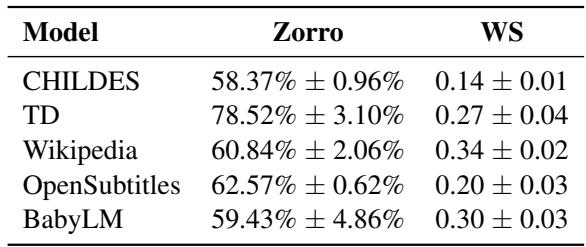
Here, TinyDialogues actually achieved the highest score on grammar (Zorro), drastically outperforming the real CHILDES transcripts. This suggests that the “cleanliness” of synthetic data might be easier for models to learn from than the messy, noisy transcripts of real toddlers.
Experiment 2: The Curriculum Hypothesis (Global Ordering)
Now for the central question: Does the order of data matter?
If the “Child Data Hypothesis” is true, a model should learn better if we feed it data in the order a child receives it: Age 2 data \(\rightarrow\) Age 5 \(\rightarrow\) Age 10 \(\rightarrow\) Age 15.
The researchers compared three ordering strategies:
- Age Order: Simple to complex.
- Reverse Order: Complex to simple (Benjamin Button style).
- Random Order: Shuffled.
They used a “Repeated Buckets” approach, training thoroughly on one age group before moving to the next, to simulate developmental stages.
The Result
Surprisingly, it didn’t really matter.
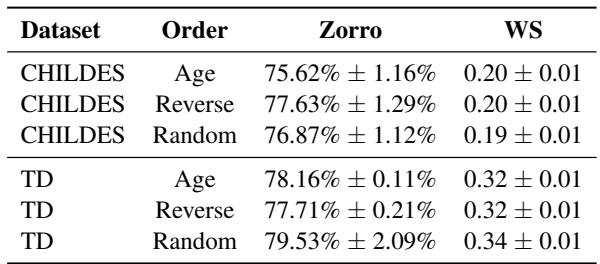
Looking at the table above for GPT-2, the performance differences between Age, Reverse, and Random order are negligible (often less than 1%).
We can see this visually in the convergence plots. The graph below tracks the training loss (blue) and validation loss (red) for the CHILDES dataset across the three different orderings.
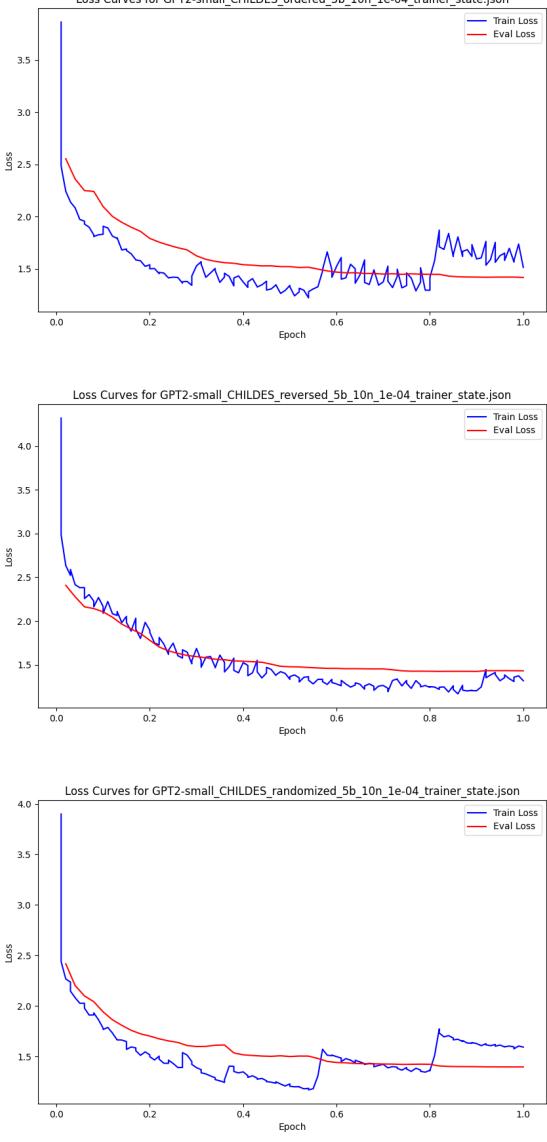
While the shape of the training curves looks different (the Age order curve has a distinct “staircase” pattern as the data gets harder), the final validation loss—where the red line ends up—is roughly the same for all three.
This suggests that Language Models are robust to curriculum order. Unlike human children, who might be overwhelmed if you started reading Shakespeare to them at age 2, LLMs seem to eventually crunch through the statistics regardless of the difficulty ramp-up.
Experiment 3: The Importance of Local Coherence
While the global order (curriculum) didn’t matter, the researchers found that local order matters a great deal.
Local ordering refers to the structure within a conversation. In a coherent dialogue, a question is followed by an answer.
- Normal: “Do you want milk?” \(\rightarrow\) “Yes please.”
- Random: “Yes please.” \(\rightarrow\) “Do you want milk?”
The researchers scrambled the sentences within conversations to break this discourse coherence.
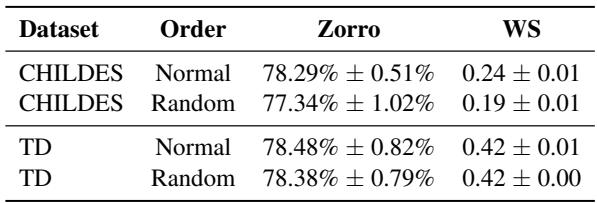
The findings:
- For CHILDES, scrambling the order significantly hurt performance, particularly on semantic tasks (WS).
- For TinyDialogues, the model was more robust.
This indicates that for real-world, noisy data (CHILDES), the conversational context is crucial for the model to figure out what words mean. If you break that local link, the model learns significantly less.
Conclusion: Data vs. Algorithm
So, is Child-Directed Speech the magic bullet for training efficient AI?
The answer from this paper appears to be no, or at least, not entirely.
- Synthetic is better than Real: The models actually learned better from synthetic conversations (TinyDialogues) than real transcripts (CHILDES). This implies that the noise and disfluencies in real human speech might actually be a hindrance to current architectures, rather than a feature.
- Curriculum is Overrated (for LLMs): Carefully structuring the data from simple to complex provided no significant benefit over random shuffling.
- The Algorithm Gap: Since giving models “child-like” data didn’t suddenly make them as efficient as children, the researchers conclude that the difference likely lies in the learning algorithm.
Human brains are not just “predict next token” machines. Children learn from multi-modal input (seeing, touching, hearing), and they have a brain architecture evolved over millions of years to acquire language.
This research suggests that simply curating better, “child-like” text datasets won’t be enough to bridge the data gap. To build AI that learns as efficiently as a child, we likely need to look beyond the data and innovate on the architecture itself.