](https://deep-paper.org/en/paper/2408.04872/images/cover.png)
Beyond Word Matching: How Syntax and Set Coverage Can Revolutionize In-Context Learning for Translation
In the era of Large Language Models (LLMs), we have grown accustomed to the magic of “few-shot” or “in-context” learning. You give the model a few examples of a task—say, translating a sentence from German to English—and suddenly, the model understands what to do. It adapts on the fly without updating its weights.
But here is the catch: Not all examples are created equal.
If you give an LLM bad examples, you get bad results. In Machine Translation (MT), the standard approach to picking examples has been “lexical matching.” If you want to translate a sentence about “cats,” you find examples in your database that contain the word “cat.” This makes intuitive sense, but language is about more than just vocabulary lists. It is about structure, grammar, and syntax.
If your test sentence has a complex nested clause, showing the model a simple “Subject-Verb-Object” sentence about cats won’t help it understand how to restructure the grammar.
Today, we are diving deep into a fascinating paper titled “SCOI: Syntax-augmented Coverage-based In-context Example Selection for Machine Translation.” This research proposes a novel way to select examples that doesn’t just look at words, but looks at the shape of the sentences—their syntax—and ensures that the selected examples cover the necessary structural complexity.
The Problem with “Word Matching”
In-context learning (ICL) works by placing demonstrations in the prompt. For machine translation, a prompt might look like this:
German: [Example 1] -> English: [Translation 1] German: [Example 2] -> English: [Translation 2] German: [Target Sentence] -> English:
The quality of the output depends entirely on Example 1 and Example 2.
Most existing methods use similarity search (like BM25 or embedding cosine similarity) to find examples. They look for sentences that share keywords or semantic meaning with the target sentence. While effective, this ignores a critical pillar of translation: Syntax.
In languages like German or Russian, the position of the verb or the case of the noun dictates the meaning. If the LLM doesn’t see an example with a similar syntactic structure (e.g., a passive voice construction or a relative clause), it might translate the words correctly but mangle the grammar.
The researchers behind SCOI (Syntax-augmented COverage-based In-context example selection) argue that to achieve high-quality translation, we need examples that maximize Set-Level Coverage of both:
- Lexical Information (The words used).
- Syntactic Information (The grammatical structure).
The SCOI Architecture: An Overview
The core idea of SCOI is to select a set of examples where the examples complement each other. Instead of picking the top 4 best matches individually, SCOI picks examples that, together, cover as much of the target sentence’s syntax and vocabulary as possible.
The selection process is “alternate.” It picks one example to maximize syntactic coverage, then one to maximize word coverage, and repeats.
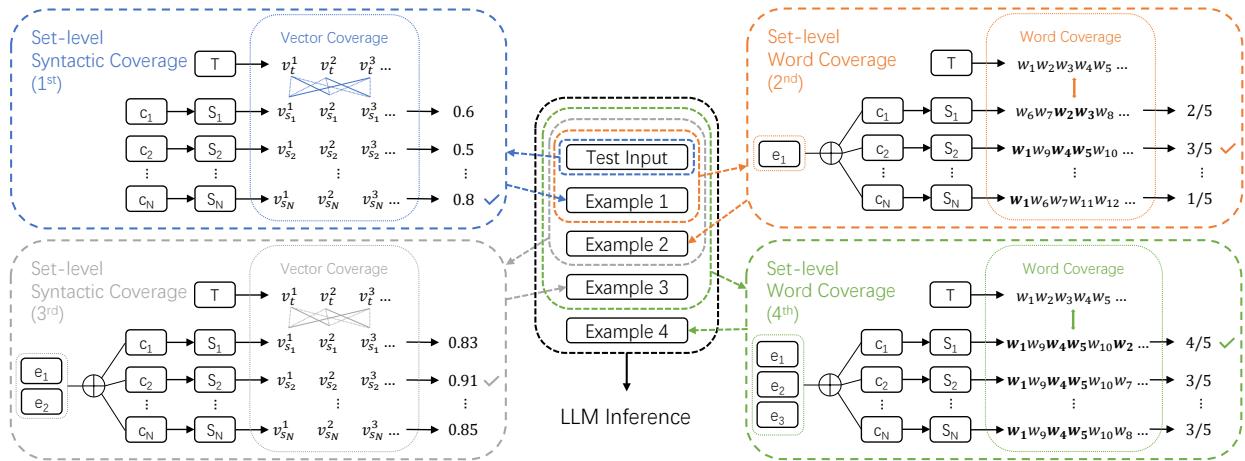
As shown in Figure 1, the system takes a test input and runs it through a cycle. It calculates “Set-level Syntactic Coverage” (measuring structural similarity) and “Set-level Word Coverage” (measuring vocabulary overlap). These two metrics drive the selection of examples \(e_1\) through \(e_4\).
Let’s break down the mathematical magic that makes this possible.
Innovation 1: Turning Trees into Polynomials
How do you measure “syntactic coverage”? Computers understand numbers, not tree diagrams.
Usually, linguists represent syntax using Dependency Trees. A sentence is broken down into a root, subjects, objects, and modifiers. Comparing two trees to see if they are similar is traditionally very computationally expensive.
The researchers utilize a method that converts a dependency tree into a mathematical polynomial. This effectively turns the “shape” of the sentence into a mathematical equation.
The Original (Slow) Way
Previous work (Liu et al., 2022) converted trees using two variable sets (\(X\) and \(Y\)). For a non-leaf node \(m^l\) with a label \(l\), the polynomial looked like this:
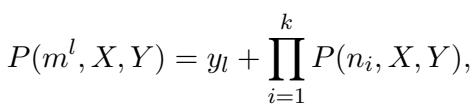
While accurate, this method had a major flaw: complexity. The researchers analyzed the computational cost of this algorithm. For a tree with specific depth and branching factors (like the one in Figure 2 below), the time complexity could explode.
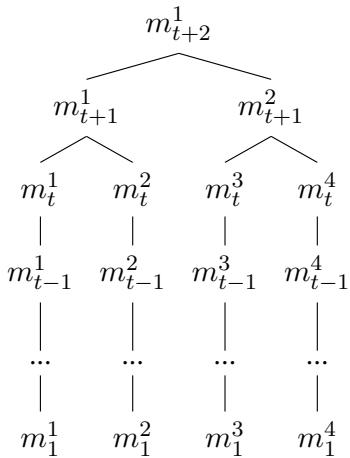
For the tree structure above, the cost of the original algorithm was calculated as:

And in worst-case scenarios with larger degrees, the complexity becomes polynomial with an arbitrarily large degree:

This is too slow for Machine Translation, where we have databases with millions of sentence pairs. We need something faster.
The SCOI (Fast) Way
The researchers proposed a Simplified Tree-to-Polynomial Algorithm. They reduced the variables to a single set \(X\). The new formula for a non-leaf node is:
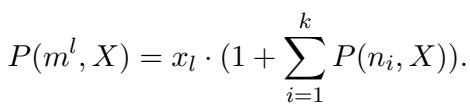
In this formula:
- \(x_l\) represents the label of the current node.
- The term \(1 + \sum P(n_i, X)\) aggregates the structure of the children nodes.
By using this simplified recursive structure, they drastically reduced the computational complexity. The cost \(T(n)\) for a tree with \(n\) nodes becomes much more manageable. The derivation shows that the cost is roughly the sum of the costs of the sub-trees plus a linear overhead:
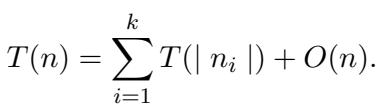
Ultimately, they proved that the complexity of this new method is bounded by quadratic time (\(O(n^2)\)), making it incredibly fast compared to the original method.

This simplification is the key enabler. It allows SCOI to process millions of sentences and calculate their “syntactic fingerprints” efficiently.
Innovation 2: Set-Level Coverage
Now that we have polynomials representing syntax, how do we select the examples?
Most systems use “Independent Selection.” They find the best match, then the second-best match, and so on. But this often leads to redundancy. If the best match covers the subject of the sentence, the second-best match probably covers the subject too. Neither might cover the complex object clause at the end.
SCOI uses Set-Level Coverage. This concept asks: “Does the group of examples I have selected so far cover all the features of the target sentence?”
Syntactic Coverage
The polynomial generated for a sentence consists of several “terms.” Each term represents a path from the root of the tree to a node. A vector \(v_t\) represents the exponents of the variables in that term:

To measure how well an example covers the target, the researchers calculate the distance between these vectors using Manhattan distance (Equation 8):

This distance is converted into a similarity score \(c(s, t)\):
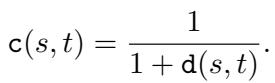
Finally, the Set-Level Syntactic Coverage is calculated. For every term \(s\) in the target sentence’s polynomial (\(T_x\)), we look for the best matching term in the entire set of selected examples (\(T_Z\)). We average these maximum similarities:

This formula ensures that every part of the target sentence’s structure finds a “buddy” somewhere in the selected examples.
Lexical Coverage
The researchers didn’t abandon word matching; they just made it part of the team. They measure set-level lexical coverage simply by looking at the overlap of words:

This calculates the percentage of words in the target input (\(W_x\)) that appear at least once in the selected example set (\(W_Z\)).
Innovation 3: The Alternating Selection Strategy
We now have two powerful metrics: Syntax Coverage and Word Coverage. How do we combine them?
The researchers chose a greedy, alternating approach.
- Step 1 (Odd): Select the example that maximizes the Syntactic Coverage of the set.
- Step 2 (Even): Select the example that maximizes the Word Coverage of the set.
- Repeat until \(k\) examples are chosen.
This ensures the LLM receives prompts that are both structurally similar (teaching it how to translate) and lexically similar (teaching it what to translate).
Experimental Setup and Results
Does this actually work? The researchers tested SCOI on two multi-lingual LLMs: XGLM (7.5B parameters) and Alpaca (7B parameters).
They focused on three language pairs involving English:
- German (DE)
- French (FR)
- Russian (RU)
They compared SCOI against several baselines:
- Zero-shot: No examples.
- Random: Random examples.
- BM25: Standard keyword search.
- CTQ Scorer: A complex, learning-based method (which requires training a separate regression model).
The Main Results
The results were evaluated using COMET, a modern metric for machine translation quality that correlates well with human judgment.
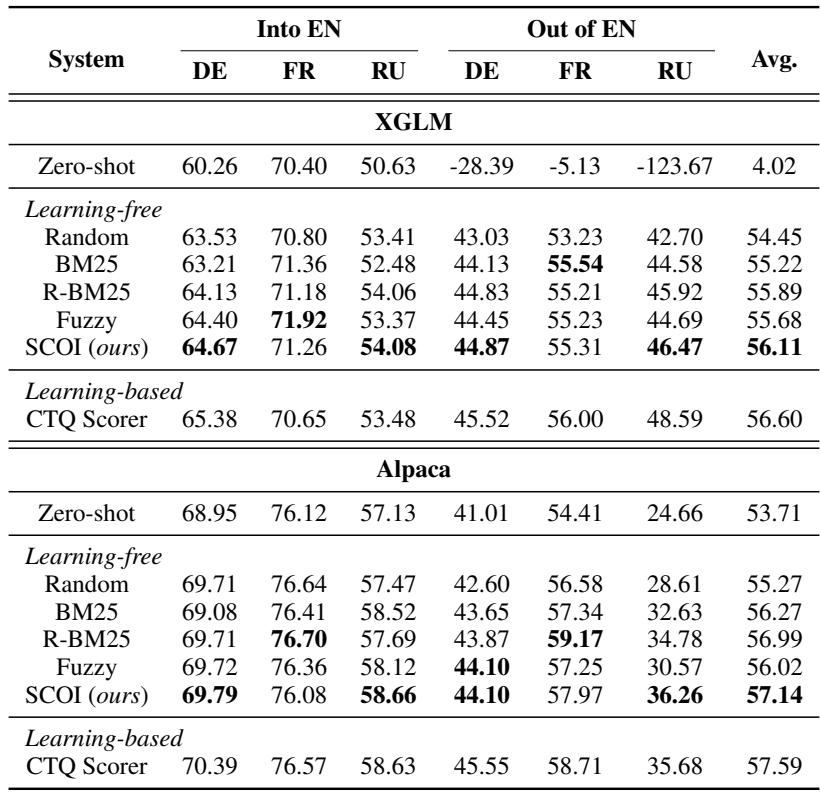
The table above highlights the success of SCOI.
- Top Performer: SCOI achieved the highest average COMET score (56.11 on XGLM) among all “learning-free” methods.
- Beating the “Smart” Methods: On Russian-to-English (RU-EN) and English-to-Russian (EN-RU), SCOI even outperformed the CTQ Scorer using Alpaca. This is impressive because CTQ requires training a model to pick examples, while SCOI is purely mathematical and requires no training.
- Low-Resource Boost: Note the massive improvement in English-to-Russian for Alpaca. Zero-shot Alpaca scored 24.66. With SCOI, it jumped to 36.26. This suggests that syntax examples are incredibly helpful for languages the model might be less familiar with.
Does Syntax Really Matter? (Ablation Study)
You might wonder, “Maybe it’s just the coverage mechanism, not the syntax?” The researchers tested this by running the system with only syntax or only word coverage.
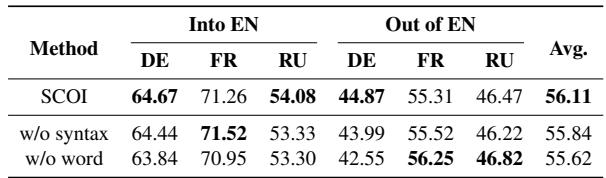
As shown in Table 3, removing either component hurts performance.
- w/o syntax: Drops performance significantly in German (DE).
- w/o word: Drops performance generally across the board.
- Combined (SCOI): Achieves the best average, proving that lexical and syntactic information complement each other.
A Real-World Example
To truly understand the impact, let’s look at a translation example provided in the paper.
Input (German): “…erzählte Bush dem Publikum von der Ausweitung des Handels in Asien.” English Meaning: “…Bush told the audience about the expansion of trade in Asia.”
The phrase “der Ausweitung” is a noun phrase (the expansion).
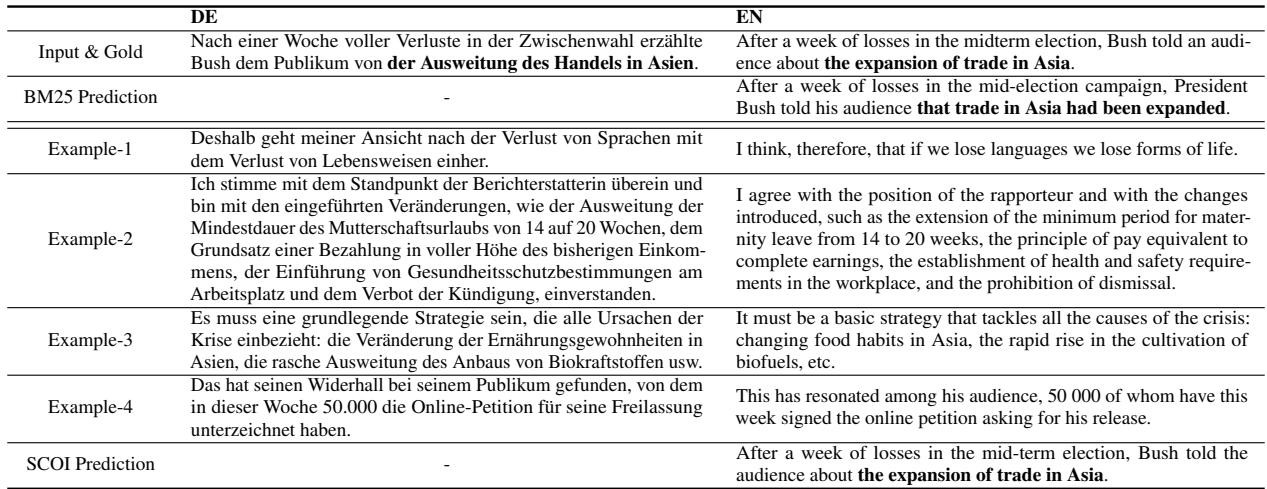
- BM25 (Word Match): The baseline method selected examples based on words. The LLM got confused by the structure and translated it as “…that trade in Asia had been expanded.” It turned a noun phrase into a reported clause with a past perfect verb (“had been”). This changes the nuance; “expansion” could be future or ongoing, while “had been expanded” implies it is finished.
- SCOI: Because SCOI selected Example 1 and Example 3 (which had very similar noun phrase structures involving “von” and genitive cases), the LLM perfectly replicated the structure: “…about the expansion of trade in Asia.”
This clearly demonstrates that providing the LLM with the right syntactic template allows it to map the grammar of the source sentence to the target language much more accurately.
Conclusion and Implications
The SCOI paper presents a compelling argument for re-evaluating how we prompt Large Language Models. While “vibes” and semantic meaning (embeddings) have dominated the conversation, strict linguistic structure (syntax) remains a powerful signal, especially for translation tasks.
Key Takeaways:
- Complexity Matters: By simplifying the tree-to-polynomial algorithm, the researchers made syntax analysis feasible for large-scale datasets.
- Sets over Individuals: Selecting examples that work together as a team (Set Coverage) is superior to picking the individual “best” examples.
- Hybrid Approaches Win: We don’t have to choose between words and grammar. By alternating selection criteria, we can give LLMs the best of both worlds.
This research opens the door for “Syntax-Augmented” generation in other fields. Could this help with code generation (matching Abstract Syntax Trees)? Could it help with complex reasoning tasks? As we continue to refine In-Context Learning, structure seems to be the next frontier.