](https://deep-paper.org/en/paper/2408.08310/images/cover.png)
If you have ever tried to train a Large Language Model (LLM), or even just fine-tuned one, you know the golden rule: Garbage In, Garbage Out. No matter how many GPUs you have or how advanced your architecture is, if your training data is low-quality, your model will be too.
This has led to a massive focus on “Data Curation.” The goal is to sift through the chaotic mess of the internet (like CommonCrawl) and find the high-quality needles in the haystack. However, current methods have a major flaw: they usually rely on a “reference” dataset—like Wikipedia or textbooks—to decide what looks “good.” This inevitably biases the model toward that specific style of writing, potentially killing diversity and creativity.
In this post, we are diving into a fascinating paper titled “ScalingFilter: Assessing Data Quality through Inverse Utilization of Scaling Laws.” The researchers propose a clever, reference-free method to identify high-quality data by exploiting the physics of how neural networks learn.
The Problem: Bias and Boredom in Data Filtering
Before we get to the solution, let’s understand why current filtering methods are problematic. Generally, filters fall into two camps:
- Reference-Dependent (The “Teacher’s Pet” Approach): You take a high-quality dataset (like Wikipedia) and train a classifier to find web pages that look like it.
- The Issue: If you only train on data that looks like Wikipedia, your model might struggle with informal dialogue, creative fiction, or coding forums. It limits the diversity of the data.
- Reference-Free (The “Perplexity” Approach): You use a small model to check how “surprised” it is by a text (perplexity). If the perplexity is too high, the text is considered “noisy” or “garbage” and is thrown out.
- The Issue: Low perplexity often means simple, repetitive text (e.g., “The cat sat on the mat”). High-quality but complex text might have higher perplexity. This method favors simplicity over quality.
We need a way to find data that is high quality without forcing it to look like an encyclopedia and without penalizing complexity.
The Solution: ScalingFilter
The authors introduce ScalingFilter, a method that assesses data quality by comparing how two different-sized models react to it.
The core intuition is brilliant but simple: High-quality data helps a model learn “faster” as the model gets bigger.
If you show a piece of text to a small model and a large model, the large model should be significantly better at predicting it than the small model. If the text is random garbage, the large model won’t have much of an advantage. If the text is high-quality, structured reasoning, the large model’s extra brainpower allows it to understand it much better than the small model.
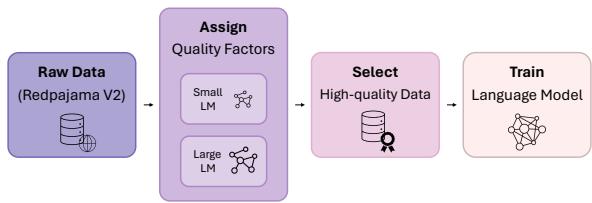
As shown in Figure 1, the process is straightforward:
- Take your raw data (like RedPajama or CommonCrawl).
- Pass the data through a Small LM and a Large LM (the “Meta-Models”).
- Calculate a Quality Factor based on the difference in their performance.
- Select the data with the highest Quality Factor to train your final model.
The Theory: Inverse Scaling Laws
To understand why this works, we have to look at Scaling Laws. In Deep Learning, scaling laws describe a power-law relationship: as you increase model parameters (\(N\)), the loss (\(L\)) decreases predictably.
The researchers analyzed this and found a crucial insight: The rate at which loss decreases depends on data quality.
- Low-Quality Data: Adding more parameters to the model yields diminishing returns. The loss curve is flat.
- High-Quality Data: Adding more parameters yields massive gains. The loss curve is steep.
This is visualized beautifully below:
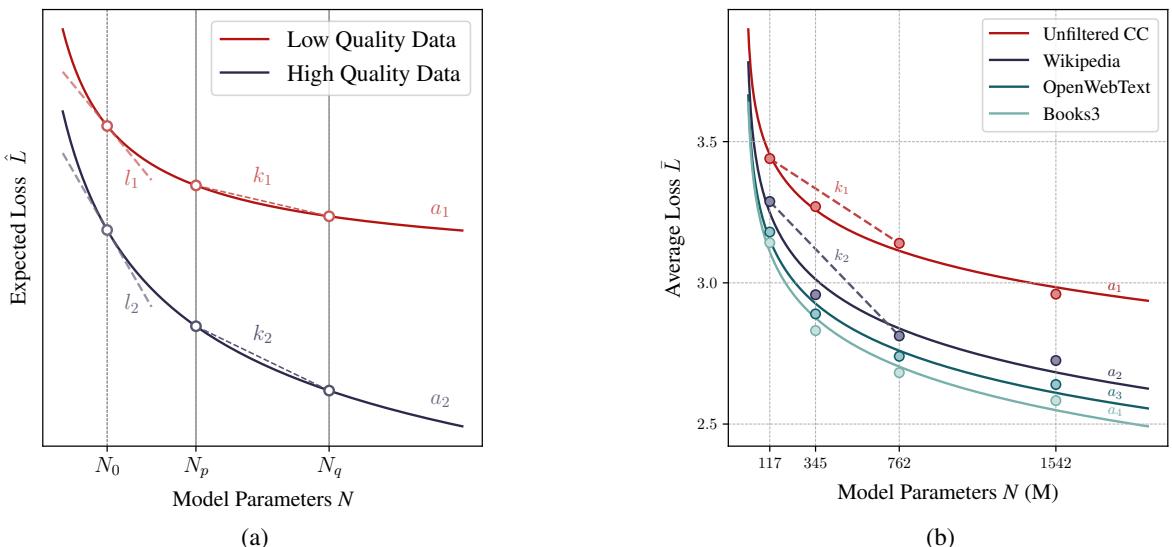
In Graph (a), notice the slope differences. The “High Quality Data” curve drops much sharper than the “Low Quality Data” curve. In Graph (b), the authors tested this with real datasets. Wikipedia (Dark Blue) and OpenWebText (Teal) have much steeper slopes than Unfiltered CommonCrawl (Red).
The Quality Factor (\(d_i\))
So, how do we turn this observation into a filter? We measure the “steepness” of that slope for every single document in our dataset.
We define the Quality Factor (\(d_i\)) for a text sample \(x_i\) as the ratio of the perplexity (PPL) of the small model (\(p\)) to the large model (\(q\)):
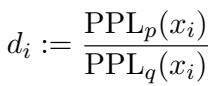
Here, \(PPL_p\) is the perplexity of the small model (e.g., 124M parameters), and \(PPL_q\) is the perplexity of the large model (e.g., 774M parameters).
- If the large model is much better than the small model, the denominator becomes small, and \(d_i\) becomes large. This indicates High Quality.
- If the large model isn’t much better than the small model, the ratio is closer to 1. This indicates Low Quality.
The authors mathematically prove that this Quality Factor \(d\) is directly proportional to the scaling exponent \(a\) (which represents how efficiently a model scales).
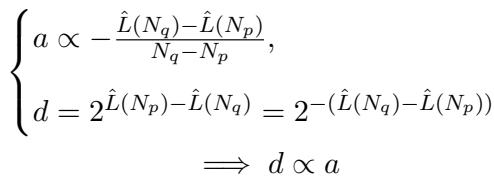
In simple terms: Selecting for a high Quality Factor (\(d\)) is mathematically equivalent to selecting data that follows a better scaling law.
Measuring Diversity: A New Metric
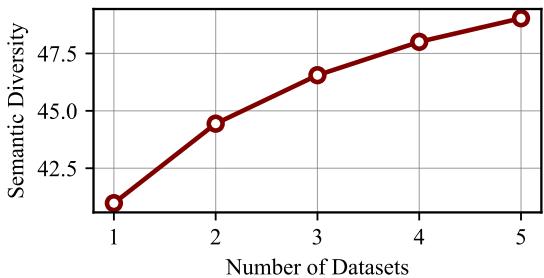
One of the main critiques of filtering is that it kills diversity. But how do we measure “diversity” in a massive text dataset? The authors propose a metric called Semantic Diversity.
They use an embedding model to turn documents into vectors and then calculate the entropy of the eigenvalues of the similarity matrix. It sounds complex, but it essentially measures how “spread out” the semantic meanings of the documents are.

To prove this metric works, they mixed different distinct datasets (News, Reddit, Wikipedia, etc.) together. As expected, the more distinct sources they added, the higher the Semantic Diversity score climbed.
Experiments and Results
Does ScalingFilter actually result in better LLMs? The researchers put it to the test.
The Setup:
- Source Data: 500GB of CommonCrawl (web data).
- Meta-Models: A 124M parameter GPT-2 (small) and a 774M parameter GPT-2 (large).
- Final Training: They filtered the data and trained a 1.3 Billion parameter model from scratch on the curated datasets.
The Baselines: They compared ScalingFilter against:
- Random Selection: (The baseline).
- Binary Classification: The industry standard (training a classifier to spot “Wikipedia-like” content).
- Perplexity Gating: Throwing out data with high perplexity.
1. Downstream Performance
They evaluated the final 1.3B models on zero-shot tasks like Hellaswag (sentence completion), PIQA (physics questions), and ARC (reasoning).

Key Takeaways from Table 1:
- ScalingFilter (Ours) wins: It achieved the highest average accuracy (51.27%), beating the widely used Binary Classification method (50.65%).
- Beating Perplexity Gating: It significantly outperformed simple Perplexity Gating (50.15%), proving that just looking at raw perplexity isn’t enough—you need the difference between models.
2. Diversity Analysis
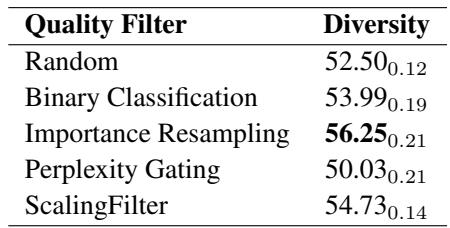
Did ScalingFilter maintain the richness of the data?
Key Takeaways from Table 5:
- Importance Resampling had the highest diversity but, as seen in the previous table, lower accuracy. This suggests it might have kept too much “noisy” diverse data.
- ScalingFilter achieved a sweet spot. It had higher diversity (54.73) than Binary Classification (53.99) and significantly higher than Perplexity Gating (50.03).
This confirms that ScalingFilter removes “bad” noise without removing “good” complexity and variety.
3. Does the size of the Meta-Models matter?
You might wonder, do we need specific model sizes for this to work? The authors ran ablations (tests) using different gaps between the small and large models.

The results suggest that the gap matters. Using a 124M and a 774M model (a large gap) worked better than using two models that were closer in size (e.g., 335M and 774M). A larger parameter gap seems to amplify the “signal” of data quality, making the filter more effective.
Conclusion
The ScalingFilter paper offers a refreshing perspective on data curation. Instead of relying on human-curated “gold standards” which introduce bias, or raw perplexity which penalizes complexity, it uses the fundamental properties of neural scaling.
By asking, “Does a bigger brain understand this text significantly better than a smaller brain?” we can identify data that contains genuine, learnable signals.
Key Takeaways:
- Reference-Free is Possible: We can find high-quality data without needing a “perfect” reference dataset like Wikipedia.
- Inverse Scaling Laws: High-quality data is defined by its ability to drive loss down faster as model size increases.
- Better Performance & Diversity: ScalingFilter produces models that are both more accurate and trained on more semantically diverse data than traditional methods.
As we move toward training larger and larger models, efficient data selection becomes critical. ScalingFilter provides a mathematically grounded, bias-resistant way to feed our AI systems the high-quality diet they need to grow.