](https://deep-paper.org/en/paper/2408.10276/images/cover.png)
Introduction
Imagine a “Super Doctor AI”—a foundation model capable of analyzing X-rays, reading clinical notes, interpreting ECG signals, and predicting mortality risks, all with expert-level precision. We have seen the rise of Large Language Models (LLMs) like GPT-4, and their medical counterparts are beginning to emerge. However, in the healthcare domain, we hit a massive wall: Privacy.
To build a truly generalist medical AI, you need access to massive amounts of diverse patient data stored in hospitals around the world. But regulations like HIPAA (in the US) and GDPR (in the EU) rightly make it nearly impossible to centralize this sensitive data into one giant training server.
This creates a paradox: We need big data to train big models, but we cannot move the data.
Furthermore, current medical models are often “one-trick ponies.” They might be great at reading text but blind to images, or good at X-rays but illiterate regarding lab results.
In this post, we are deep-diving into FEDKIM, a novel framework proposed by researchers from Pennsylvania State University and Georgia State University. FEDKIM solves this paradox by combining Federated Learning (FL) with Knowledge Injection. It allows a centralized Foundation Model to “learn” from private, decentralized data without that data ever leaving the hospital, effectively injecting medical knowledge into a frozen Large Language Model (LLM).
The Problem: Data Silos and Specialized Models
Before we understand the solution, we must understand the limitations of the current landscape. Most existing medical foundation models are trained on public datasets. While impressive, they suffer from two major flaws:
- They are unrealistic for large-scale application: You cannot train a model on all medical data because you cannot collect it in one place.
- They are modality-constrained: As shown in the table below, most current models specialize in just one or two modalities (usually text or text+image). Real-world diagnosis is messy and involves vitals, lab results, waveforms, and imaging simultaneously.
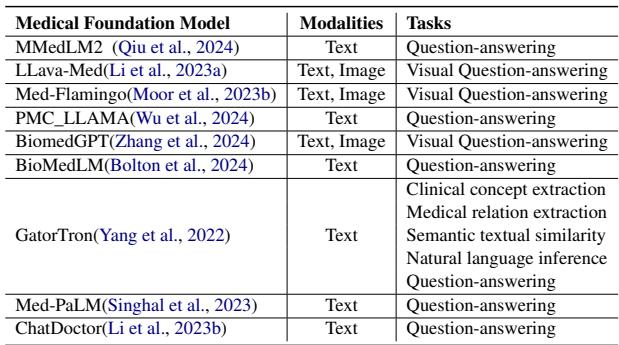
The researchers propose a solution that keeps the heavy Foundation Model on a server but uses lightweight “Knowledge Extractors” at the hospitals (clients).
The FEDKIM Framework: An Overview
FEDKIM stands for Federated Knowledge Injection for Medical foundation models.
The core idea is distinct from standard Federated Learning. in standard FL, the entire model is usually sent to the clients. However, Medical Foundation Models are huge (billions of parameters). Sending them to every hospital server is computationally expensive and slow.
Instead, FEDKIM flips the script:
- Server: Hosts the large, frozen Medical Foundation Model.
- Clients (Hospitals): Host lightweight, modality-specific Encoders (Knowledge Extractors).
The clients train their small encoders on private patient data. They send only the parameters of these small encoders to the server. The server then “injects” this learned knowledge into the large Foundation Model.
Let’s look at the high-level architecture:
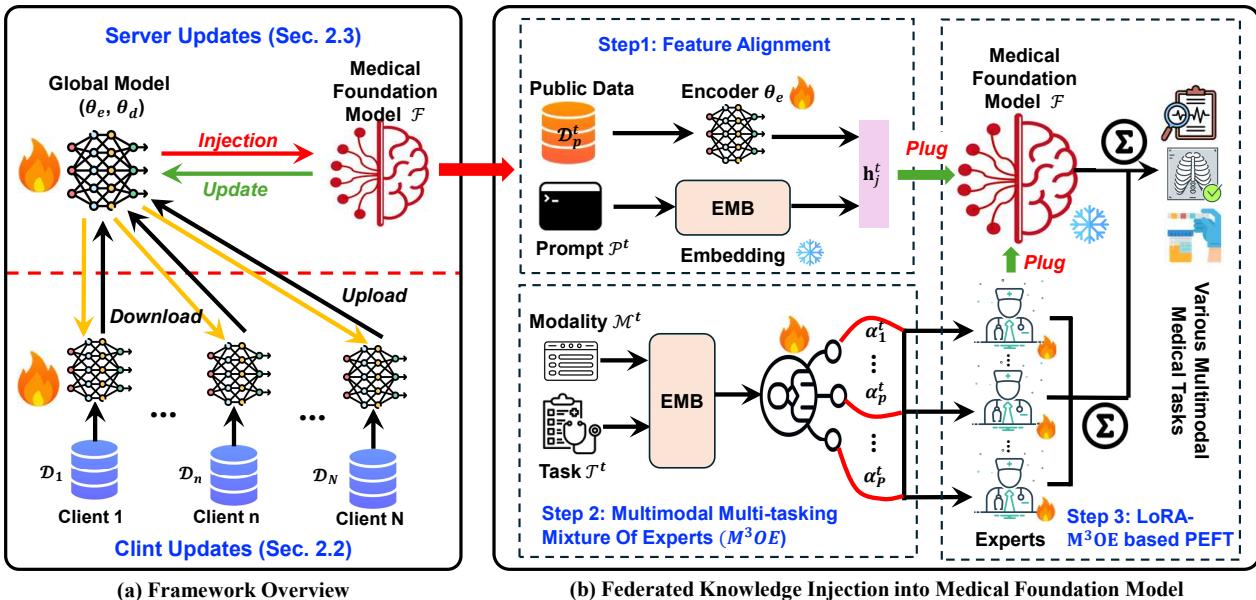
As you can see in Part (a) of the figure above, the process is cyclical. The global model aggregates updates from clients, injects them into the Foundation Model (\(\mathcal{F}\)), refines them using a small set of public data on the server, and sends the updated encoders back to the clients.
Step-by-Step: How Knowledge Injection Works
This is the most technically fascinating part of the paper. How do you take a small encoder trained on private ECG data in a hospital and force a giant text-based LLM to understand it?
The process occurs in three specific steps (as shown in Part (b) of Figure 1 above).
Step 1: Feature Alignment
First, the server receives the encoders from various clients. These encoders have learned how to process specific medical modalities (like an X-ray or an ECG signal) into feature vectors.
However, the Foundation Model (let’s say, a variant of LLaMA tailored for medicine) doesn’t inherently “speak” the language of these feature vectors.
The system uses a Feature Alignment strategy. It takes the features \(h\) produced by the encoders and projects them into the semantic space of the Foundation Model. It essentially translates “image features” into “word embeddings” that the LLM can understand. This is done using a learnable projection layer.
Step 2: Multitask Multimodal Mixture of Experts (\(M^3OE\))
This is the core innovation of the paper. A naive approach would be to just jam all these features into the LLM. But different medical tasks require different types of attention. Diagnosing COVID-19 from an X-ray is different from predicting mortality based on lab results.
To handle this, the authors introduce the Multitask Multimodal Mixture of Experts (\(M^3OE\)).
The \(M^3OE\) module acts as a smart switchboard. It decides which “experts” (sub-modules) are needed to handle the current input based on two factors:
- The Modality: (e.g., Is this an image? A signal?)
- The Task: (e.g., Is this a classification task? A QA task?)
The mechanism calculates a gating weight \(\alpha^t\) to select the right experts. The mathematical formulation for this selection uses an attention mechanism:

Here’s what the equation tells us:
- \(\mathcal{M}^t\) and \(\mathcal{T}^t\) represent the modality and task descriptions.
- The model computes the relationship (attention) between the task and the modality.
- The result, \(\alpha^t\), determines how much influence each “expert” should have on the final output.
This dynamic selection allows the model to be a “generalist” that can switch contexts instantly.
Step 3: Parameter-Efficient Fine-Tuning (LoRA)
Training the entire Foundation Model on the server would be too slow and require too much data. Instead, the authors use LoRA (Low-Rank Adaptation).
LoRA freezes the pre-trained model weights and injects trainable rank decomposition matrices into each layer of the Transformer architecture. In FEDKIM, the \(M^3OE\) module specifically manipulates these LoRA adapters.
The final representation for each layer in the Foundation Model is calculated as:
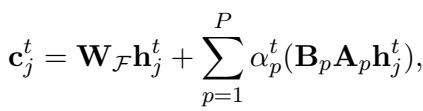
- \(\mathbf{W}_{\mathcal{F}}\): The frozen parameters of the Foundation Model (the massive brain).
- \(\mathbf{B}_p \mathbf{A}_p\): The p-th expert system (the LoRA adapter).
- \(\alpha_{p}^{t}\): The weight assigned to that expert by the \(M^3OE\) module.
By doing this, FEDKIM injects knowledge into the model without destroying the pre-trained capabilities of the LLM, and it does so efficiently.
The Federated Learning Backbone
While the injection happens on the server, the extraction of knowledge happens on the clients using Federated Learning.
The clients optimize their local encoders to minimize the loss on their private data tasks:

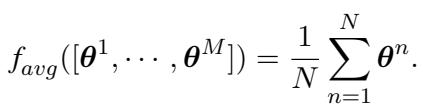
Once trained, these parameters are sent to the server. The server aggregates them using standard FL algorithms. The paper explores two major aggregation strategies:
- FedAvg: Simple averaging of parameters.
- FedProx: A more robust method that handles heterogeneity (differences) in client data better.
Experiments and Results
The researchers rigorously tested FEDKIM across a diverse set of medical challenges.
The Setup:
- 12 Tasks encompassing classification and generation.
- 7 Modalities, including X-rays (Image), ECGs (Signal), Vital signs, Lab events, and Clinical text.
- Backbone Model: MMedLM-2 (a specialized medical LLM).
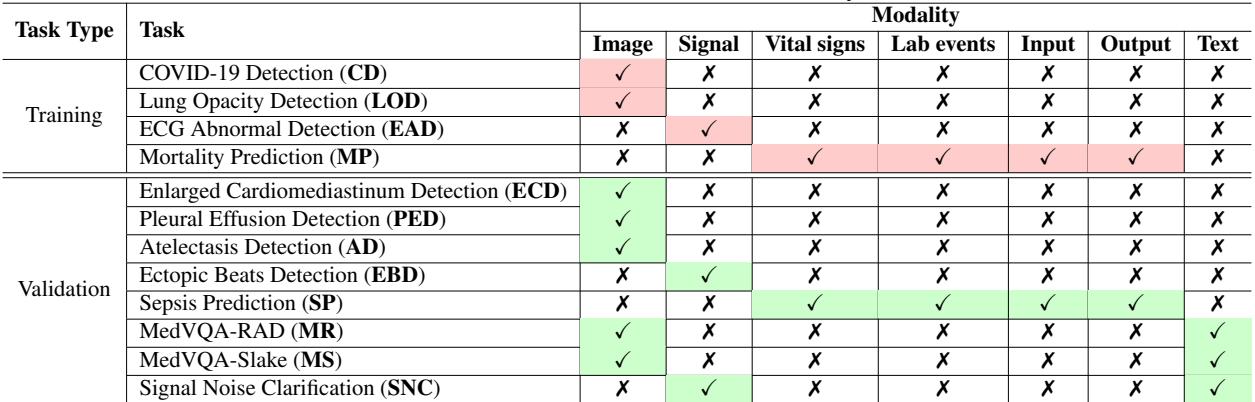
A detailed list of the tasks and the modalities they utilize can be found here:
1. Zero-Shot Evaluation (The Real Test)
The most impressive claim of Foundation Models is their ability to perform tasks they haven’t explicitly been trained on (Zero-shot learning).
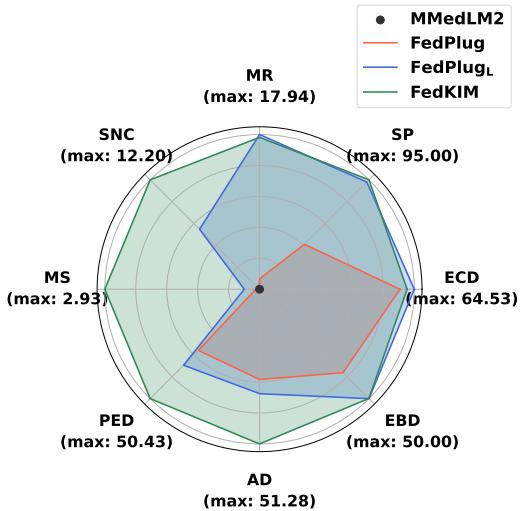
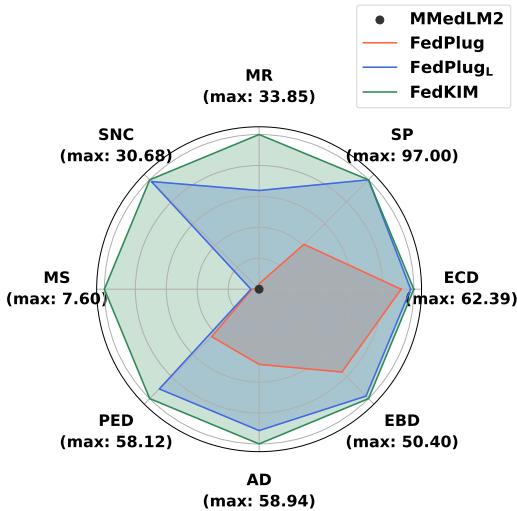
The authors trained FEDKIM on a set of “Training Tasks” (like COVID-19 detection) and then tested it on completely “Unseen Tasks” (like Sepsis Prediction or Visual QA).
The results were visualized in radar charts. Below is the comparison using FedAvg as the aggregator:
And here is the performance using the more advanced FedProx aggregator:
Key Takeaways from the Charts:
- FEDKIM (Green line) consistently encompasses the other shapes, meaning it achieves higher accuracy/scores across almost all unseen tasks (SP, ECD, PED, AD).
- FedPlug (Orange line), a baseline that just plugs in encoders without the adaptive \(M^3OE\) module, performs significantly worse. This proves that how you inject knowledge (using the Mixture of Experts) matters just as much as the knowledge itself.
- MMedLM-2 (Black dot), the original foundation model without federated knowledge injection, effectively fails at these multimodal tasks because it lacks the modality-specific encoders trained on the private data.
2. Fine-Tuning Performance
The researchers also checked how well the model performed on the tasks it was trained on (Fine-tuning evaluation).
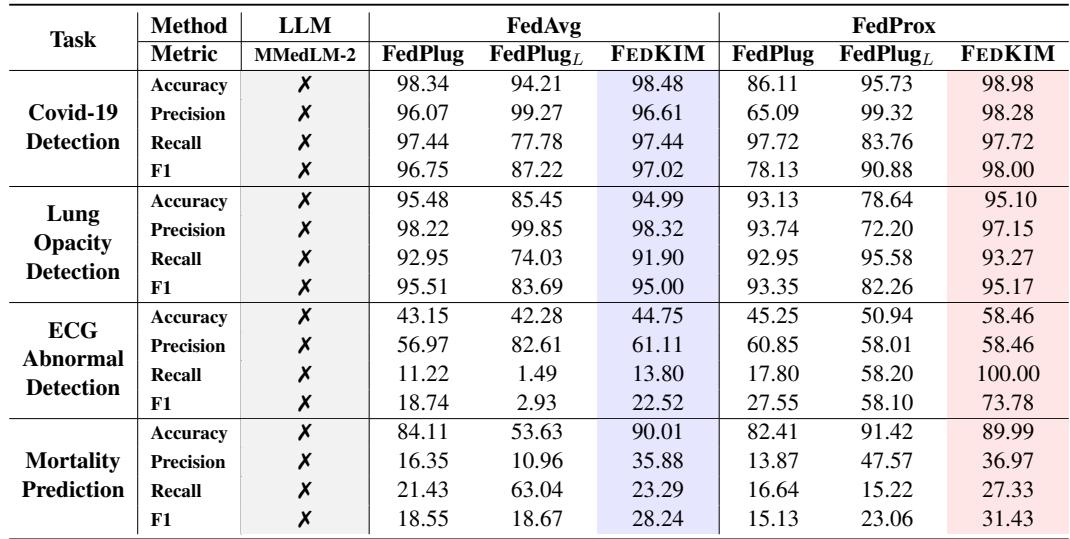
Looking at Table 3, FEDKIM achieves superior accuracy and F1 scores compared to the baselines (FedPlug and FedPlug-LoRA). For example, in ECG Abnormal Detection (a difficult signal processing task), FEDKIM with FedProx achieves an F1 score of 73.78, while the baseline FedPlug only manages 27.55.
This massive gap highlights the power of the Adaptive Mixture of Experts. Because the model can dynamically route the ECG signal to the correct “expert” modules, it interprets the waveform far better than a static model could.
Why This Matters
The FEDKIM paper presents a significant step forward for Medical AI. It successfully addresses the “Privacy vs. Utility” trade-off.
- Privacy Preserved: Patient X-rays and notes never leave the local hospital. Only the mathematical weights of a small encoder are transmitted.
- Multimodal Mastery: By using specialized local encoders and a central Mixture of Experts, the model becomes a true generalist, capable of understanding the diverse language of medicine (images, signals, and text).
- Scalability: Since the massive Foundation Model stays on the server, hospitals don’t need supercomputers to participate. They only need to train lightweight encoders.
This architecture paves the way for a future where a global Medical AI can learn from every hospital in the world, constantly improving its diagnostic capabilities without ever compromising a single patient’s privacy.