](https://deep-paper.org/en/paper/2408.10764/images/cover.png)
Large Language Models (LLMs) are undeniably impressive. They can write poetry, debug code, and summarize history. However, anyone who has worked with them extensively knows they are not without their flaws. They can hallucinate, produce toxic content, or fail at complex reasoning tasks.
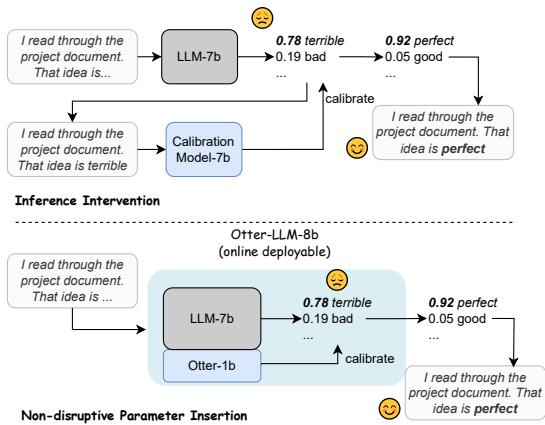
To fix this, we generally have two options: finetuning the model (which risks “catastrophic forgetting,” where the model loses its original knowledge) or inference intervention. Inference intervention involves using a separate, smaller “calibration” model (often a Reward Model) to guide the main LLM during text generation.
While inference intervention is effective, it is computationally expensive. It requires running two models simultaneously—the massive LLM and the calibration model—which doubles the memory requirements and significantly slows down generation.
But what if we didn’t need a separate model? What if we could smuggle the calibration mechanism inside the main LLM without disturbing its original knowledge?
In this post, we will explore Otter (NOn-disruptive parameTER insertion), a novel architecture proposed by researchers from the University of Manchester and Alibaba Group. Otter creates a “sidecar” within the transformer architecture, allowing the model to predict rewards or calibration signals alongside normal tokens, saving up to 86.5% of memory and 98.5% of time compared to traditional methods.
The Problem with Current Interventions
Before diving into Otter, let’s clarify the bottleneck it solves.
In a standard Inference Intervention setup (like the ARGS or DEXP methods), you have your base LLM (say, Llama-7B) generating text. To ensure this text is safe or high-quality, you run the generated tokens through a secondary “Reward Model” or “Expert Model.” This secondary model scores the tokens, and the system adjusts the probabilities accordingly.
The downsides are obvious:
- Space Overhead: You need GPU memory for both models.
- Time Overhead: Data has to pass through the LLM, then the Reward Model, and then back again for the next step.
- Latency: This back-and-forth kills real-time performance.
Otter proposes a different approach: Parameter Insertion. instead of an external model, why not add a small set of trainable parameters inside the LLM’s layers? These parameters “ride along” with the original computation, calculating the reward signal in parallel with the next token prediction.
The Core Method: Inside the Otter Architecture
The genius of Otter lies in how it modifies the standard Transformer block. It introduces a concept we can call “Extended Hidden States.”
In a standard Transformer, a hidden state \(h\) passes through layers. In Otter, the hidden state is expanded to \(\tilde{h} = [h, h']\).
- \(h\) is the original hidden state (frozen, untouched).
- \(h'\) is the new “Otter” state (trainable).
This allows the model to carry two streams of information simultaneously: the original language generation context and the new intervention/reward signal.
Let’s look at the architecture:
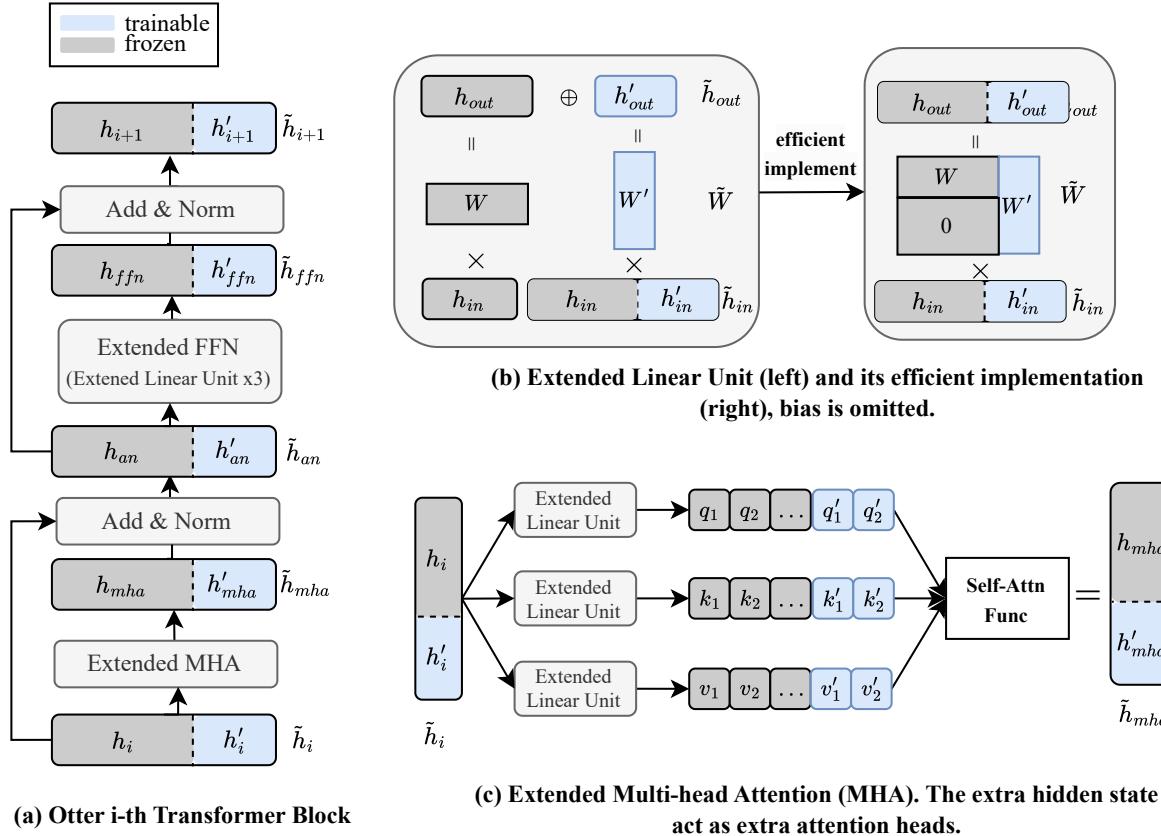
As shown in Figure 2, Otter inserts parameters into two specific areas: the Feed-Forward Network (FFN) and the Multi-Head Attention (MHA) layers.
1. FFN Layer Adaptation
In a standard FFN layer, the input is projected by weight matrices to a larger dimension and then projected back. Otter expands these weight matrices.
Imagine the original weight matrix \(W\). Otter creates a new, larger matrix by concatenating a zero-matrix and a new trainable matrix \(W'\).
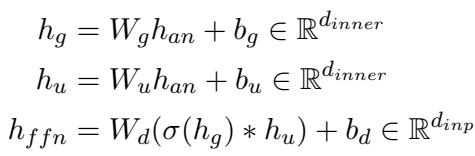
The key here is the “non-disruptive” nature. By structuring the matrices carefully (often utilizing zero-initialization or specific masking), the calculation for the original part of the hidden state (\(h\)) remains mathematically identical to the original model. The new parameters only affect the new part of the hidden state (\(h'\)). This means the original LLM doesn’t even “know” the Otter parameters are there.
2. Multi-Head Attention (MHA) Adaptation
The attention mechanism is where tokens relate to one another. Otter adapts this by adding extra attention heads.
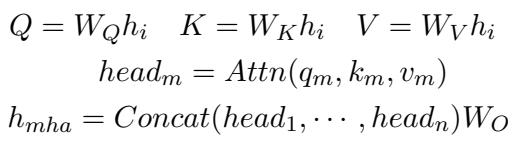
The original heads (\(head_1\) to \(head_n\)) remain frozen. Otter introduces new heads that process the extended state information. The results are concatenated. Because the original heads are untouched, the core language modeling capability is preserved perfectly. This seamless integration allows Otter to work with modern optimizations like FlashAttention without breaking them.
3. The “Non-Disruptive” Secret: RMSNorm
There is one specific operation in Transformers that poses a risk to this “non-disruptive” goal: Layer Normalization.
Standard normalization (like RMSNorm) looks at the entire vector to calculate variance. If we include the new Otter parameters (\(h'\)) in this calculation, their values would shift the mean and variance, altering the normalized values of the original hidden state (\(h\)). This would effectively “break” the original model, leading to degradation in text quality.
To solve this, the researchers modified the normalization step:
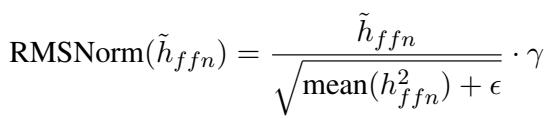
In this modified RMSNorm, the variance is calculated only using the original hidden state (\(h_{ffn}\)), ignoring the Otter state (\(h'_{ffn}\)). This ensures that the original part of the vector is normalized exactly as it would be in the base model, preserving the original distribution perfectly.
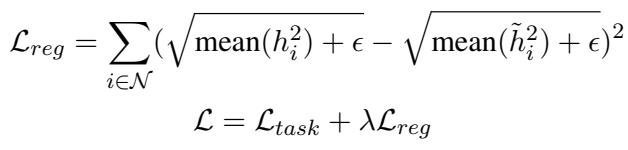
To enforce stability during training, they also add a regularization term to the loss function. This term penalizes the model if the statistics of the combined state deviate too wildly, ensuring the new parameters behave well alongside the old ones.
Experimental Results
The researchers tested Otter on three demanding tasks: Alignment (Helpful/Harmless), Detoxification, and Speculative Decoding.
Task 1: Alignment (Helpful and Harmless)
The goal here is to guide the LLM to produce answers that are safe and useful, similar to RLHF (Reinforcement Learning from Human Feedback) but done at inference time.
They compared Otter against ARGS, a state-of-the-art method that uses a separate reward model. They used the Llama-7b model.
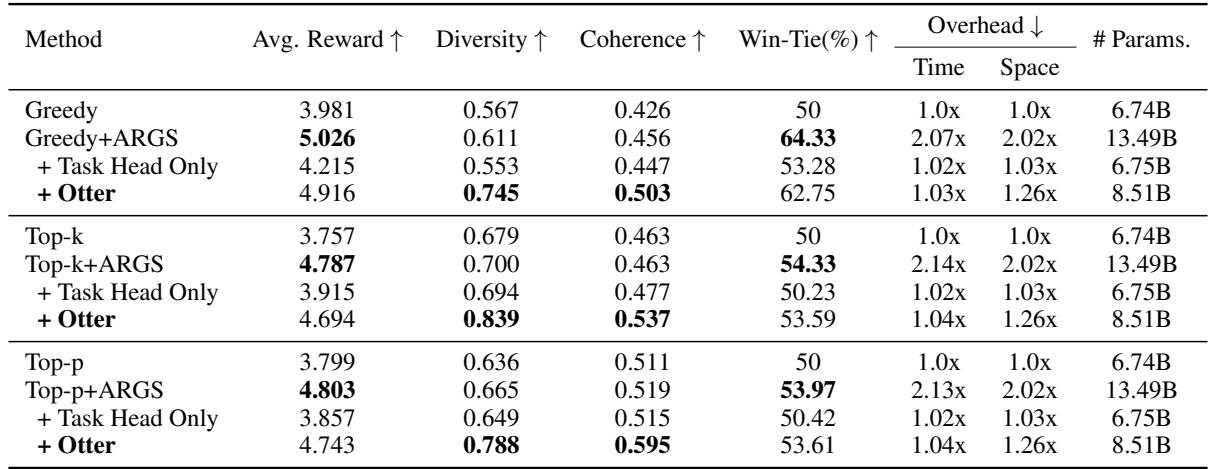
Key Takeaways from Table 1:
- Performance: Otter achieves an Average Reward (4.916) and Win-Tie rate (62.75%) that is comparable to the heavy ARGS model (Reward 5.026).
- Space Overhead: ARGS requires 2.02x the memory (since it loads a second model). Otter only requires 1.26x.
- Time Overhead: ARGS doubles the inference time (2.07x). Otter is almost invisible, with only 1.03x time overhead.
This means you get the safety benefits of a reward model with almost zero latency cost.
We also see similar efficiency gains when testing on larger models like Llama2-7b-chat:
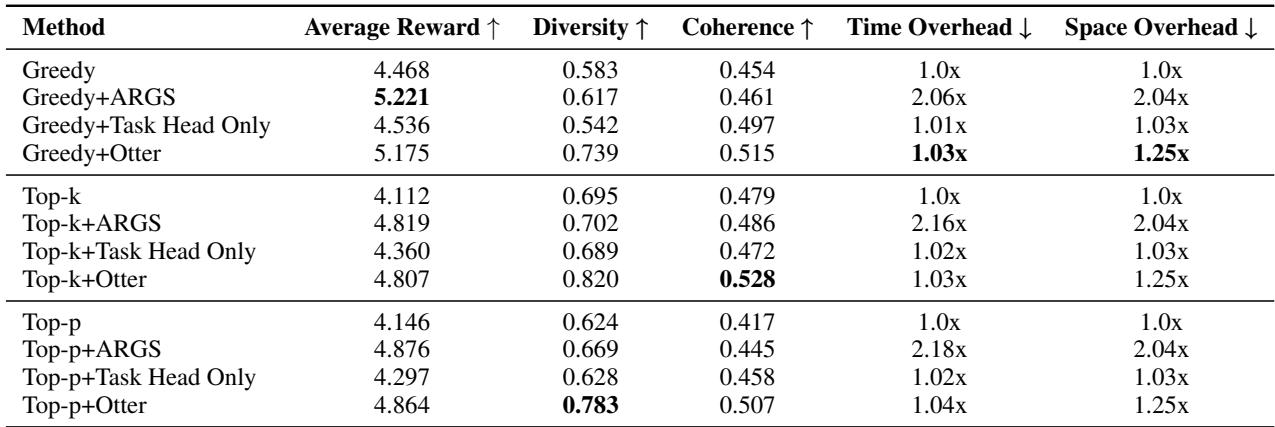
Even on the more advanced Llama2, Otter maintains that sweet spot of high reward scores with minimal computational cost.
Task 2: Detoxification
The researchers used the “RealToxicityPrompts” dataset to see if Otter could prevent a GPT-2 model from generating toxic text.
The results mirrored the alignment task. Otter reduced the toxicity probability significantly (from ~52% in the base model down to ~16%) while maintaining text fluency. Most importantly, it did this with a fraction of the parameter count required by the “DEXP” baseline, which uses large expert and anti-expert models to steer generation.
Task 3: Speculative Decoding (Speedup)
This is a fascinating application. Speculative Decoding is a technique where a small “draft” model guesses the next few tokens, and the big model verifies them. If the draft is right, you save time.
Otter can be trained to act as this “draft” model inside the main model. Instead of predicting a reward, the Otter heads predict the next few tokens.
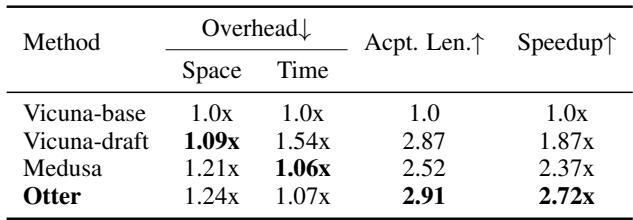
As shown in Table 3, Otter outperforms standard speculative decoding (Vicuna-draft) and the “Medusa” architecture.
- Speedup: Otter achieves a 2.72x speedup over the base model.
- Accept Length: On average, 2.91 tokens generated by Otter are accepted per step, which is higher than the baselines.
Does Initialization Matter?
Since Otter adds new parameters to a pre-trained model, how you initialize those parameters matters. The researchers tested Random initialization, Normal initialization, and Parameter Copying (copying weights from the original model to the new Otter slots).

Figure 3 shows that Parameter Copying (green line) is the superior strategy. It leads to faster convergence (lower loss) and higher reward values/accuracy compared to random initialization. This makes sense: starting with the “knowledge” of the base model gives the Otter parameters a head start.
Training Efficiency
Finally, one might wonder if training these internal parameters is difficult.
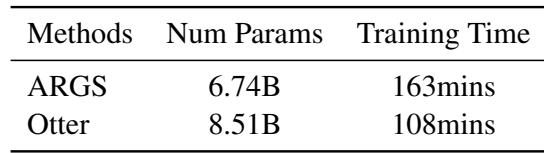
Table 8 puts those fears to rest. Training Otter is actually faster (108 mins vs 163 mins) than training the separate ARGS model, likely because Otter leverages the shared forward pass of the frozen backbone more efficiently.
Conclusion and Implications
The Otter paper presents a compelling shift in how we think about controlling LLMs. For a long time, the assumption was that to control a model, you either had to fundamentally change it (finetuning) or supervise it from the outside (external reward models).
Otter proves there is a third way: internal augmentation. By inserting non-disruptive parameters:
- We keep the original model’s “brain” intact (no catastrophic forgetting).
- We avoid the latency of external supervision.
- We achieve state-of-the-art performance in alignment, safety, and speed.
For students and researchers, this opens up exciting avenues. It suggests that LLM architectures are not immutable monoliths but flexible backbones that can support multiple parallel “intentions” (like generation + safety check) in a single forward pass. As models get larger, efficient techniques like Otter will likely become the standard for deploying safe, aligned AI in production environments.