](https://deep-paper.org/en/paper/2408.15270/images/cover.png)
Hoops in the Matrix: How SkillMimic Teaches Physics-Based Characters to Play Basketball
If you’ve ever played a sports video game, you know that while the graphics look realistic, the underlying animation is often just a “playback” of a recorded motion. But in the world of robotics and physics-based simulation, we want something different: we want a digital character that actually “learns” to move its muscles to perform a task, adhering to the laws of physics.
We have gotten pretty good at teaching these simulated characters to run or backflip (locomotion). But handing them an object—like a basketball—changes everything. Suddenly, the character needs to synchronize its body movements with an external object that bounces, spins, and flies.
In this post, we are diving deep into SkillMimic, a research paper that proposes a groundbreaking data-driven framework. This system allows physically simulated humanoids to learn complex basketball skills—dribbling, shooting, layups, and picking up balls—purely from demonstration data, without the need for painfully hand-crafted rewards for every single move.
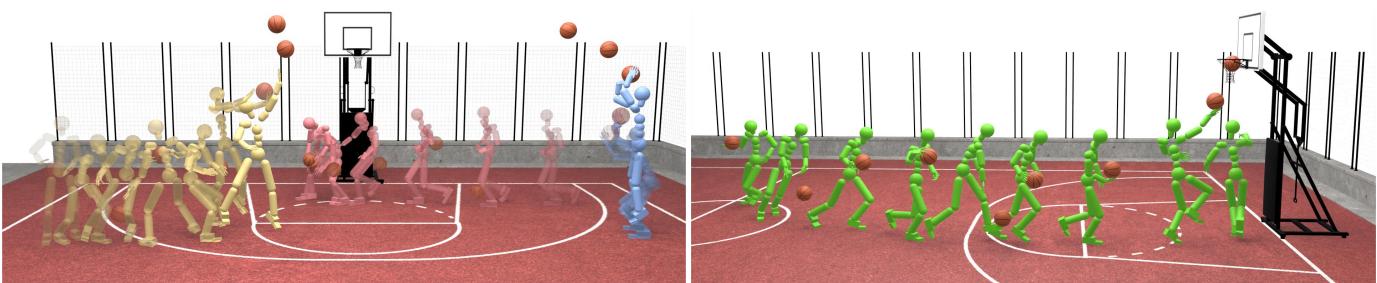
1. The Core Problem: Why is Basketball So Hard for AI?
In Reinforcement Learning (RL), agents learn by trial and error. To teach an agent, you define a reward function—a score that tells the agent, “Good job, you did the right thing.”
For simple running, the reward might be “stay upright and move forward.” But for Human-Object Interaction (HOI), specifically basketball, it’s a nightmare. If you want a character to dribble, you need to reward hand placement, force application, ball height, and rhythm. If you want them to shoot, you need a completely different set of rewards.
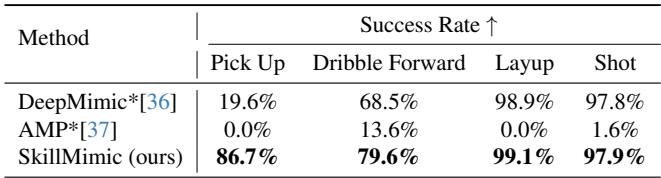
Previous methods (like DeepMimic or AMP) excel at imitating body motion but fail when objects are involved. They often result in “floaty” physics where the ball doesn’t quite stick to the hand correctly, or the character ignores the ball entirely.
The researchers behind SkillMimic asked a crucial question: Can we design a single, unified framework that learns all these skills just by looking at data, without manual tweaking for each skill?
2. Background: From Motion Capture to Simulation
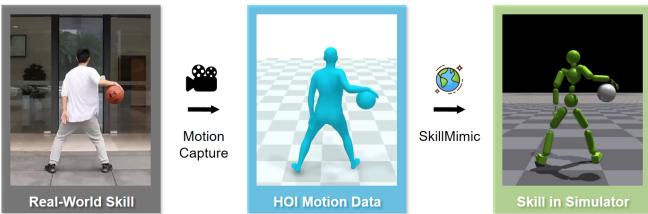
Before understanding the solution, we need to understand the input. The system relies on Human-Object Interaction (HOI) data. This is essentially motion capture data that records two things simultaneously:
- The pose of the human (joint angles, limb positions).
- The state of the object (ball position and rotation).
The researchers introduced two datasets for this work: BallPlay-V (extracted from video) and BallPlay-M (high-precision optical motion capture).
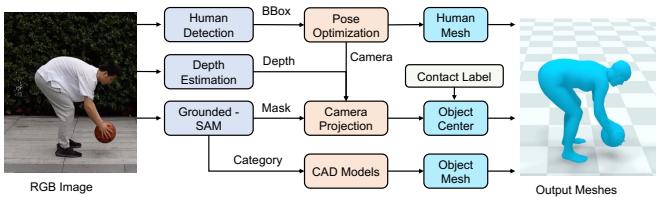
As shown above, creating this data involves sophisticated pipelines to extract 3D human meshes and object trajectories from video. However, having the data is only step one. The challenge is transferring that recorded motion into a physics simulator where a character has to actively balance and manipulate the ball using simulated muscles (PD controllers).
3. The SkillMimic Framework
The core philosophy of SkillMimic is simple: Imitation via State Transitions.
An “interaction skill” is defined as a sequence of states where the human and the object change over time. If the simulated character can make itself and the ball mimic these transitions, it has learned the skill.
3.1 The Architecture
The system is built on a standard Reinforcement Learning setup.
- The Policy (The Brain): A neural network takes in the current state of the world (body pose, ball position, etc.) and outputs actions (target angles for the body’s joints).
- The Environment: A physics simulator (Isaac Gym) that calculates the result of those actions.
The input to the policy is comprehensive. It sees the “proprioception” (body state), fingertip contact forces, and the object’s state.

3.2 The Secret Sauce: A Unified HOI Imitation Reward
The biggest contribution of this paper is the Unified HOI Imitation Reward. Instead of adding different rewards together (e.g., Reward = Body + Ball + Contact), the researchers utilize multiplication.
Why multiplication? In an additive system, if the agent ignores the ball but mimics the body motion perfectly, it still gets a decent score. In a multiplicative system, if any component (like ball control) is zero, the entire reward is zero. This forces the agent to pay attention to every aspect of the interaction.
The total reward \(r_t\) is calculated as:

Let’s break down these terms:
- \(r_t^b\): Body Kinematics. Is the body moving like the reference data?
- \(r_t^o\): Object Kinematics. Is the ball moving like the reference data?
- \(r_t^{rel}\): Relative Motion. Is the ball in the correct position relative to the body (e.g., near the hand)?
- \(r_t^{reg}\): Regularization. Prevents jittery, unnatural shaking.
- \(r_t^{cg}\): Contact Graph Reward. This is the game-changer.
3.3 The Contact Graph (CG)
Standard RL struggles with the precise moment a hand touches a ball. The researchers solved this by modeling the interaction as a Contact Graph.
Imagine a graph where the nodes are the “Left Hand,” “Right Hand,” “Body,” and “Ball.” An edge (connection) exists between two nodes if they are touching.
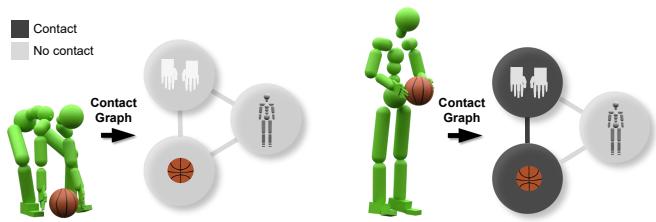
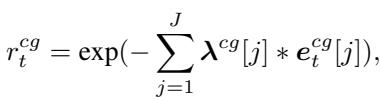
The Contact Graph Reward (\(r_t^{cg}\)) measures the error between the simulated contact graph and the reference contact graph. If the reference data says “Ball is touching Right Hand,” the simulated character is heavily penalized if that contact isn’t happening in the simulation.
The mathematical formulation for this specific reward component is:
Why is the Contact Graph so important?
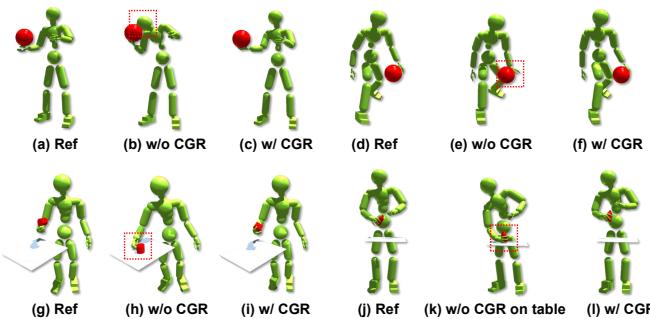
Without it, the physics simulation finds “cheats” or local optima. For example, without the contact reward, a character might try to balance the ball on its head or trap it against its chest because that’s easier than dribbling. The Contact Graph forces the character to use its hands exactly when it’s supposed to.
Look at the difference in the ablation study below. Without the Contact Graph Reward (CGR), the character fails to catch the ball or uses awkward body parts to control it.
4. Reusing Skills: The High-Level Controller
Once the Interaction Skill (IS) Policy has learned the basics (dribbling, shooting, passing), we effectively have a library of moves. But how do we play a game?
The researchers introduce a High-Level Controller (HLC). This is a second, hierarchical policy. It doesn’t control muscles; it controls the skills. It looks at the game situation (e.g., “I am far from the basket”) and tells the IS Policy: “Switch to Dribble Forward,” then “Switch to Jump Shot.”
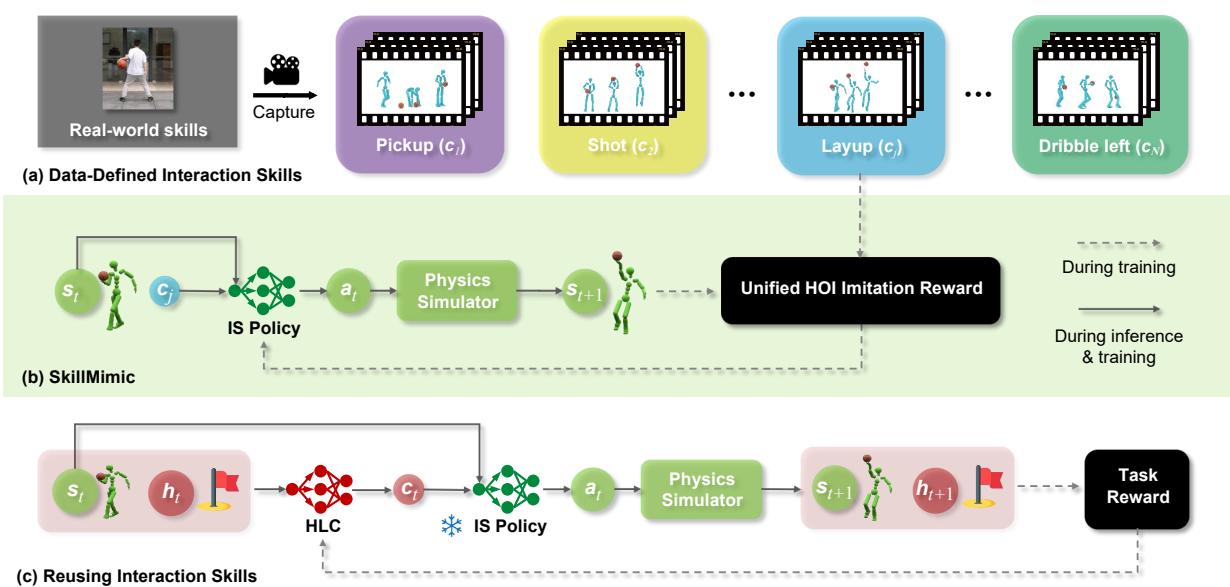
This hierarchical approach allows the system to solve long-horizon tasks, like picking up a ball, dribbling to the hoop, and scoring, which would be impossible to learn from scratch.
5. Experiments and Results
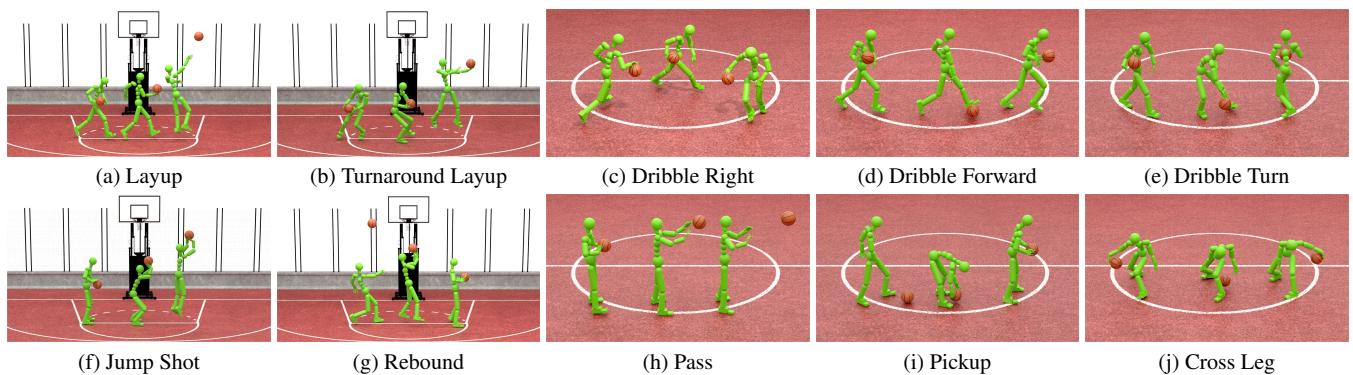
The results are visually impressive. SkillMimic successfully learned a wide variety of skills, covering almost all fundamental basketball interactions.
5.1 Comparison with Baselines
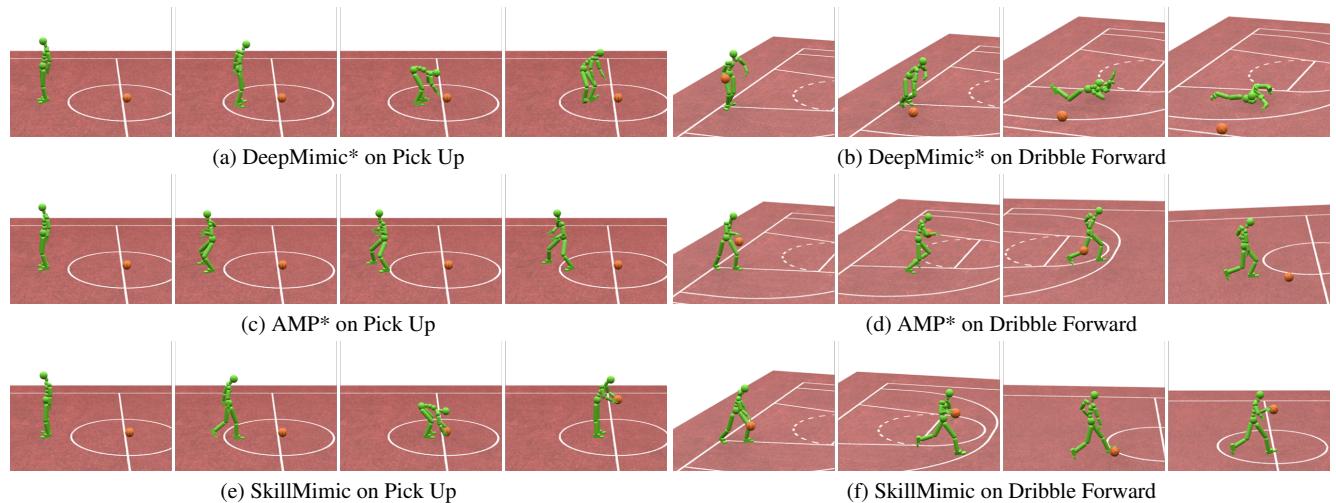
The researchers compared SkillMimic against variants of DeepMimic and AMP (Adversarial Motion Priors). As seen in the comparison below, previous methods struggle significantly. AMP* (middle row) often fails to control the ball or hesitates, while DeepMimic* (top row) can get stuck in unnatural poses. SkillMimic (bottom row) produces smooth, human-like motion.
5.2 Generalization
A major question is: Does the character simply memorize the motion capture data? Or can it react? The “Pickup” skill experiment answers this. The character was trained on specific clips of picking up a ball. In testing, the ball was placed in random locations within a 5-meter radius (situations the character had never seen exactly).
As shown in the heatmap below, as the training data scale increases (from 1 clip to 131 clips), the character’s ability to generalize and pick up the ball from anywhere on the court skyrockets.
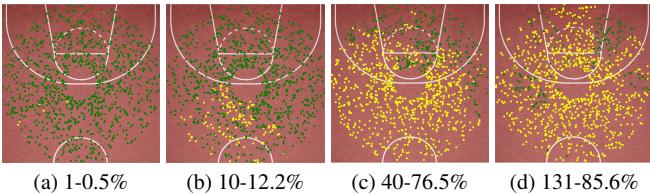
This demonstrates that SkillMimic isn’t just playing back animation—it’s learning a robust control policy that adapts to the physics of the environment.
5.3 Complex Tasks
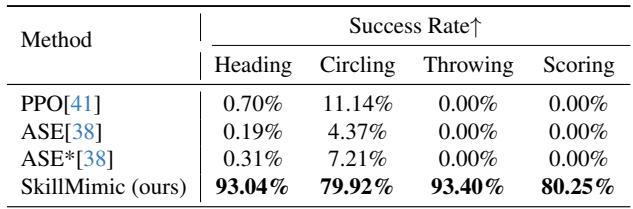
Finally, the researchers tested the High-Level Controller on tasks like “Scoring” (dribble -> shoot -> score). The table below compares SkillMimic against PPO (learning from scratch) and ASE (a locomotion-focused method). The baselines fail completely (0% success) because the task is too complex. SkillMimic achieves high success rates because it leverages the pre-learned interaction skills.
6. Conclusion and Future Implications
SkillMimic represents a significant leap forward in character animation. By moving away from hand-crafted rewards and introducing the Contact Graph and a Unified Imitation Reward, the researchers have created a scalable way to teach robots and virtual avatars how to interact with the world.
Key Takeaways:
- Multiplication over Addition: In complex multi-objective tasks (body + object), multiplicative rewards prevent the agent from ignoring difficult parts of the task.
- Contact is Key: Modeling contact explicitly via a graph structure is essential for realistic object manipulation.
- Hierarchy Works: Learning basic skills first, then learning how to sequence them, is a powerful recipe for solving long-term tasks.
While this paper focuses on basketball, the implications extend to any scenario where digital characters need to handle objects—from virtual reality gaming to training functional humanoid robots for household tasks. The days of “floaty” physics animations are numbered; the future looks grounded, physical, and very skillful.