](https://deep-paper.org/en/paper/2408.15666/images/cover.png)
Every time you write—whether it’s an academic paper, a blog post, or a tweet—you leave behind a digital fingerprint. Your choice of words, your sentence length, your use of punctuation, and even how often you use sarcasm contribute to a unique “stylometric” signature. In the field of Natural Language Processing (NLP), identifying who wrote a specific text based on these features is known as authorship attribution.
But what if you want to remain anonymous? Perhaps you are a whistleblower, a double-blind reviewer, or simply a privacy-conscious individual in an anonymous forum. This is where authorship obfuscation comes in. The goal is to rewrite a text so that the original author’s identity is hidden, while keeping the meaning and fluency intact.
Historically, this has been a tug-of-war between rigid, rule-based systems (which often ruin the grammar) and modern Large Language Models (LLMs) which are fluent but act as “black boxes”—you tell them to rewrite something, but you can’t easily control how they change the style.
Enter StyleRemix, a new approach presented by researchers from the University of Washington and the Allen Institute for AI. Instead of just asking an AI to “rewrite this,” StyleRemix treats authorship like a music mixing board. It identifies specific style “knobs”—like formality, length, or sarcasm—and turns them up or down to steer the text away from the author’s identity.
In this post, we will deconstruct how StyleRemix works, how it uses efficient machine learning techniques to “remix” text, and why it outperforms massive models like Llama-3-70B.
The Problem: The “Black Box” vs. The “Robot”
To understand why StyleRemix is necessary, we have to look at the previous options available for obfuscation:
- Rule-Based Methods: These old-school methods rely on simple metrics. If an author uses long sentences, the system chops them up. If they use specific synonyms, the system swaps them. While this hides the author, the result often sounds robotic or broken.
- LLM Rewriting: You can ask ChatGPT or Llama to “rewrite this text.” The result is usually fluent, but it lacks steerability. The model might just make the text generic, or worse, it might fail to hide the subtle stylistic tics that identify the author. It doesn’t know what to hide, so it just guesses.
The researchers identified a need for a system that is interpretable (we know what is changing), controllable (we can choose what to change), and efficient (it doesn’t require training a massive new model).
The Solution: StyleRemix Overview
StyleRemix operates on the intuition of a “remix.” If you want to disguise a song, you might change the tempo, swap the instruments, or alter the pitch. StyleRemix does the same for text.
The architecture is split into two distinct phases: Pre-Obfuscation (building the tools) and Obfuscation (using the tools).
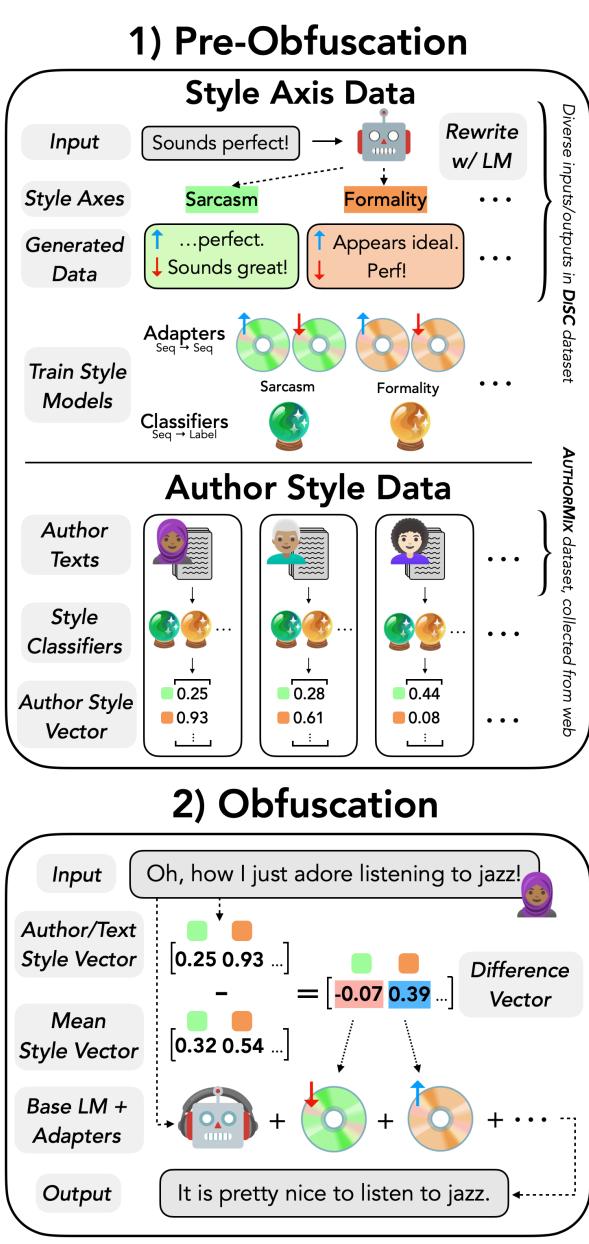
As shown in Figure 1 above, the system doesn’t just rewrite text blindly. It calculates a “Style Vector” for the input, determines how it differs from the average, and then applies specific “Adapters” to counteract those unique traits.
Let’s break down the machinery under the hood.
Phase 1: Pre-Obfuscation (Building the Mixing Board)
Before the system can remix a text, it needs to learn what different styles actually look like. The authors identified seven key Style Axes that usually give an author away:
- Length: Are the sentences verbose or succinct?
- Function Words: How often does the author use words like “the,” “is,” “of,” etc.?
- Grade Level: Is the writing complex (academic) or simple?
- Formality: Is it casual blog-speak or formal prose?
- Sarcasm: Is the tone sincere or sarcastic?
- Voice: Active vs. Passive voice.
- Writing Intent: Is the text descriptive, persuasive, narrative, or expository?
The DISC Dataset
To teach the model these styles, the researchers created a dataset called DISC (Distilled Style Components). They took thousands of paragraphs and used GPT-4 to rewrite them in specific directions (e.g., “Rewrite this to be more sarcastic” or “Rewrite this to use fewer function words”). This created a massive parallel dataset of 24,000 texts where the same content exists in 16 different stylistic variations.
Training LoRA Adapters
Here is where the efficiency comes in. Retraining a massive Large Language Model (LLM) for every single style would be computationally expensive and slow. Instead, the authors use LoRA (Low-Rank Adaptation).
LoRA is a technique that freezes the massive weights of the base model (in this case, Llama-3 8B) and only trains a tiny set of additional parameters. Think of the base LLM as a musician who knows how to play music generally. A LoRA adapter is a small sheet of sheet music that teaches the musician a specific genre.
The researchers trained separate LoRA adapters for each style direction: one for “High Sarcasm,” one for “Low Formality,” one for “Short Length,” etc. These adapters are lightweight and can be swapped in and out instantly.
Phase 2: Obfuscation (The Remix)
Now, imagine a user inputs a text they want to obfuscate. How does StyleRemix decide which knobs to turn?
1. The Author Vector
First, the system analyzes the input text to create an Author Vector. This is a mathematical representation of where the author sits on those seven style axes.
For example, if the input is from Donald Trump, the vector might show high repetition, specific grade-level patterns, and high assertiveness. If the input is from a 1900s novelist, the vector might show high sentence length and complex vocabulary.
2. The Difference Vector
The goal of obfuscation is to make the author look like “everyone else”—to blend into the crowd. The system calculates the average style vector for a generic population. It then subtracts the Author Vector from this average to get the Difference Vector.
\[ \mathrm { s t y l e s ~ t o ~ c h a n g e } = \mathrm { t o p } _ { k } \left( \left| x _ { i } - \sum _ { j = 1 } ^ { m } x _ { j } \right| \right) , \]This equation effectively asks: “In what specific ways is this author most weird?” If the author is significantly more sarcastic than the average person, the “Sarcasm” value in the difference vector will be high.
3. Steering the Generation
Based on the difference vector, StyleRemix automatically selects the top \(k\) style axes that need to be changed. If the author is too formal, it selects the “Lower Formality” LoRA adapter. If they write sentences that are too long, it selects the “Short Length” adapter.
The system then merges these adapters with the base model. This allows the model to apply multiple style changes simultaneously.
To visualize how different adapters affect the same text, look at the example below using a speech text:
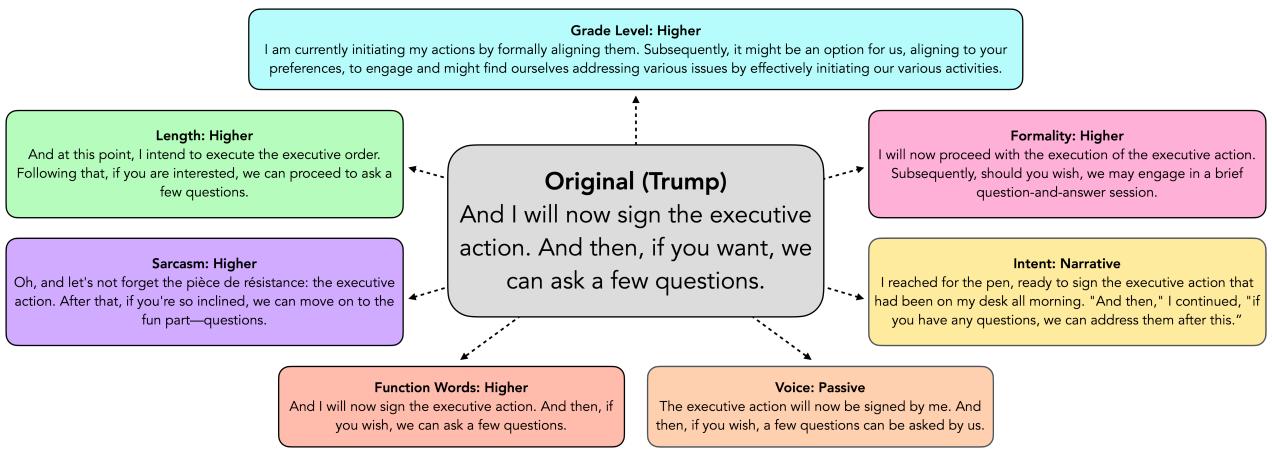
In Figure 2, you can see the original text in the center. Notice how the “Sarcasm” adapter adds a snarky “piece de resistance,” while the “Length” adapter makes the text more concise. StyleRemix combines these effects to pull the text away from the author’s original quadrant.
4. Fine-Tuning the Weights (LoraHub+)
Merely turning a style “on” isn’t always enough; you need to control the intensity. The authors introduced LoraHub+, an optimization method.
\[ w _ { i } \left\{ { \begin{array} { l l } { 0 . 7 } & { { \mathrm { s t d } } ( { \bar { x } } _ { i } ) \leq 1 } \\ { 0 . 9 } & { 1 < { \mathrm { s t d } } ( { \bar { x } } _ { i } ) \leq 2 } \\ { 1 . 2 } & { 2 < { \mathrm { s t d } } ( { \bar { x } } _ { i } ) \leq 3 } \\ { 1 . 5 } & { { \mathrm { s t d } } ( { \bar { x } } _ { i } ) > 3 } \end{array} } \right. \]As seen in the equation above, the weight (\(w_i\)) of an adapter is determined by how extreme the author’s style is (measured in standard deviations). If an author is extremely deviant from the norm (e.g., 3 standard deviations away), the system applies a heavy weight (1.5) to the adapter to force a correction.
Experiments and Results
To test StyleRemix, the authors needed a diverse playground. They created AUTHORMIX, a dataset containing 30,000 texts from four very different domains:
- Presidential Speeches: (Trump, Obama, Bush)
- Novels: (Hemingway, Fitzgerald, Woolf)
- Scholarly Articles
- Blogs
They compared StyleRemix against several baselines, including standard machine translation methods (translating to German and back to hide style), simple paraphrasers, and standard LLMs (Llama-2, Llama-3, Gemma) prompted to “rewrite” the text.
Quantitative Analysis
The researchers used three main metrics:
- Drop Rate: How much did the accuracy of an authorship classifier drop? (Higher is better—it means the classifier couldn’t guess the author).
- Grammar/Fluency: Is the text still readable?
- Content Preservation: Does it still mean the same thing?
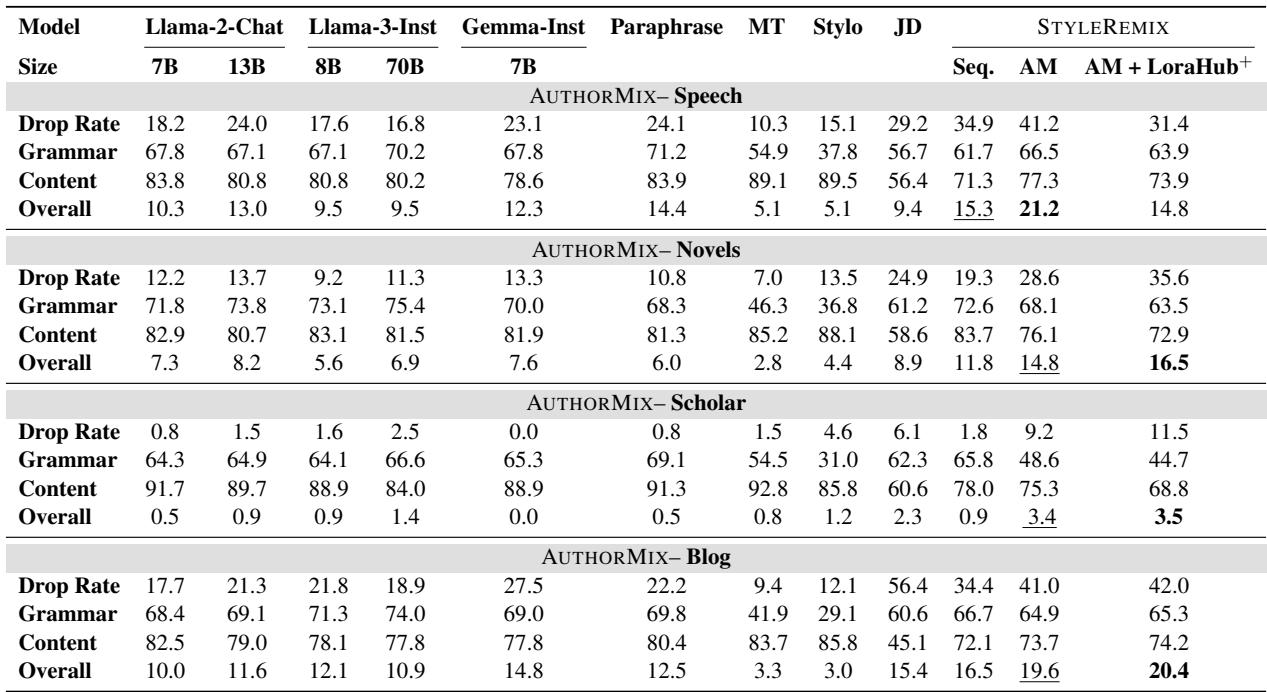
Table 2 (above) tells a compelling story. The Drop Rate for StyleRemix (specifically the “AM” or Adapter Merging variant) is significantly higher than the baselines.
- In the Blog domain, StyleRemix achieved a drop rate of 41.2%, compared to just 16.8% for the massive Llama-3-70B model.
- This proves that simply being a “smart” model (like Llama-3-70B) isn’t enough for obfuscation. You need targeted stylistic control.
Human Evaluation
Automatic metrics are useful, but human judgment is the gold standard for fluency. The researchers asked human annotators to rate the outputs.
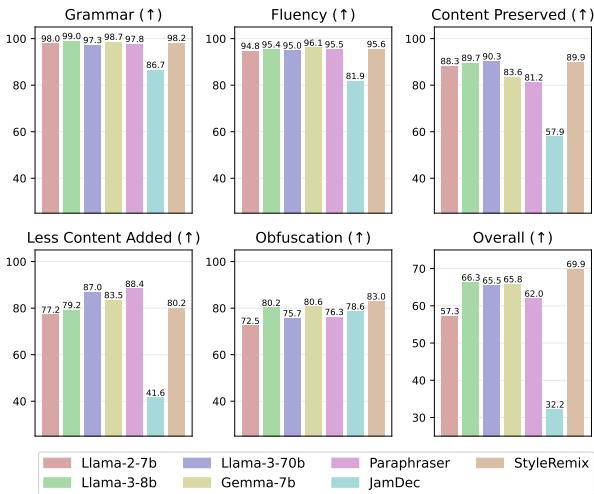
Figure 3 highlights that StyleRemix (the tan/brown bar) dominates in Obfuscation. Crucially, it doesn’t sacrifice Grammar or Content Preservation to achieve this, scoring comparably to the unmodified Llama-3 models.
Qualitative Analysis: Seeing the Difference
Let’s look at a concrete example of how StyleRemix handles a blog post compared to other methods.
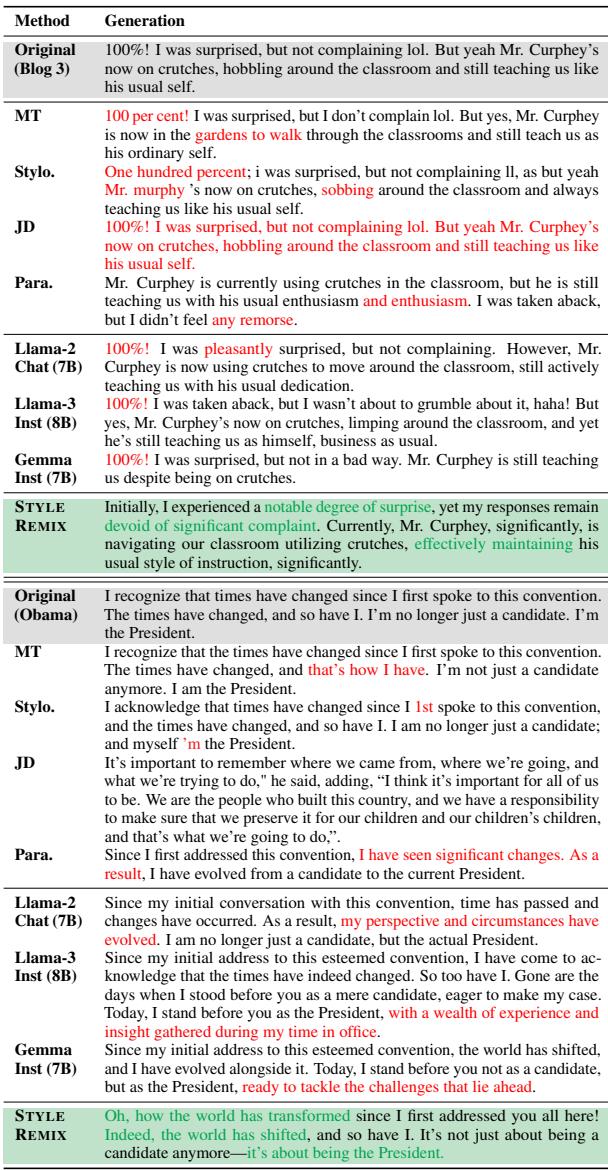
In the Blog example (top of Table 3), the original text is casual: “I was surprised, but not complaining lol.”
- Llama-3 (8B) keeps the “hahahaha” and the casual vibe. It fails to obfuscate the style.
- StyleRemix drastically shifts the register: “Initially, I experienced a notable degree of surprise…”
This transformation makes the text sound like a completely different person (perhaps a formal academic), which is exactly the goal of obfuscation.
Visualizing Style Clusters
To further prove that the authors in their dataset actually had distinct styles to begin with, the researchers performed a Principal Component Analysis (PCA).
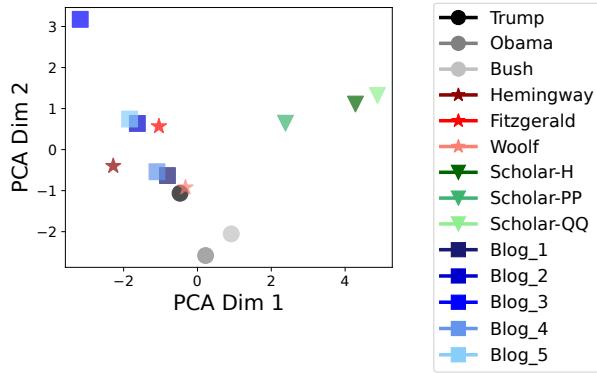
Figure 6 shows that authors within domains (like the green stars for Novels) cluster tightly together, while being distinct from other domains (like the purple circles for Speeches). This validates that there are indeed measurable “style vectors” that StyleRemix can target and manipulate.
Conclusion and Implications
StyleRemix represents a shift in how we think about text generation. Rather than treating an LLM as a monolith, this research shows the power of decomposition. By breaking “style” down into its atomic components (length, formality, etc.) and training lightweight adapters for each, we gain:
- Interpretability: We know why the text changed (e.g., “The model increased formality to hide the author’s casual tone”).
- Efficiency: We can use a smaller 8B model to outperform a 70B model.
- Customization: The user can manually tweak the knobs if they want specific results.
As privacy becomes increasingly difficult in the age of AI, tools like StyleRemix offer a “digital mask” that is flexible, effective, and crucially, allows the user to retain control over their own voice—or lack thereof.
For students interested in this field, this paper highlights the incredible potential of LoRA and Model Merging. It shows that you don’t always need more compute or bigger data; sometimes, you just need a smarter way to mix the signals.