](https://deep-paper.org/en/paper/2408.16807/images/cover.png)
Introduction
The rise of Large-scale Text-to-Image Diffusion (T2ID) models, such as Stable Diffusion, has revolutionized digital creativity. With a simple text prompt, users can conjure photorealistic images, art, and designs. However, this power comes with significant risks. Trained on massive datasets scraped from the open internet, these models often inadvertently memorize and generate inappropriate content—ranging from NSFW material and copyrighted artistic styles to prohibited objects.
To combat this, the field of Concept Erasure emerged. The goal is simple: modify the model so it refuses to generate specific “banned” concepts (like nudity or a specific artist’s style). Early methods showed promise, but researchers quickly discovered a glaring security hole. Even after a concept is “erased,” a clever adversary can bring it back. By using “jailbreak” prompts or injecting specific mathematical embeddings, attackers can bypass the erasure mechanisms, regenerating the very content the developers tried to hide.
This creates a cat-and-mouse game. Developers patch the model; attackers find a new “blind spot.” Furthermore, existing attempts to make these models robust often result in “lobotomizing” the AI—destroying its ability to generate high-quality images of benign (safe) concepts.
In this post, we will dive deep into STEREO, a new framework presented at a major computer vision conference. STEREO proposes a two-stage solution that doesn’t just erase concepts; it aggressively hunts down the model’s vulnerabilities first, and then fixes them using a novel “anchor” method to preserve image quality.
The Vulnerability of Modern Erasure
Before we understand the solution, we must understand the threat. Most concept erasure methods work by fine-tuning the model’s weights to disassociate specific words (e.g., “Van Gogh”) from their visual representation.
However, recent research has shown that these methods provide a false sense of security. Attackers can use Concept Inversion Attacks. Instead of typing “Van Gogh,” they search for a vector in the model’s mathematical embedding space that looks like Van Gogh to the model but doesn’t trigger the erasure filter.
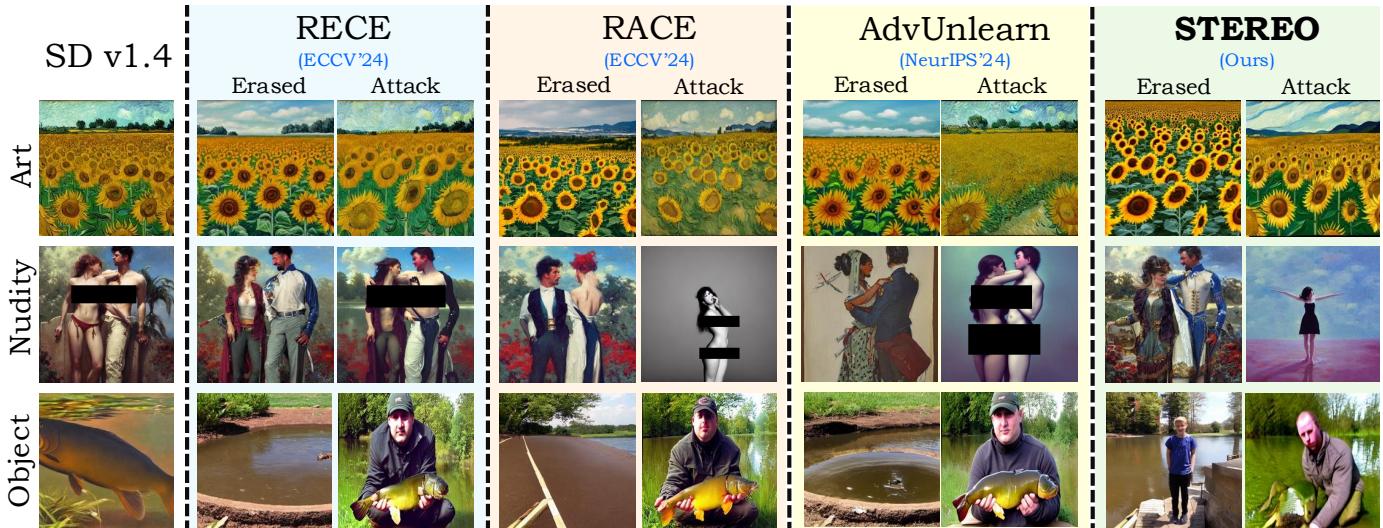
As shown in Figure 1, even state-of-the-art (SOTA) methods designed to be “robust” fail against these advanced attacks. When subjected to a Concept Inversion Attack (specifically the CCE attack), models like RACE and AdvUnlearn collapse, regenerating the erased content (nudity, artistic styles, or objects) almost perfectly.
The Robustness-Utility Trade-off
The core engineering challenge here is the trade-off between Robustness (how hard it is to hack) and Utility (how good the images look).
If you aggressively erase a concept, you might accidentally destroy the model’s understanding of related, safe concepts. For example, erasing “nudity” might make the model bad at generating “people” or “skin.” Conversely, if you are too gentle to preserve quality, the erasure is easily bypassed.
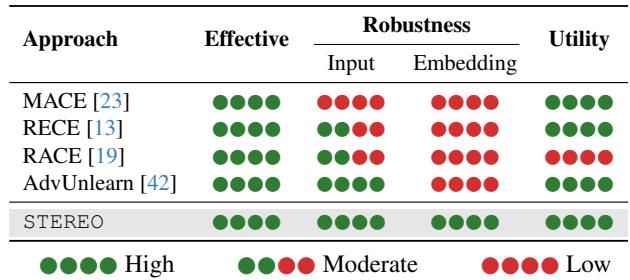
Table 1 illustrates this landscape. Existing methods tend to compromise. Some preserve utility but are weak against attacks (input or embedding space). Others are robust but destroy the image quality. STEREO claims to be the first to achieve high marks across all three categories.
The STEREO Framework
The researchers propose a solution called STEREO. It stands for a two-stage process:
- Search Thoroughly Enough (STE)
- Robustly Erase Once (REO)
The intuition is that you cannot robustly erase a concept if you don’t know where the “backdoors” are. Current methods try to erase and defend simultaneously, which leads to suboptimal results. STEREO separates these tasks.
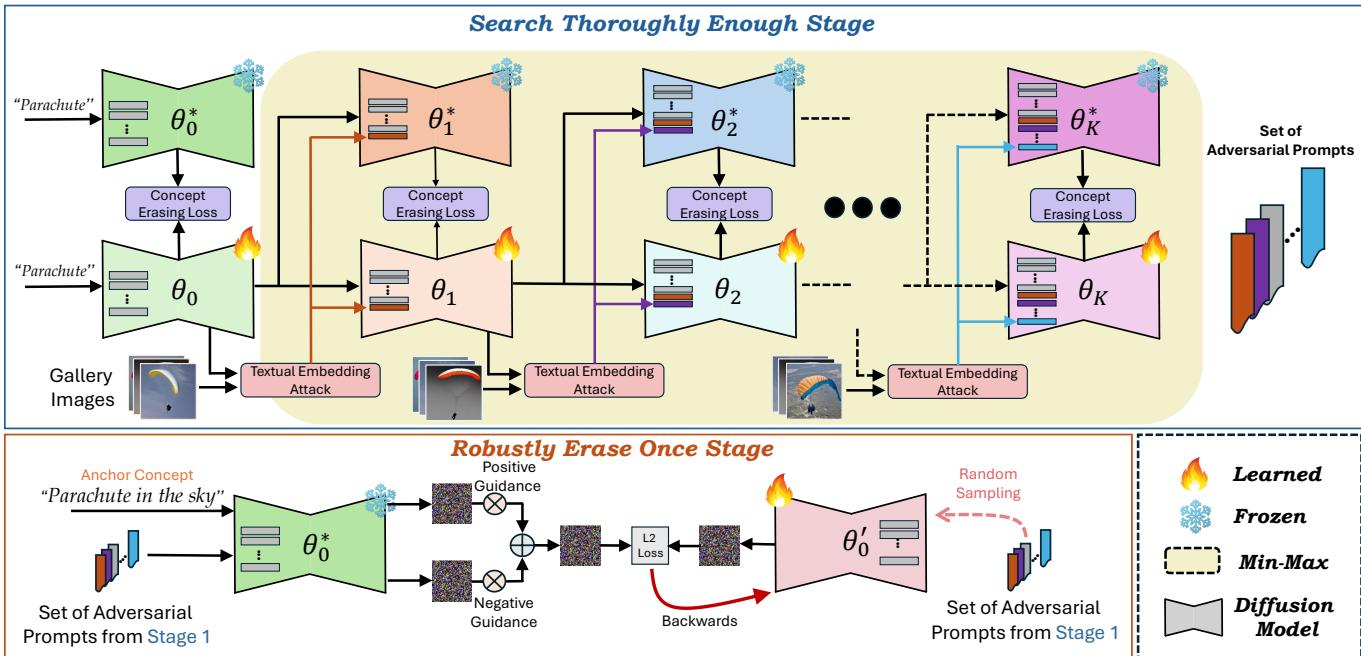
As visualized in Figure 2, the framework operates in a pipeline.
- Stage 1 (Top): The model undergoes an intense “red-teaming” phase. It iteratively attacks itself to find a collection of “Adversarial Prompts”—special text embeddings that successfully bypass the current erasure.
- Stage 2 (Bottom): Once these dangerous prompts are identified, the model undergoes a single, final fine-tuning session. It uses “Anchor Concepts” to tell the model what to generate (preserving quality) while pushing away from the adversarial prompts (ensuring safety).
Let’s break down the mathematics and logic of each stage.
Stage 1: Search Thoroughly Enough (STE)
The goal of this stage is vulnerability identification. It treats the erasure process as a Min-Max optimization problem.
- Minimize: The probability of generating the bad concept (Erasing).
- Maximize: The probability of finding a prompt that generates the bad concept (Attacking).
Why Synonyms Are Not Enough
A naive approach would be to simply erase all synonyms of a word (e.g., to erase “Church,” you also erase “Chapel,” “Cathedral,” etc.). However, embedding space is continuous and complex.
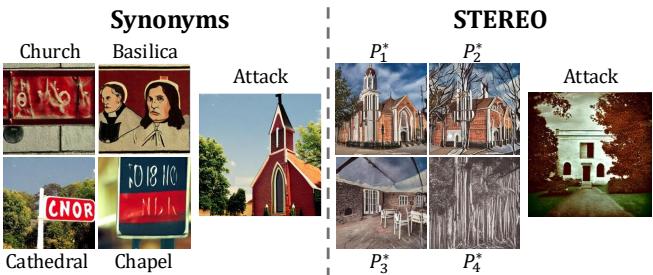
Figure 3 demonstrates why simple synonyms fail. If you only erase the word “Church” and its synonyms, an advanced attack (CCE) can still find a path to generate a church. STEREO, however, hunts for adversarial prompts (\(P^*\))—weird, non-human-readable vectors that trigger the concept—and adds them to the “kill list.”
The Iterative Loop
The STE stage loops \(K\) times. In every iteration \(i\):
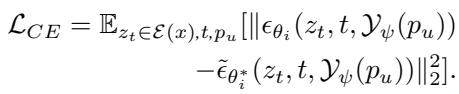
- Minimization (Erasing): The model parameters \(\theta\) are updated to erase the target concept \(c_u\). The researchers use a loss function that pushes the model’s noise prediction away from the bad concept.
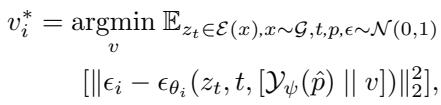
- Maximization (Attacking): The parameters are frozen, and the system searches for a new adversarial embedding \(v^*_i\). This is done using Textual Inversion. The system asks: “What input vector, when fed into this specific version of the model, reconstructs the forbidden concept?”
By the end of Stage 1, the model has a collection of extremely potent adversarial prompts (\(\mathbf{p}_K^*\)). These represent the model’s “blind spots.”
Stage 2: Robustly Erase Once (REO)
At this point, we have a list of dangerous prompts. A simple reaction would be to just suppress all of them. However, suppressing too many things usually ruins the model. If you tell a diffusion model “Don’t do X, don’t do Y, don’t do Z,” it often gets confused and forgets how to generate high-quality backgrounds or subjects.
This is where Anchor Concepts come in.
Instead of just telling the model what not to do (Negative Guidance), STEREO tells the model what it should do (Positive Guidance) in the presence of those concepts.
Compositional Guidance
The researchers employ a Compositional Objective. They use GPT-4 to generate benign “Anchor Prompts” (\(L_a\)).
- Target to Erase: “Nudity”
- Anchor Prompt: “A person standing on a beach with a sunset.”
The training objective essentially says: “Move away from the Adversarial Prompts (Nudity), but move TOWARD the Anchor Prompt (Beach/Sunset).”
This ensures that while the specific forbidden attributes are removed, the surrounding context, lighting, and composition (the utility) remain intact.
The final noise estimate used for training is a composition of the anchor and the erased direction:
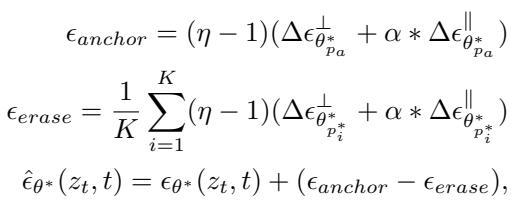
Here, \(\epsilon_{anchor}\) pulls the model toward safe concepts, and \(\epsilon_{erase}\) pushes it away from the list of adversarial prompts discovered in Stage 1. This “Push-Pull” dynamic is the secret sauce that preserves image fidelity.
Experiments and Results
The researchers benchmarked STEREO against seven state-of-the-art methods, including ESD, MACE, RECE, RACE, and AdvUnlearn. They tested three difficult scenarios: Nudity Removal, Artistic Style Removal (Van Gogh), and Object Removal (Tench/Fish).
1. Nudity Removal
Nudity is the most common target for concept erasure safety. The team tested against three types of attacks:
- UD (UnlearnDiff): A white-box attack modifying prompt tokens.
- RAB (Ring-A-Bell): A black-box attack using prompt templates.
- CCE (Circumventing Concept Erasure): The most powerful attack, using embedding inversion.
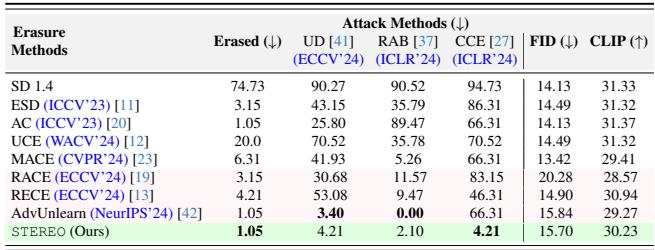
Table 2 shows the results.
- ASR (Attack Success Rate): Lower is better. While baseline methods like ESD collapse under the CCE attack (86.31% success rate for the attacker), STEREO holds the line at 4.21%.
- Utility (FID/CLIP): STEREO maintains image quality (FID) and text alignment (CLIP) comparable to the original Stable Diffusion (SD 1.4) model.
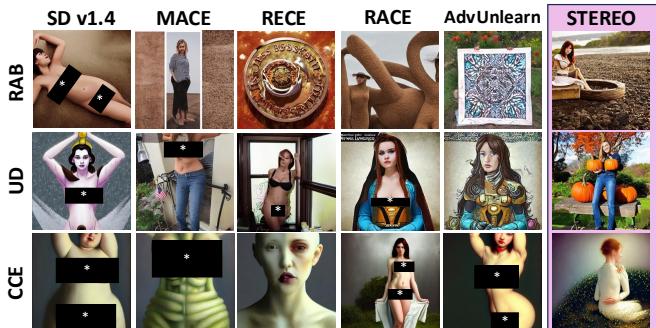
Figure 4 visualizes this robustness. Under the powerful CCE attack, methods like RACE and AdvUnlearn fail to mask the content (represented by black boxes). STEREO consistently blocks the concept.
2. Artistic Style Removal (Van Gogh)
Artists are increasingly concerned about AI mimicry. Erasing “Van Gogh” style is a standard benchmark.
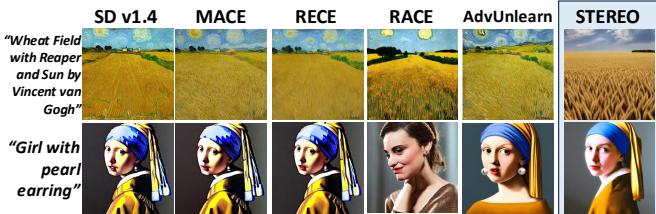
In Figure 5, look at the top row (Attacked Model). Most models, when attacked, revert to generating Van Gogh-style swirls. STEREO generates a generic painting, successfully resisting the attack.
Crucially, look at the bottom row (Benign Concept: “Girl with a Pearl Earring”). This tests Utility.
- RACE destroys the style, generating a photorealistic person instead of a Vermeer painting.
- AdvUnlearn creates artifacts and color distortions.
- STEREO faithfully renders the Vermeer style, proving that erasing Van Gogh didn’t break the model’s ability to paint in other styles.
3. Object Removal (The “Tench” Fish)
This experiment removes a specific object class: the “Tench” (a type of fish).
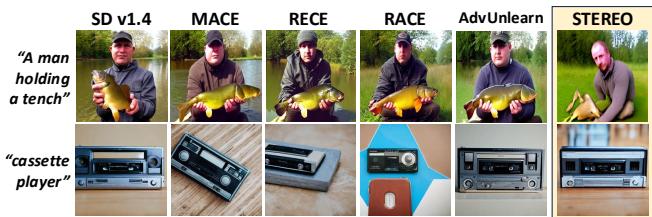
Figure 6 highlights a fascinating failure mode of other methods (Row 2, bottom).
- Task: Generate a “Cassette Player” (Benign object).
- Competitors: Because they aggressively erased the “Tench” (fish), some models (like RACE) hallucinate and struggle to generate a proper cassette player, damaging the object details.
- STEREO: Generates a perfect, high-fidelity cassette player.
When attacked (Top Row), STEREO refuses to generate the fish, whereas the base model and others succumb to the attack.
Conclusion
The STEREO framework represents a maturing of safety techniques in Generative AI. It moves beyond simple “fine-tuning” into a rigorous regimen of vulnerability detection followed by surgical correction.
The key takeaways are:
- Iterative Vulnerability Search: You cannot fix what you cannot find. Using adversarial training to hunt for “blind spots” (Stage 1) is essential for true robustness.
- Anchors Preserve Quality: Simply deleting concepts damages the model. Using “Anchor Concepts” (Stage 2) provides the model with a safe target, preserving the generation quality of benign images.
- Comprehensive Defense: STEREO is the first to offer significant protection against both white-box and black-box attacks, including the notoriously difficult Concept Inversion attacks.
As AI models continue to integrate into commercial products, frameworks like STEREO will be critical in ensuring they remain safe and compliant without sacrificing the magical creativity that makes them so valuable.