](https://deep-paper.org/en/paper/2409.02224/images/cover.png)
Introduction
Imagine playing a piano in Virtual Reality. You see your digital hands hovering over the keys, but when you strike a chord, there is a disconnect. You don’t feel the resistance, and the system struggles to know exactly how hard you pressed. Or consider a robot attempting to pick up a plastic cup; without knowing the pressure it exerts, it might crush the cup or drop it.
In the world of computer vision, we have become incredibly good at determining where things are (pose estimation) and what they are (object recognition). However, understanding the physical interaction—specifically touch contact and pressure—remains a massive challenge. This is particularly difficult in “egocentric” vision (first-person perspective), which is the standard view for AR/VR headsets and humanoid robots.
The problem stems from a lack of data. Existing datasets either lack pressure information entirely, rely on third-person static cameras, or require users to wear bulky gloves that ruin natural tactile feedback.
Enter EgoPressure, a groundbreaking research paper that introduces a massive dataset and a novel method for estimating hand pressure and pose from an egocentric perspective. By combining a head-mounted camera, a multi-view rig, and a high-resolution pressure pad, the researchers have created a way to teach machines not just to see hands, but to understand the force they apply.
The Background: Why Touch Matters
To understand the significance of EgoPressure, we need to look at the current landscape of Hand-Object Interaction (HOI).
The Limits of Vision-Only Approaches
Traditionally, if you wanted to know if a hand was touching a table, you would look at the pixels. If the hand pixels overlapped with the table pixels, you assumed contact. But this is imprecise. A hand hovering 1mm above a surface looks almost identical to a hand pressing down with 10 Newtons of force.
The Problem with Sensors
Previous attempts to solve this involved instrumenting the user. Researchers would put pressure sensors on gloves. While accurate, this is intrusive. It changes how the user interacts with objects and obscures the visual appearance of the hand, making the data less useful for training vision-based AI.
The EgoPressure Gap
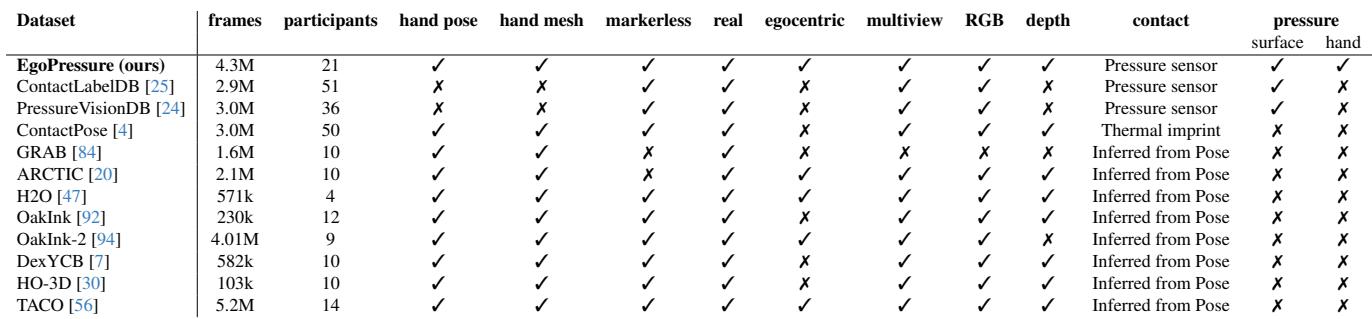
As shown in the comparison table below, prior datasets had gaps. Some had pressure but no hand pose. Others had pose but no pressure. Very few were egocentric (first-person). EgoPressure fills this void by providing:
- Egocentric Video: Captured from a head-mounted camera.
- Accurate Hand Poses: 3D meshes of the hand.
- Ground Truth Pressure: Precise force maps from a sensor pad.
- No Gloves: The hands are bare, ensuring natural interaction.
The EgoPressure Dataset
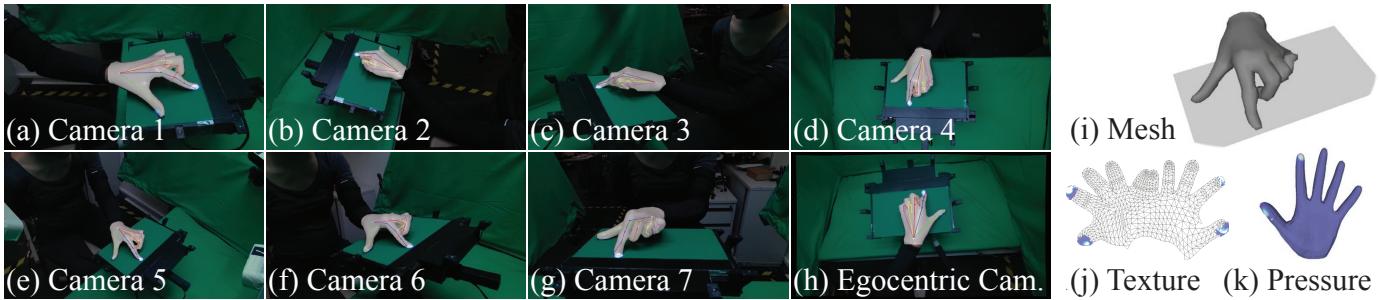
The foundation of this work is the data collection rig. The researchers didn’t just record video; they built a synchronized multi-sensor environment.
The Capture Rig
The setup involves 21 participants performing various gestures (pressing, dragging, pinching) for a total of 5 hours of footage. The rig consists of:
- One Head-Mounted Camera: To capture the egocentric view (what the user sees).
- Seven Static Cameras: Placed around the user to capture the hand from every angle.
- Sensel Morph Touchpad: A high-resolution pressure sensor that acts as the interaction surface.
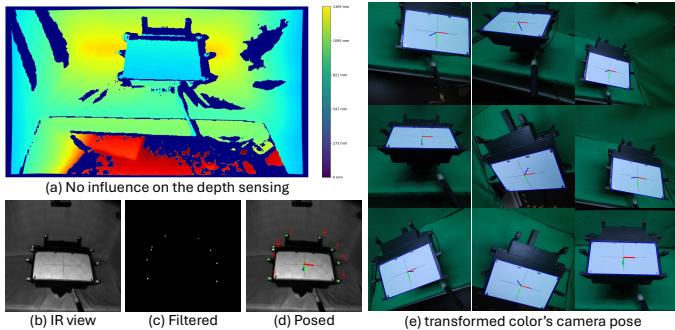
A clever engineering detail is the synchronization method. The team used active infrared (IR) markers (shown in Figure 4 above) placed around the touchpad. These markers flash in a specific pattern, allowing the system to perfectly synchronize the timing between the cameras and the pressure pad, ensuring that a visual frame matches the exact millisecond of pressure data.
The Core Method: Marker-less Annotation
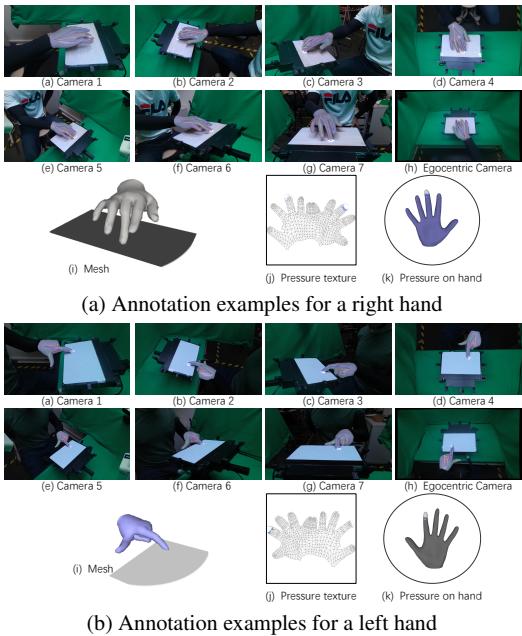
Collecting the data is only half the battle. The raw data consists of video files and pressure readings. The challenge is connecting them: How do you get a precise 3D hand mesh that aligns perfectly with the pressure readings?
The researchers proposed a Marker-less Annotation Method. Instead of using motion capture markers on the hand, they used an optimization pipeline that refines the hand’s shape based on the visual data and the pressure data.
The Optimization Pipeline
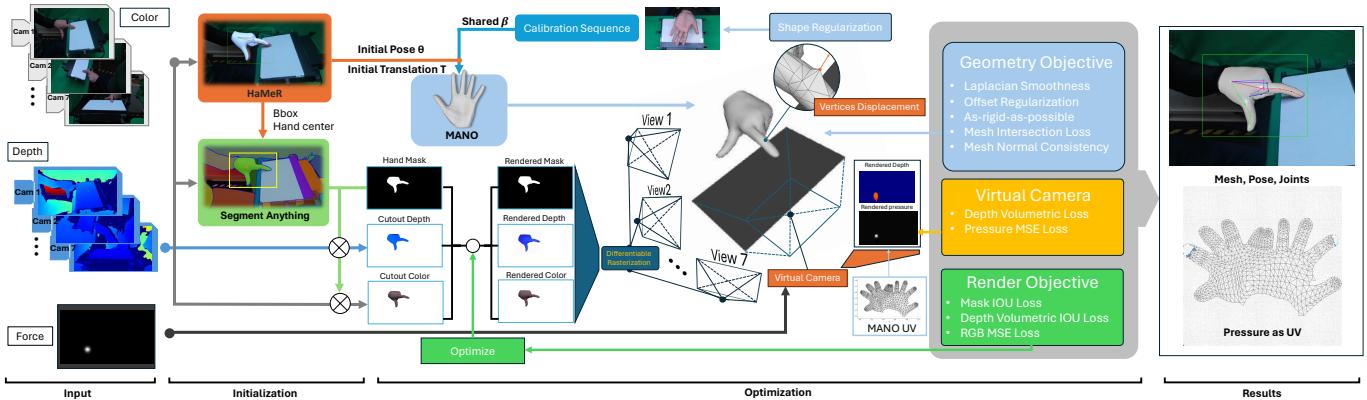
The process is broken down into an initialization phase and two refinement stages.
1. Initialization
First, they use off-the-shelf tools to get a rough starting point. They use HaMeR (a state-of-the-art hand estimator) to guess the initial pose and Segment-Anything (SAM) to cut the hand out of the background image.
2. Pose Optimization
The system creates a 3D hand model (using the MANO topology). It tries to align this 3D model so that it matches the images from all 7 static cameras simultaneously.
The objective function for this stage looks like this:

Here, \(\mathcal{L}_{\text{pose}}\) minimizes the difference between the rendered hand and the real images (\(\mathcal{L}_{\mathcal{R}}\)) while ensuring the mesh doesn’t intersect with itself (\(\mathcal{L}_{\text{insec}}\)).
3. Shape Refinement and the “Virtual Camera”
This is the most innovative part of the method. Standard vision algorithms often struggle with depth—a hand might look like it’s touching the table, but in 3D space, it might be floating slightly above it or clipping through it.
To fix this, the researchers introduced a Virtual Orthogonal Camera. Imagine a camera placed under the touchpad, looking up at the hand.
- The pressure sensor tells us exactly where the hand is touching.
- The system renders the hand mesh from this virtual bottom-up view.
- It then optimizes the hand shape so that the “touching” parts of the mesh align perfectly with the pressure readings.
The loss function for this shape refinement includes a specific term for the virtual render (\(\mathcal{L}_{\breve{\mathcal{R}}}\)):

The virtual render loss is defined as:

This equation essentially says: “Minimize the error between the rendered pressure texture and the real pressure data (\(P_{gt}\)), and ensure that wherever there is pressure, the distance between the hand mesh and the pad is zero.”
Handling Occlusions (Depth Culling)
One difficulty in multi-view setups is that the hand might be hidden behind the touchpad from certain camera angles. The method accounts for this using Depth Culling. By modeling the scene geometry, the system knows when a finger is behind the pad and ignores that part of the image during optimization, preventing the model from getting confused.

Benchmark: The PressureFormer Model
With the dataset created and annotated, the researchers established a baseline for future AI models. They introduced PressureFormer, a neural network designed to estimate pressure from a single egocentric RGB image.
Moving Beyond 2D Pressure
Previous methods (like PressureVisionNet) treated pressure estimation as an image segmentation task—painting “pressure pixels” on the 2D image. PressureFormer takes a leap forward by estimating pressure on the UV map of the hand mesh.
What is a UV Map? Think of it like peeling the skin off a 3D hand and flattening it out like a map of the world. By predicting pressure on this map, the model learns exactly which part of the skin is pressing down. This allows the system to reconstruct the pressure in 3D space, regardless of the hand’s orientation.

Architecture
- Input: An RGB image of the hand.
- Backbone: The HaMeR network extracts image features and estimates the 3D hand vertices.
- Transformer Decoder: A transformer mechanism attends to these features to predict a UV Pressure Map.
- Projection: This map is wrapped back onto the 3D hand mesh. Using a differentiable renderer, it projects the pressure back onto the image plane to compare with the ground truth.
The loss function balances predicting the correct UV texture (\(\mathcal{L}_c\)) and the correct projected 2D pressure (\(\mathcal{L}_p\)):

Experiments and Results
The researchers compared PressureFormer against existing baselines (PressureVisionNet) and extended versions that utilize hand pose data.
Quantitative Results
The results, summarized in Table 3, show that PressureFormer outperforms baselines in Contact IoU (Intersection over Union—basically, how accurately it locates the contact area). More importantly, because it predicts on the UV map, it enables 3D pressure reconstruction, which image-based baselines simply cannot do.

Qualitative Analysis
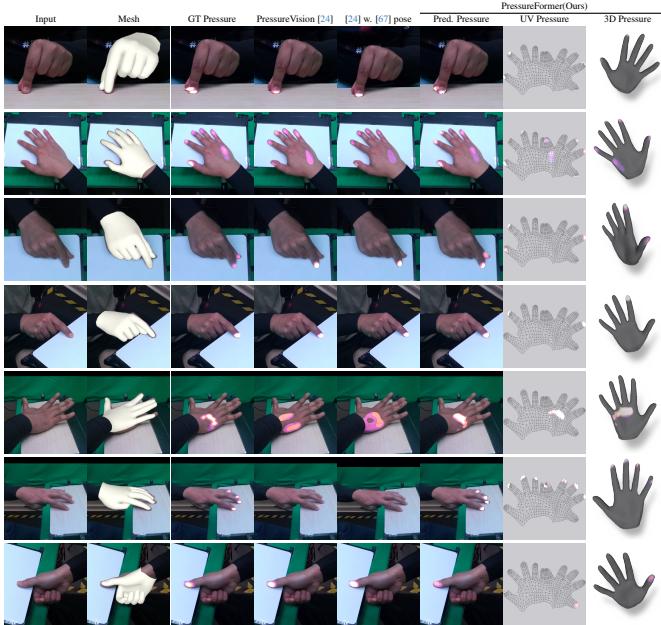
The visual results are striking. In the figure below, you can see the comparison.
- GT Pressure: The ground truth.
- PressureVision: Often smears the pressure or misses fingertips.
- PressureFormer (Pred. Pres.): Pinpoints the pressure on the specific fingertips that are active. The “On Hand” column shows the 3D mesh glowing exactly where the force is applied.
The Importance of the UV Loss
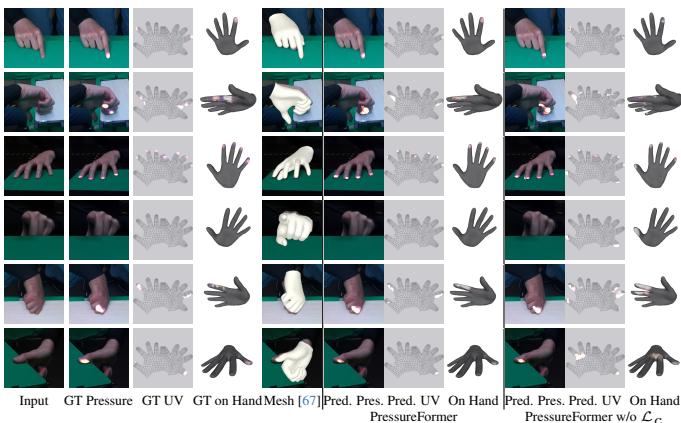
The researchers found that supervising the training with the UV map was crucial. Without it (using only 2D image supervision), the model might hallucinate pressure on parts of the hand facing the camera (which is physically impossible since the pressure is on the bottom). The UV loss forces the network to learn that pressure comes from the contact surface.
Improving Hand Pose Estimation
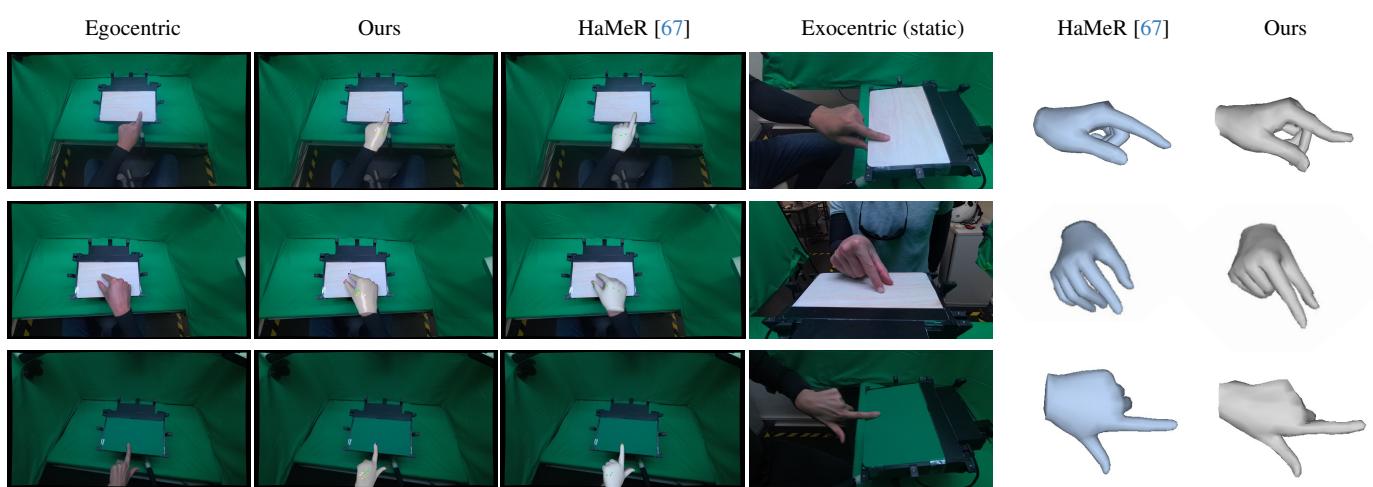
Interestingly, the EgoPressure dataset isn’t just for pressure; it improves pose estimation too. By fine-tuning the standard HaMeR model on this new dataset, the researchers achieved much better mesh alignment with surfaces. In the comparison below, notice how the standard HaMeR mesh (middle) hovers unnaturally, while the model fine-tuned on EgoPressure (right) makes convincing contact.
Conclusion and Implications
EgoPressure represents a significant step forward in making machines “feel” the world. By creating a high-quality dataset that links egocentric vision with physical pressure, the authors have opened the door for:
- Better AR/VR: Interfaces where you can type on a table or play virtual instruments with realistic force feedback.
- Skilled Robotics: Robots that can manipulate delicate objects by understanding the subtle cues of pressure visible in human hands.
- 3D Interaction Understanding: Moving away from simple 2D bounding boxes to fully volumetric understanding of force.
While the current dataset is limited to flat surfaces (touchpads), the method of using optimization to fuse vision and pressure sensors sets a strong precedent. Future work will likely expand this to curved objects and tools, bringing us closer to a world where computers understand the physical consequences of a touch just as well as we do.