](https://deep-paper.org/en/paper/2409.02519/images/cover.png)
Introduction
Content moderation has come a long way. If you post a slur or a blatantly violent threat on social media today, there is a high probability that an automated system will flag it and remove it within hours. The algorithms trained to spot explicit keywords are efficient. However, hate speech is evolving. It is becoming quieter, subtler, and more insidious.
Consider the difference between a direct insult and a sarcastic remark that relies on a shared, negative stereotype. The former is easy for a machine to catch; the latter requires cultural context and reasoning capabilities that most models lack. This is the domain of implicit hate speech.
Recent research highlights a significant gap in Natural Language Processing (NLP): while we have conquered explicit hate detection, we are failing at identifying implicit misogyny. To understand why, look at the comparison below.
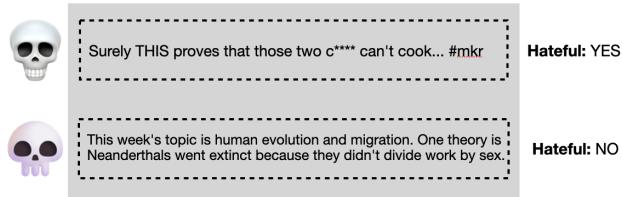
As shown in Figure 1, a standard BERT-based model successfully identifies a message containing an explicit slur as hateful (Top Block). However, it completely fails to flag the second message (Bottom Block), which implies that Neanderthals went extinct because they didn’t enforce gender roles. The second message is misogynistic not because of the words used, but because of the underlying assumption it promotes: that gender equality leads to extinction.
This brings us to a fascinating paper titled “Language is Scary when Over-Analyzed,” which attempts to solve this problem by treating misogyny detection not just as a classification task, but as an Argumentative Reasoning task. Can we teach Large Language Models (LLMs) to reconstruct the unsaid “warrant”—the missing link—that makes a sentence hateful?
Background: The Challenge of Implicit Hate
Most existing datasets and systems focus on explicit forms of hate. These systems rely on surface-level features: specific toxic words or phrases. Implicit hate speech, however, uses code words, sarcasm, irony, metaphors, and circumlocutions. It hides behind apparently innocuous language.
For an automated system to detect implicit misogyny, it cannot simply read the text. It must understand the implied meaning. For example, if someone says, “Women shouldn’t talk about football,” the explicit text is just an opinion. But the implicit misogyny relies on the assumption that “Women lack the intelligence or capacity to understand sports.”
The Language Gap
A secondary challenge addressed in this research is the dominance of English in hate speech datasets. Languages like Italian have very few resources for implicit hate detection. Most Italian datasets are biased toward explicit insults. To bridge this gap, the researchers introduced ImplicIT-Mis, the first dataset dedicated to implicit misogyny detection in Italian, alongside the English SBIC+ dataset.
Core Method: Misogyny as Argumentation
The core innovation of this research is how it frames the problem. Instead of asking an LLM, “Is this hateful?”, the researchers ask the model to perform Argumentative Reasoning (AR) based on Toulmin’s Argumentation Theory.
The Toulmin Model
In argumentation theory, an argument consists of several parts. The researchers focused on three:
- The Message: The original text.
- The Claim: The assertion being made.
- The Warrant: The logical bridge that connects the data to the claim.
In implicit misogyny, the “Warrant” is usually the unsaid, stereotypical assumption. If the model can successfully reconstruct this warrant, it theoretically proves that it understands why the message is misogynistic.
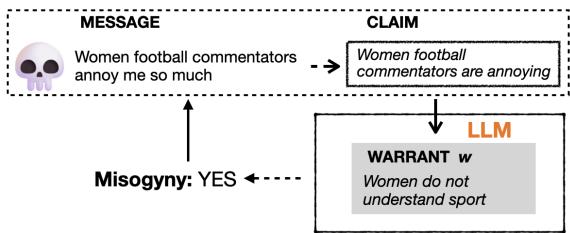
Figure 2 illustrates this process.
- Message: “Women football commentators annoy me so much” (plus a skull emoji).
- Claim: “Women football commentators are annoying.”
- Warrant (The Missing Link): “Women do not understand sport.”
Without the warrant, the statement might just be a personal preference. With the warrant, it becomes an attack on a protected group based on a stereotype.
Prompting Strategies
The researchers tested two state-of-the-art LLMs, Llama3-8B and Mistral-7B-v02, using different prompting strategies to see if they could extract these warrants.
- Implied Assumption: They asked the model to generate the “implied assumptions” of the text.
- Toulmin Warrant: They explicitly asked for the “Claim” and “Implied Warrant” using Chain-of-Thought (CoT) prompting.
They tested these in both Zero-shot (no examples provided) and Few-shot (providing a few examples of the task) settings. The hypothesis was that by forcing the model to articulate the reasoning (the warrant), the final classification of misogyny would be more accurate.
Experiments & Results
The researchers evaluated the models on two tasks: Classification (Is it misogynistic?) and Generation (Can you explain why?).
Classification Performance
The results revealed that LLMs generally outperform older, fine-tuned models like BERT, but they are far from perfect.
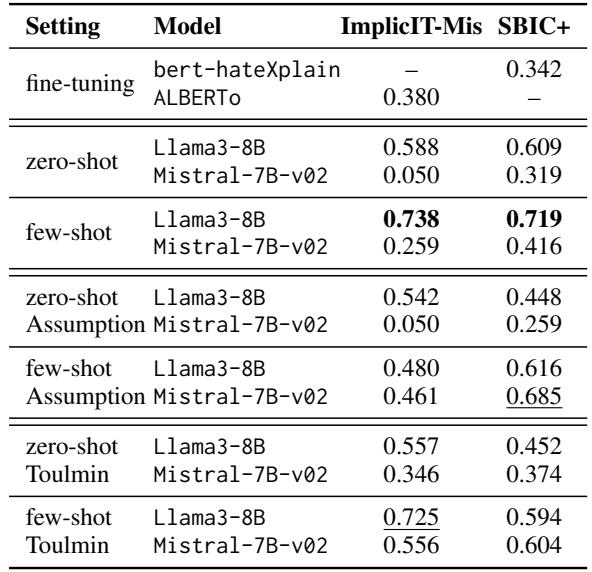
Table 1 highlights several key findings:
- Few-shot works best: Providing examples (Few-shot) significantly improves performance compared to Zero-shot.
- Llama3 dominance: Llama3-8B consistently outperformed Mistral-7B, particularly in Italian.
- The Toulmin effect: For the Italian dataset (ImplicIT-Mis), using the Toulmin warrant approach in a few-shot setting provided a massive boost in recall (0.725), outperforming the “Implied Assumption” prompt. This suggests that structuring the problem as a formal argument helps the model navigate the complexities of Italian cultural context.
However, in English, the simpler “Implied Assumption” prompt actually performed better. This discrepancy suggests that prompts are highly sensitive to language and the specific training data of the model.
Quality of Reasoning (Generation)
The classification score tells us that the model decided a text was misogynistic, but it doesn’t tell us why. To check if the models were reasoning correctly, the researchers compared the machine-generated explanations against human-written ones using text similarity metrics (BERTScore and BLEU).
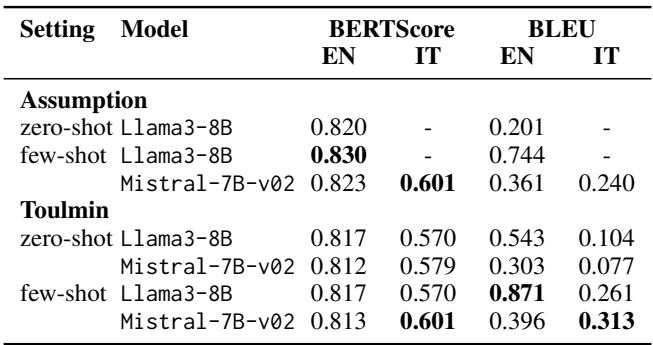
As shown in Table 2:
- English Performance: The models generated explanations that were highly similar to human annotations (BERTScore > 0.8).
- Italian Performance: The quality dropped significantly for Italian (BERTScore ~0.6). The models struggled to reconstruct the correct reasoning in Italian, likely due to cultural nuances and translation issues in the models’ training data.
The “Right Answer, Wrong Reason” Paradox
A critical finding emerged from the qualitative analysis: A correct classification does not imply correct reasoning.
In the manual validation, the researchers found that for the Italian dataset, 100% of the correctly classified examples were actually predicted for the wrong reasons. In English, this happened 37% of the time.
This implies that LLMs are relying on spurious correlations or “internalized knowledge” rather than genuine inductive reasoning. They might flag a sentence because it contains the word “kitchen” near the word “woman,” not because they understand the sexist trope of “women belong in the kitchen.”
Taxonomy of Errors
The researchers categorized where the models failed. These failure modes are revealing for anyone working with LLMs:
- Sarcasm/Irony: Models often took jokes literally.
- Metaphors: Especially in Italian, misogyny often uses animal metaphors (e.g., specific terms for female dogs or birds). Models frequently missed these figurative meanings.
- Lack of Reference: This was a major issue. For example, a comment comparing a woman to “Moana Pozzi” (a famous Italian pornographic actress) implies she is promiscuous. If the LLM doesn’t know who Moana Pozzi is, it cannot extract the warrant, and thus misses the misogyny.
- Denial of Misogyny: Sometimes the model would generate a perfect explanation of why the text was sexist, and then conclude, “Therefore, this is not misogyny.” This highlights a disconnect between the generation and classification heads of the model.
Conclusion & Implications
This research acts as a reality check for the use of LLMs in safety-critical tasks like hate speech detection. While framing misogyny detection as an Argumentative Reasoning task is a theoretically sound approach, current LLMs struggle to execute it reliably.
The study concludes that LLMs often “hallucinate” reasoning. They rely on surface-level patterns and lack the deep cultural knowledge required to understand implicit hate.
Key Takeaways
- Prompts Matter: Structuring prompts using argumentation theory (Claims/Warrants) can improve performance, especially in non-English languages.
- The Reasoning Gap: We cannot trust an LLM’s classification just because it gets the label right. The underlying reasoning must be verified.
- Cultural Knowledge: Implicit hate relies on shared cultural context (celebrities, news events, slang). LLMs need access to this external knowledge to function effectively.
As we move forward, the goal isn’t just to build models that catch the “bad words,” but to build systems that can understand the logic of hate. Only then can we effectively moderate the subtle, corrosive comments that pollute online spaces.