](https://deep-paper.org/en/paper/2409.05224/images/cover.png)
The dream of a “universal translator”—a single AI model capable of fluently translating between hundreds of languages—is closer than ever. Models like NLLB (No Language Left Behind) and M2M-100 have demonstrated that massive, pre-trained transformers can handle a dizzying array of linguistic pairs.
But there is a catch. These models are behemoths, often containing billions of parameters. Fine-tuning them for specific tasks or new data is computationally expensive and storage-heavy. Worse, there is a phenomenon known as “negative interference” or the “curse of multilinguality.” When you fine-tune a model to improve a low-resource language (like Zulu or Occitan), the model often forgets or degrades its performance on high-resource languages (like English or French). It’s a zero-sum game where languages fight for capacity within the neural network.
In a fascinating paper titled “Exploring Intrinsic Language-specific Subspaces in Fine-tuning Multilingual Neural Machine Translation,” researchers from the Nara Institute of Science and Technology propose a solution that challenges the conventional wisdom of “bigger is better.” They demonstrate that fine-tuning doesn’t require updating the whole model. Instead, it happens in tiny, language-specific “subspaces.”
By isolating these subspaces and realizing that high-resource languages actually need fewer parameters than low-resource ones, they achieved better translation quality with a fraction of the computational cost. Let’s dive into how they did it.
The Problem with Full-Parameter Fine-Tuning
To understand the solution, we first need to look at the standard way Multilingual Neural Machine Translation (MNMT) is trained. The goal is to maximize the probability of a target sentence \(y\) given a source sentence \(x\) across various language pairs.
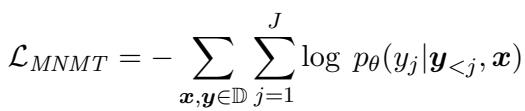
Usually, when researchers want to improve an MNMT model, they perform “full-parameter fine-tuning.” They take the pre-trained weights and update all of them based on new data.
This approach has two major flaws:
- Inefficiency: Updating billions of parameters requires massive GPU memory and storage.
- Interference: Because all languages share the same parameters, an update that helps Sindhi might hurt German. The high-resource languages often suffer from “catastrophic forgetting.”
Enter LoRA: A Quick Primer
To solve the efficiency problem, the AI field adopted LoRA (Low-Rank Adaptation). Instead of updating the massive weight matrix \(\mathbf{W}\), LoRA freezes \(\mathbf{W}\) and adds two small trainable matrices, \(\mathbf{B}\) and \(\mathbf{A}\).

Think of \(\mathbf{W}\) as a finished encyclopedia. Instead of rewriting the pages (full fine-tuning), LoRA adds a sticky note (\(\mathbf{BA}\)) on top of the page. It modifies the output without changing the original book. This drastically reduces the number of trainable parameters.
However, standard LoRA shares these “sticky notes” across all languages. The researchers hypothesized that this was the root of the interference problem. If English and Oriya are forced to use the same low-rank adaptation, one will inevitably pull the parameters in a direction that doesn’t suit the other.
The Solution: Language-Specific LoRA (LSLo)
The authors propose Language-Specific LoRA (LSLo). The concept is intuitive: instead of one shared LoRA module, the model maintains a bank of modules. When the model processes a specific language, it activates only the LoRA module assigned to that language.
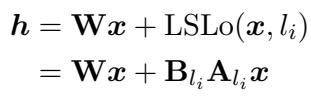
Here, \(l_i\) represents the language. If the input is French, the model uses the French-specific matrices \(\mathbf{B}_{fr}\) and \(\mathbf{A}_{fr}\). This effectively isolates the fine-tuning process. Updates to the “French subspace” cannot negatively impact the “Korean subspace.”
But this introduces new complexities. A Transformer model has an encoder (which reads the input) and a decoder (which generates the output). It has many layers, and each layer has different components (Attention, Feed-Forward Networks).
Two massive questions arise:
- Which language controls the switch? In the encoder, should we use the source language (e.g., English) or the target language (e.g., Chinese) to select the module?
- How big should the subspace be? Do we give English the same number of parameters as Occitan?
Architecture Learning: Solving the “Where” and “How Big”
The researchers didn’t just guess the answers; they developed algorithmic ways to find them.
1. Weight Learning: Source vs. Target
In a translation task \(src \rightarrow tgt\), the encoder processes the \(src\). However, deep learning theory suggests that as data moves up the layers of the encoder, it becomes more abstract and aligned with the target output.
To confirm this, the authors used a technique called Weight Learning. They allowed the model to use both source-indexed and target-indexed LSLo modules but assigned them learnable weights (\(w_{src}\) and \(w_{tgt}\)).
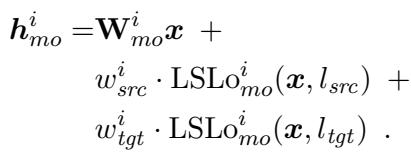
The model learned to prefer the module that helped it translate better. The results, visualized below, were striking.
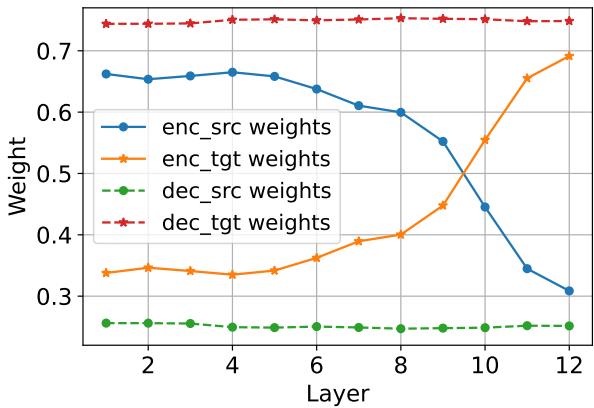
As shown in Figure 1, the bottom layers of the encoder (blue line) heavily prefer the source language. However, as we move to the top layers (Layer 12), the preference flips toward the target language (orange line). The decoder (red line) almost exclusively cares about the target language.
Takeaway: The optimal architecture uses source-specific modules for the bottom 9 layers of the encoder, and target-specific modules for the top 3 layers and the entire decoder.
2. Intrinsic Subspace Estimation: The “Resource” Hypothesis
Here is the paper’s most critical insight. Most multilingual models allocate the same capacity to every language. The authors hypothesized this is inefficient.
Hypothesis: High-Resource Languages (HRL) like English and French are already well-represented in the pre-trained model. They should require a tiny subspace for fine-tuning. Conversely, Low-Resource Languages (LRL) like Wolof or Sindhi were likely under-represented during pre-training and need a larger subspace to learn effectively.
To test this, they used a pruning technique. They trained a large LSLo model and then tried to “prune” (delete) parameters to see which languages resisted. If a language’s parameters could be easily deleted without hurting performance, that language has a low demand for space.
They defined an importance score based on how many parameters remained after pruning:

The resulting heatmap confirms their hypothesis beautifully:
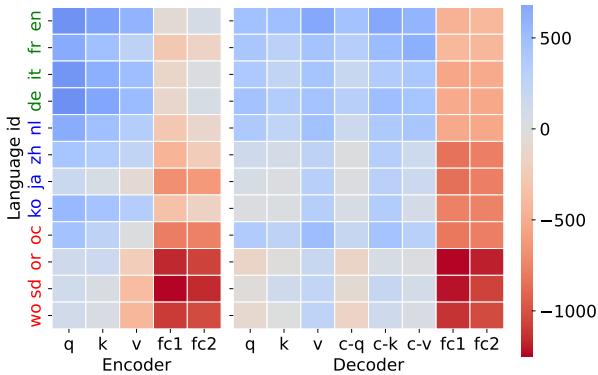
Look at Figure 2. The rows are languages.
- Green Group (High Resource): Languages like English (en) and French (fr) are deep blue. They have very low demand for new parameters.
- Red Group (Very Low Resource): Languages like Wolof (wo) and Sindhi (sd) are red/orange. They are “hungry” for parameters.
This proves that we should not treat all languages equally. High-resource languages can be fine-tuned in a tiny subspace, while low-resource languages need more room to grow.
The Gradual Pruning Schedule
Armed with this knowledge, the researchers implemented a Gradual Pruning Schedule (GPS).
Instead of just setting a small rank for high-resource languages from the start, they start with a moderate size and slowly cut away parameters during training. This prevents the model from overfitting—a common issue when fine-tuning high-resource languages on limited new data.
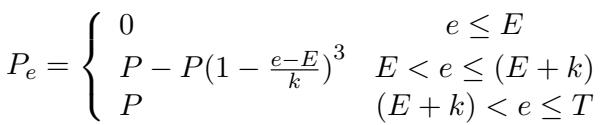
The schedule gradually increases the pruning ratio \(P_e\) from 0 to a target \(P\) (e.g., 90%). This allows the model to “settle” into the most essential parameters for English or German, eventually leaving only a tiny, highly efficient sliver of active weights.
Experimental Results
The team tested their method on subsets of the FLORES-101 dataset, comparing it against full-parameter fine-tuning (Ft-all).
Efficiency and Performance
The results were impressive. By using their optimized setup—where high-resource languages are aggressively pruned (up to 90%) and low-resource languages are given more rank—they outperformed the baseline.
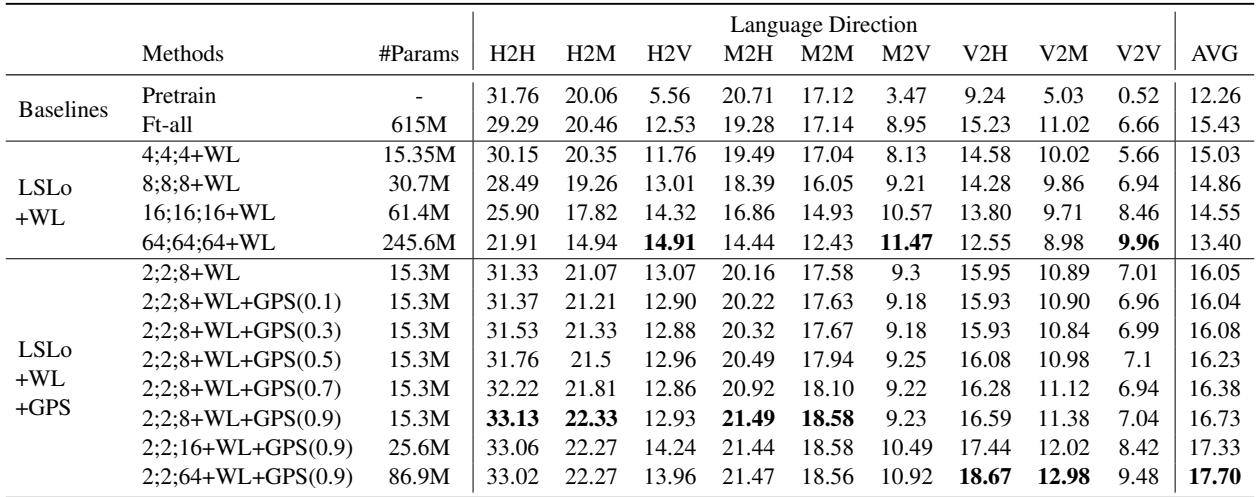
In Table 1, look at the row 2;2;8+WL+GPS(0.9).
- H2H (High-to-High): improved from 29.29 (Ft-all) to 33.13.
- V2V (Very-Low-to-Very-Low): improved from 6.66 (Ft-all) to 7.04.
- Params: This was achieved using only 15.3 Million trainable parameters, compared to the 615 Million required for full fine-tuning.
Solving the Degradation of High-Resource Languages
One of the most persistent problems in multilingual learning is that as the model learns new low-resource languages, it gets worse at the high-resource ones it already knew.
The researchers analyzed the training progress per epoch to see if LSLo solved this.
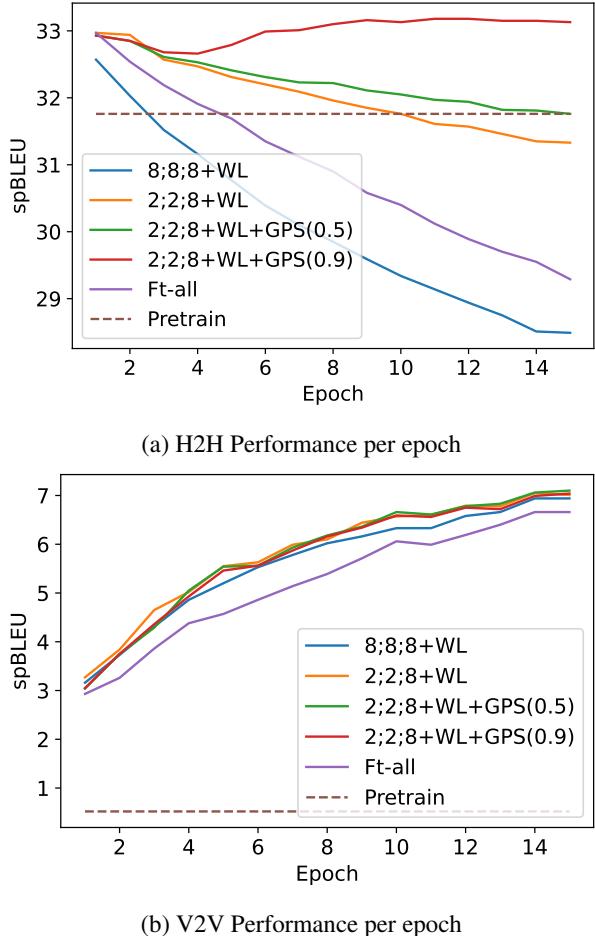
Figure 3(a) tells a compelling story. The purple dotted line (Ft-all) shows performance on High-to-High translation dropping as training progresses. The model is forgetting. However, the red line (the proposed method with aggressive pruning) stays high and stable. By restricting the high-resource languages to a tiny subspace, the model prevents them from drifting away from their optimal pre-trained state (overfitting).
Scaling Up
They extended the experiment to 30 languages to ensure the method scales.

As shown in Table 2, even with more languages adding more modules, the total parameter count remains a fraction of the original model (46M vs 615M), and the average spBLEU score is significantly higher (13.86 vs 11.61).
Where Does the Magic Happen?
In a final piece of analysis, the authors asked: Which parts of the Transformer need these language-specific adaptations the most?
Is it the Attention mechanism (Query, Key, Value)? Or the Feed-Forward Networks (FC1, FC2)?
They ran the pruning analysis again, this time grouping by component type.
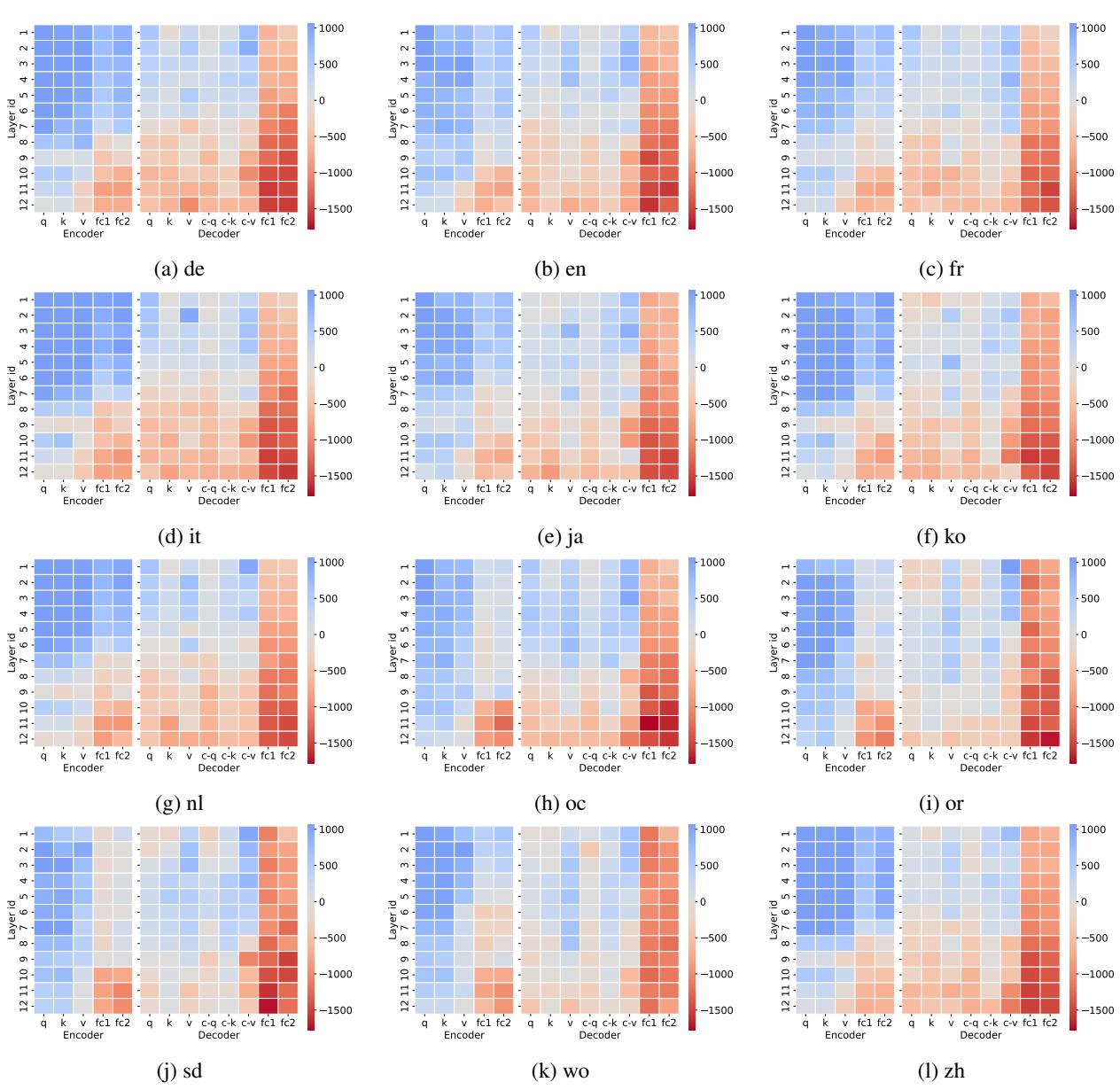
Figure 6 (and the aggregate Figure 4 in the paper) shows a clear trend. The FC1 and FC2 columns are consistently “hotter” (redder) than the attention columns. This suggests that the Feed-Forward layers act as the “memory” or knowledge base of the model, making them the most critical place to apply language-specific fine-tuning.
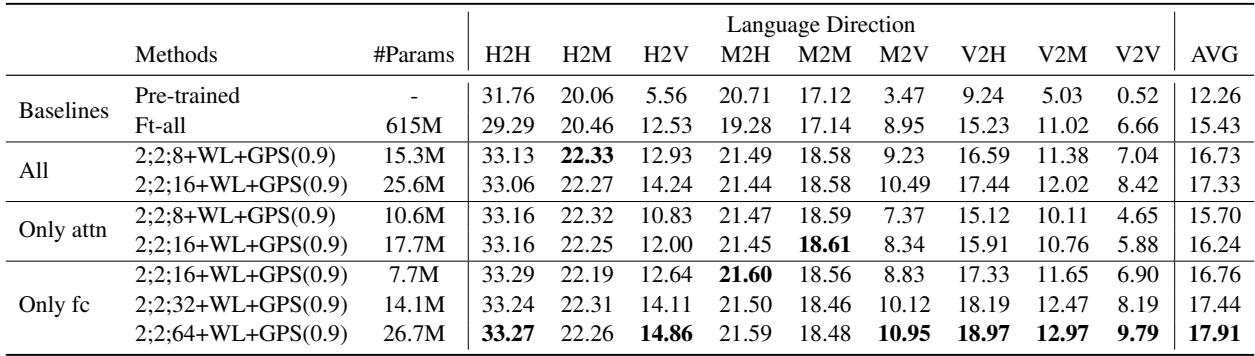
Validating this, Table 4 confirms that applying LSLo only to the FC layers yields better results than applying it only to Attention layers, given a similar parameter budget.
Conclusion
This research offers a blueprint for the future of efficient AI. It debunks the idea that we need massive parameter updates to fine-tune large models. Instead, it paints a picture of a nuanced, efficient system:
- Isolation: Languages should have their own private subspaces to prevent interference.
- Asymmetry: High-resource languages need tiny adjustments; low-resource languages need major ones.
- Targeting: The Feed-Forward layers are the prime candidates for these adjustments.
By using Language-Specific LoRA combined with Gradual Pruning, we can fine-tune massive multilingual models on consumer-grade hardware, achieving better results without forgetting the languages the model already knows. It is a “less is more” approach that makes the dream of the universal translator more accessible and sustainable.