](https://deep-paper.org/en/paper/2409.13609/images/cover.png)
Introduction
Imagine you are looking at a crowded photograph of a street scene. A friend stands beside you and says, “Look at the guy in the yellow shirt standing near the bike.” Instantly, your brain processes the language, scans the image, filters out the “guys in blue shirts” and “guys near cars,” and locks onto the specific target.
In computer vision, this task is known as Referring Expression Comprehension (REC). The goal is to ground a specific region in an image based on a natural language description. While this sounds intuitive to humans, it is a complex challenge for AI. It requires a model to possess strong visual perception, deep linguistic understanding, and—most importantly—the ability to align these two modalities perfectly.
Traditionally, achieving state-of-the-art results in REC has required “full fine-tuning.” This means taking massive, pre-trained models (like Vision Transformers) and updating every single parameter in the network to adapt them to the task. While effective, this approach is computationally expensive and storage-heavy. It also risks “catastrophic forgetting,” where the model loses the rich general knowledge it gained during its original pre-training.
Recently, researchers have turned to Parameter-Efficient Transfer Learning (PETL). The idea is simple: freeze the massive pre-trained model and only train a tiny set of extra parameters (adapters). However, standard PETL methods often fail at REC because they lack the specific ability to align text with fine-grained visual details.
Enter MaPPER (Multimodal Prior-guided Parameter Efficient Tuning). In a new paper, researchers propose a novel framework that achieves better accuracy than full fine-tuning while updating only 1.41% of the parameters.
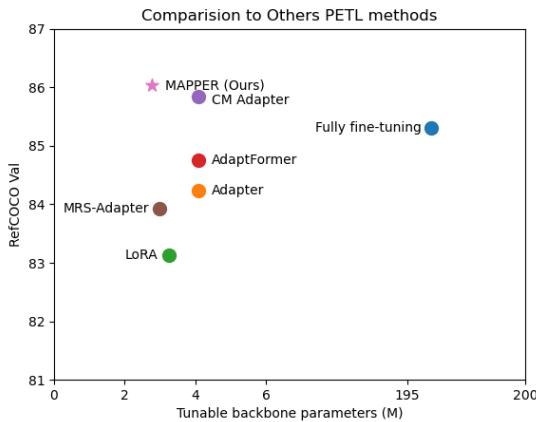
As shown in Figure 1 above, MaPPER (the pink star) achieves superior performance on the RefCOCO benchmark with a fraction of the trainable parameters compared to full fine-tuning (the blue circle on the far right) and other adapter methods.
In this post, we will deconstruct how MaPPER works, exploring how it uses “multimodal priors” and “local convolutions” to bridge the gap between efficiency and accuracy.
Background: The Challenge of Efficient Tuning
To understand why MaPPER is necessary, we first need to look at the limitations of existing approaches in the context of Referring Expression Comprehension.
The Problem with Full Fine-Tuning
Current REC methods typically use a two-tower architecture: a visual encoder (to see the image) and a text encoder (to read the prompt). To make these models good at pointing to specific objects, engineers retrain the entire backbone.
- Pros: The model learns the task deeply.
- Cons: It requires massive GPU memory. If you have a 1 billion parameter model, you are updating 1 billion numbers. It also breaks the “prior knowledge” embedded in the model during its original pre-training.
The Limitation of Standard PETL
Parameter-Efficient Transfer Learning (PETL) methods, like LoRA (Low-Rank Adaptation) or Adapters, insert small, trainable modules into frozen backbones. This is great for general tasks, but REC is unique.
- Local Perception: Standard vision transformers are good at global context (“This is a park”) but often miss local details (“This is the specific texture of a small bird”). Standard adapters don’t fix this.
- Multimodal Alignment: Generic language adapters don’t inherently know about images. They process text in isolation, making it harder to align “yellow shirt” with the visual pixels of a yellow shirt.
The researchers behind MaPPER realized that to make PETL work for REC, they needed task-specific adapters that introduce local visual semantics and vision-language alignment cues.
The MaPPER Framework
MaPPER stands for Multimodal Prior-guided Parameter Efficient Tuning for REC. The philosophy behind the architecture is to keep the heavy backbones (DINOv2 for vision and BERT for text) completely frozen. Instead of changing the backbones, MaPPER wraps them in smart, lightweight modules.
Let’s look at the high-level architecture:
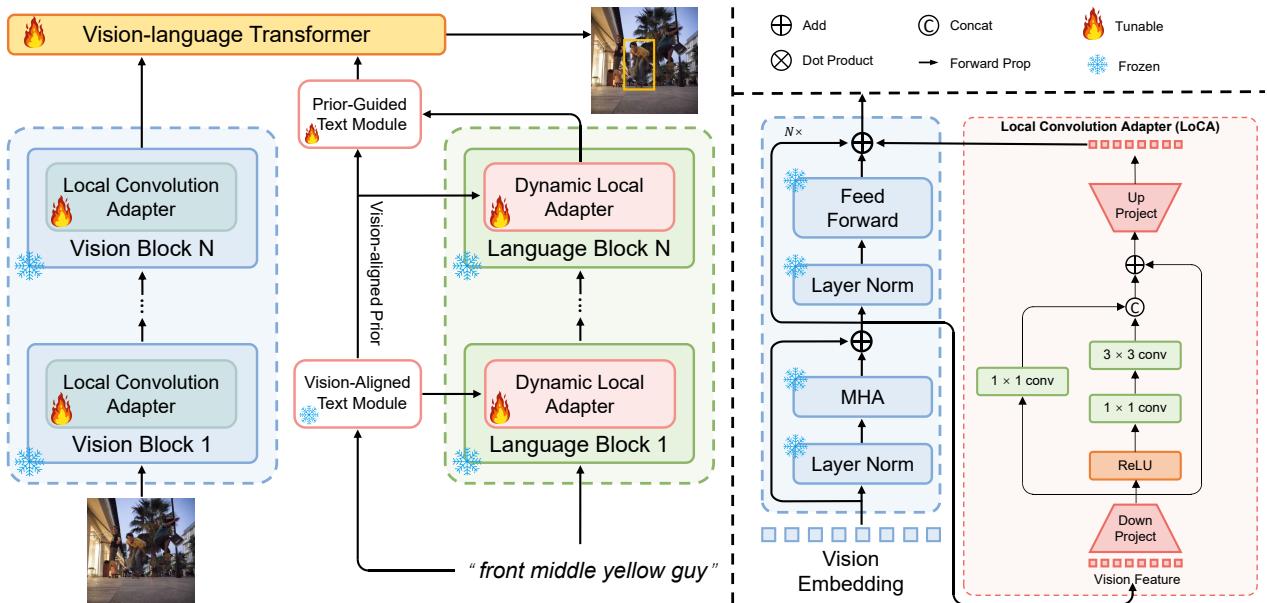
As illustrated in Figure 2, the framework consists of two main parallel streams:
- Language Branch (Right): Uses a frozen BERT encoder enhanced with Dynamic Prior Adapters (DyPA).
- Vision Branch (Left): Uses a frozen DINOv2 encoder enhanced with Local Convolution Adapters (LoCA).
These branches converge at a multimodal transformer that predicts the bounding box. Let’s break down the innovations in each branch.
1. Prior-Guided Text Understanding
Standard text encoders like BERT are trained on pure text. They understand the word “dog,” but they don’t inherently know what a dog looks like. To bridge this gap without retraining BERT, MaPPER introduces a Vision-Aligned Prior.
The Vision-Aligned Prior (VAP)
The researchers utilize a frozen CLIP model to generate a “prior.” CLIP is a model explicitly trained to match images and text. Given a text input \(\pmb{t}\), the model passes it through the frozen CLIP text encoder to get a vector representation that is already aligned with visual concepts. This vector is the “Prior” (\(\pmb{p}\)).

Here, \(M\) is a mapping layer. This prior \(\pmb{p}\) acts as a “hint” for the rest of the network, carrying information about what the text should look like.
Dynamic Prior Adapter (DyPA)
Now that we have this visual hint (the prior), how do we use it? The authors introduce the Dynamic Prior Adapter (DyPA). Unlike a standard adapter that just processes text, the DyPA adjusts its behavior based on the visual prior.
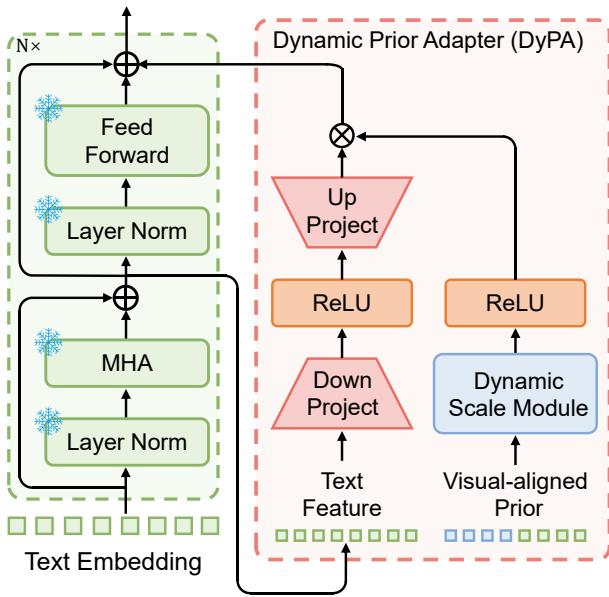
As shown in Figure 3, the DyPA is inserted into the BERT layers. It takes the intermediate text features and the Vision-aligned Prior as inputs.
The magic happens in the Dynamic Scale Module. Instead of adding the adapter features directly, the model calculates a scaling factor \(S_f\) based on the prior.

The scaling factor \(S_f\) determines how much influence the adapter should have. If the visual prior suggests a strong correlation, the scale might increase. This allows the frozen text encoder to dynamically adjust its focus based on visual concepts.
The full operation of the DyPA is governed by the following equation, where the adapter’s output is scaled by \(S_f\) before being projected back up:

Prior-Guided Text Module (PGT)
Finally, at the end of the text encoding process, the framework explicitly fuses the prior with the text features. This ensures that the final representation fed into the cross-modal interaction module is rich with visual cues.
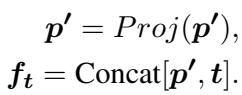
By concatenating the transformed prior \(\pmb{p'}\) with the text tokens \(\pmb{t}\), the model ensures the language representation is “primed” for visual grounding.
2. Global & Local Visual Perception
The vision backbone used is DINOv2, a powerful transformer. Vision Transformers (ViTs) process images by splitting them into patches. While this is efficient, ViTs sometimes struggle with fine-grained local details—the exact edge of a bounding box or the distinction between a small foreground object and the background.
To fix this, MaPPER introduces the Local Convolution Adapter (LoCA).
Local Convolution Adapter (LoCA)
The LoCA is designed to inject “localness” back into the transformer. Convolutions (CNs) are naturally good at processing local neighborhoods of pixels. By inserting a small convolutional network alongside the transformer layers, MaPPER gets the best of both worlds: the global context of the Transformer and the local precision of CNNs.
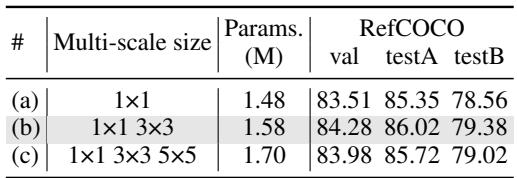
The LoCA uses a multi-scale design. It processes features using both \(1\times1\) convolutions (for channel mixing) and \(3\times3\) convolutions (for spatial context), effectively capturing details at different scales.
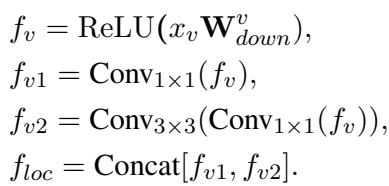
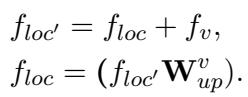
The results of these convolutions are concatenated to form a local feature \(\pmb{f_{loc}}\). This local feature is then added to the global features produced by the Transformer.
Integration
The integration into the transformer block is additive. The output of the standard Multi-Head Attention (MHA) and MLP layers is augmented by the scaled local features from the LoCA.

This simple addition (\(s \cdot f_{loc}\)) allows the frozen DINOv2 model to suddenly “see” local textures and boundaries much more clearly, which is critical for drawing accurate bounding boxes.
Experiments and Results
The researchers tested MaPPER on three standard benchmarks: RefCOCO, RefCOCO+, and RefCOCOg. These datasets contain images with complex descriptions used to locate objects.
Comparison with State-of-the-Art (SOTA)
The results, presented in Table 1 below, are quite remarkable. MaPPER (bottom row) outperforms not only other PETL methods like DARA but also beats methods that use Full Fine-Tuning (the top section).
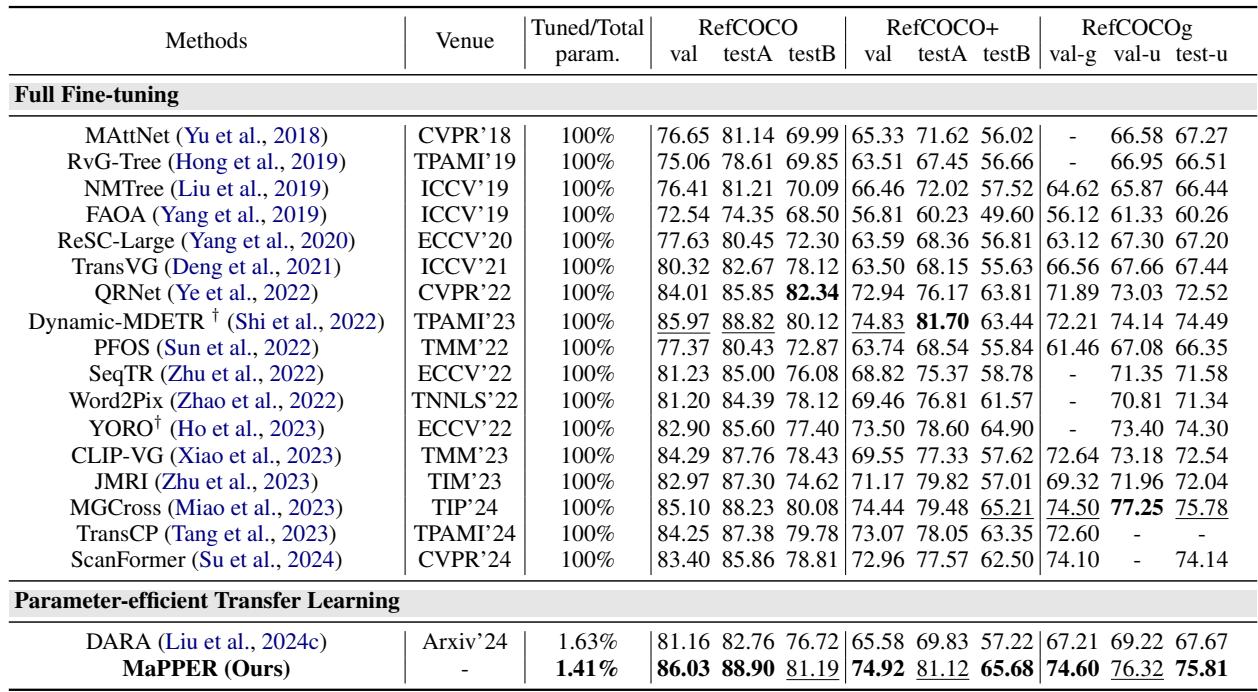
Notice the “Tuned/Total param.” column. Traditional methods tune 100% of the parameters. MaPPER tunes only 1.41%. Despite this massive reduction in computational overhead, it achieves higher accuracy (e.g., 88.90% on RefCOCO TestA vs. 88.82% for Dynamic-MDETR).
Comparison with Other PETL Methods
How does MaPPER stack up against generic adapters like LoRA or AdaptFormer?
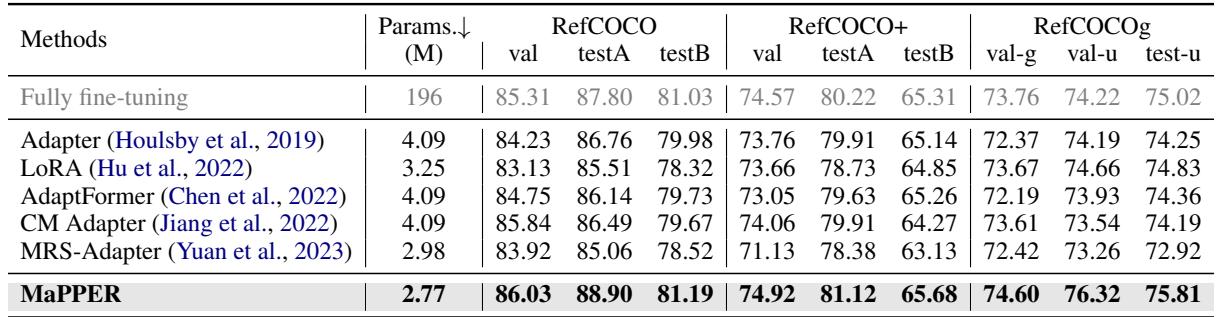
Table 2 shows that simply applying LoRA or standard Adapters to this task yields suboptimal results (around 83-84% on RefCOCO val). MaPPER jumps to 86.03%. This confirms the hypothesis that generic adapters aren’t enough for REC; the Prior-Guided and Local Convolution designs are essential.
Ablation Studies: Do the Components Work?
The researchers performed ablation studies to prove that each part of MaPPER is necessary.
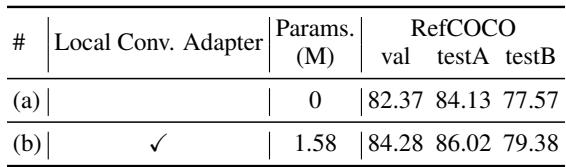
1. Does the Local Convolution Adapter (LoCA) help? Yes. As shown in Table 3, adding LoCA improves performance significantly compared to a frozen baseline (Row ‘a’ vs Row ‘b’).
2. Does the Multi-scale Convolution matter? Yes. Using only a 1x1 convolution isn’t enough. Combining 1x1 and 3x3 convolutions (Row ‘b’ in Table 4) provides the best balance of local detail.
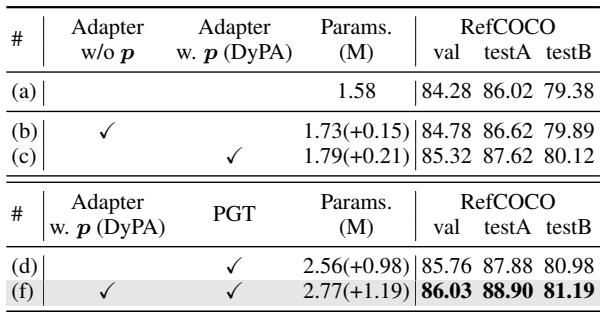
3. Does the Vision-Aligned Prior help? Table 5 (below) dissects the text branch.
- Row (b) uses a standard adapter without the prior.
- Row (c) uses the DyPA (with the prior). The score jumps from 84.78 to 85.32.
- Row (f) adds the PGT module, achieving the final high score.
Visualization
Numbers are great, but can we see the difference? The researchers visualized the attention maps of the model.
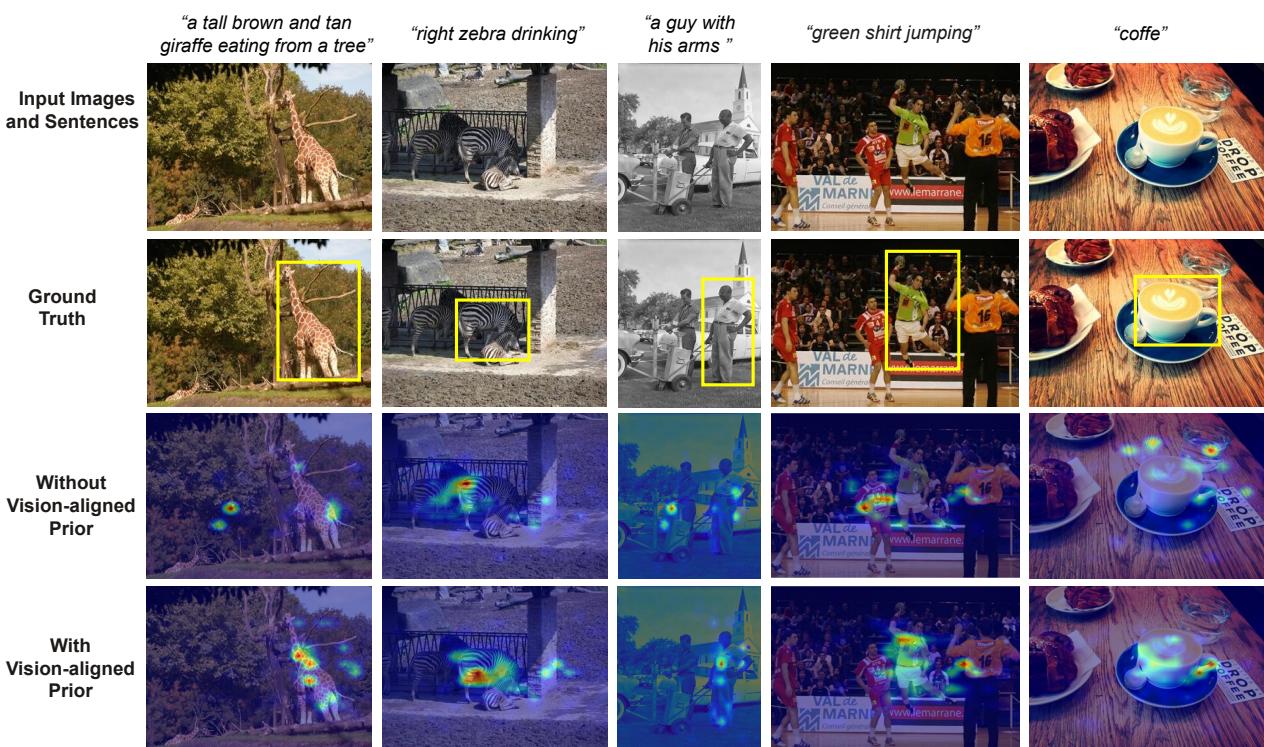
In Figure 4, the top row shows the input (e.g., “right zebra drinking”).
- The Third Row (Without Prior) shows the model’s attention is scattered. It looks at the general area but misses the precise target.
- The Fourth Row (With Vision-aligned Prior) shows tight, focused heatmaps that align perfectly with the ground truth (Second Row). The prior successfully guides the model to focus on the “right zebra” or the “green shirt.”
Conclusion & Implications
MaPPER represents a significant step forward in efficient multimodal learning. It addresses the “Elephant in the Room” of modern AI: models are getting too big to retrain for every specific task.
By identifying the specific weaknesses of frozen models in the context of Referring Expression Comprehension—namely, the lack of local visual detail and weak text-image alignment—the authors designed a surgical solution.
- DyPA injects visual understanding into the language model using priors.
- LoCA injects local precision into the vision model using convolutions.
The result is a model that is computationally cheap to train (tuning only ~1.4% of parameters) yet performs better than heavyweight, fully fine-tuned counterparts. For students and researchers with limited GPU resources, MaPPER offers a blueprint for how to adapt Foundation Models effectively: don’t just add parameters; add priors and inductive biases that match your specific task.