](https://deep-paper.org/en/paper/2409.14469/images/cover.png)
Introduction
In the rapid evolution of Natural Language Processing (NLP), we often assume that “more data” and “more structure” always equal better performance. For years, the gold standard for improving language models involves explicitly teaching them the grammatical and logical structures of language—a process known as Semantic Parsing.
By converting a messy natural language sentence into a structured, logical form (like a diagram of who did what to whom), we helped models like BERT achieve state-of-the-art results. But as we transitioned into the era of Large Language Models (LLMs) like GPT-4 and LLaMA, a strange paradox emerged: feeding these giant models explicit structural data often makes them worse.
Why does a method that works so well for small models fail for large ones? And more importantly, can we still leverage the power of linguistic structure without breaking the LLM?
In this post, we dive deep into the paper “Rethinking Semantic Parsing for Large Language Models,” which proposes a fascinating solution called SENSE. Instead of force-feeding complex parse trees to an LLM, the researchers discovered that simply providing a “semantic hint”—nudging the model to use its internal understanding of grammar—can significantly boost performance across understanding, translation, and simplification tasks.
Background: The Role of Semantic Parsing
To understand the innovation of SENSE, we first need to understand what Semantic Parsing is and why it matters.
What is Semantic Parsing?
Semantic Parsing is the task of translating a natural language sentence into a machine-understandable representation. Think of it as sentence diagramming on steroids. It breaks down a sentence to identify the relationships between words. Common frameworks include:
- Semantic Role Labeling (SRL): Identifies the predicate (action) and arguments (participants) in a sentence. For example, in “John ate the cake,” John is the Agent and the cake is the Patient.
- Abstract Meaning Representation (AMR): A graph-based representation that captures the logic of a sentence, abstracting away the specific wording to focus on the meaning.
The Pre-LLM Era vs. The LLM Era
In the era of “smaller” deep learning models (like BERT or RoBERTa), integrating these semantic structures was a reliable way to boost performance. If you were building a Question Answering system, feeding the model the SRL tags helped it understand the context better.
However, LLMs operate differently. They are trained on massive amounts of raw text and have learned these structures implicitly. The researchers behind this paper posed a critical question: Can semantic information still contribute to improving downstream tasks on LLMs?
Their initial investigations revealed a problem. When they tried to integrate explicit parsing results (like AMR graphs) into the input of an LLM, the performance dropped. The complex symbols and schemas of semantic parsing seemed to act as noise, confusing the model rather than helping it.
The Problem: Explicit Injection Fails
The researchers identified three standard paradigms for interacting with LLMs, as illustrated in the figure below.
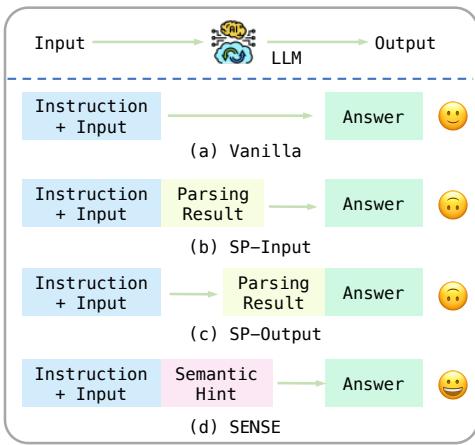
Let’s break down the approaches shown in Figure 1:
- Vanilla (a): The standard approach. You give the LLM an instruction and an input, and it gives an answer.
- SP-Input (b): You take the input sentence, run it through an external parser to get a logical structure (like an AMR graph), and paste that structure into the prompt alongside the original sentence.
- Result: Performance degradation. The LLM struggles to process the rigid symbolic representation.
- SP-Output (c): You ask the LLM to first generate the parse tree itself, and then use that to answer the question.
- Result: Performance degradation. The model might generate erroneous parsing results, which then mislead its final answer.
The researchers concluded that explicitly injecting parsing results is counterproductive because it limits the model to fixed types of parsing and introduces “unfamiliar symbolic representation.”
The Solution: SENSE (Semantic Hints)
If feeding the result of semantic parsing is bad, what if we just reminded the model that semantic parsing exists?
The proposed method, SENSE, takes a psychological approach to prompting. Instead of providing the parsed data, SENSE embeds Semantic Hints within the prompt.
How SENSE Works
Look at Figure 1(d) again. The workflow is cleaner. The model isn’t given a parse tree. Instead, the instruction includes a phrase like:
“Please use semantic parsing result to enhance comprehension of the sentence’s structure and semantics…”
This acts as a trigger. It encourages the LLM to “harness their internal semantic parsing capabilities.” It is a zero-shot approach, meaning the model doesn’t need to be retrained; it just needs to be asked correctly.
The specific prompts used for different tasks are quite revealing. They don’t demand a specific output format (like JSON or XML); they simply contextualize the task linguistically.

As shown in Figure 2, the difference is subtle but powerful:
- Translation: “Utilizing its semantic parsing result which helps to understand grammar and semantics…”
- Paraphrasing: “Use semantic parsing result which can enhance comprehension…”
- Simplification: “With the help of sentence’s semantic parsing result…”
By framing the prompt this way, the LLM is nudged to attend to the structural elements of the sentence—the verbs, the subjects, the relationships—before generating a response.
Experimental Results
The researchers tested SENSE across a variety of NLP tasks to see if this “placebo-like” hint actually made a difference. The results were consistent: SENSE outperforms vanilla prompting and explicit parsing methods.
1. Natural Language Understanding (GLUE)
The GLUE benchmark is a collection of tasks designed to test how well a model “understands” language (e.g., sentiment analysis, grammatical correctness, textual entailment).
The table below compares SENSE against standard baselines (like GPT-3.5 and LLaMA-3) and older supervised models (BERT).
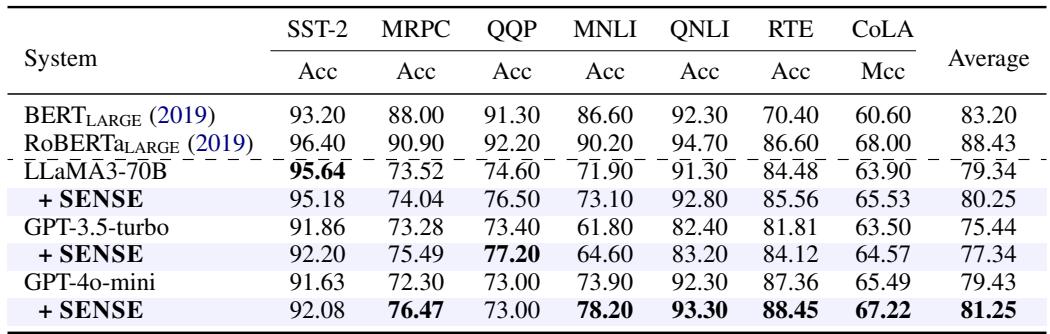
Key Takeaways from Table 1:
- Closing the Gap: While LLMs generally lag behind fine-tuned BERT models on these specific tasks, SENSE narrows that gap significantly. For example, GPT-4o-mini improves from 79.43% to 81.25% average accuracy.
- Consistent Gains: Improvements are seen across almost all tasks. Look at MRPC (paraphrase detection), where GPT-4o-mini jumps from 72.30% to 76.47%.
- Model Agnostic: The method works for both open-source models (LLaMA-3) and closed-source models (GPT-series).
2. Text Generation: Paraphrasing
Paraphrasing requires a model to rewrite a sentence with different words while keeping the exact same meaning. It’s a delicate balance between Semantic Similarity (keeping meaning) and Lexical/Syntactic Diversity (changing words and structure).
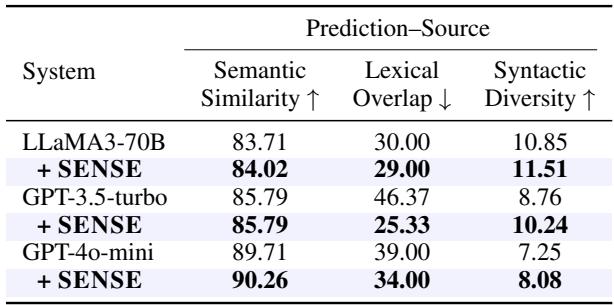
Key Takeaways from Table 2:
- Lower Lexical Overlap: SENSE (rows marked with +SENSE) significantly reduces lexical overlap (from 39.00 to 34.00 for GPT-4o-mini). This means the model is using different words rather than just copying the input.
- Higher Syntactic Diversity: The diversity score increases, indicating the model is changing the grammatical structure of the sentence, not just swapping synonyms.
- Maintained Meaning: Crucially, the Semantic Similarity score remains high (around 90%).
This confirms that the semantic hint prompts the model to deeply understand the sentence structure and reconstruct it, rather than shallowly editing it.
3. Text Simplification
Text simplification involves making sentences easier to read. This is measured by metrics like SARI (comparing against references) and SAMSA (measuring structural preservation).
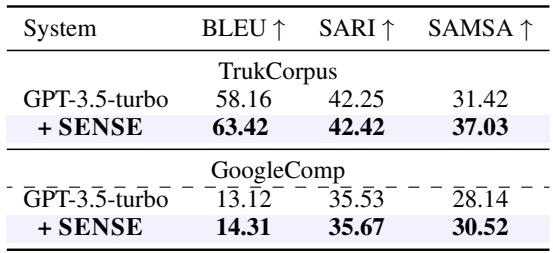
Key Takeaways from Table 3:
- SAMSA Score Spike: The most notable improvement is in the SAMSA metric (from 31.42 to 37.03 on TurkCorpus). This metric specifically measures how well the meaning is preserved when the structure is split or simplified.
- BLEU Score: Standard accuracy metrics (BLEU) also see a significant bump (58.16 to 63.42).
4. Machine Translation
Finally, the authors tested SENSE on translation tasks (WMT22 benchmark). Translation requires a deep grasp of grammar in both source and target languages.
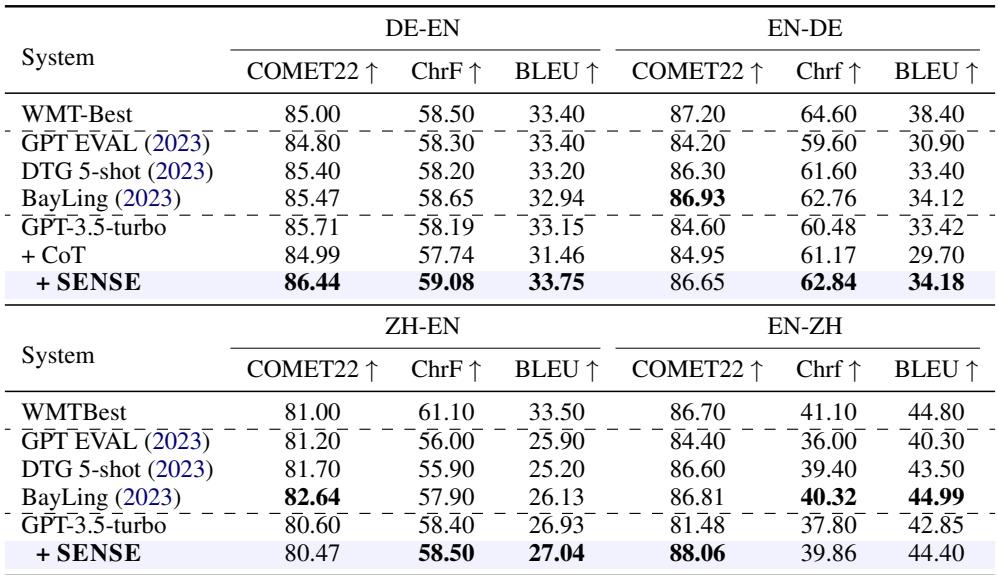
Key Takeaways from Table 8:
- State-of-the-Art Performance: On the German-to-English (DE-EN) task, SENSE combined with GPT-3.5 achieves a COMET score of 86.44, outperforming the previous “WMT-Best” system.
- Chain-of-Thought Comparison: Interestingly, standard Chain-of-Thought (CoT) prompting (“Let’s think step by step”) actually hurt performance in translation (see the +CoT rows). SENSE, however, consistently improved it.
Why Does SENSE Work?
It might seem like magic. Why does adding a sentence about “semantic parsing” to a prompt change the mathematical output of a neural network?
To investigate this, the researchers visualized the Attention Scores of the models. Attention mechanisms determine which parts of the input sentence the model focuses on when generating output.
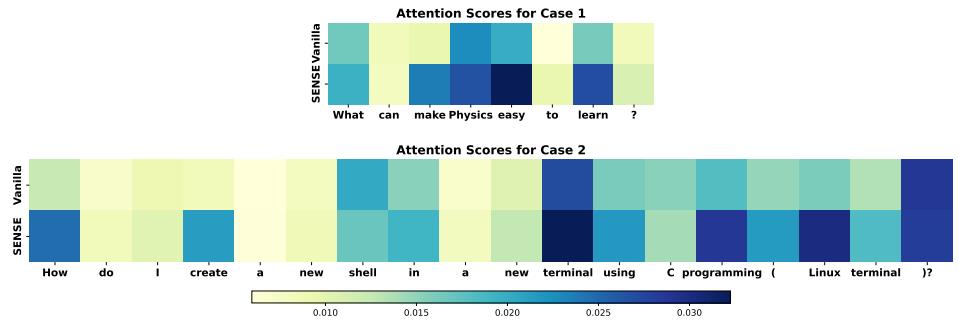
Figure 3 provides a compelling visual explanation:
- Top Heatmap (Case 1): In the sentence “What can make Physics easy to learn?”, the Vanilla prompt spreads attention somewhat loosely. The SENSE prompt (the deeper blue bars) puts significantly higher attention on the word “Physics”.
- Bottom Heatmap (Case 2): In the complex technical command, SENSE focuses heavily on key entities like “terminal”, “C programming”, and “shell”.
The Conclusion: The semantic hint acts as a focusing mechanism. It suppresses the model’s tendency to focus on function words (like “the”, “a”, “is”) and redirects its computational resources toward the words that carry the core semantic meaning. By telling the model to “think about semantics,” the model effectively attends to the “meaning-bearing” words more intensely.
Comparison with Other Methods
The paper makes a strong case that SENSE is not just better than vanilla prompting, but also better than previous attempts to use structure.
- Vs. Explicit Parsing (SP-Input/Output): As mentioned earlier, explicit parsing introduces noise. SENSE avoids this by keeping the prompt clean.
- Vs. Chain-of-Thought (CoT): CoT is famous for reasoning tasks (math, logic). However, the researchers found CoT less effective for linguistic tasks like translation or classification. SENSE appears to be the “CoT equivalent” for language-centric tasks.
Conclusion and Implications
The research presented in “Rethinking Semantic Parsing for Large Language Models” offers a valuable lesson for prompt engineers and NLP researchers: Trust the model’s internal representations.
We don’t always need to provide external tools or rigid data structures to get better performance. LLMs have ingested the entire internet; they know what a verb is, and they know what a subject is. They just need to be reminded to use that knowledge.
Key Takeaways:
- Explicit is not always better: Injecting raw semantic parse trees into LLMs hurts performance.
- Hints are powerful: A simple instruction (“use semantic parsing”) can trigger complex internal processing.
- Focus matters: SENSE works by redirecting the model’s attention to semantically important keywords.
- Broad applicability: The method works across understanding, paraphrasing, simplification, and translation.
As we continue to explore the capabilities of Large Language Models, methods like SENSE highlight that the frontier of prompt engineering isn’t just about what data we put in, but how we guide the model’s “thought process” to leverage what it already knows.