](https://deep-paper.org/en/paper/2409.14513/images/cover.png)
Large Language Models (LLMs) are trained on massive datasets scraped from the internet, often containing sensitive personal information, proprietary code, or copyrighted works. This creates a significant privacy risk: these models can “memorize” their training data. If an adversary can query an LLM and determine whether a specific document was part of its training set, they have successfully mounted a Membership Inference Attack (MIA).
For organizations deploying LLMs, auditing these models for privacy leaks is crucial. However, the current “gold standard” for auditing—training “shadow models”—is prohibitively expensive. It requires training multiple copies of LLMs just to test one.
In this post, we will dive deep into a research paper titled “Order of Magnitude Speedups for LLM Membership Inference.” The researchers propose a novel method using quantile regression ensembles that drastically reduces the computational cost of these audits (by nearly 95%) while maintaining or even exceeding the accuracy of state-of-the-art methods.
We will break down the problem with current attacks, explain the mathematics behind the new regression-based approach, and analyze the results that show why this might be the new standard for privacy auditing.
The Problem: Privacy Auditing is Too Expensive
To understand the contribution of this paper, we first need to understand the mechanics of a Membership Inference Attack.
The goal of an MIA is to determine if a specific data point \(x\) (like a medical record or an email) was included in the private dataset \(D_{priv}\) used to train a target model \(f\).
The Naive Approach: Loss Thresholding
The simplest intuition is that models “like” data they have seen before. If you feed a sentence to an LLM and it predicts the next tokens with very high probability (low loss), it might have memorized that sentence.
However, simply looking at the loss is flawed. Some sentences are just naturally easier to predict than others (e.g., “The cat sat on the mat” vs. a complex medical diagnosis). A low loss might mean the model memorized the data, or it might just mean the data is simple.
The Gold Standard: LiRA and Shadow Models
To fix this, researchers use Likelihood Ratio Attacks (LiRA). Instead of looking at the raw loss, they look at the calibrated loss. They ask: “Is the loss on this document significantly lower than we would expect for a model not trained on this document?”
To answer this, they train Shadow Models. These are models identical to the target model but trained on different data subsets. By passing a document through multiple shadow models, an auditor can build a distribution of “expected scores” for that document.
If the target model’s score is an outlier compared to the shadow models, the document was likely in the training set.
The Bottleneck: Training shadow models is computationally crushing. If you want to audit a 7-billion parameter Llama model, LiRA might require you to train multiple 7-billion parameter models from scratch. For most researchers and companies, this is impossible.
The Solution: Quantile Regression Ensembles
The researchers propose a method that removes the need for expensive shadow models entirely. Instead of simulating the training process, they aim to directly predict the distribution of scores using a much smaller, cheaper model.
The Core Concept
The hypothesis test remains the same: we want to distinguish between the Null Hypothesis (\(H_0\), the data is new) and the Alternative Hypothesis (\(H_1\), the data was in training).

The attack defines a score function \(s(x)\), typically the loss or negative log-likelihood of the document under the target model.

The attacker’s goal is to learn a threshold function \(q(x)\). If the score \(s(x)\) is higher than this threshold, we reject the null hypothesis and assume membership.

Replacing Shadow Models with Regression
In the shadow model approach, we estimate \(q(x)\) by training huge models. In this new approach, the authors propose training a Quantile Regression Model.
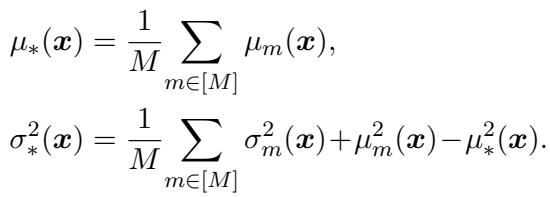
This regression model takes the text \(x\) as input and outputs the predicted statistics of the score distribution for that text. Specifically, it predicts the mean \(\mu(x)\) and standard deviation \(\sigma(x)\) of the score that a generic LLM would produce for that text if it hadn’t seen it during training.
Crucially, the regression model does not need to be an LLM of the same size. You can use a tiny 160-million parameter model to predict the score difficulty for a 7-billion parameter target.
The Objective Function
The regression model is trained on a public dataset \(D_{pub}\) (data known not to be in the target’s training set). The researchers explored two objective functions to train this model.
- Gaussian Negative Log-Likelihood: Minimizing the error assuming the scores follow a normal distribution.
- Pinball Loss: A robust method often used in quantile regression to directly estimate specific quantiles (like the median) without strictly assuming a normal distribution.
The training objectives are formalized as follows:
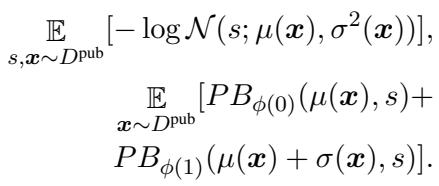
Here, the second equation minimizes the Pinball Loss (PB), which is defined to penalize errors differently depending on whether the prediction is an overestimation or underestimation:

By minimizing these losses on public data, the small regression model learns to look at a sentence like “The cat sat on the mat” and predict, “Generic models usually find this easy, so the expected loss is 0.5 with a variance of 0.1.”
The Power of Ensembles
To further improve accuracy and stability, the authors do not rely on a single regression model. Instead, they use an ensemble of small models.
They train \(M\) different small models (e.g., 5 tiny Pythia-160m models). When evaluating a suspect document, they average the predictions of these models. This reduces the noise inherent in training just one model and significantly boosts the attack’s reliability.
Experimental Setup
To prove that this method works, the authors conducted extensive experiments. They tested whether their cheap regression ensemble could catch privacy leaks as effectively as the expensive LiRA method.
Datasets and Models
They used three standard datasets:
- AG News (News articles)
- WikiText-103 (Wikipedia articles)
- XSum (Summarization dataset)
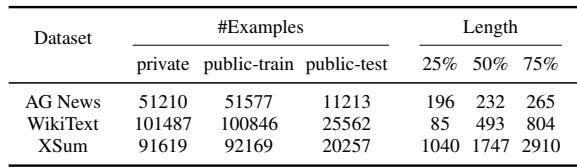
The target models (the victims) were from the Pythia, OPT, and Llama families, ranging up to 7 billion parameters.
The attacker models (the regression ensemble) were primarily tiny Pythia-160m or OPT-125m models. This is a massive size mismatch—the attacker is roughly 2% the size of the target.
Baselines
They compared their method against:
- Loss Attack: Simple uncalibrated loss.
- Min-k% / Zlib / Neighborhood: Other heuristic scoring methods.
- LiRA: The state-of-the-art shadow model approach.
Key Results
The results are striking. The regression ensemble method consistently matches or outperforms the computationally expensive baselines.
1. Accuracy vs. False Positives
The most critical metric in membership inference is the True Positive Rate (TPR) at a low False Positive Rate (FPR). We want to catch members without falsely accusing non-members.
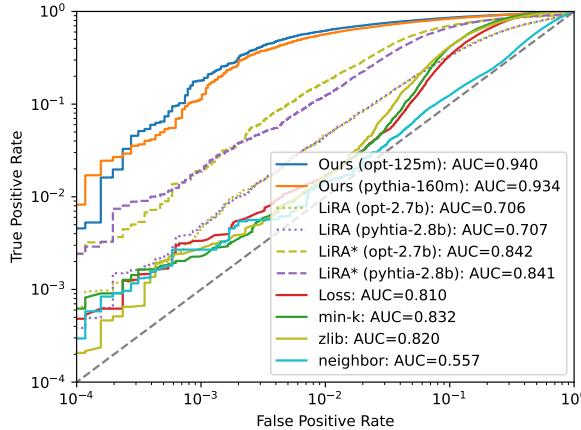
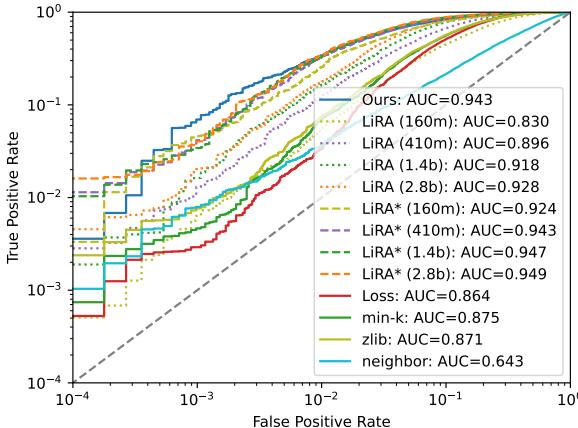
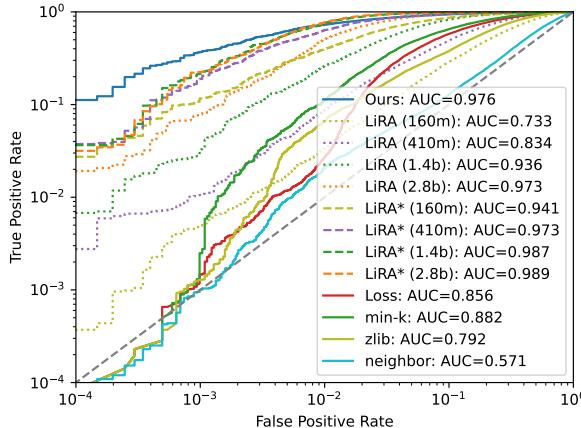
In the ROC curves below, the blue line (“Ours”) represents the regression ensemble. You can see it consistently hugs the top-left corner (higher is better), outperforming the various LiRA baselines (dotted lines) and simple loss metrics.
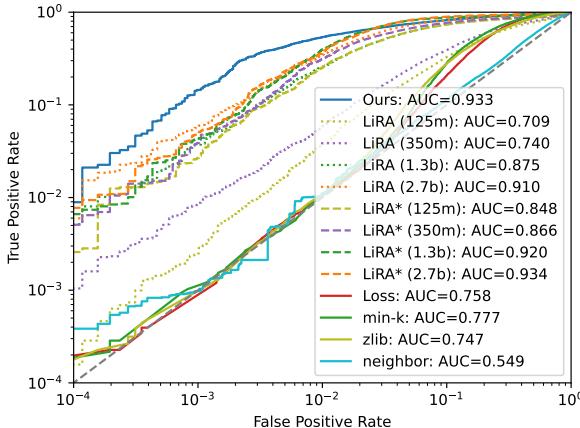
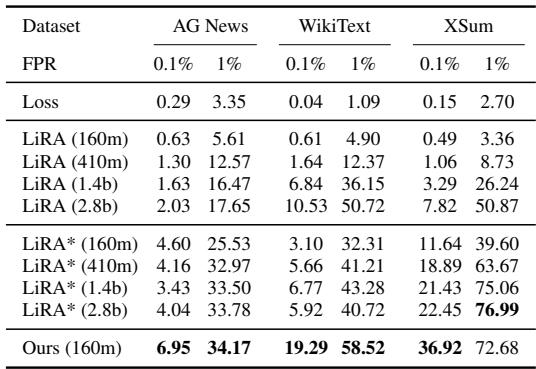
The table below quantifies this. At a strict 0.1% False Positive Rate (meaning only 1 in 1000 non-members is falsely accused), the regression method (“Ours”) finds significantly more members than LiRA in almost every setting.
2. Cross-Architecture Robustness
One of the most impressive findings is that you don’t need to know the target model’s architecture.
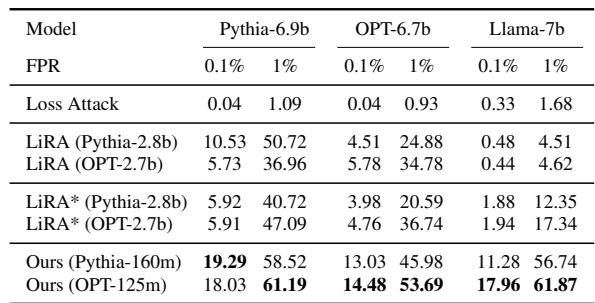
In the experiment below, the target was Llama-7b. The LiRA attack (using OPT shadow models) struggled significantly. However, the regression attack (“Ours”), using a tiny Pythia-160m or OPT-125m, maintained high performance.
This implies that auditors can build a single, standardized “auditing suite” of regression models and apply them to various LLMs (Llama, Mistral, Falcon) without needing to train specific shadow models for each one.
3. The “Order of Magnitude” Speedup
The title of the paper claims order-of-magnitude speedups. Do they deliver?
Yes. Training shadow models effectively requires re-doing the work of the original model creators multiple times. In contrast, the regression models are:
- Smaller: 160m parameters vs 7b parameters.
- Faster to converge: They only need to learn score distributions, not language generation.
The authors note that their method uses as little as 6% of the compute budget required for a comparable shadow model attack. This transforms privacy auditing from a massive project into a routine unit test.
4. Impact of Ensemble Size and Training Epochs
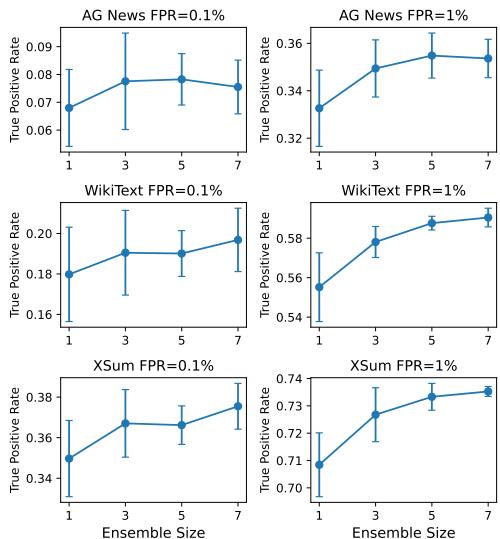
The researchers analyzed how the attack improves as you add more models to the ensemble. As shown in Figure 2, performance improves and variance decreases as the ensemble size grows from 1 to 7. Even a small ensemble of 5 models provides a stable, high-performance attack.
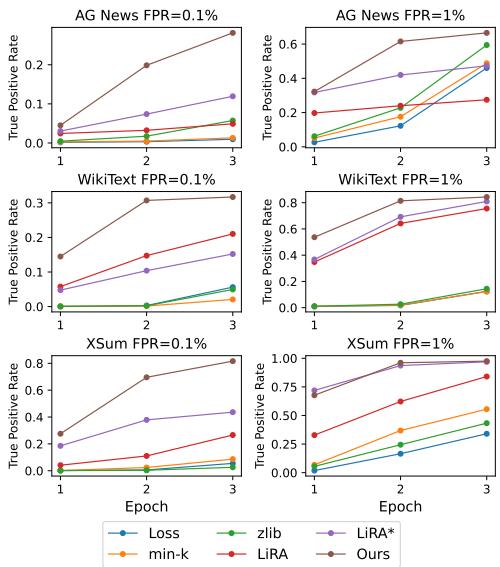
They also looked at how the target model’s training affects vulnerability. As expected, models trained for more epochs (overfitting more) are more vulnerable to attacks. The regression method (Brown line) consistently tracks this risk better than other metrics.
5. Detailed Visualizations
The paper provides extensive ROC curves for different datasets, confirming the consistency of the results.
On AG News, the method dominates baselines, achieving nearly perfect Area Under Curve (AUC) scores.
Similarly, on XSum, the separation between the proposed method and the baselines is stark.
Conclusion and Implications
The research presented in “Order of Magnitude Speedups for LLM Membership Inference” marks a turning point for AI privacy and safety.
The key takeaways are:
- Efficiency: We can audit large models using tiny regression models, slashing costs by ~95%.
- Performance: We do not trade accuracy for speed; in fact, the regression method often outperforms traditional shadow models, likely because the regression task is easier to learn than the language modeling task.
- Flexibility: The attack is agnostic to the target model’s architecture, making it a versatile tool for external auditors who might not have access to the target’s internal details.
Why does this matter? Previously, privacy auditing was a luxury available only to those with massive compute resources. This paper democratizes the process. It allows developers to treat privacy leakage checks like unit tests—running them cheaply and frequently during the development cycle.
While better attacks theoretically increase risk, in the long run, they are essential for defense. We cannot fix privacy leaks we cannot measure. By making measurement cheap and accurate, this work paves the way for safer, more private Language Models.