](https://deep-paper.org/en/paper/2409.15376/images/cover.png)
Large Language Models (LLMs) are incredible conversationalists, poets, and coders. Yet, when you ask them to solve a unique math problem—one that isn’t a carbon copy of a textbook example they’ve seen a million times—they often stumble.
This is the current frontier in AI research: moving from in-domain proficiency (solving problems similar to training data) to out-of-domain generalization (solving truly novel problems).
Today, we are diving deep into a paper titled “ControlMath: Controllable Data Generation Promotes Math Generalist Models”. This research introduces a fascinating pipeline that doesn’t just feed the model more data, but constructs better data from scratch. By generating mathematical equations first and wrapping them in language second, the authors have created a way to build “Math Generalist” models that understand the underlying logic rather than just memorizing patterns.
The Problem with Current Math AI
To make open-source models (like LLaMA or Mistral) better at math, researchers typically use a technique called data augmentation. They take existing high-quality datasets (like GSM8K, a grade-school math dataset) and use a larger model (like GPT-4) to rewrite the questions.
For example, “John has 5 apples” becomes “Susan has 5 oranges.”
While this helps the model learn to parse language, it creates a “diversity trap.” The model sees the same types of reasoning steps and numerical operations over and over again. It becomes an expert at the specific distribution of the training set but fails when the numbers get larger, the topics change (e.g., probability or polynomials), or the reasoning steps become more complex.
The authors of ControlMath demonstrate this issue clearly. As shown in the figure below, models trained with standard augmentation techniques (like MetaMath) see a massive boost on the dataset they were trained on (GSM8K). However, look at the cliff they fall off when tested on out-of-domain tasks like SVAMP-Hard or DM-Polynomials.
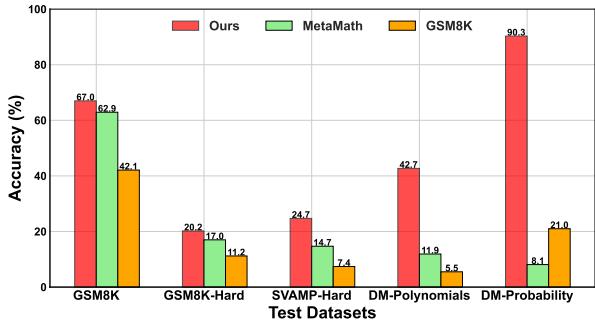
The baseline model trained with MetaMath (the green bars) often performs worse on these novel tasks than a model that wasn’t fine-tuned at all. This is classic overfitting. The model hasn’t learned math; it has learned to mimic the specific style of GSM8K questions.
The Solution: ControlMath
To fix this, the researchers propose ControlMath. Instead of rewriting existing questions, ControlMath generates training data from the ground up using a “Reverse Engineering” approach.
The core philosophy is: Equation \(\rightarrow\) Problem \(\rightarrow\) Filter.
The pipeline consists of three distinct stages:
- Controllable Equation Generation: Creating the mathematical skeleton.
- Problem-Crafter Agent: Adding the narrative flesh.
- Adaptively Efficient Data Selection: Filtering out the “junk” to keep the model efficient.
Let’s break these down.
1. Controllable Equation Generation
The process doesn’t start with language; it starts with Python. To ensure mathematical diversity, the system uses a Python module to generate raw equations based on specific constraints.
This allows the researchers to control the difficulty and type of math precisely. They can specify:
- Multi-step Calculations: Define the number of steps (e.g., 4 steps), the operators involved (square roots, percentages), and the numerical range (1 to 1,000).
- Polynomials: Define degrees and coefficients.
- Probability: Define sample spaces and sequences.
By generating the math programmatically, the system ensures that the model is exposed to reasoning paths and numerical values it would rarely encounter in standard datasets.
2. The Problem-Crafter Agent
Once the Python module spits out an equation (e.g., 37 + 47 = 84, 84 % 2 = 42...), it’s time to turn that abstract math into a human-readable word problem.
This is where the Problem-Crafter Agent comes in. This is a powerful LLM (like GPT-4) prompted to take the equation and weave a scenario around it.
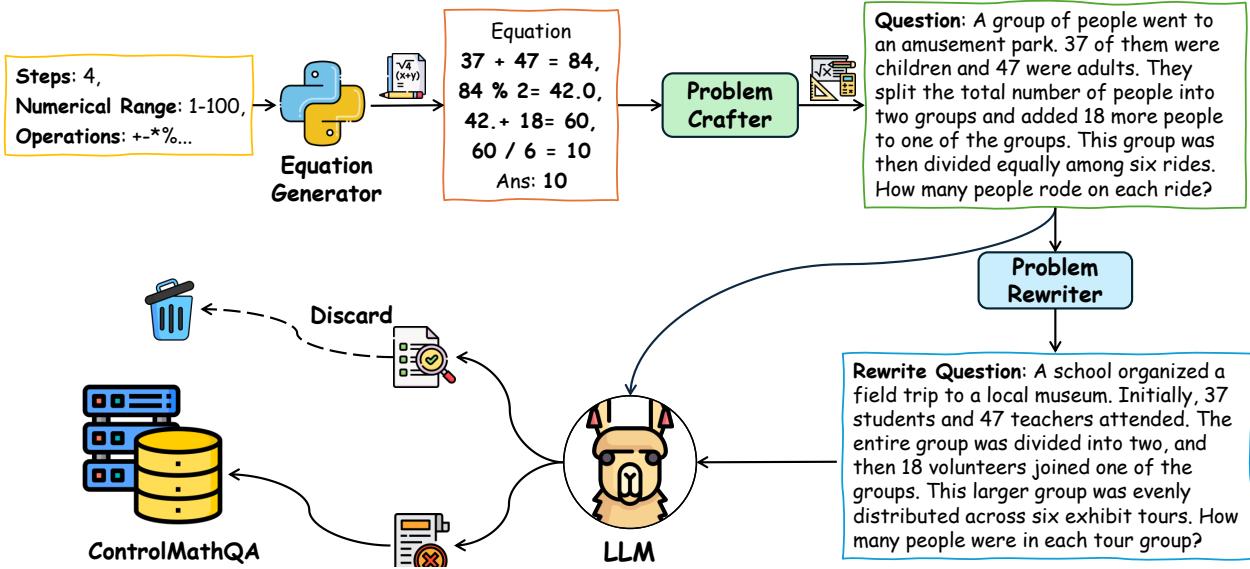
As you can see in Figure 2 above, the system takes the raw numbers and generates a story about people at an amusement park. This ensures the training data has the linguistic complexity of real-world problems but the mathematical diversity of the generated equations.
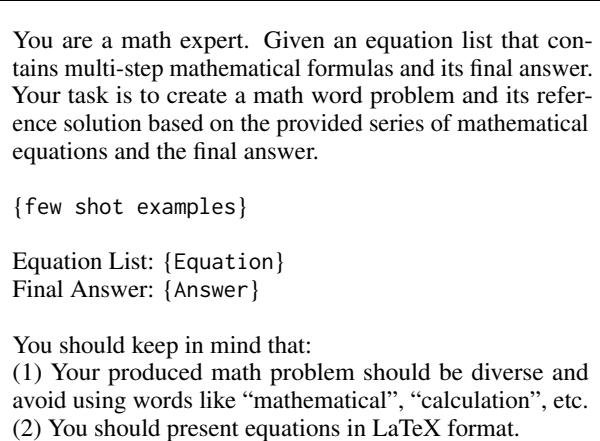
The researchers use specific prompts to ensure the LLM understands its role. You can see the prompt template below, which explicitly instructs the agent to create diverse problems based on the provided equations.
3. Adaptively Efficient Data Selection (The “Less is More” Filter)
This is perhaps the most innovative part of the paper. Just generating millions of problems isn’t efficient—it creates a bloated dataset filled with easy problems the model already knows how to solve.
The authors mimic human learning: We learn most when we struggle. If a problem is too easy, practicing it 100 times is a waste of time.
To implement this, they introduce a Problem-Rewriter Agent. This agent takes the newly created word problem and rewrites it (changing the setting/topic but keeping the numbers the same).
The system then takes the “Student Model” (the small model being trained, e.g., LLaMA-7B) and asks it to solve both the original problem and the rewritten problem.
- Case A: The student solves both correctly. \(\rightarrow\) The student has mastered this concept. Discard the data.
- Case B: The student fails one or both. \(\rightarrow\) The student has a gap in understanding. Keep the data.
This creates a feedback loop where the training dataset (ControlMathQA) is composed entirely of problems that the model currently finds difficult.
Does It Actually Work?
The researchers compiled a dataset called ControlMathQA, consisting of roughly 190,000 samples. They then trained various models (LLaMA-2, Mistral) and compared them against standard benchmarks.
Generalization Capabilities
Referring back to Figure 1 (in the Introduction), the “Ours” bars (ControlMath) show significantly better performance on out-of-domain datasets compared to MetaMath.
- On Probability tasks, ControlMath achieved 89.3% accuracy compared to just 8.1% for MetaMath.
- On Polynomials, it scored 39.0% vs 11.9%.
This proves that starting with diverse equations leads to a “Generalist” model that understands mathematical concepts, not just specific word-problem templates.
Efficiency: Quality Over Quantity
One might assume that throwing more data at the model always helps. ControlMath proves otherwise. The authors compared training runs using their selection strategy vs. training runs where they just used all generated data.
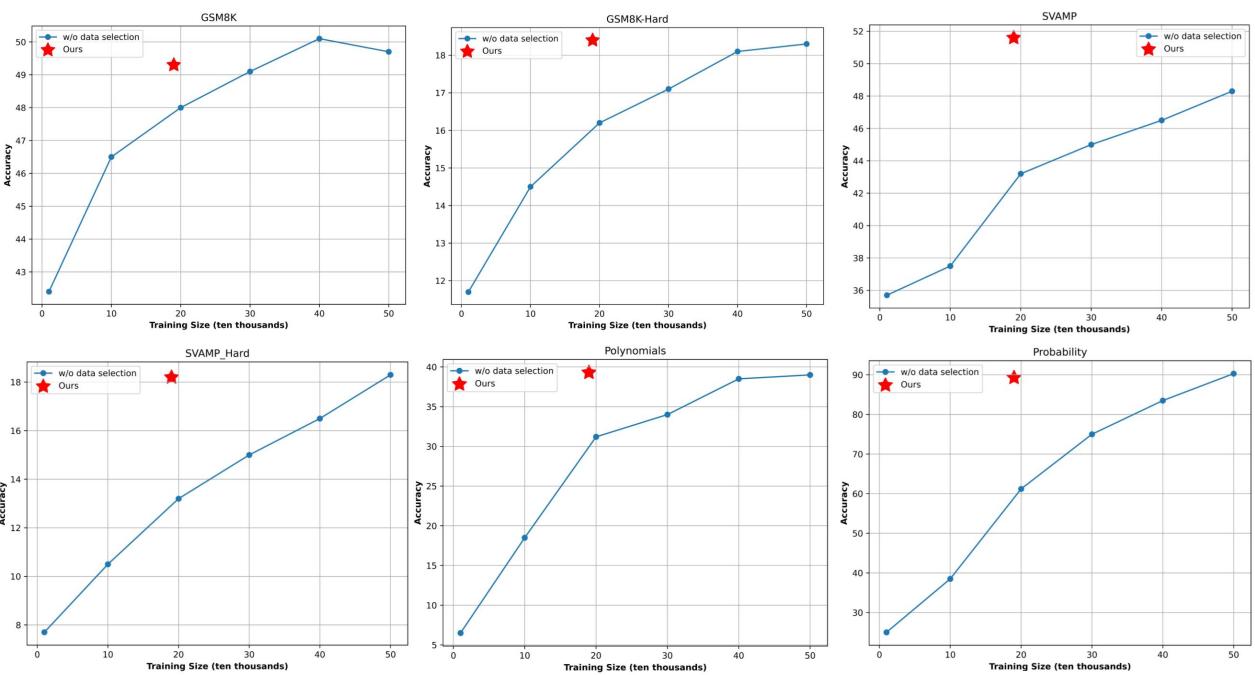
The graphs above are telling. The red stars (ControlMath with selection) consistently beat the blue lines (ControlMath without selection). In many cases, the model achieves better performance with significantly less data. This confirms the hypothesis: Training on what you don’t know is far more efficient than training on what you already know.
Adaptability and Specialized Tuning
Another strength of ControlMath is its plug-and-play nature. Because the equation generation is controllable, you can tailor the data generation to target specific weaknesses in a dataset.
The authors demonstrated this by tailoring ControlMath specifically for the GSM8K dataset (creating ControlMathQA-GSM8K). They analyzed the error rates of the base model on specific equation difficulties and generated more data for the “hard” equations.
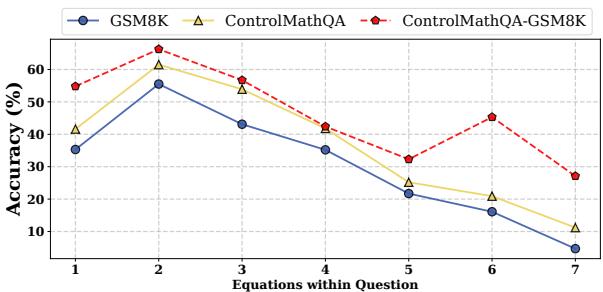
As shown in Figure 4, the tailored approach (red line) significantly boosts performance across all levels of equation complexity (steps 1 through 7). This suggests that ControlMath can be used as a targeted tool to patch specific holes in a model’s reasoning capabilities.
The “Teacher” Matters: GPT-4 vs. Open Source
A practical question arises: Do we really need expensive models like GPT-4 to generate this data? Can’t we use a cheaper, open-source model like Mistral?
The authors tried this, creating a dataset called ControlMathQA-Open using Mistral-7B as the generator. Despite generating 1 million samples (5x more data than the GPT-4 version), the results were worse.

Why did the larger, open-source dataset fail? The authors investigated the perplexity of the generated questions. Perplexity is essentially a measure of how “confused” or “surprised” a model is by a piece of text. Lower perplexity generally indicates clearer, more logical text that matches the model’s understanding of language.

The data generated by the smaller model (Open-Question) had significantly higher perplexity. This implies that the smaller model generates “noisier,” less coherent questions that are harder to learn from. This reinforces the idea of Knowledge Distillation: for a student model to learn effectively, the teacher model must be significantly more capable.
Conclusion and Key Takeaways
The ControlMath paper offers a compelling blueprint for the future of synthetic data in AI training. Here are the big takeaways for students and practitioners:
- Start with the Logic, Not the Text: By generating the math equations first, we ensure diversity that simple text rephrasing cannot match.
- Diverse Math Leads to Generalization: If you want a model to solve probability problems, you can’t just train it on arithmetic word problems, no matter how many you have.
- Less is More: Intelligent data selection—filtering out problems the model can already solve—is vastly more efficient than brute-force training.
- The Quality of Synthetic Data is Key: You cannot cheat the system by using weak generators. A high-quality “Teacher” (like GPT-4) is currently necessary to produce effective training data for reasoning tasks.
ControlMath moves us away from models that mimic mathematicians and toward models that are mathematicians. As we look for ways to break the data bottleneck in AI, “controlling” the generation process seems to be the way forward.