](https://deep-paper.org/en/paper/2409.15594/images/cover.png)
Introduction: The “Walkie-Talkie” Problem
If you have ever conversed with a voice assistant like Alexa, Siri, or current iterations of ChatGPT Voice, you have experienced a “half-duplex” interaction. Much like using a walkie-talkie, the protocol is rigid: you speak, you stop, the machine detects silence, processes your request, and finally responds.
This turn-based exchange is functional, but it is distinctly non-human.
Real human conversation is “full-duplex.” It is a chaotic, synchronized dance. We interrupt each other to clarify points. We offer verbal “backchannels” (like “uh-huh,” “right,” or “yeah”) while the other person is still talking to signal engagement. We anticipate what the other person is about to say before they finish their sentence.
The primary bottleneck preventing Large Language Models (LLMs) from achieving this natural flow is that pre-trained LLMs do not have a sense of time. They process sequences of tokens, but they are agnostic to whether a token represents a millisecond or a minute. Without a shared clock with the real world, an AI cannot time a polite interruption or a well-placed laugh.
In the research paper “Beyond Turn-Based Interfaces: Synchronous LLMs as Full-Duplex Dialogue Agents,” researchers from Meta AI and the University of Washington propose SyncLLM. This new architecture integrates time information directly into Llama3-8b, allowing it to run synchronously with the real-world clock. The result is a system capable of meaningful, low-latency, full-duplex conversation.
The Architecture of Synchrony
To bridge the gap between static text processing and dynamic speech, SyncLLM fundamentally changes how an LLM views an interaction. Instead of waiting for a full sentence (a prompt) to be completed, the model operates on a stream of audio “chunks.”
The SyncLLM Mechanism
The core innovation of SyncLLM is its ability to stream input and output simultaneously while maintaining a concept of current time.
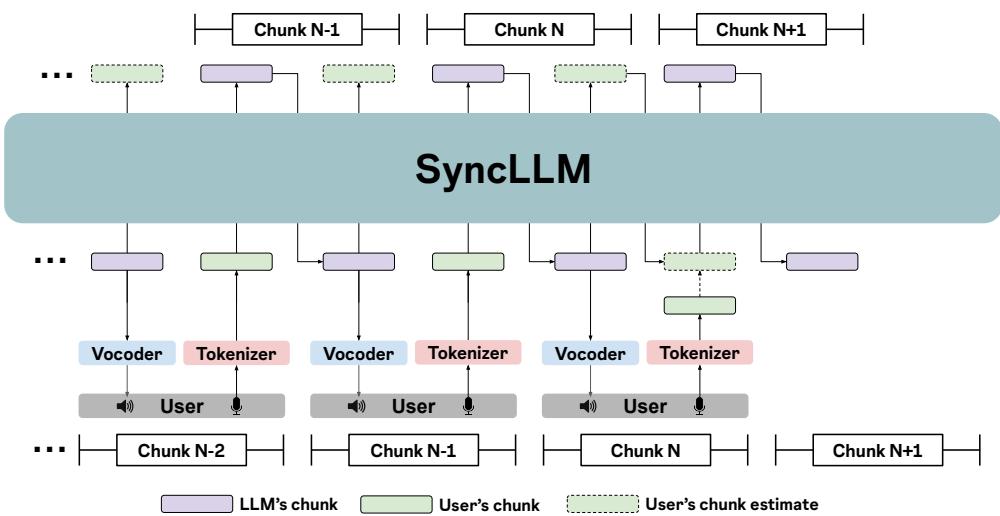
As illustrated in Figure 1, the architecture operates on a step-by-step basis:
- Input Stream: The user’s voice is captured in sequential chunks (Chunk N-1, Chunk N, etc.). These are passed through a vocoder and tokenizer to become understandable data for the model.
- Streaming Context: At any given time step (e.g., Chunk N), the model has access to everything that happened previously—both what the user said and what the AI said.
- The Prediction Challenge: In a real-world internet setting, there is latency. By the time the server receives “Chunk N” from the user, time has already moved forward. If the AI waits to process Chunk N before generating a response, it will fall behind, breaking the synchronization.
To solve this, SyncLLM does something remarkably human: Prediction.
Look closely at the green boxes in Figure 1 labeled “User’s chunk estimate.” The model does not just generate its own response; it also predicts what the user is currently saying or is about to say in the immediate future (Chunk N+1). By estimating the user’s current speech chunk, the model can append this estimate to its context and generate its own next chunk immediately. This allows the AI to “speak” in synchrony with the user, effectively masking the latency inherent in cloud-based processing.
Tokenization: Giving the Model a Clock
Standard LLMs predict the next text token. SyncLLM, however, must predict speech units that correspond to specific durations of time. The researchers utilize HuBERT, a self-supervised speech representation model, to tokenize audio.
However, raw audio tokenization presents a data problem. Silence or long vowels result in massive repetition of the same tokens (e.g., [75], [75], [75]...). This bloats the sequence length and dilutes the semantic information, making it hard for the LLM to understand what is actually being said.
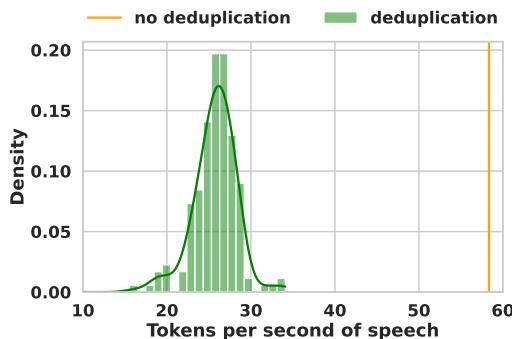
Figure 3 highlights this issue. The orange line shows that without deduplication, the model is flooded with a fixed, high density of tokens (roughly 60 per second) regardless of information content. The green distribution shows the result of deduplication, where redundant tokens are removed, reducing the load to a manageable 25-30 tokens per second.
The Format of Time
While deduplication solves the semantic problem, it destroys the timing information. If five [75] tokens represent 200ms of silence, reducing them to a single [75] token makes the model think the silence was instant.
SyncLLM solves this by re-injecting time via Synchronization Tokens.
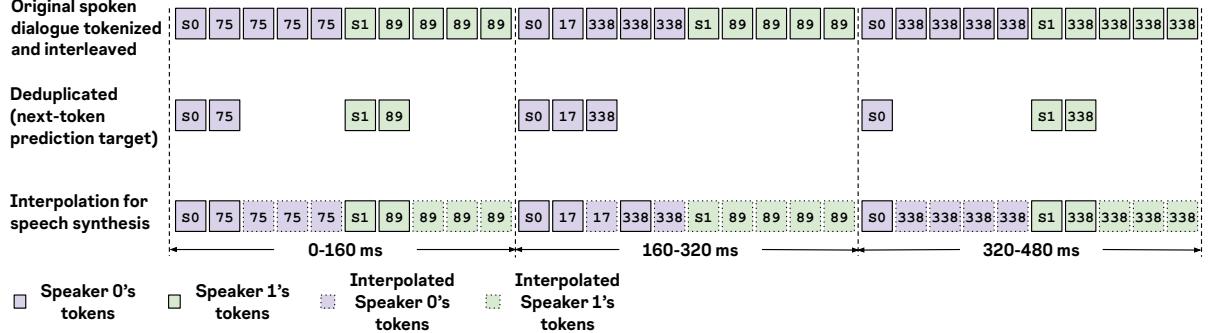
Figure 2 demonstrates this clever formatting strategy:
- Top Row (Original): Shows the raw interleaved speech. Speaker 0 (purple) and Speaker 1 (green) have repetitive tokens corresponding to time.
- Middle Row (Training Target): This is what SyncLLM actually learns. The sequence is deduplicated to preserve meaning, but special “Speaker Tags” (
[S0]and[S1]) are inserted periodically.
- These tags act as a metronome.
- The model learns that the distance between one
[S0]tag and the next[S0]tag corresponds to exactly one “chunk” of real-world time (e.g., 160ms), regardless of how many speech tokens are squeezed in between.
- Bottom Row (Inference): When the model generates speech, it outputs the deduplicated format. The system then interpolates (repeats) the tokens to fill the time chunk, reconstructing the audio waveform for playback.
The Training Recipe: Solving Data Scarcity
Training a robust spoken dialogue model requires massive amounts of data. Unfortunately, high-quality, two-channel spoken dialogue datasets are rare. The researchers note that combining all significant datasets yields only about 3,000 hours of data—a drop in the bucket compared to text datasets.
To overcome this, the authors devised a three-stage training recipe leveraging synthetic data.
Stage 1: Text-to-Speech Alignment
The team started with Llama3-8b, a text-only model. They took large text dialogue datasets and converted them into audio using a Text-to-Speech (TTS) engine.
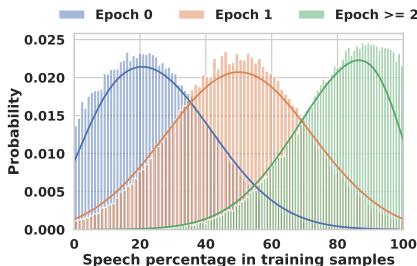
As shown in Figure 4, they didn’t just swap text for speech instantly. They used a curriculum learning approach where they mixed text sentences and speech tokens. Early in training (blue curve), the data is mostly text. As training progresses (green curve), the model sees mostly speech tokens. This helps the text-based LLM gradually align its semantic knowledge with the new vocabulary of acoustic tokens.
Stage 2 & 3: From Turn-Based to Full-Duplex
In Stage 2, the model is trained on synthetic dialogues formatted as full-duplex streams, but with a simplification: no overlaps. This teaches the model the “metronome” structure of the synchronization tokens without the chaos of simultaneous speech.
Finally, in Stage 3, the model is fine-tuned on the Fisher dataset (2,000 hours of real telephone conversations). Because the model has already learned language semantics and timing structures from the massive synthetic data, it can effectively learn the nuances of human turn-taking—interruptions, backchannels, and pacing—from this relatively small real-world dataset.
Experimental Results
Does SyncLLM actually work better than existing models? The researchers compared it primarily against dGSLM, the previous state-of-the-art in full-duplex modeling.
Semantic Meaningfulness
One of the biggest risks in speech modeling is that the AI might sound natural but speak nonsense (high naturalness, low meaningfulness).
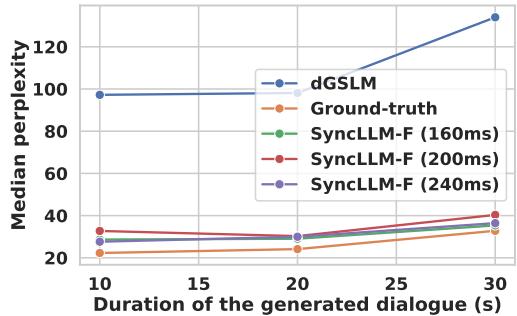
Figure 5 measures the perplexity (lower is better) of the generated dialogue.
- dGSLM (Blue line): Suffers from high perplexity, meaning its output is often semantically confused or nonsensical.
- SyncLLM (Green/Red/Purple lines): regardless of the chunk size (160ms to 240ms), SyncLLM maintains low perplexity, very close to the Ground Truth (Orange line). This confirms that basing the architecture on Llama3 preserves the “intelligence” of the large language model.
Human Evaluation
Metrics are useful, but human judgment is the gold standard for conversation. The researchers conducted a study where human annotators rated dialogues on Meaningfulness (does it make sense?) and Naturalness (does the turn-taking feel human?).
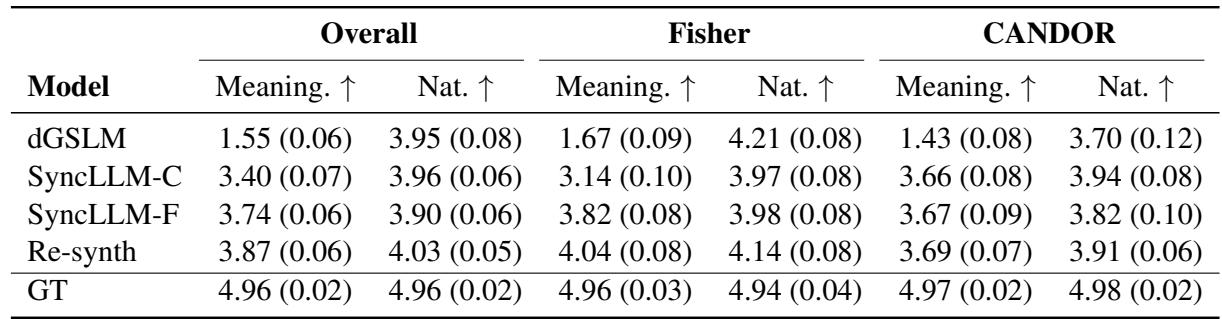
Table 3 reveals a stark difference:
- Naturalness (Nat.): SyncLLM performs comparably to dGSLM. Both are decent at sounding like a conversation.
- Meaningfulness (Meaning.): This is where SyncLLM shines. dGSLM scores a very poor 1.55, indicating it often generates gibberish. SyncLLM scores 3.74, dramatically closing the gap toward the re-synthesized ground truth (3.87).
This proves that SyncLLM achieves the best of both worlds: the smarts of a text LLM with the timing of a speech model.
Generalization
A common failure mode for AI is performing well only on data similar to its training set. SyncLLM was trained on the Fisher dataset. When tested on the CANDOR dataset (a completely different corpus of conversations), it maintained high performance, whereas baseline models saw significant degradation.
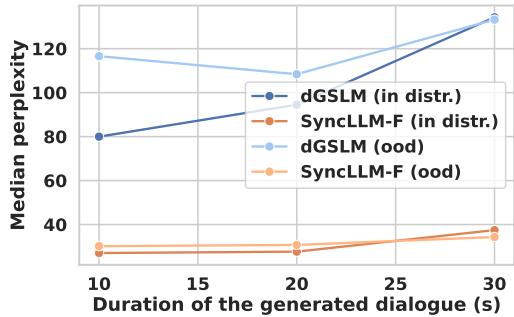
Figure 6 visualizes this robustness. Whether on in-distribution data (Fisher) or out-of-distribution data (CANDOR), SyncLLM (green/red/purple) maintains stable, low perplexity compared to the erratic performance of dGSLM (blue).
Surviving the Internet Lag
Perhaps the most practical contribution of this paper is the handling of latency. In a real-world application, your voice takes time to travel to the server. If the AI waits until it hears you stop speaking to generate a response, the moment has passed.
Because SyncLLM predicts the user’s speech into the future (as detailed in the Architecture section), it is resilient to delays.
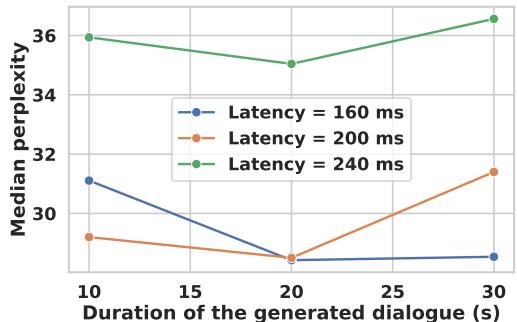
Figure 8 shows the model’s performance under different simulated latencies. The model remains stable and effective at latencies of 160ms and 200ms. Performance only begins to degrade slightly at 240ms. This buffer is critical for deploying full-duplex agents over standard internet connections, ensuring the AI doesn’t constantly accidentally interrupt or fall into awkward silences due to lag.
Conclusion
SyncLLM represents a significant step away from the “command-and-response” paradigm of current voice assistants. By treating conversation as a continuous, synchronized stream of events rather than a series of isolated turns, the researchers have created a system that captures the messy, overlapping, and dynamic nature of human speech.
The key takeaways are:
- Time is a Token: Integrating synchronization tokens allows text-based LLMs to understand the passage of time.
- Prediction is Key: Anticipating user speech allows the model to handle network latency and overlap naturally.
- Synthesis Scales: Using synthetic data to bridge the gap between text pre-training and speech fine-tuning creates smarter, more coherent agents.
As this technology matures, we can expect a future where talking to an AI feels less like using a walkie-talkie and more like chatting with a friend—interruptions, “uh-huhs,” and all.