](https://deep-paper.org/en/paper/2409.15977/images/cover.png)
Introduction
The intersection of Artificial Intelligence and music has always been a fascinating frontier. We have seen remarkable progress in Text-to-Speech (TTS) systems, where models can now generate speech that is nearly indistinguishable from human voices. However, Singing Voice Synthesis (SVS) remains a significantly harder challenge.
Why is singing so difficult to synthesize? Unlike speech, singing requires precise control over pitch (F0), rhythm, and specific vocal techniques like vibrato, falsetto, or glissando. Furthermore, a singer’s “style” is a complex amalgamation of their timbre (voice identity), their emotional expression, and the specific singing method they employ (e.g., Bel Canto vs. Pop).
Most existing SVS models operate under a “closed-set” assumption: they perform well on singers seen during training but struggle to generalize to unseen singers—a problem known as zero-shot synthesis. Moreover, even when they manage to clone a voice’s timbre, they often fail to capture the stylistic nuances. They might get the melody right, but the voice sounds flat, lacking the breathiness of a sad ballad or the punchy articulation of a rock anthem.
In this post, we will deep dive into TCSinger, a novel architecture proposed by researchers from Zhejiang University and Shanghai AI Laboratory. TCSinger stands out as the first zero-shot SVS model capable of cross-lingual style transfer and multi-level style control. It doesn’t just copy a voice; it disentangles style from content and timbre, allowing for granular control over how a song is performed.
Background and Core Concepts
Before dissecting the architecture, we need to establish a few foundational concepts that TCSinger builds upon.
The Components of a Singing Voice
To synthesize singing effectively, we must treat it as a composition of distinct features:
- Content: The linguistic information (lyrics) and the musical score (notes and duration).
- Timbre: The static characteristic of the voice that makes a singer recognizable (the “identity”).
- Style: The dynamic, time-variant attributes. In TCSinger, “style” is rigorously defined to include singing method (e.g., opera vs. pop), emotion, rhythm, technique (e.g., vibrato), and pronunciation.
Zero-Shot Synthesis
“Zero-shot” refers to the model’s ability to handle data it has never seen before. In this context, it means generating a song using the voice and style of a singer that was not part of the training dataset, usually by providing a short audio reference (a prompt) of that singer.
The Bottleneck of Previous Approaches
Previous models like DiffSinger or VISinger made strides in audio quality using diffusion models and DSP (Digital Signal Processing). However, they generally entangled style with timbre. If you tried to transfer a “happy” style to a “sad” singer, the model would often confuse the singer’s identity with the emotion. TCSinger addresses this by explicitly disentangling these features using a specialized architecture.
The TCSinger Architecture
The TCSinger framework is sophisticated, utilizing a divide-and-conquer strategy. The architecture creates separate representations for content, style, and timbre, and then recombines them to generate the final audio.
Let’s look at the high-level overview of the system:

As shown in Figure 1(a), the pipeline consists of several key modules:
- Encoders for Content (Lyrics/Notes) and Timbre.
- A Clustering Style Encoder to extract style from audio prompts.
- A Style and Duration Language Model (S&D-LM) to predict style and timing.
- A Style Adaptive Decoder (based on diffusion) to generate the final Mel-spectrogram.
Let’s break these down one by one.
1. The Clustering Style Encoder
One of the hardest parts of style transfer is representing “style” mathematically. If the representation is too broad, it captures the lyrics (content). If it’s too specific, it captures the recording quality or background noise.
The researchers introduce a Clustering Style Encoder (shown in Figure 1(d)). It takes a Mel-spectrogram as input and refines it through WaveNet blocks. But the innovation lies in how it quantizes this information.
Clustering Vector Quantization (CVQ)
Standard Vector Quantization (VQ) maps continuous features to a discrete codebook. However, VQ suffers from “codebook collapse,” where the model only uses a tiny fraction of the available codes, limiting expressiveness.
TCSinger uses Clustering Vector Quantization (CVQ). CVQ creates an information bottleneck. By forcing the style information into a compact, discrete latent space, the model strips away non-style information (like content or speaker identity). It uses a dynamic initialization strategy to ensure all codes in the codebook are utilized, capturing a rich variety of singing styles.
The training objective for this encoder includes a specific loss function to maintain this structure:

Here, the loss includes terms for reconstruction (making sure the code matches the input) and a contrastive loss. The contrastive loss is crucial—it pushes the representation of different styles apart while pulling similar styles together, ensuring the latent space is semantically meaningful.
2. The Style and Duration Language Model (S&D-LM)
Once we have a way to represent style, we need a way to predict it. Singing style is highly correlated with duration. For example, a “bel canto” style often involves elongated vowels, whereas “pop” might differ in rhythm.
The S&D-LM is a Transformer-based model that predicts both style and phoneme duration simultaneously. This joint prediction allows the two features to reinforce each other.
The S&D-LM operates in two distinct modes, as visualized in Figure 2:
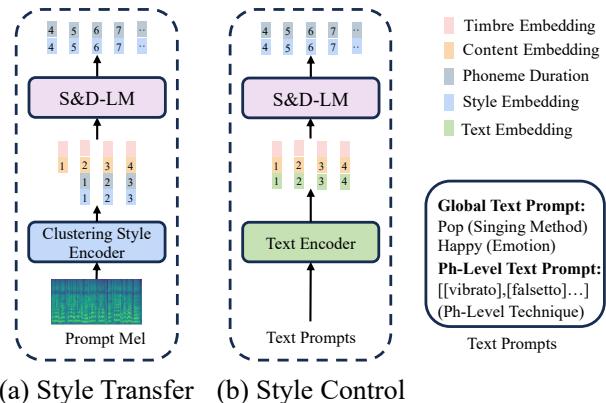
Mode A: Style Transfer
In this mode (Figure 2a), the model takes an audio prompt (a recording of someone singing).
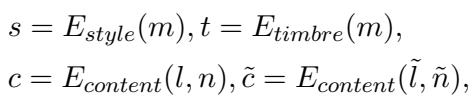
- The encoders extract the Style (\(s\)), Timbre (\(t\)), and Content (\(c\)) from the prompt.
- The S&D-LM uses this context to predict the target style (\(\tilde{s}\)) and duration (\(\tilde{d}\)) for the new lyrics you want to generate.
The mathematical formulation for the style transfer inference is:
Followed by the autoregressive prediction of the target style and duration:
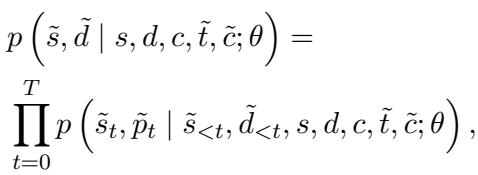
This implies that the model looks at the prompt’s style and the target content to generate a sequence of style vectors that match the prompt’s vibe but fit the new lyrics.
Mode B: Multi-Level Style Control
This is where TCSinger becomes a creative tool. Instead of an audio prompt, you can provide Text Prompts (Figure 2b).
- Global Level: You can specify the singing method (e.g., “Bel Canto”) and emotion (e.g., “Sad”).
- Phoneme Level: You can tag specific words or phonemes with techniques like “vibrato,” “falsetto,” or “breathy.”
The text encoder converts these tags into embeddings that replace the extracted audio style vectors. The prediction process then becomes conditioned on these text prompts (\(tp\)):

3. The Pitch Diffusion Predictor
With style and duration predicted, the model needs to determine the fundamental frequency (F0), or pitch contour. The authors employ a Pitch Diffusion Predictor.
Diffusion models are excellent at generating high-resolution data by reversing a noise process. Here, the model predicts the F0 curve and the Unvoiced/Voiced (UV) decision. By using diffusion, the model generates diverse and realistic pitch curves that aren’t overly smooth or robotic, preserving the natural jitter and vibrato of a human voice.
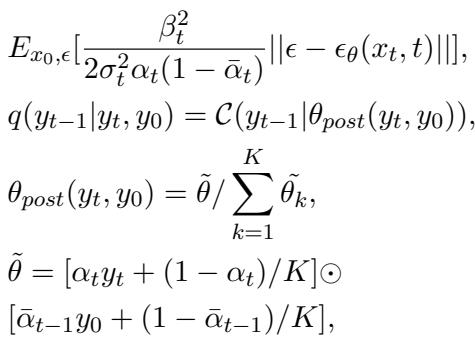
The training involves both Gaussian diffusion (for continuous pitch) and multinomial diffusion (for categorical voicing decisions):

And the reverse process (generation) is mathematically defined to iteratively clean the noisy pitch signal:
4. The Style Adaptive Decoder
The final stage is converting all these representations (Content, Timbre, Style, Duration, Pitch) into a Mel-spectrogram, which can then be turned into audio.
Standard decoders often fail to incorporate the subtle “style” information extracted earlier. They might get the pitch right, but lose the breathiness or the specific tonal quality of the style.
TCSinger introduces a Style Adaptive Decoder. This is a diffusion-based decoder that uses a novel mechanism: Mel-Style Adaptive Normalization.
Adaptive Normalization
In computer vision, “Adaptive Instance Normalization” (AdaIN) is famous for style transfer on images. TCSinger adapts this for audio.
Inside the decoder’s neural network layers, the intermediate feature maps (\(m^{i-1}\)) are normalized. Then, the style vector (\(s\)) is used to predict scale (\(\gamma\)) and bias (\(\beta\)) parameters that modulate these features.

In this equation:
- \(\mu\) and \(\sigma\) are the mean and standard deviation of the current features.
- \(\phi_{\gamma}(s)\) and \(\phi_{\beta}(s)\) are learned transformations of the style vector.
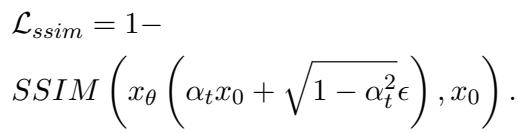
This effectively “injects” the style information into every layer of the spectrogram generation. To ensure high fidelity, the decoder is trained using both Mean Absolute Error (MAE) and Structural Similarity Index (SSIM) losses, ensuring the generated spectrogram matches the ground truth in both pixel-level accuracy and structural coherence.

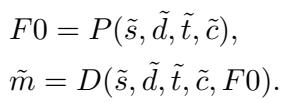
Once the decoder outputs the Mel-spectrogram, the final step involves generating the output variables (Pitch and Mel) based on the predicted style and duration:
Finally, a vocoder (HiFi-GAN) turns the Mel-spectrogram into audible waveforms.
Experiments and Results
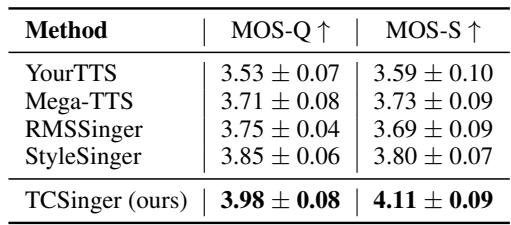
To validate TCSinger, the authors conducted extensive experiments using datasets containing Chinese and English singing and speech. They compared TCSinger against strong baselines like StyleSinger, RMSSinger, and speech-to-speech transfer models like YourTTS.
1. Zero-Shot Style Transfer
The primary test was generating songs using unseen singers. The metrics used were:
- MOS-Q (Mean Opinion Score - Quality): How good does it sound?
- MOS-S (Similarity): Does it sound like the target singer?
- FFE, MCD: Objective error metrics (lower is better).
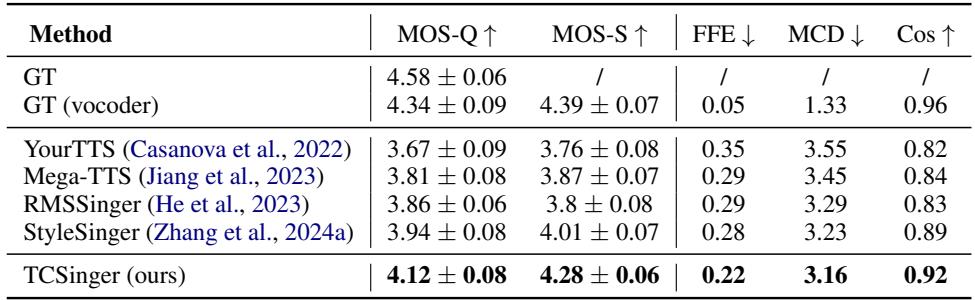
Table 1 below summarizes the results. TCSinger achieves the highest scores in both quality and similarity, significantly outperforming the baselines.
Visualizing the output helps us understand why it scores better. In Figure 3, we can see the Mel-spectrograms.
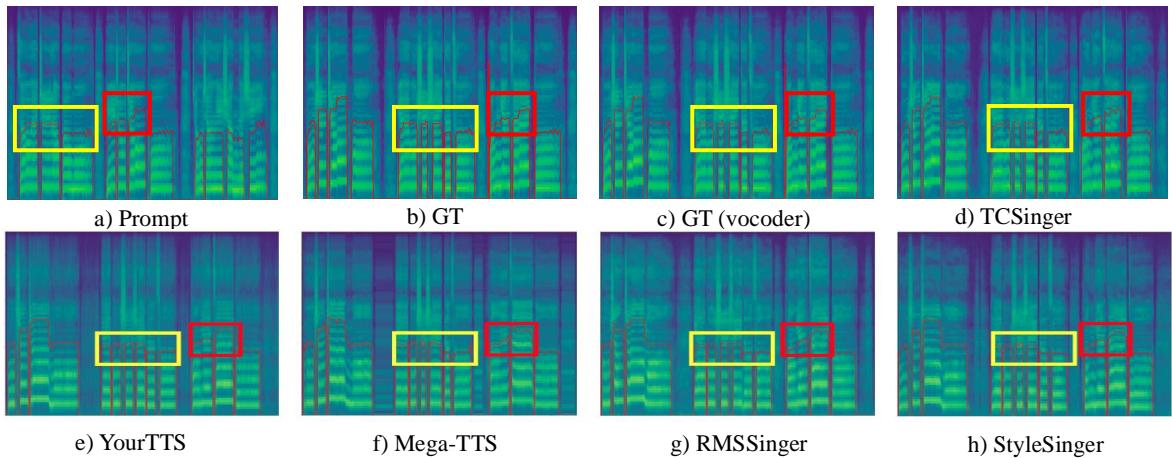
Notice the boxes highlighted in the TCSinger spectrogram (row d).
- Yellow Box: Shows vibrato. TCSinger reproduces the wavy frequency pattern characteristic of vibrato.
- Red Box: Shows rhythm and pronunciation. TCSinger preserves the detailed spectral texture of the consonants and vowels.
- In contrast, baselines like YourTTS (row e) or RMSSinger (row g) often produce “blurrier” spectrograms or miss these fine-grained temporal details.
2. Multi-Level Style Control
Can the model accurately control style via text? The researchers tested this by asking the model to generate songs with specific attributes (e.g., “Pop + Happy” or “Falsetto”).
Table 2 shows the results for “Style Controllability” (MOS-C).
(Note: Table 2 is contained within this image file)
TCSinger achieves a MOS-C of 3.95 to 4.09, whereas the best baseline (StyleSinger) trails behind. This confirms that the text encoder successfully maps semantic labels (like “breathy”) to the correct acoustic features in the latent space.
3. Cross-Lingual and Speech-to-Singing
A fascinating capability of TCSinger is Cross-Lingual Transfer. Can an English speaker’s voice be used to sing a Chinese song, while retaining the English speaker’s vocal style?
Table 3 demonstrates that TCSinger handles this remarkably well.
Because TCSinger decouples content (phonemes) from timbre and style, it can swap the content (language) while keeping the other two constant.
Similarly, the model supports Speech-to-Singing (STS). You can feed it a spoken sentence as a prompt, and it will generate singing that sounds like that speaker, adopting the “style” of the speech (e.g., if the speech is angry, the singing might carry that intensity).
4. Ablation Studies
To prove that every component is necessary, the authors removed parts of the model and measured the performance drop.
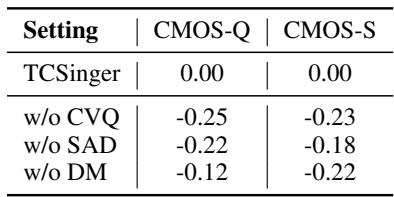
- w/o CVQ: Replacing Clustering VQ with standard VQ caused a drop in quality, proving that the clustering mechanism is vital for stable style extraction.
- w/o SAD: Removing the Style Adaptive Decoder caused a significant drop, showing that injecting style into the normalization layers is crucial for detail.
- w/o DM: Using a simple duration predictor instead of the joint S&D-LM also degraded performance, confirming that style and duration are deeply linked.
Conclusion and Implications
TCSinger represents a significant leap forward in AI music generation. By treating “style” not as a vague concept but as a measurable, multi-faceted attribute (method, emotion, technique), the researchers have created a system that offers granular control to creators.
Key Takeaways:
- Disentanglement is King: Separating content, timbre, and style allows for flexible mixing and matching (e.g., English speaker singing Chinese opera).
- Bottlenecks are Useful: The Clustering Style Encoder forces the model to learn a compact, meaningful representation of style, avoiding the “copy-paste” trap of overfitting.
- Holistic Modeling: Predicting duration and style together (via S&D-LM) results in more natural, rhythmic, and expressive singing.
This technology opens doors for personalized music production, allowing composers to experiment with singers and styles that may physically not exist, or to perform cross-lingual dubbing for musical content with unprecedented fidelity. While current limitations exist—such as a limited vocabulary of controllable techniques—TCSinger lays a robust foundation for the future of controllable neural audio synthesis.