](https://deep-paper.org/en/paper/2409.16198/images/cover.png)
In the modern era of Natural Language Processing (NLP), we are spoiled for choice. If you open the Hugging Face model hub today, you are greeted with hundreds of thousands of models. For a student or a practitioner trying to build a text ranking system—like a search engine or a RAG (Retrieval-Augmented Generation) pipeline—this abundance creates a paradox.
Which model should you choose? Should you use a BERT variant? A RoBERTa clone? A specialized biomedical model?
The traditional answer is “intuition.” We look at the model name, maybe read the abstract, and guess. The rigorous answer is “brute-force fine-tuning”: train all of them on your dataset and pick the winner. But with the size of modern models, fine-tuning dozens of candidates is computationally expensive and environmentally irresponsible.
This brings us to a crucial research paper: “Leveraging Estimated Transferability Over Human Intuition for Model Selection in Text Ranking.” The authors propose a mathematically grounded method called AiRTran (Adaptive Ranking Transferability). This method allows us to predict which model will perform best on a specific dataset without the heavy cost of full fine-tuning.
In this deep dive, we will explore why human intuition fails at model selection, why existing metrics designed for classification don’t work for ranking, and how AiRTran uses linear algebra to solve the problem in seconds.
The Context: Text Ranking and the Dual-Encoder
To understand the solution, we first need to understand the architecture we are selecting for. In text ranking, the standard workhorse is the Dual-Encoder.
A dual-encoder consists of two Pre-trained Language Models (PLMs)—one for the query and one for the document. The goal is to map both the query and the document into a vector space (embeddings) such that relevant documents are “close” to the query, and irrelevant ones are “far away.”
Mathematically, the probability of a relevant document \(d^+\) being selected over a set of irrelevant documents \(d^-\) is usually optimized using a softmax function:

Here, \(e_q\) and \(e_d\) are the embeddings. The model learns to maximize the dot product (similarity) of the relevant pair while minimizing it for the irrelevant ones.
The Problem: Model Selection (MS)
The challenge is that different PLMs (the starting point before fine-tuning) have vastly different “transferability.” Some models have pre-training biases that align perfectly with your specific medical dataset; others might be fundamentally mismatched.
Transferability Estimation (TE) is the field of research dedicated to calculating a score that predicts a model’s final performance based solely on its initial features and the dataset labels. The goal is a high correlation between this cheap-to-compute score and the expensive-to-compute final accuracy.
Most existing TE methods (like LogME or H-Score) were designed for classification tasks (e.g., is this image a cat or a dog?). Text ranking is fundamentally different. It is not about putting an input into a bucket; it is about the relative order of items. The authors of AiRTran found that applying classification metrics to ranking problems yielded poor results.
The Core Solution: AiRTran
The authors propose Adaptive Ranking Transferability (AiRTran). The method is built on two major insights:
- Expected Rank: We should measure transferability by actually checking where the model ranks the correct answer, not just by looking at feature variance.
- Adaptive Isotropization: Raw embeddings from PLMs are geometrically “broken” (anisotropic). We need to fix the geometry and adapt it to the task to get a real signal.
Let’s look at the complete pipeline:
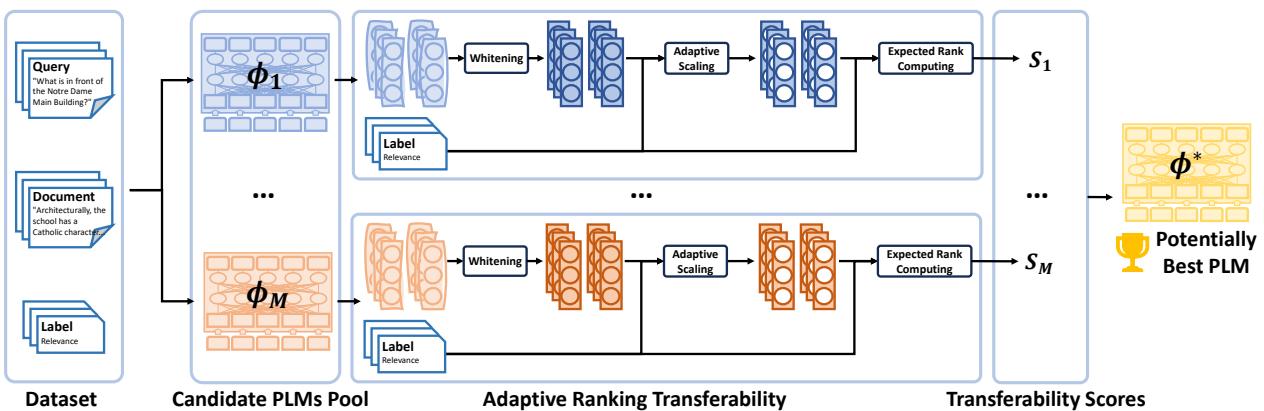
As shown above, the process involves encoding the data, “whitening” it, applying “adaptive scaling,” and finally computing the “expected rank.” Let’s break down each step.
1. Expected Rank as Transferability
The most intuitive way to check if a model is good at ranking is to ask it to rank some data. Even before fine-tuning, a good PLM should ideally place relevant documents higher than irrelevant ones.
The authors propose calculating the Expected Rank. Instead of complex information-theoretic bounds used in classification, they compute the expected reciprocal rank of the relevant document \(d_+\) among a set of negatives:

This equation essentially asks: “On average, does this model put the right answer at the top?” If \(S(\mathcal{D})\) is high, the model already “understands” the task to some degree, making it a prime candidate for fine-tuning.
2. The Hurdle: The Anisotropy Problem
If we simply run the Expected Rank calculation on raw BERT or RoBERTa embeddings, the results are often inaccurate. Why? Because of Anisotropy.
In high-dimensional vector spaces, PLM embeddings tend to cluster in a narrow cone rather than being spread out uniformly (isotropic). This “entanglement” means that two sentences might have very high cosine similarity just because they share common frequent words, not because they are semantically related. This geometric distortion confuses the ranking metric.
3. Step One: Whitening
To fix the cone problem, the authors employ BERT-whitening. This is a statistical transformation that forces the embeddings to have a mean of zero and a covariance matrix of identity (uncorrelated features with unit variance).
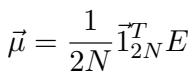
First, they compute the mean vector \(\mu\) of all embeddings:
Next, they calculate the covariance matrix \(\Sigma\):

Finally, they transform the original embeddings \(E\) into whitened embeddings \(\hat{E}\) using the eigenvectors \(U\) and eigenvalues \(\Lambda\) of the covariance matrix:

This operation spreads the embeddings out, resolving the “cone” issue. However, whitening is unsupervised. It doesn’t look at the labels (which document is actually relevant). It just spreads the data out. This leads to the novel contribution of the paper.
4. Step Two: Adaptive Scaling (AdaIso)
Pure whitening ignores the “training dynamics.” When we actually fine-tune a model, we stretch and squeeze dimensions based on the labels. To simulate this without actually training a neural network, the authors introduce Adaptive Scaling.
They propose a scaling weight vector \(\gamma\) that modifies the whitened embeddings. This vector effectively weights the importance of different dimensions.
The predicted matching score matrix \(\hat{Y}\) is derived from the Hadamard product (element-wise multiplication) of the query and document embeddings, scaled by \(\gamma\):
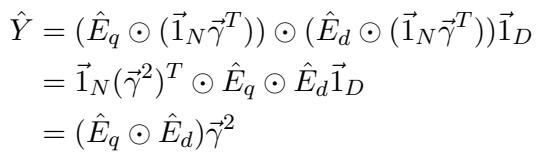
The goal is to find the optimal \(\gamma\) that minimizes the difference between these predicted scores and the actual labels \(Y\). This is formulated as a least-squares problem:
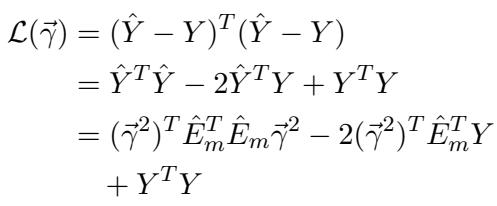
The beauty of this formulation is that we don’t need gradient descent or epochs of training. Because it is a linear least-squares problem, there is a closed-form analytical solution.
We set the derivative with respect to \(\gamma^2\) to zero:

And solving for \(\gamma^*\), we get:
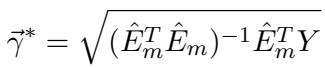
This result is powerful. It means the “training” of this adaptive layer happens instantly using basic matrix operations. This allows AiRTran to capture how well a model can adapt to the dataset, essentially simulating a lightweight fine-tuning step in a fraction of the time.
Experimental Results
The researchers validated AiRTran on five diverse datasets (SQuAD, NQ, BioASQ, SciFact, and MuTual) using two pools of models: “Small” PLMs (like BERT-base) and “Large” PLMs (1B+ parameters).
They measured success using Kendall’s \(\tau\), which calculates the correlation between the AiRTran ranking and the actual fine-tuning performance ranking.

Beating the State-of-the-Art
The results, shown in Table 1 below, are compelling. AiRTran (bottom row) achieves the highest correlation in 8 out of 10 experimental setups, significantly outperforming methods designed for classification (like LogME, TransRate, and GBC).
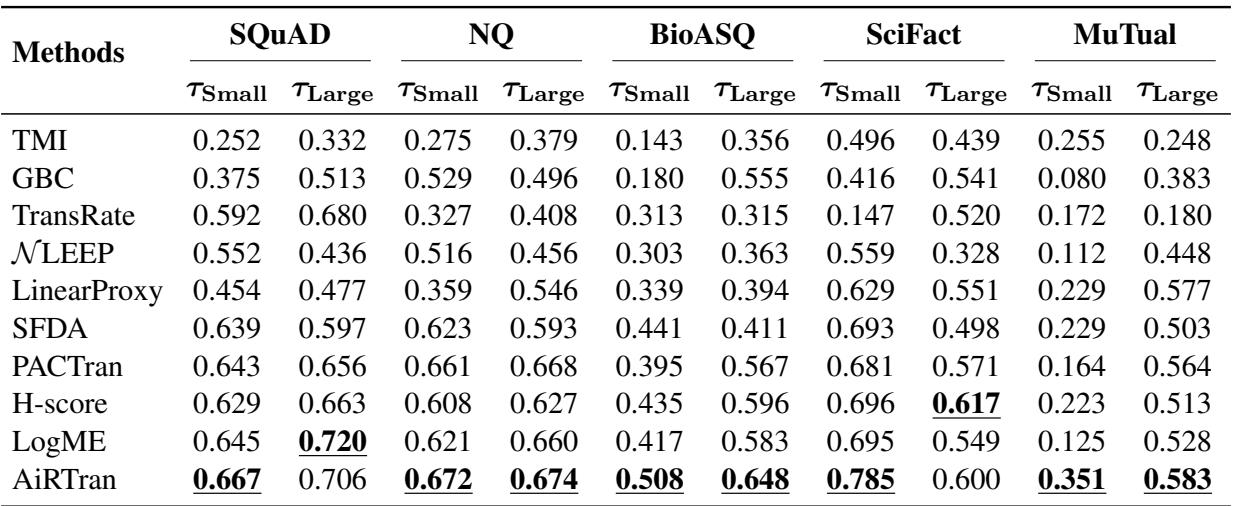
Notice how some classification-based methods (like GBC or TMI) perform very poorly, sometimes even showing negative correlation. This confirms that ranking requires specialized metrics.
Visualizing the Prediction
To visualize this success, look at the scatter plots below. The X-axis represents the predicted score by AiRTran, and the Y-axis represents the actual fine-tuned performance.
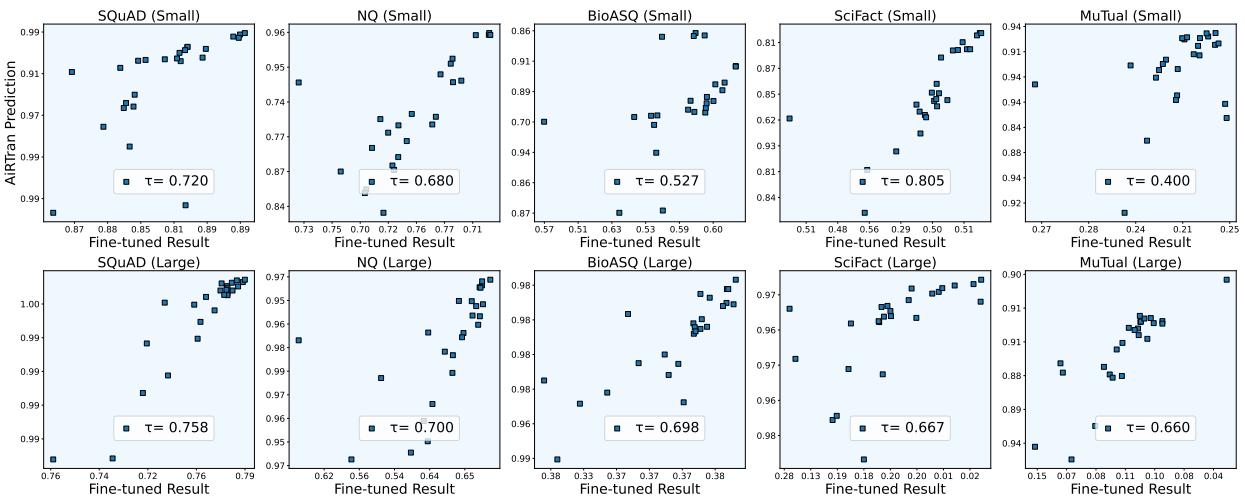
In datasets like SciFact (Small), the points cluster tightly along the diagonal, indicating a very strong predictive capability (\(\tau = 0.785\)).
Stability with More Data
One interesting finding is that AiRTran gets better as you give it more “distractor” documents (irrelevant negatives).
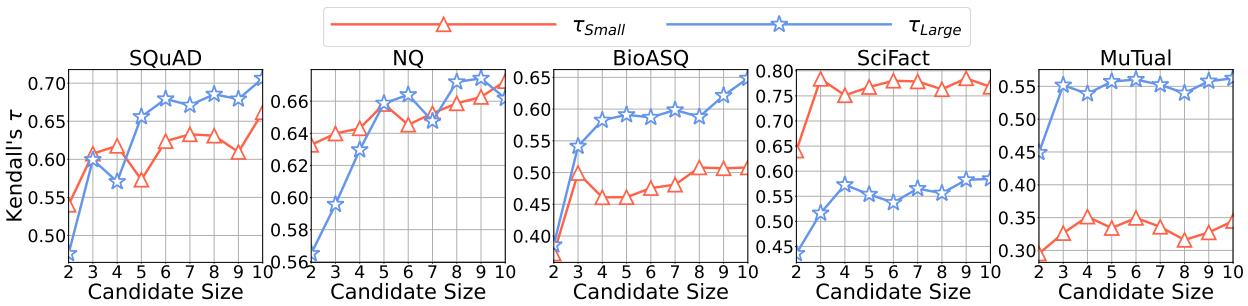
As the “Candidate Size” (number of documents to rank) increases, AiRTran’s correlation generally improves or remains stable. This suggests that the metric effectively leverages the difficulty of the ranking task to differentiate between mediocre and great models.
Efficiency
Is it fast? Yes.
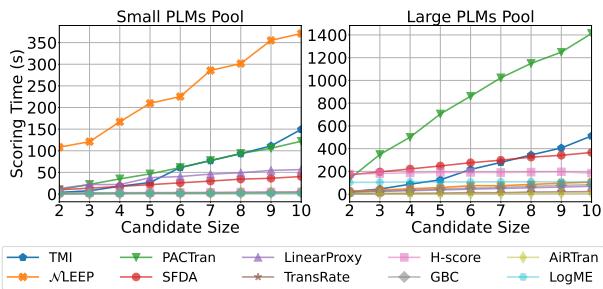
While brute-force fine-tuning took the authors nearly three months on a GPU, AiRTran (represented by the yellow stars in Figure 3) takes only seconds to minutes. It is orders of magnitude faster than methods like \(\mathcal{N}\)LEEP, making it practical for real-world workflows.
Man vs. Machine vs. ChatGPT
Perhaps the most provocative experiment in the paper compared AiRTran against human experts and ChatGPT.
- Humans: 5 NLP practitioners (PhDs and Masters) were given dataset descriptions and model metadata.
- ChatGPT: OpenAI’s model was given detailed prompts with the same metadata.
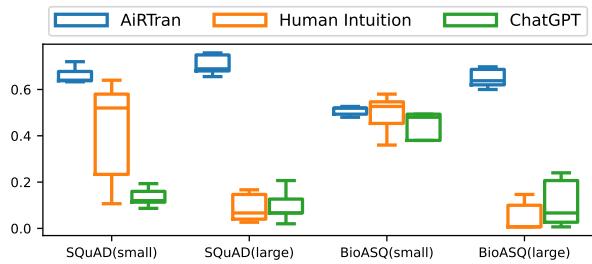
The results (Figure 4) are stark. The blue boxes (AiRTran) consistently show higher and more stable correlations than Human Intuition (orange) or ChatGPT (green). Humans and LLMs struggle to predict “compatibility” between a model’s internal features and a specific dataset; they mostly rely on heuristics (e.g., “BioBERT should be good for BioASQ”), which aren’t always accurate indicators of fine-tuning success.
Why Does It Work? Alignment and Uniformity
The authors offer a theoretical explanation for AiRTran’s success using the concepts of Alignment and Uniformity.
- Alignment: Relevant pairs should be close together.
- Uniformity: All embeddings should be spread out to preserve information.
They define a “Quality” score (\(Q\)) combining these two:
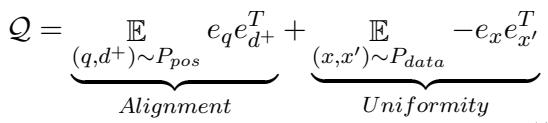
The paper demonstrates that raw embeddings have poor Alignment/Uniformity scores. However, after the Whitening + Adaptive Scaling (AdaIso) process used in AiRTran, the embeddings exhibit much better properties, which explains why the Expected Rank becomes such an accurate predictor.
Conclusion
The “AiRTran” paper provides a compelling solution to the paralysis of choice in modern NLP. By moving away from unreliable human intuition and ill-fitting classification metrics, the authors have provided a robust tool for text ranking.
Key takeaways for students and practitioners:
- Don’t trust your gut: Even experts are bad at guessing which PLM will fine-tune best.
- Don’t use classification metrics for ranking: Ranking is a distinct geometric problem.
- Math beats brute force: Using linear algebra (whitening and least squares) allows us to “simulate” training dynamics instantly.
AiRTran allows us to navigate the ocean of open-source models with a compass, rather than drifting and hoping for the best. As model repositories continue to grow, such efficient selection methods will transition from being a convenience to being a necessity.