](https://deep-paper.org/en/paper/2409.16283/images/cover.png)
The dream of general-purpose robotics is a machine that can walk into a messy, unseen kitchen and simply “wash the dishes” or “put away the groceries” without needing weeks of specific training for that exact room. However, the reality of robotic learning is often far more brittle. Most robots are trained via Behavior Cloning (BC), where they meticulously mimic collected datasets of robot actions. The problem? Collecting robot data is expensive, slow, and dangerous.
Conversely, the world of Generative AI is exploding with data. We have models trained on millions of web videos that understand how humans move, how objects interact, and how physics generally works.
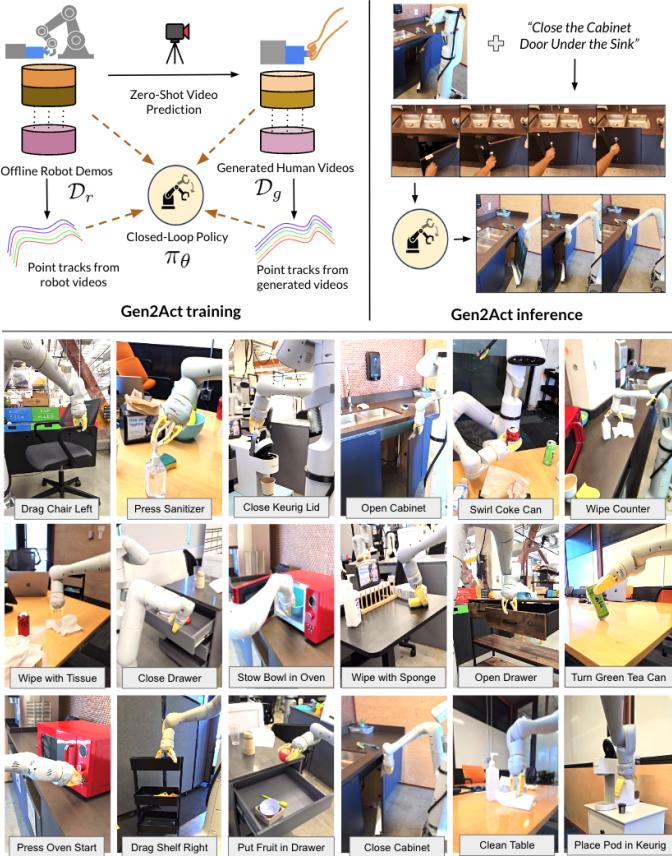
In this post, we are doing a deep dive into Gen2Act, a fascinating paper that attempts to bridge this gap. The researchers propose a novel idea: instead of collecting more robot data, what if we use a generative video model to hallucinate a human performing a task in a new scene, and then teach the robot to follow that hallucination?
The Core Problem: The Data Bottleneck
To understand why Gen2Act is significant, we first need to understand the bottleneck in modern robotics.
State-of-the-art models like RT-1 (Robotics Transformer) are incredibly capable, but they are data-hungry. To teach a robot to open a specific type of drawer, you typically need to show it thousands of examples of a robot opening that drawer. If you then present the robot with a drawer it has never seen before, or ask it to perform a motion it hasn’t practiced (like “wiping” instead of “picking”), the policy often fails.
There are two main ways researchers have tried to fix this:
- Scaling Robot Data: Just collect more data. This is the brute-force approach, but it hits a wall of practicality. We cannot possibly record a robot interacting with every object in existence.
- Using Web Data: Pre-train visual encoders on ImageNet or YouTube videos. This helps the robot “see” better, but it doesn’t necessarily teach the robot how to move.
Gen2Act takes a third path. It posits that we don’t need to show the robot how to do a new task. We can just generate a video of a human doing it, and use that video as a dynamic instruction manual.
The Gen2Act Pipeline
The Gen2Act framework operates on a simple but powerful premise: Cast language-conditioned manipulation as a video generation problem.
The process is split into two distinct phases:
- The Imagination: Generating a video of a human performing the task.
- The Translation: converting that human video into robot actions.
Let’s break down the architecture.
Phase 1: Zero-Shot Human Video Generation
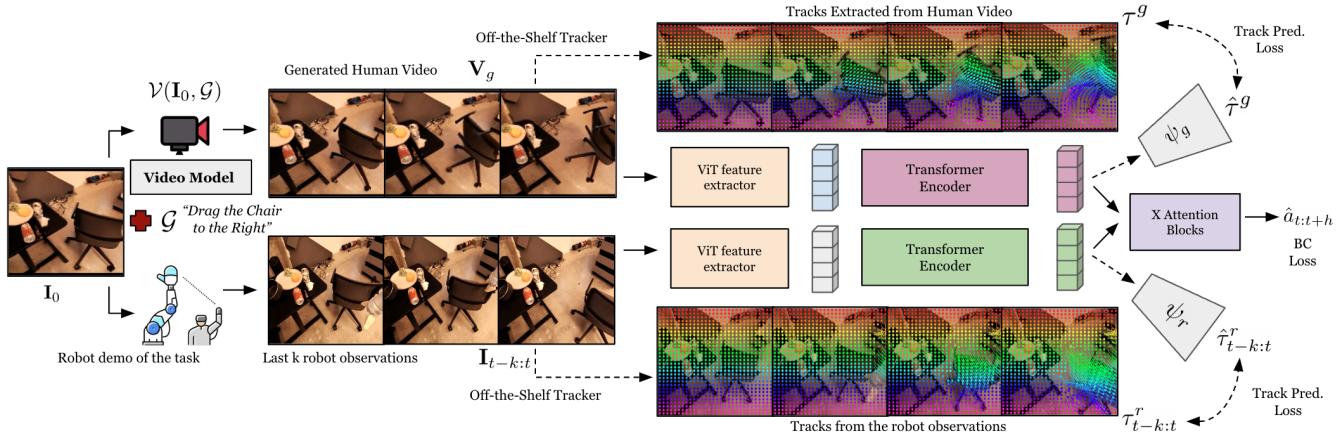
Look at the left side of Figure 2 above. The process starts with a static image of the current scene (\(I_0\)) and a text instruction (\(G\)), such as “Drag the chair to the right.”
The system feeds this into a pre-trained video generation model (in this paper, they use a model similar to VideoPoet). Crucially, this model is not fine-tuned on robot data. It is an off-the-shelf generative model trained on web data.
The model generates a “human video” (\(V_g\)). It hallucinates a human hand entering the scene and performing the requested task.
Why generate a human video instead of a robot video?
- Data Availability: Video generation models are trained on YouTube/Web data, which is full of humans, not robots. They are much better at generating realistic human motion zero-shot.
- Generalization: Because the video model has seen millions of clips of people opening jars, wiping tables, and moving chairs, it can generalize to new objects and scenes far better than a robot policy trained on a limited dataset.
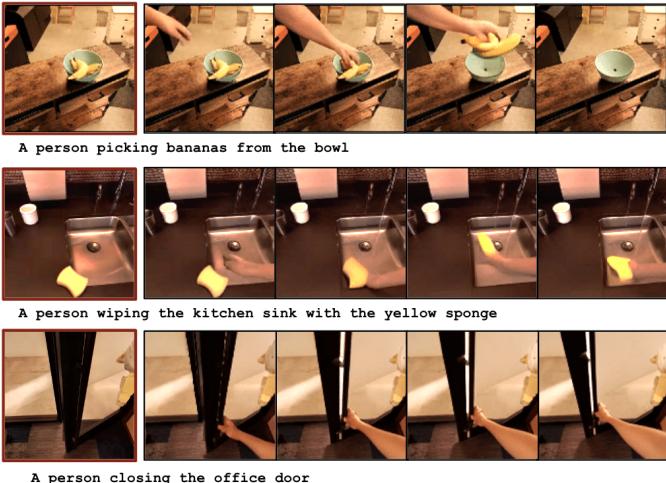
As shown in the visualization below, these generations are surprisingly coherent. Even though the model has never seen this specific kitchen or this specific bowl, it understands the physics and semantics required to “pick bananas” or “wipe the sink.”
Phase 2: The Translation Model (Closed-Loop Policy)
Once we have this generated video of a human, we have a “visual plan.” Now, the robot needs to execute it. This is where the Translation Model comes in (the right side of Figure 2).
This is a learned policy (\(\pi_\theta\)) that takes two inputs:
- The generated human video (\(V_g\)).
- The robot’s current and past observations (\(I_{t-k:t}\)).
The policy needs to look at the human video to understand what to do and how to move, and look at its own camera feed to close the loop and actually move its arm.
The Secret Sauce: Point Track Prediction
Here is the most technical and innovative part of Gen2Act. Simply feeding pixel data of a human video into a robot policy is often insufficient. There is a “domain gap”—a human hand looks nothing like a robot gripper. Furthermore, raw pixels can be noisy.
To bridge this gap, the authors utilize Point Tracks.
A point track is simply the trajectory of a specific pixel over time. If you track a point on a sponge as it is being wiped across a table, that trajectory represents the essence of the motion, regardless of whether a hand or a gripper is holding it.
During training, the researchers use an off-the-shelf tracker (like TAP-Vid or CoTracker) to extract point tracks from:
- The generated human video.
- The ground-truth robot video (from the training set).
They then add an auxiliary loss function called the Track Prediction Loss.
How it works: Inside the neural network, there are “latent tokens” (compressed representations of the video). The network is forced to predict the movement of random points in the scene using only these tokens.
If the network can accurately predict how points move in the video, it proves that the network “understands” the motion dynamics of the task. This forces the visual encoders (the parts of the AI that process images) to focus on movement and geometry, rather than just static textures.
This mechanism allows the robot to extract the intent of the motion from the human video and map it to its own physical reality.
The Deployment Workflow
When deployed in the real world (Inference), the pipeline is straightforward:
- Robot looks at the scene.
- Robot receives a text command.
- Gen2Act generates a video of a phantom human doing the task.
- The policy watches this video and the live camera feed.
- The policy outputs motor commands.
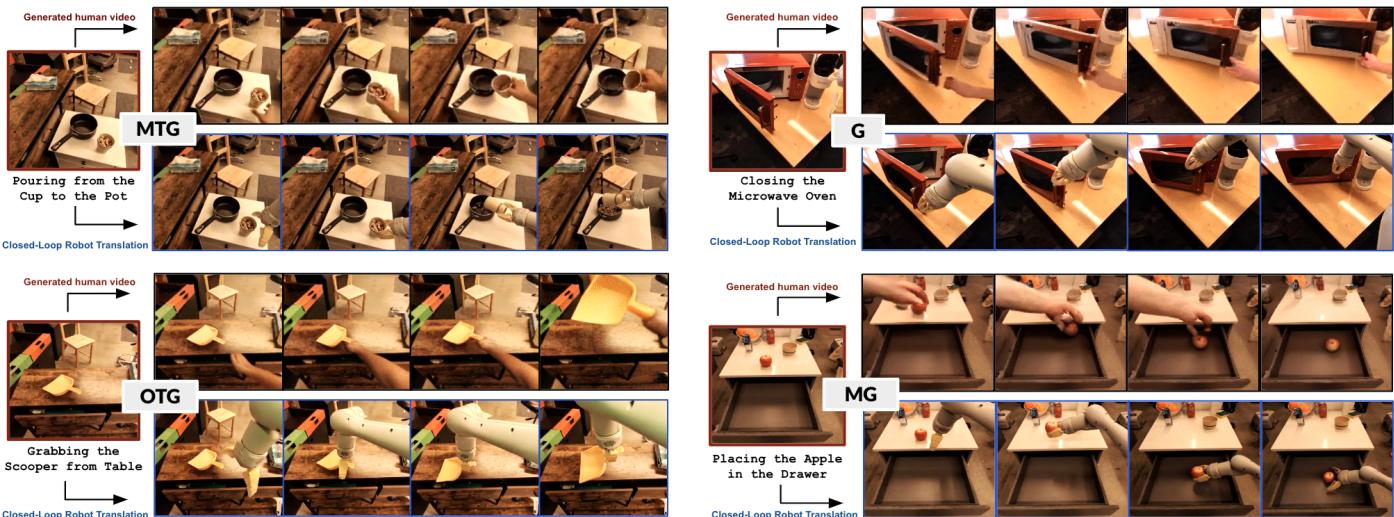
The image below beautifully illustrates this translation. The top row shows the “hallucinated” human video, and the bottom row shows the robot faithfully executing that same motion plan.
Experiments and Results
The researchers put Gen2Act to the test against strong baselines, including RT-1 (a standard language-conditioned policy) and Vid2Robot (a policy conditioned on real human videos).
They evaluated the system on different levels of difficulty:
- Mild Generalization (MG): Scenes are varied (lighting, background), but objects are known.
- Standard Generalization (G): Unseen object instances (e.g., a different color mug).
- Object-Type Generalization (OTG): Completely new types of objects the robot has never practiced with.
- Motion-Type Generalization (MTG): New motions (e.g., the robot has only practiced picking, but now must wipe).
The Generalization Gap
The results (Table I) are striking.
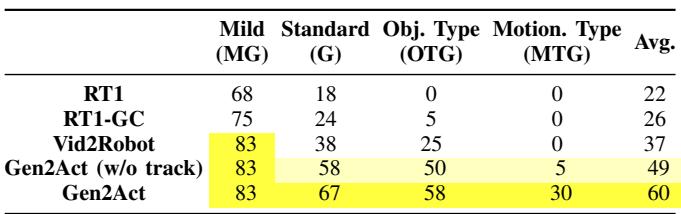
- RT-1 struggles significantly with new objects (0% success on OTG) and new motions (0% on MTG). It relies entirely on memorizing the training data.
- Gen2Act achieves 58% success on unseen object types and 30% on unseen motions.
This confirms the hypothesis: by leveraging the “world knowledge” contained in the video generation model, the robot can handle scenarios that are completely absent from its training data. The video generator acts as a bridge, translating the unknown scenario into a visual plan the robot can understand.
Long-Horizon Chaining
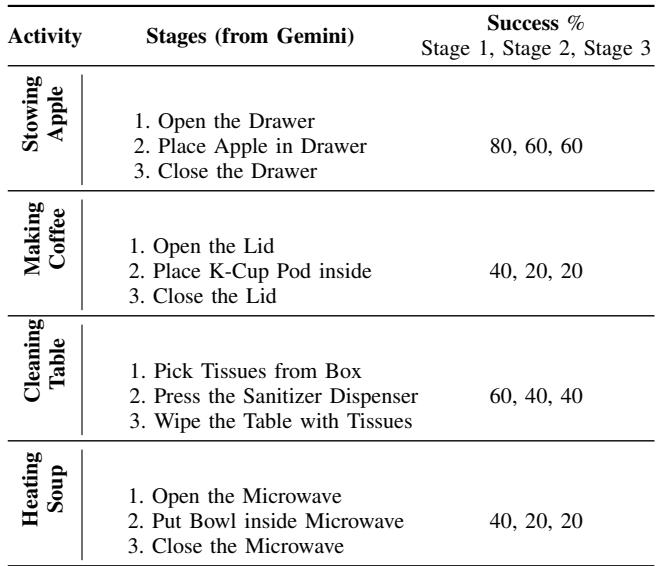
One of the coolest applications of Gen2Act is chaining tasks. Real-world chores aren’t just “pick up apple.” They are complex sequences: “Open the drawer, put the apple inside, close the drawer.”
The authors use a Large Language Model (LLM) to break a complex command into steps. Then, they run Gen2Act sequentially. Crucially, they use the final frame of the previous step as the initial frame for the next step’s video generation.

For example, in the “Cleaning the Table” task shown above:
- Step 1: Generate video of picking tissue -> Execute.
- Step 2: Take new photo. Generate video of pressing sanitizer -> Execute.
- Step 3: Take new photo. Generate video of wiping -> Execute.
The success rates for these chained tasks are promising, though they naturally degrade as the chain gets longer (since an error in step 1 ruins step 2).
Co-Training Improvements
The authors also found that Gen2Act isn’t just a zero-shot tool; it’s also a great way to augment training. By adding a small dataset of diverse human tele-operated demonstrations (just ~400 trajectories) and co-training the model, they squeezed out even better performance across all metrics.

When Does It Fail?
No robotic system is perfect, and Gen2Act has a very specific failure mode: Garbage In, Garbage Out.
The robot relies entirely on the generated video to know what to do. If the generative model hallucinates something physically impossible, or fails to interact with the object correctly in the video, the robot is doomed.
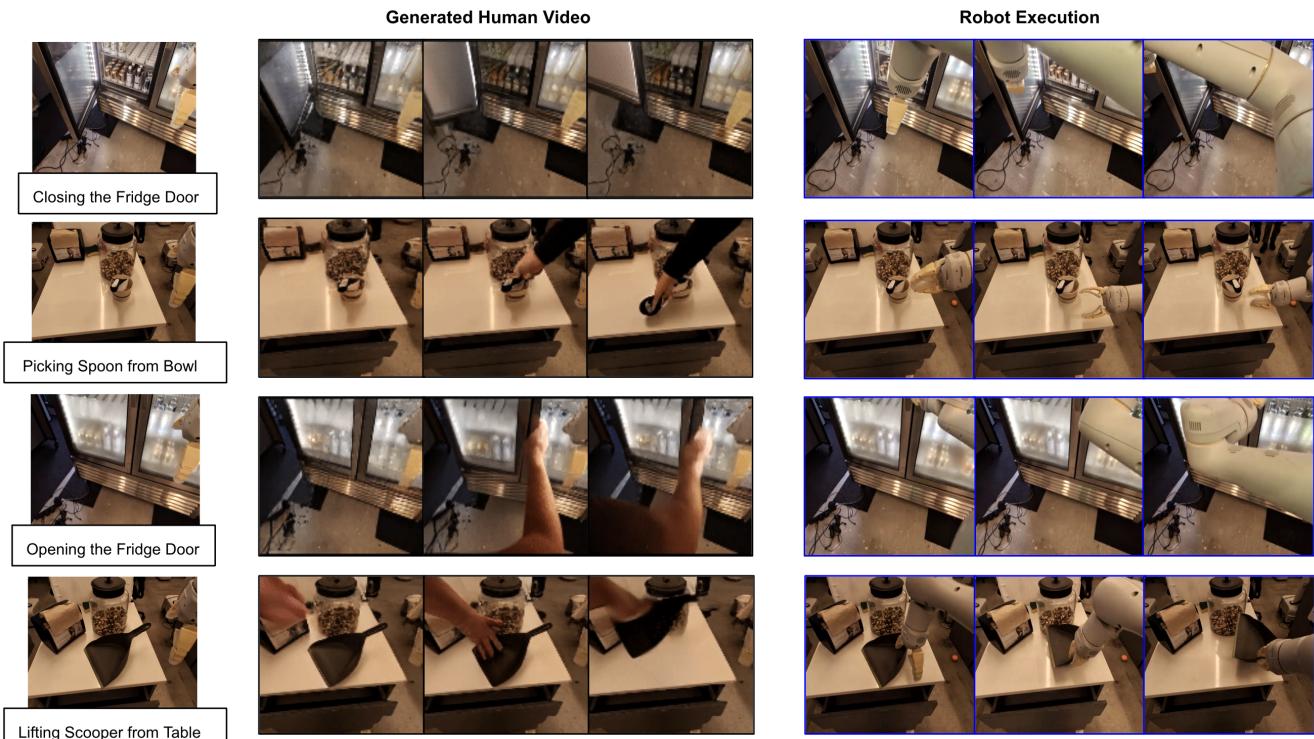
In Figure 6, we see examples of this:
- Top rows: The video generation is flawed (the hand misses the object or moves strangely). Consequently, the robot fails.
- Bottom row: The video generation looks okay, but the robot fails to translate the grasp accurately.
This highlights a dependency: Gen2Act will only get better as video generation models (like Sora, Gen-3, or VideoPoet) get better.
Conclusion: The Future of Embodied AI
Gen2Act represents a significant shift in how we think about robot learning. Instead of asking “How can we collect more robot data?”, it asks “How can we translate the massive amount of human data we already have?”
By treating video generation as an intermediate reasoning step—a way for the robot to “imagine” a solution before acting—we can unlock generalization capabilities that brute-force training simply cannot achieve.
The key takeaways from this work are:
- Generative Priors: Pre-trained video models contain rich physical and semantic knowledge that robots can leverage zero-shot.
- Motion Tracks Matter: Implicitly learning motion through point tracks is a powerful way to bridge the visual gap between humans and robots.
- Scalability: This approach allows robots to perform tasks they have never seen, provided a video model can imagine them.
As generative video models continue to improve in realism and consistency, frameworks like Gen2Act suggest a future where robots can learn to perform almost any household task simply by “imagining” it first.