](https://deep-paper.org/en/paper/2409.16434/images/cover.png)
The Hitchhiker’s Guide to PEFT: Unlocking Vision Transformers with Tiny Updates
If you are working in Computer Vision today, you are likely living in the era of “Download, Pre-train, Fine-tune.” We have access to massive foundation models like Vision Transformers (ViT) or CLIP, trained on millions (or billions) of images. But there is a catch: these models are gigantic.
Fine-tuning a billion-parameter model for a specific task—like classifying rare bird species or detecting defects in manufacturing—usually involves updating all the parameters (Full Fine-Tuning). This is computationally expensive and storage-heavy. If you have 50 downstream tasks, you need to store 50 copies of that massive model.
Enter Parameter-Efficient Fine-Tuning (PEFT). The promise of PEFT is simple: update only a tiny fraction of the parameters (or add a few new ones) and freeze the rest.
But here lies the problem. There are dozens of PEFT methods—LoRA, Adapter, VPT, SSF, BitFit. Which one should you use? Do they actually work as well as full fine-tuning? Until recently, the computer vision community lacked a unified, fair comparison of these methods.
In this post, we are diving deep into a paper that finally sets the record straight: “Lessons and Insights from a Unifying Study of Parameter-Efficient Fine-Tuning (PEFT) in Visual Recognition.” The researchers conducted a massive empirical study to give us a practical user guide. Let’s unpack what they found.
The Landscape of PEFT
Before we look at the results, we need to understand what we are actually tuning. The backbone for this study is the Vision Transformer (ViT).
In a standard ViT, an image is split into patches, embedded, and passed through layers of Multi-Head Self-Attention (MSA) and Multi-Layer Perceptrons (MLP).
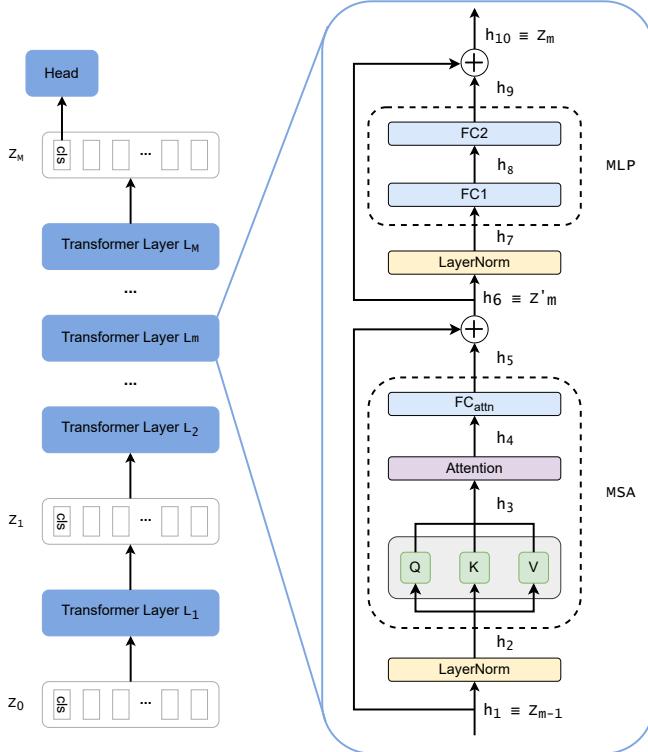
Figure 1: Inside a Vision Transformer block. PEFT methods intervene at various points (\(h_1\) to \(h_{10}\)) within this structure.
The researchers categorized PEFT methods into three main families:
- Prompt-based: Inspired by NLP, these methods (like VPT) add learnable “tokens” to the input data. It’s like whispering a hint to the model before it sees the image.
- Adapter-based: These methods insert small, trainable neural network modules (bottlenecks) inside the frozen transformer layers. Examples include Adapter, AdaptFormer, and Convpass.
- Selective Tuning: These methods don’t add new layers; they just pick specific existing parameters to unfreeze.
- BitFit: Only tunes the bias terms (\(b\)).
- LayerNorm: Only tunes the Layer Normalization parameters.
- LoRA (Low-Rank Adaptation): Updates weight matrices by learning low-rank decomposition matrices.
Insight 1: They All Work (If You Tune Them Right)
For a long time, the literature suggested that some PEFT methods were vastly superior to others. The authors of this paper argue that many of these comparisons were unfair—methods were often tested with different hyperparameters or suboptimal settings.
The researchers tested 14 PEFT methods on VTAB-1K, a benchmark containing 19 diverse tasks categorized into Natural (regular photos), Specialized (medical/satellite), and Structured (geometry/counting).
The verdict? When properly implemented and tuned, representative PEFT methods achieve remarkably similar accuracy.
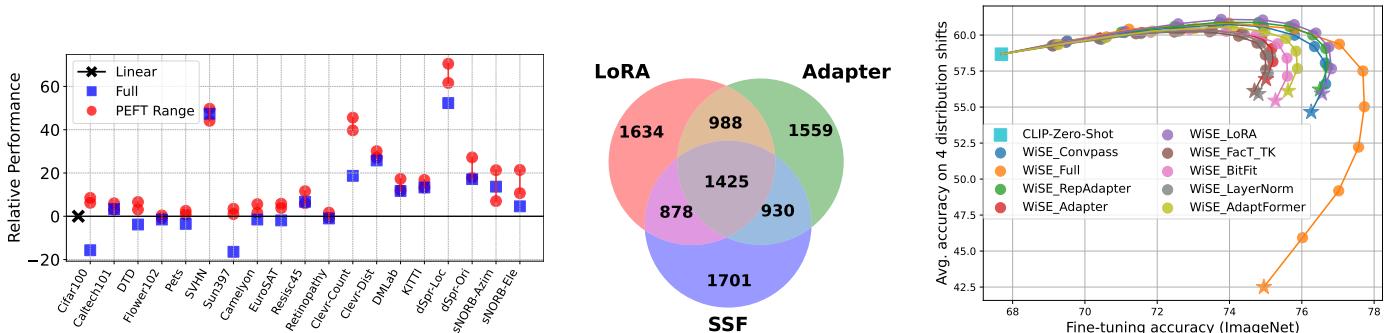
Figure 2: The relative performance of PEFT methods compared to Linear Probing (the horizontal line). Note how most PEFT methods (the dots) cluster closely together and consistently outperform Full Fine-Tuning (the black square) in these low-shot scenarios.
The Secret Ingredient: Drop Path
How did the authors achieve such consistent results? They discovered that a specific hyperparameter, Drop Path Rate, is critical. Drop Path is a regularization technique that stochastically “drops” (skips) layers during training.
Because PEFT is often used in low-data regimes (like VTAB-1K, which has only 1,000 training examples), models are prone to overfitting.
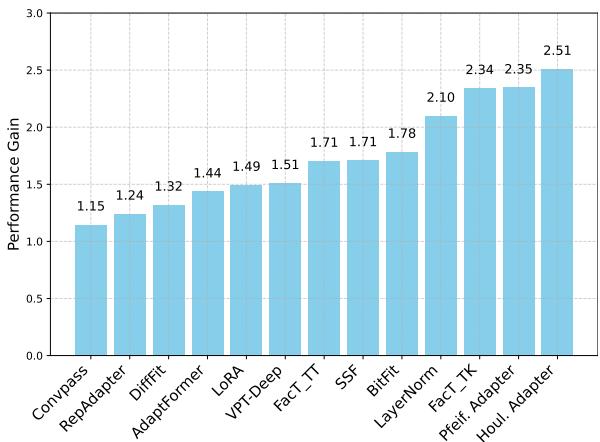
Figure 3: Look at the gains! Simply turning on Drop Path leads to significant performance boosts across almost all methods.
Simple Methods Are Underrated
One of the most surprising findings is the performance of BitFit. This method only updates the bias terms—less than 0.1% of the total parameters. Yet, in the “Natural” image tasks, it performs competitively with complex methods like LoRA or Adapters.
However, complexity does matter when the domain shift is large.
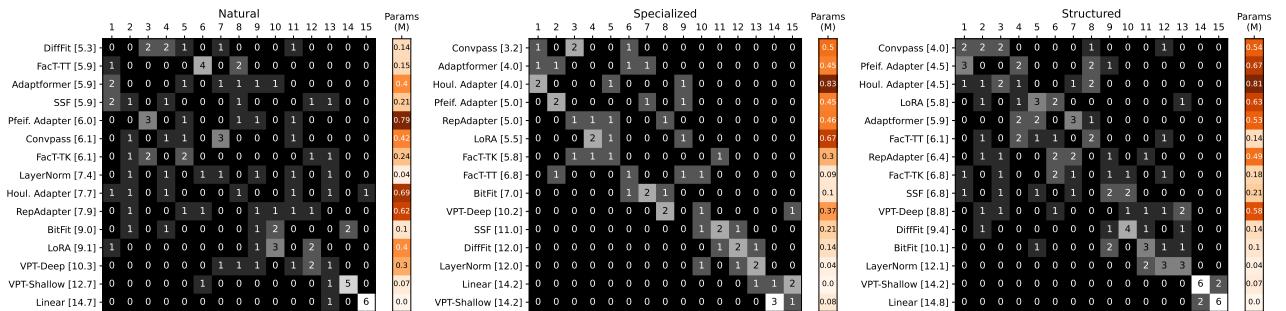
Figure 4: A ranking of methods across task types. In “Natural” tasks (top), simple methods like DiffFit rank highly. But in “Structured” tasks (bottom), which require understanding geometry and counting (very different from ImageNet pre-training), more complex methods like RepAdapter tend to win.
Key Takeaway: If your downstream task looks like ImageNet (natural photos), start with simple methods like BitFit or LoRA. If your task is abstract or specialized, you might need the extra capacity of Adapters.
Insight 2: Similar Accuracy, Different Minds
If LoRA, Adapters, and SSF all achieve ~85% accuracy on a dataset, you might assume they are learning the exact same things. You would be wrong.
The researchers analyzed the predictions of different PEFT methods and found that they make diverse errors. They succeed and fail on different images. This is likely due to their “inductive biases”—the specific way they modify the network architecture forces them to process information differently.
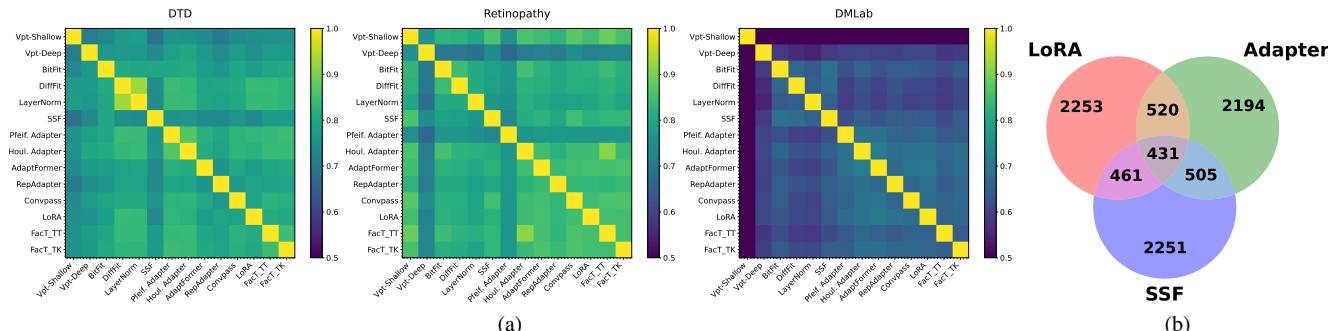
Figure 5: The heatmap (a) shows prediction similarity. Even though methods have high accuracy, they don’t have 100% overlap in predictions. The Venn diagram (b) shows the overlap of WRONG predictions. Each method gets different images wrong.
The Power of Ensembles
This diversity is a goldmine for Ensemble Learning. By simply averaging the predictions of different PEFT models (e.g., a LoRA model + an Adapter model), you can get a “free” boost in performance without collecting more data.
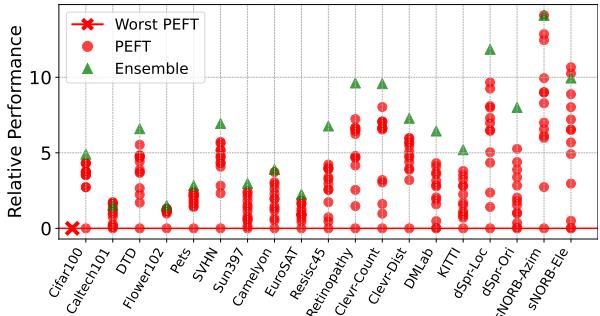
Figure 6: The green triangles represent the ensemble performance. It consistently sits above the individual PEFT methods (red dots), proving that diversity pays off.
Insight 3: PEFT is Not Just for “Few-Shot”
A common misconception is that PEFT is only useful when you don’t have enough data to run full fine-tuning. The logic goes: “If I have massive data, I should fine-tune the whole model to get the best results.”
The study challenges this. They tested PEFT in many-shot regimes (using the full training sets of CIFAR-100 and RESISC45).
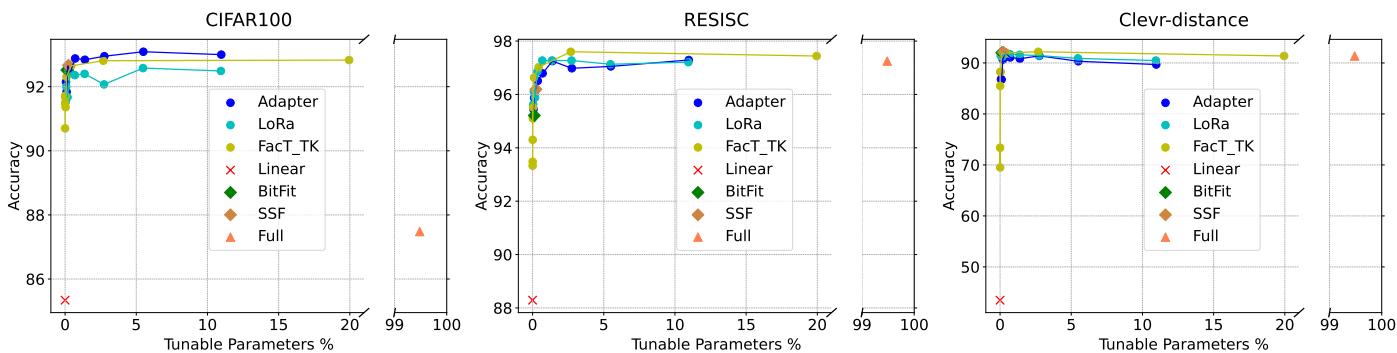
Figure 7: Accuracy vs. Tunable Parameters. Even with ample data, PEFT methods (lines) ramp up to high accuracy very quickly with only 2-5% of parameters. In some cases (CIFAR-100), PEFT actually outperforms Full Fine-Tuning (orange triangle).
Why? Full fine-tuning can sometimes be too aggressive, destroying the general knowledge the model learned during pre-training (a phenomenon known as catastrophic forgetting). PEFT acts as a regularizer—it allows the model to learn new tasks while forcing it to retain the core capabilities of the pre-trained backbone.
Insight 4: Robustness and WiSE
Finally, the authors looked at Robustness. If you fine-tune a model on ImageNet, how well does it handle sketched versions of ImageNet objects, or adversarial examples?
Standard Full Fine-Tuning often significantly degrades this “Out-of-Distribution” (OOD) robustness. PEFT, because it freezes most of the model, preserves robustness much better.
But can we do better? The authors applied a technique called WiSE (Weight-Space Ensembles) to PEFT. WiSE involves linearly interpolating the weights of the fine-tuned model with the weights of the original pre-trained model (or the zero-shot head in the case of CLIP).
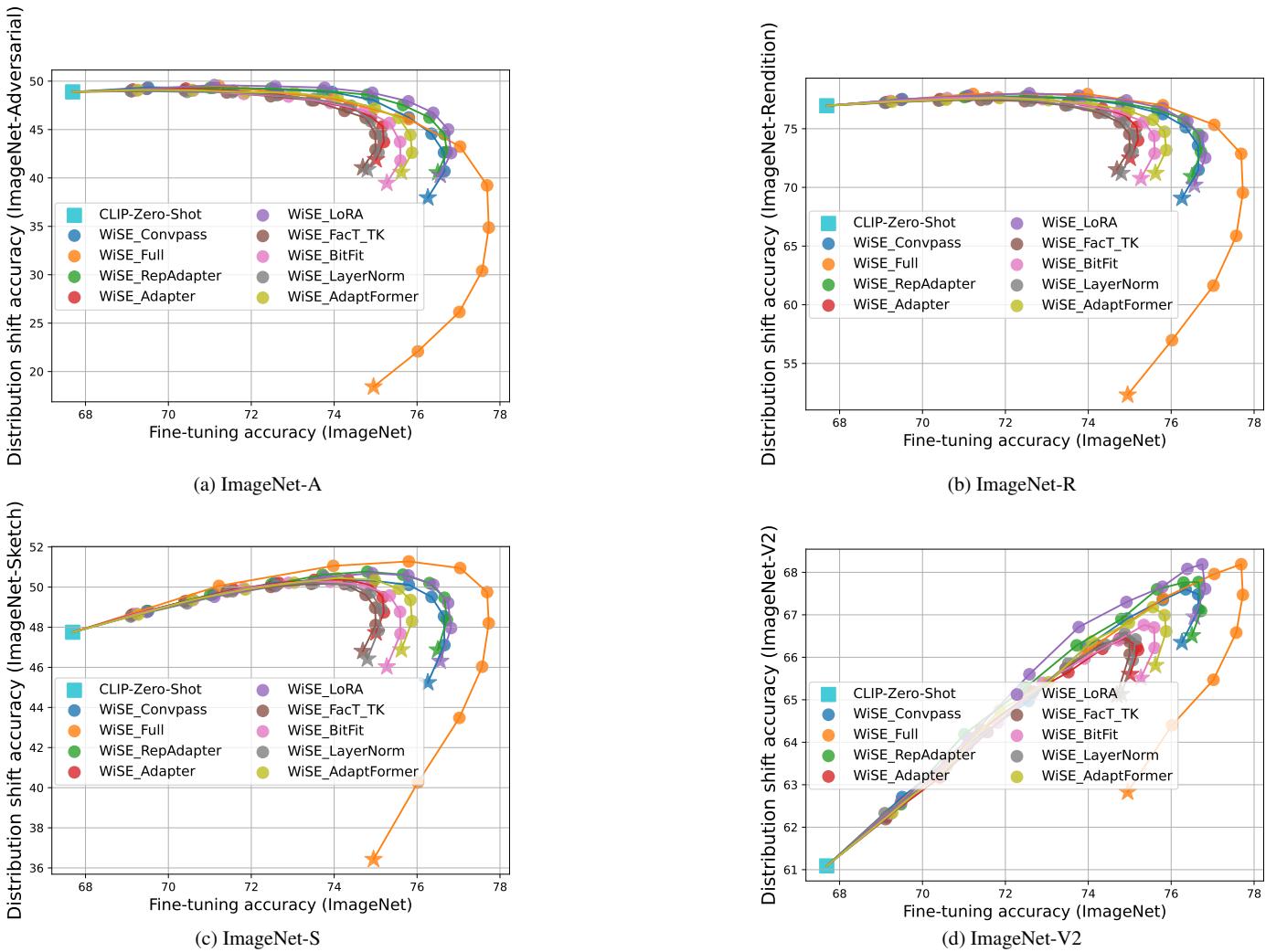
Figure 8: The stars (\(\star\)) represent standard PEFT. The lines show what happens when you use WiSE (blending weights). In almost every case, WiSE pushes the performance up and to the right—improving both accuracy on the target task and robustness on shifted distributions.
A Look Under the Hood: The Architectures
To wrap up, let’s briefly visualize the actual architectural changes some of these methods make. The paper highlights that while the mathematical formulations differ, many adapter-based methods share a similar philosophy: inject a bottleneck.
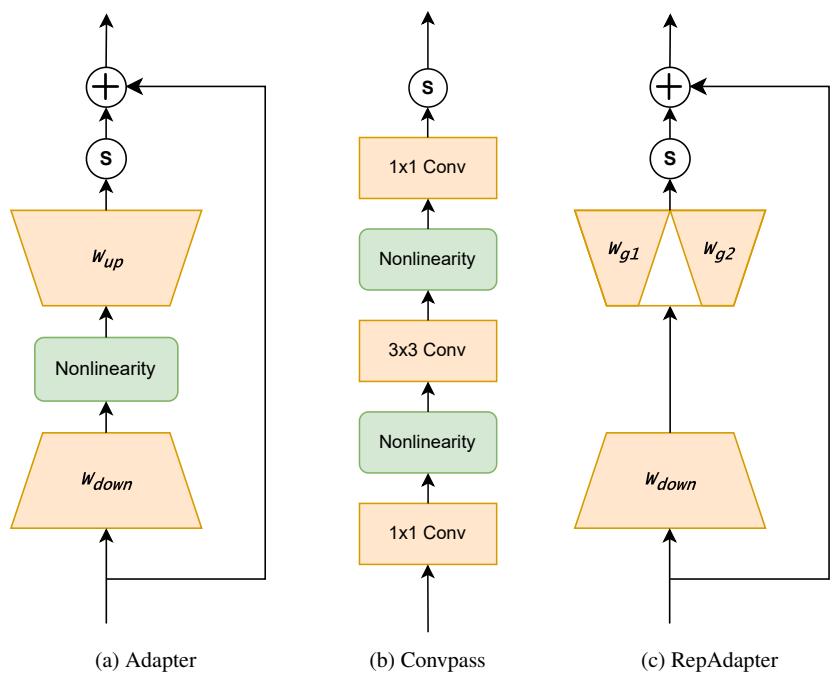
Figure 9: (a) The standard Adapter uses a Down-projection -> Nonlinearity -> Up-projection. (b) Convpass introduces Convolutional layers to capture spatial information. (c) RepAdapter uses a parallel design that can be re-parameterized (merged) back into the main weights for faster inference.
Conclusion: The PEFT Recipe
This unifying study moves us from “trial and error” to engineering discipline. Here are the practical recommendations for students and practitioners:
- Don’t overcomplicate it: For tasks similar to the pre-training data (natural images), simple methods like LoRA or even BitFit are often sufficient.
- Tune your regularization: Do not ignore Drop Path Rate. It is often the difference between a mediocre and a state-of-the-art result.
- Ensemble for the win: If you need that extra 1-2% accuracy, don’t just train one model. Train a LoRA model and an Adapter model and average their predictions. Their distinct inductive biases will complement each other.
- Use PEFT for robustness: If you care about your model working in the wild (where data might look different from training), PEFT is generally safer than full fine-tuning.
PEFT transforms the massive, unwieldy giants of the deep learning world into agile, adaptable tools. By understanding the “how” and “why” derived from this study, you can deploy Vision Transformers more efficiently and effectively.