](https://deep-paper.org/en/paper/2409.16686/images/cover.png)
Introduction
Imagine you are teaching a robot how to navigate a kitchen. On day one, you teach it how to make a salad. It learns a valuable lesson: “Use a bowl to hold the ingredients.” On day two, you ask the robot to water a plant. The robot, eager to apply its past knowledge, remembers the concept of a “bowl” and the action “fill with water.” However, because its memory is cluttered, it might erroneously try to “slice” the water or mix the plant with dressing because it associates bowls with cooking.
This scenario highlights a critical bottleneck in Embodied Artificial Intelligence (AI): Memory Management.
With the rise of Large Language Models (LLMs) like GPT-4, we finally have agents capable of complex reasoning. However, as these agents learn from experience, they accumulate a vast amount of “insights.” If an agent tries to remember everything at once, the sheer volume of irrelevant information can confuse it. Conversely, if it generalizes too much, it loses the specific nuances required for distinct tasks.
In this deep dive, we will explore the Multi-Scale Insight Agent (MSI-Agent), a novel framework proposed by researchers from Tsinghua University and collaborators. This paper introduces a sophisticated method for organizing an agent’s long-term memory into different “scales”—from broad, general rules to specific, task-oriented tricks.
By the end of this post, you will understand how MSI prevents “memory overflow,” how it outperforms existing methods in complex simulations, and why hierarchical memory is the future of autonomous agents.
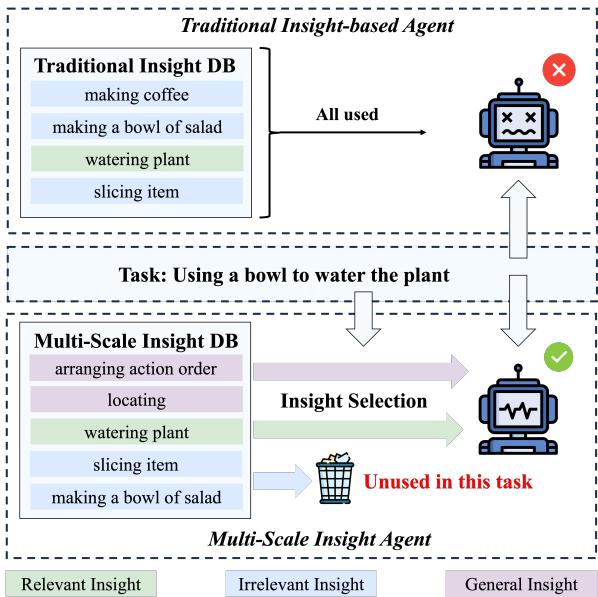
As illustrated above, the core difference lies in filtering. While traditional agents are overwhelmed by their own knowledge database, the MSI-Agent selectively retrieves only what is necessary for the task at hand.
Background: The Challenge of Embodied Agents
What is an Embodied Agent?
An embodied agent is an AI system that controls a physical or virtual body (like a robot) to interact with an environment. Unlike a chatbot that lives in a text box, an embodied agent must navigate space, manipulate objects, and understand physical consequences.
The Role of LLMs in Planning
Modern agents use LLMs as their “brain.” When you give a command like “Clean the kitchen,” the LLM breaks this down into a sequence of atomic actions:
- Walk to the table.
- Pick up the sponge.
- Walk to the sink.
- Scrub the plate.
The Memory Dilemma: Examples vs. Insights
To make these agents smarter, they need Long-Term Memory. There are generally two ways to implement this:
- Example Memory (RAG): The agent stores exact recordings of past successes. When facing a new task, it retrieves a similar past example. This is effective but rigid.
- Insight Memory: The agent uses an LLM to summarize its experiences into textual rules or “insights” (e.g., “Always open the fridge before trying to grab the milk”).
The Problem: Existing “Insight Memory” systems are often flat. They generate a list of rules and dump them all into the context window for every new task. This leads to two failure modes:
- Interference: Irrelevant insights (like cooking rules during a cleaning task) confuse the LLM.
- Lack of Abstraction: The insights are often too specific (low-level) and lack the high-level general principles needed for broad reasoning.
Core Method: The Multi-Scale Insight (MSI) Agent
The researchers proposed the MSI-Agent to solve these issues by mimicking how humans organize knowledge. We don’t treat “how to open a door” (general knowledge) the same way we treat “how to reset this specific router model” (specific knowledge). We categorize them.
The MSI architecture operates on a three-stage pipeline: Experience Selection, Insight Generation, and Insight Selection.
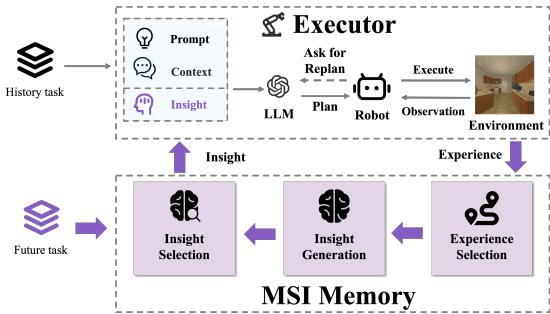
Let’s break down each stage of this pipeline in detail.
1. Experience Selection: Learning from Success and Failure
Before an agent can form an insight, it needs experience. The agent performs training tasks and records the outcomes. But which experiences are worth remembering?
The MSI-Agent uses two strategies, but the most effective one is the Pair Mode.
In Pair Mode, the system doesn’t just look at what went right; it compares a successful attempt (\(s_s\)) with a failed attempt (\(s_f\)). By contrasting these two, the agent can identify exactly what caused the failure.
The system pairs a success with a relevant failure using cosine similarity of their embeddings:

Here, \(emb(s)\) represents the vector embedding of the user query. The system searches the database of failed attempts (\(S_f\)) to find the one most semantically similar to the successful attempt (\(s_s\)). This ensures the agent is comparing “apples to apples”—learning from a failure in a similar context.
2. Multi-Scale Insight Generation
This is the heart of the paper’s contribution. Once the experiences are selected, the MSI-Agent generates insights at three distinct hierarchical scales:
- General Insights: High-level rules applicable to all tasks (e.g., “To pick up an object, you must be close to it”).
- Environment Insights: Rules specific to a room type (e.g., “In the Kitchen, knives are usually in the drawer or near the toaster”).
- Subtask/Task Insights: Fine-grained rules for specific actions (e.g., “When slicing a tomato, ensure you have a knife first”).
The generation process uses an LLM to update a persistent insight database. It’s not just appending text; the LLM acts as a database manager. It can perform five specific atomic actions on the insights:
- Add: Create a new rule.
- Remove: Delete an incorrect or duplicate rule.
- Edit: Refine a rule to be more accurate.
- Agree: Reinforce an existing rule (increasing its confidence score).
- Move: Shift a rule between scales (e.g., promoting a Task rule to a General rule if it proves universally useful).
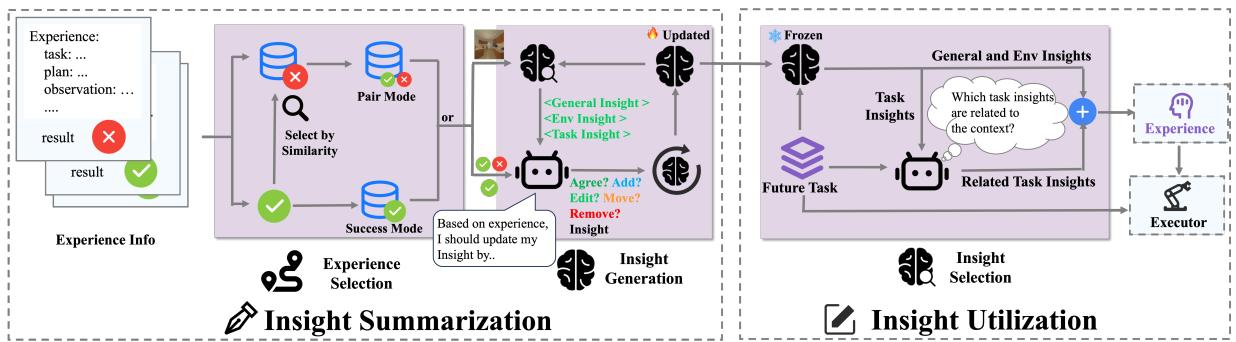
As shown in Figure 3, this dynamic updating ensures the memory evolves. If a rule is found to be wrong later (getting a “Remove” vote), it is discarded. This self-correcting mechanism prevents the database from becoming a trash heap of bad advice.
3. Insight Selection: filtering the Noise
Generating insights is only half the battle. The other half is retrieving the right ones during a new task.
If the agent simply retrieved “similar” insights using vector search (a common technique in AI), it often failed. For example, a task involving a “bowl” for plants might retrieve insights about “bowls” for soup, leading to hallucinated cooking actions.
To solve this, MSI employs Hashmap Indexing for task-specific insights.
- The system tags insights with specific subtask names.
- When a new user query comes in, the LLM identifies the relevant subtasks.
- The system retrieves only the insights tagged with those subtasks, plus the General and Environment insights.
This creates a highly focused prompt for the planner, free from “distracting” memories.
Experiments and Results
The researchers evaluated MSI-Agent on two challenging embodied AI benchmarks: TEACh and Alfworld.
Metrics for Success
To understand the results, we first need to define how success is measured in these simulations.
Success Rate (SR): Did the robot complete the task?

Goal Condition Success Rate (GC): How much of the task did it complete? (e.g., if the goal was “wash two plates” and it washed one, the GC is 0.5).

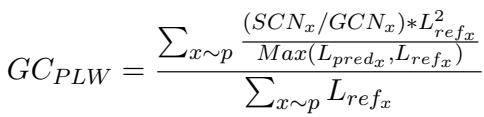
They also measured “Path Length Weighted” (PLW) metrics, which penalize the robot for taking inefficient, winding paths to the solution.
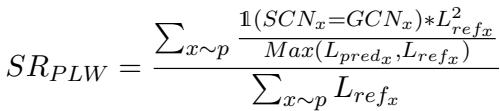
RQ1: Does MSI outperform other methods?
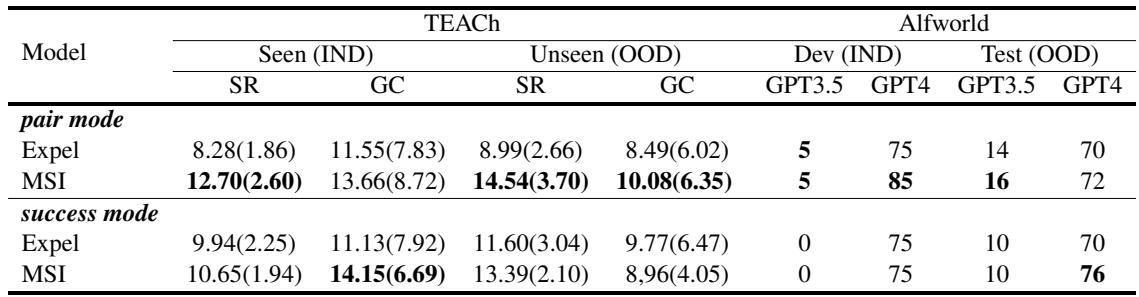
The results were compelling. In the TEACh benchmark, MSI significantly outperformed the baseline “Expel” method and the standard “HELPER” agent.
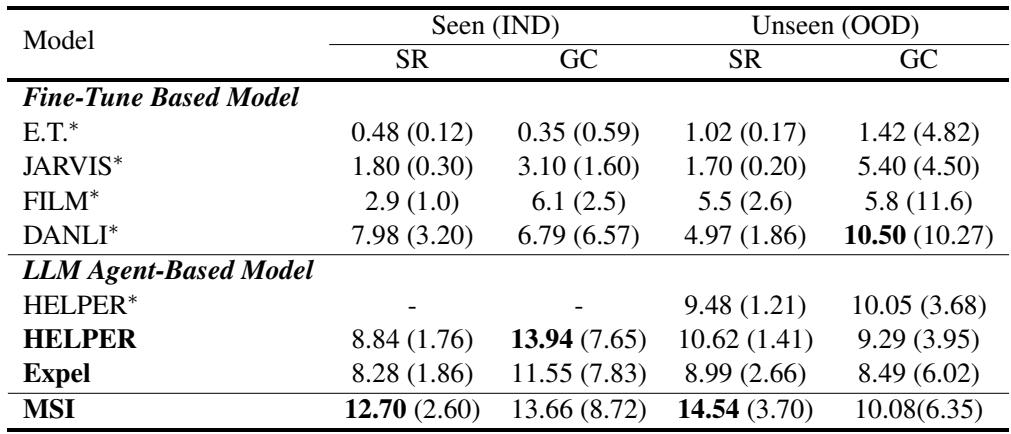
In Unseen (Out-of-Domain) scenarios—which test how well the robot handles new, unfamiliar environments—MSI achieved a 14.54% Success Rate compared to Expel’s 8.99%. This indicates that the multi-scale approach helps the agent generalize much better than flat memory structures.
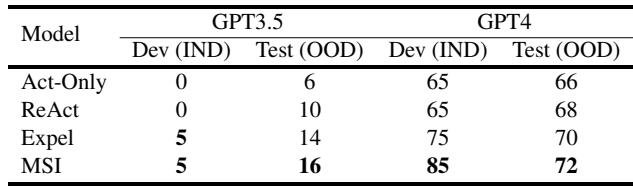
Similar trends were observed in the Alfworld benchmark, where MSI achieved higher scores across the board using both GPT-3.5 and GPT-4.
Case Study: The “Tomato” Test
Quantitative data is great, but qualitative examples show us why the system works.
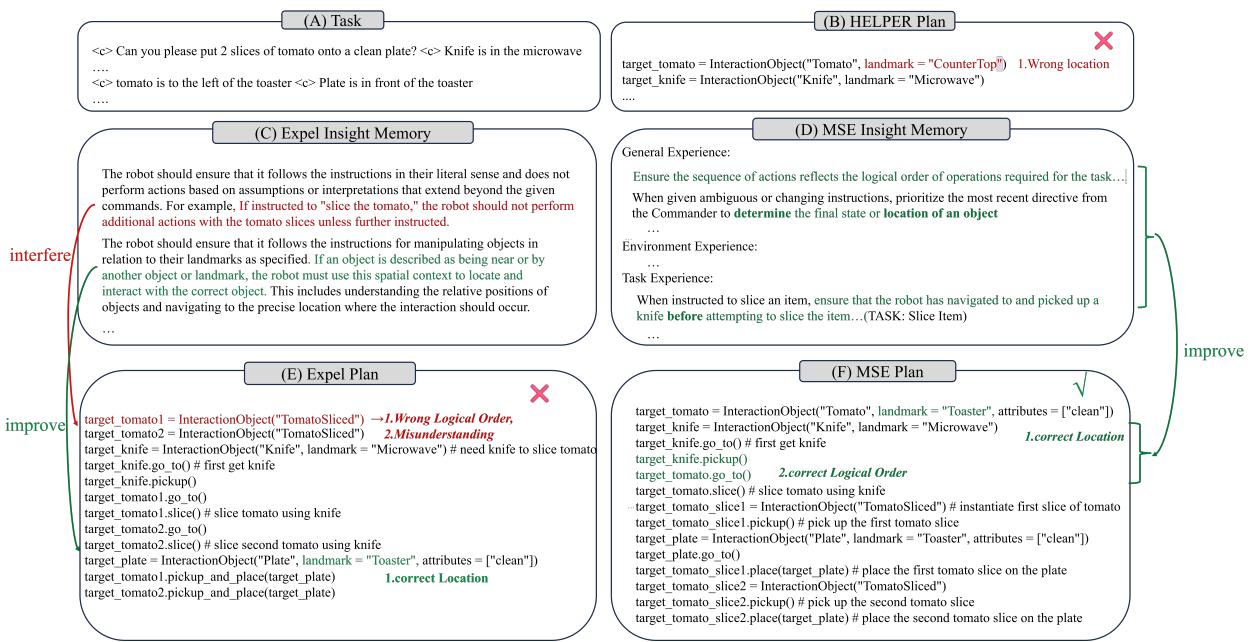
Consider a task: “Slice tomatoes and put them on a plate.”
- Expel (Baseline): The agent retrieves an insight related to landmarks but gets confused by an irrelevant memory about “Action Order” from a different task. It tries to slice the tomato before picking up the knife, or it hallucinates that the tomato is already sliced.
- MSI-Agent: It retrieves a specific Subtask Insight: “Ensure accurate positioning when dialogue mentions ’near another object’.” It ignores the irrelevant cooking order from other recipes. Consequently, it correctly navigates to the knife first, then the tomato.
RQ2 & RQ3: Selection Strategies Matter
The researchers also investigated how they selected experiences and insights.
Success vs. Pairs: Is it better to learn only from winners, or from winners and losers? The data shows that for MSI, Pair Mode (Success + Failure) is superior. By analyzing why a previous attempt failed, the generated insights are more robust and corrective.
Hashmap vs. Vector Search: As mentioned in the Core Method, how you find the insights matters. The experiment confirmed that Hashmap Indexing (matching exact subtask names) drastically outperforms Vector Indexing.

Vector search dropped the success rate from 14.54% to 11.43% in unseen environments. This validates the hypothesis that vector similarity often introduces “semantic noise” (retrieving conceptually related but functionally irrelevant tasks).
RQ4: Robustness and Catastrophic Forgetting
A major risk in AI learning is “Catastrophic Forgetting”—where learning new things causes the agent to forget old things.
The researchers tested this by training the agent sequentially: first on Kitchen tasks, then Living Room, then Bedroom. They checked if the performance in the Kitchen dropped after learning about Bedrooms.
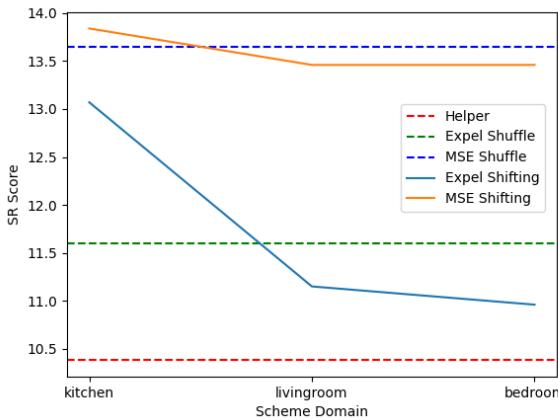
The graph above shows that while all agents suffer some performance drop on the original domain (Kitchen) as they learn new ones, MSI (Blue Line) stabilizes much higher than the baseline. The separation of General and Environment-specific insights acts as a buffer, protecting core knowledge while allowing new environment rules to be added safely.
Conclusion & Implications
The MSI-Agent represents a significant step forward in making Embodied AI reliable. By moving away from a “flat” list of memories and adopting a Multi-Scale approach, the agents become:
- Less Distracted: They filter out irrelevant past experiences.
- More Generalizable: They apply broad rules to new environments effectively.
- More Robust: They learn new domains without forgetting old ones.
Key Takeaways for Students
- Hierarchy is Key: Just as software engineering uses abstraction layers, AI memory benefits from distinguishing between global rules and local implementation details.
- Contrastive Learning: Learning from “Success vs. Failure” pairs often provides deeper signal than learning from Success alone.
- Retrieval Precision: In RAG (Retrieval-Augmented Generation) systems, how you retrieve is just as important as what you store. Sometimes, strict keyword/category matching (Hashmap) beats fuzzy semantic matching (Vector).
As we look toward the future, we can expect to see even more complex memory structures, perhaps incorporating visual “insights” or episodic video memory, further bridging the gap between robot and human cognition.