](https://deep-paper.org/en/paper/2409.17993/images/cover.png)
Introduction
In computer vision, one of the most fundamental tasks is alignment. Whether it is a drone navigating via satellite maps, a robot fusing infrared and visible light data, or a medical system overlaying MRI and CT scans, the system must understand how two images relate to each other geometrically. This relationship is often described by a homography—a transformation that maps points from one perspective to another.
When images come from the same sensor (e.g., two standard photos), finding this relationship is relatively straightforward. We can simply slide one image over the other until the pixels match. However, the problem becomes significantly harder in cross-modal scenarios. How do you align a black-and-white thermal image with a color satellite photo? The pixel intensities are completely different; a hot engine is bright white in thermal but might be a dark grey block in a visible photo.
Traditionally, Deep Learning approaches to this problem required large datasets of “ground truth” labels—pairs of images where the perfect alignment is already known. But in the real world, getting these perfect labels is expensive or impossible. This has led to a rise in unsupervised learning, where the model teaches itself.
However, unsupervised cross-modal estimation faces a massive hurdle: the “solution space” is full of traps.
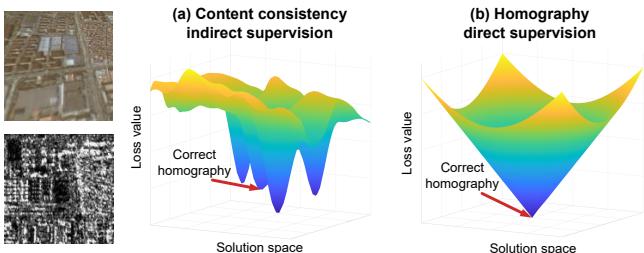
As shown in Figure 1, standard unsupervised methods rely on “content consistency” (Part a). Because the images look so different, the loss function is bumpy, full of local minima (traps) where the model thinks it has found a solution but hasn’t. Ideally, we want the smooth, convex landscape of “homography direct supervision” (Part b), but that usually requires labels we don’t have.
In this post, we will dive deep into SSHNet (Split Supervised Homography estimation Network). This research paper proposes a clever way to reformulate this unsupervised nightmare into two manageable, supervised sub-problems, allowing for highly accurate image alignment without a single manual label.
Background: The Cross-Modal Challenge
Before dissecting SSHNet, we need to understand why existing methods struggle.
Homography Estimation
A homography is a \(3 \times 3\) matrix that describes the transformation between two planar surfaces. In deep learning, we typically feed two images (\(I_A\) and \(I_B\)) into a Convolutional Neural Network (CNN), which outputs the matrix or the movement of the four corners of the image.
The Failure of Standard Metrics
In mono-modal tasks (e.g., RGB to RGB), unsupervised learning minimizes the photometric error. If the alignment is perfect, \(I_A - Warped(I_B) \approx 0\).
In cross-modal tasks (e.g., RGB to Infrared), \(I_A - Warped(I_B)\) is never zero because the modalities represent physical reality differently. Researchers have tried to use “Mutual Information” or “Correlation” as metrics, but these are computationally heavy and often fail when the geometric deformation is large.
Recent State-of-the-Art (SOTA) methods like SCPNet attempted to solve this by mixing cross-modal learning with self-supervised intra-modal learning. While effective, they still relied on indirect supervision, which makes converging on the correct answer difficult for iterative networks.
The Core Method: SSHNet
The researchers behind SSHNet didn’t just tweak the network architecture; they fundamentally changed how the problem is framed. They realized that the unsupervised cross-modal problem is actually two supervised problems tangled together.
1. Problem Reformulation
The core innovation of SSHNet is splitting the unsupervised task into two coupled sub-problems that provide direct supervision to each other.
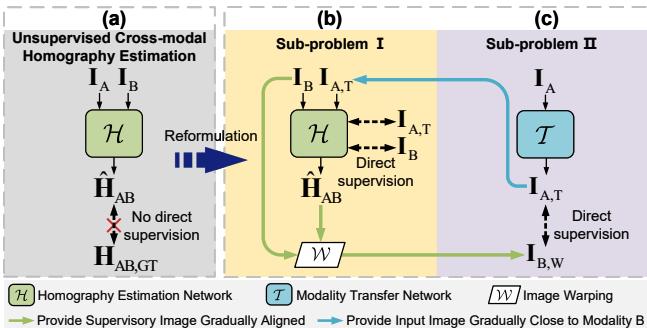
Let’s look at Figure 2:
- (a) The Original Problem: We have input images \(I_A\) and \(I_B\) and want to find the homography \(\hat{H}_{AB}\). There is no ground truth, so supervision is impossible directly.
- (b) Sub-problem I (Homography Estimation): Imagine we could perfectly translate image \(I_A\) into the style of modality B (creating \(I_{A,T}\)). We could then treat this as a mono-modal problem. We can generate synthetic deformations on \(I_B\) (where we know the answer) and train the network to align \(I_{A,T}\) to \(I_B\).
- (c) Sub-problem II (Modality Transfer): To get that translated image \(I_{A,T}\), we need a network that turns modality A into B. To train this network, we need to know which pixel in A corresponds to which pixel in B. If we have the estimated homography from Sub-problem I, we can align \(I_B\) to match \(I_A\), giving us a target image for supervision.
This creates a “chicken and egg” loop:
- To estimate the Homography, we need good Modality Transfer.
- To learn Modality Transfer, we need a good Homography (to align the training pairs).
SSHNet solves this loop using a Split Optimization Strategy.
2. Split Optimization Architecture
Instead of trying to optimize everything at once (which the authors found leads to failure), SSHNet trains the two specific networks—the Homography Estimation Network (\(\mathcal{H}\)) and the Modality Transfer Network (\(\mathcal{T}\))—separately in an alternating fashion.
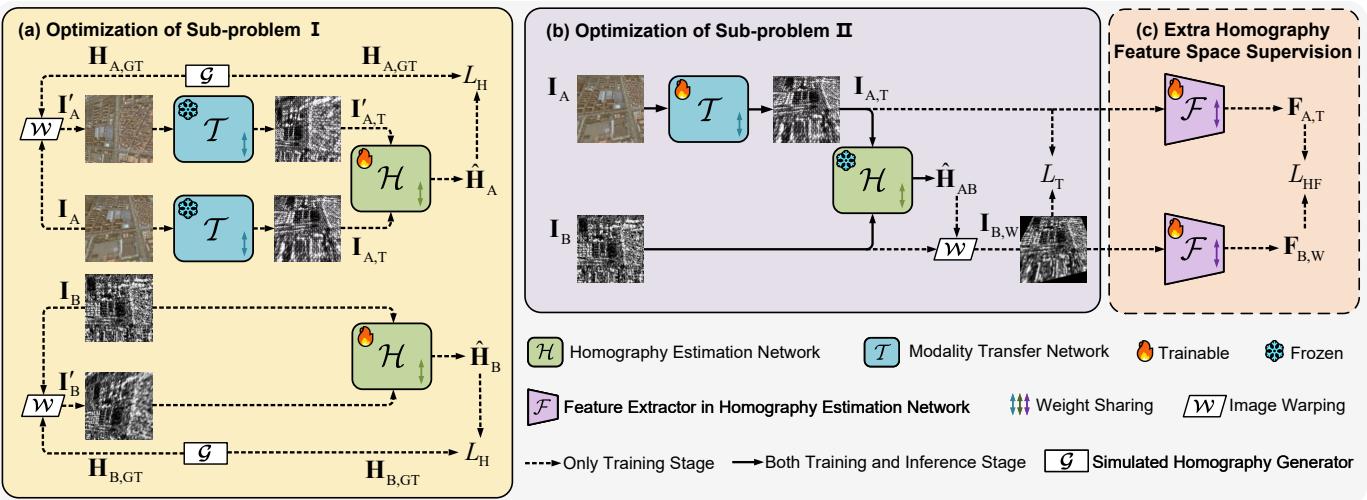
Figure 4 illustrates the complete workflow. Let’s break down the two phases shown in the diagram.
Phase 1: Optimization of Sub-problem I (Homography)
In this phase (Figure 4a), the goal is to train the homography network. The Modality Transfer Network is frozen (represented by the snowflake icon).
- Input Generation: The system takes inputs \(I_A\) and \(I_B\). It applies random, known deformations to create pairs. For example, it warps \(I_B\) to create \(I'_B\) using a known homography \(H_{B, GT}\).
- Transfer: The frozen transfer network converts the A-modality images into B-modality style (\(I_{A,T}\)).
- Training: The Homography Network (\(\mathcal{H}\)) tries to predict the movement.
- Crucially, the authors use a two-branch self-supervised training. It learns from the clean B-to-B pair (\(I_B, I'_B\)) AND the cross-modal pair (\(I_{A,T}, I'_{A,T}\)). This ensures the network learns features robust enough for both tasks.
The objective function for this phase minimizes the error between the predicted homography and the ground truth (synthetic) homography:

Here, \(\mathcal{R}\) acts as a regularization term using the transferred images to guide the network.
Phase 2: Optimization of Sub-problem II (Modality Transfer)
In this phase (Figure 4b), the Homography Network is frozen. The goal is to teach the Transfer Network (\(\mathcal{T}\)) how to make image A look like image B.
- The Transfer Network takes \(I_A\) and generates \(I_{A,T}\).
- To verify if \(I_{A,T}\) is good, we compare it to \(I_B\).
- The Alignment Trick: Since \(I_A\) and \(I_B\) are not naturally aligned, we use the current best guess of the homography (from the frozen Homography Network) to warp \(I_B\).
- The loss is calculated between the generated image and the warped \(I_B\).

Because the alignment might still be slightly imperfect, the authors don’t use simple pixel-to-pixel subtraction (L1 loss). Instead, they use Perceptual Loss (using a VGG network) to compare high-level features, which is more forgiving of slight misalignments.

Why Split Optimization?
You might wonder, why not train them together? The authors tested “Straight Optimization” (joint training) versus their Split approach.
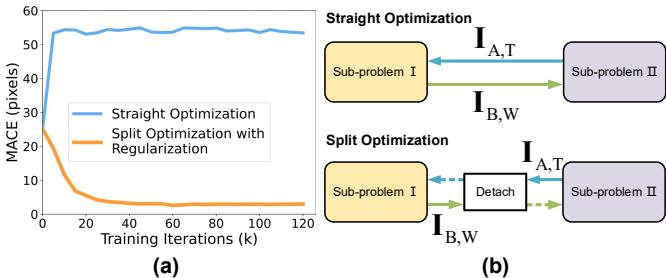
Figure 3 shows the dramatic difference. The blue line (Straight Optimization) fails to converge—the error stays high because the two networks confuse each other. The orange line (Split Optimization with Regularization) drops rapidly. By improving one network, you provide better training data for the other, creating a positive feedback loop.
3. Extra Homography Feature Space Supervision
While the method described above is powerful, the Modality Transfer Network is supervised primarily to make images look alike visually. However, for homography estimation, feature consistency is more important than visual aesthetics.
To enforce this, the authors introduced an extra supervision module (shown in Figure 4c). They force the features extracted from the Transferred Image (\(I_{A,T}\)) to match the features of the Warped Target Image (\(I_{B,W}\)).
They utilize a correlation-based loss function for this, ensuring that the deep features used for matching are highly correlated:

This step bridges the gap between simply “generating a picture” and “generating a picture that is geometrically alignable.”
4. Distillation Training: Making it Efficient
The SSHNet framework is complex. It requires running a Modality Transfer Network (which is essentially a U-Net style transformer) just to prepare the images for alignment. This is computationally expensive and introduces extra parameters.
To solve this, the researchers employ Distillation Training.

As shown in Figure 5, the full SSHNet acts as a “Teacher.” Once trained, it is very good at estimating homographies (\(\hat{H}_{teacher}\)). They then create a “Student” network (SSHNet-D). The Student:
- Does not have the Modality Transfer Network.
- Takes raw \(I_A\) and \(I_B\) as input.
- Is trained to mimic the output of the Teacher.

This results in a final model that is lightweight, fast, and surprisingly, often generalizes better than the teacher because it learns robust features directly rather than relying on an intermediate image generation step.
Experiments and Results
The researchers evaluated SSHNet on several challenging datasets representing different sensor gaps.

Figure 6 highlights the difficulty:
- (c) OPT-SAR: Optical vs. Synthetic Aperture Radar. The difference is stark; SAR images look like scattered noise compared to optical maps.
- (d) Flash/No-flash: Lighting changes drastically change textures.
- (e) RGB/NIR: Vegetation looks bright in Near-Infrared but dark in RGB.
Quantitative Performance
The results are, frankly, stunning for an unsupervised method.
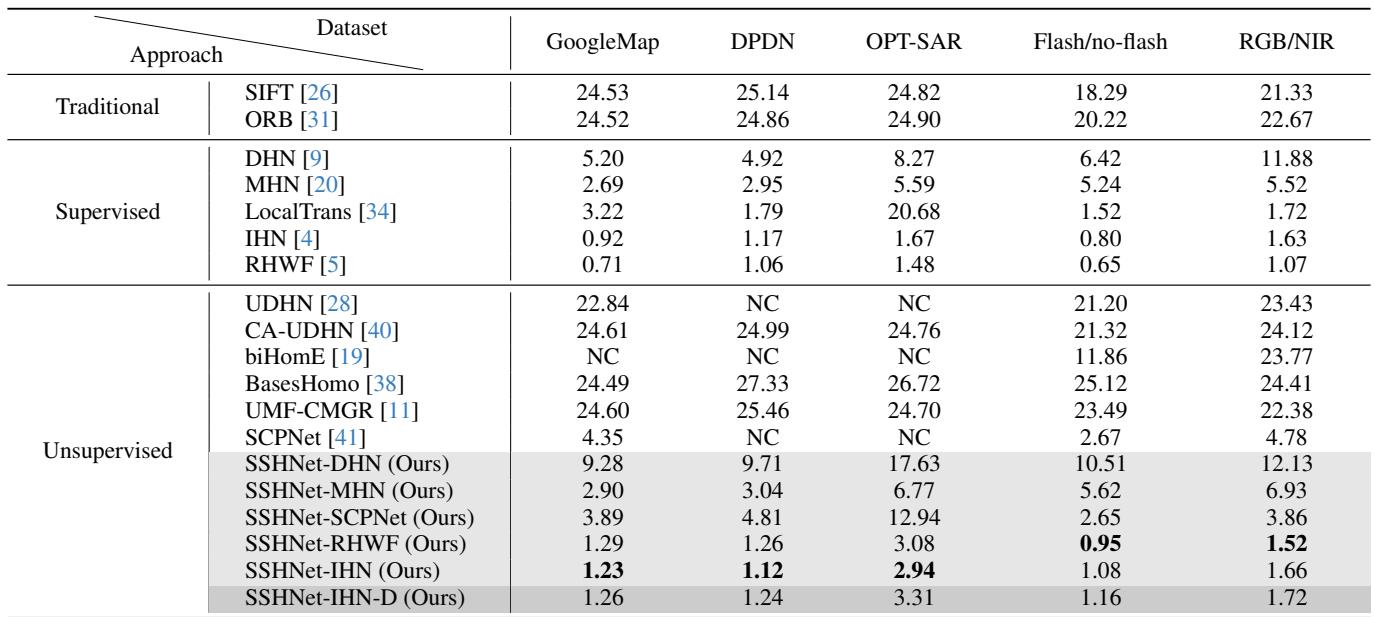
Table 5 lists the Mean Average Corner Error (MACE)—lower is better.
- SSHNet-IHN (SSHNet using an iterative backbone) achieves a score of 2.94 on the difficult OPT-SAR dataset.
- Compare this to MHN (a supervised method), which scored 5.59. SSHNet reduced the error by 47.4% despite having no ground truth labels.
- Compared to the previous unsupervised SOTA, SCPNet (which failed to converge on OPT-SAR), SSHNet is remarkably stable.
Ablation Studies
To prove their components work, the authors stripped the model down.
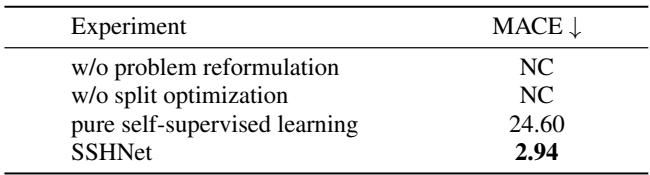
Table 1 confirms that without the reformulation and split optimization, the model simply does not converge (NC).
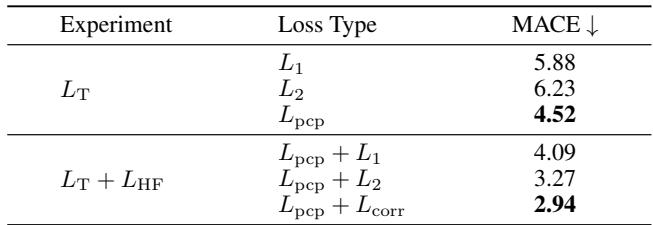
Table 3 shows the impact of the loss functions. Using basic L1 loss for transfer yields an error of 5.88. Adding Perceptual Loss (\(L_{pcp}\)) drops it to 4.52. Adding the specific Homography Feature correlation loss (\(L_{corr}\)) drops it further to 2.94.
Generalization and Real-World Application
One of the most interesting findings came from the Distillation experiments.
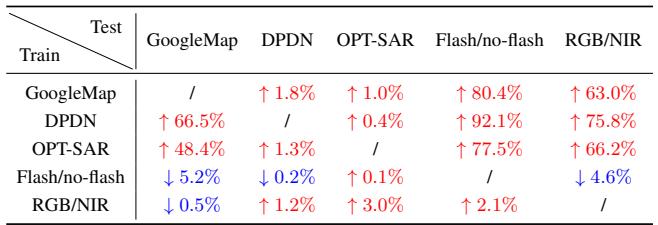
In Table 6, the researchers tested how well the model works when trained on one dataset and tested on another. The Distilled version (SSHNet-IHN-D) often outperformed the full teacher model (SSHNet-IHN) in cross-dataset scenarios (red numbers indicate improvement). By removing the reliance on a specific style-transfer network (which might overfit to the training dataset’s specific “look”), the student network learned more universal geometric features.
Finally, the method was tested on real-world, imperfect data.
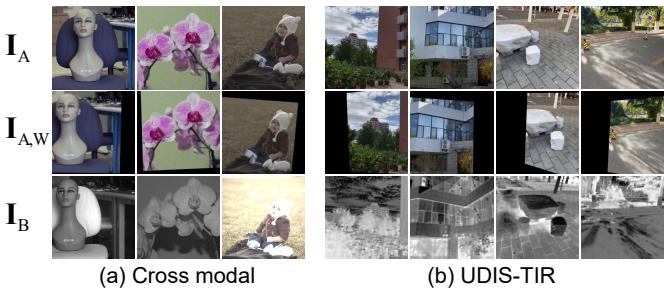
Figure 7 shows the qualitative results. In row (b), we see Thermal (TIR) images aligned with visible images. The alignment is tight, preserving straight lines of buildings and roads, proving the method handles real-world parallax and sensor noise effectively.
Conclusion
SSHNet represents a significant step forward in unsupervised learning. By recognizing that the cross-modal homography problem is essentially two interdependent problems—geometry and style—the researchers formulated a way to solve them iteratively.
Key takeaways for students and practitioners:
- Reformulation is powerful: Sometimes the best way to solve a hard unsupervised problem is to break it into coupled supervised sub-problems.
- Split Optimization: When two networks depend on each other, training them simultaneously can lead to chaos. Alternating optimization stabilizes the learning process.
- Direct vs. Indirect: Moving from indirect content consistency (which causes local minima) to direct supervision via synthetic data and style transfer is the key to high precision.
SSHNet allows us to align data from different sensors with accuracy that previously required expensive manual labeling, opening doors for more autonomous and robust multi-sensor systems.