](https://deep-paper.org/en/paper/2409.19270/images/cover.png)
Imagine standing in the middle of a bustling city street. You hear a cacophony of sounds: a car honking, a child yelling, footsteps on the pavement, and perhaps a distant siren. As a human, your brain performs a miraculous feat called the “cocktail party effect”—you can focus on the child yelling while tuning out the car horn. You can isolate specific sounds from a complex mixture almost instantly.
For machines, however, this task—known as audio source separation—is notoriously difficult. While deep learning has made strides in separating specific sounds (like vocals from a music track), the “open world” presents a much harder challenge. Real-world audio mixtures contain a variable number of sources, many of which a model may never have encountered during training.
How do we build a system that can handle any sound, even ones it hasn’t been explicitly trained to recognize?
Enter OpenSep, a novel framework proposed by researchers at The University of Texas at Austin. OpenSep fundamentally changes the approach to audio separation by introducing a bridge between audio and language. Instead of just training a model to “hear,” they use Large Language Models (LLMs) to give the system “knowledge” about what it is listening to.
In this deep dive, we will explore how OpenSep automates the separation pipeline, leveraging the reasoning capabilities of models like LLaMA to parse complex audio environments without human intervention.
The Problem: The Limits of Current Audio Separators
To understand why OpenSep is a breakthrough, we first need to look at the limitations of the two dominant approaches in the field today: Unconditional and Conditional separation.
Unconditional Separators
Unconditional models attempt to separate a mixture into a fixed number of tracks blindly. They don’t know what they are looking for; they just try to disentangle distinct signals.
- The Flaw: They suffer from “over-separation” (splitting one sound into two artifacts) or “under-separation” (failing to split two sounds). They are also rigid; if the model is built to output three tracks but the audio has four sources, the system fails.
Conditional Separators
Conditional models are more guided. You provide a prompt—text, an image, or a reference audio clip—and the model extracts the matching sound. For example, you might type “separate the dog barking.”
- The Flaw: This requires manual intervention. A user must know what is in the audio to ask for it. Furthermore, these models struggle with unseen classes. If the model was trained on “dogs” and “cars,” but encounters a “flute,” it often fails to separate the flute because it lacks a learned representation for that class.
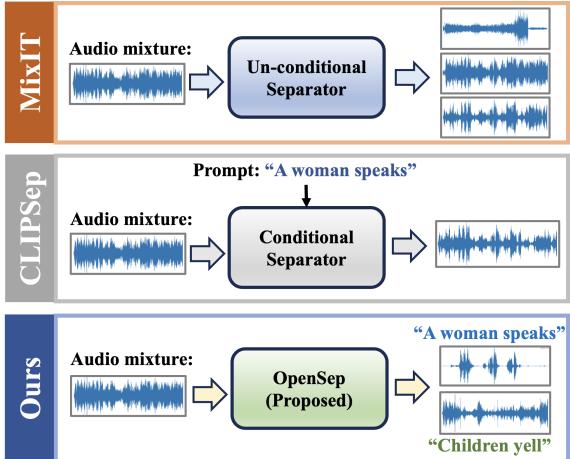
As shown in Figure 1, existing methods essentially force a trade-off between automation and precision. OpenSep removes this trade-off. It fully automates the parsing and separation flow, handling varying numbers of noisy sources, even if those sources were not part of the training set.
The OpenSep Methodology: A Three-Stage Pipeline
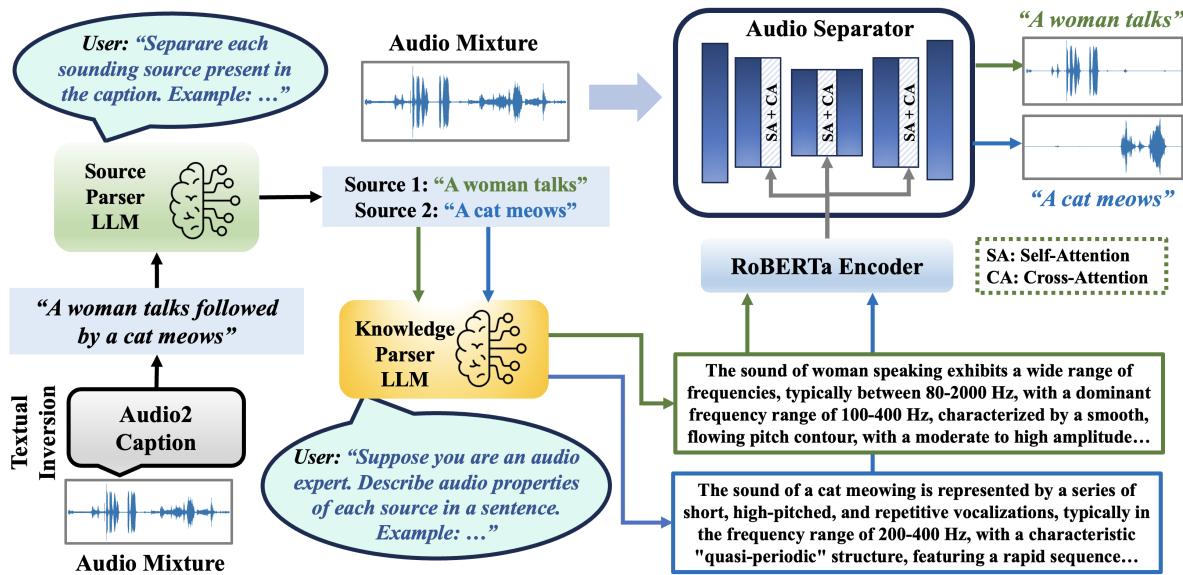
OpenSep creates a fully automated pipeline by combining audio captioning, LLM reasoning, and text-conditioned separation. The core idea is to translate the raw audio signal into a rich textual description, use an LLM to “understand” the acoustic properties of the described sounds, and then use those details to guide the separation.
The architecture, illustrated in Figure 2, operates in three distinct phases:
- Textual Inversion (Source Detection)
- Knowledge Parsing (Contextual Enrichment)
- Text-Conditioned Separation (Extraction)
Phase 1: Source Parsing with Textual Inversion
The first challenge in open-world separation is figuring out what is in the mixture without a human listening to it. OpenSep solves this using Textual Inversion.
The system feeds the noisy audio mixture into an off-the-shelf audio captioning model (specifically, a CLAP-based model). This model “listens” to the mixture and generates a natural language description, such as: “A woman talks followed by a cat meows.”
This step effectively converts the signal processing problem into a natural language processing (NLP) problem. Instead of trying to detect source boundaries in the waveform blindly, the system now has a semantic summary of the content.
Once the caption is generated, an Instruction-Tuned LLM (LLaMA-3-8b) acts as a Source Parser. It takes the caption and breaks it down into distinct entities.
- Input Caption: “Children yelling while a dog is barking in the background.”
- LLM Output: “Source 1: Children yelling. Source 2: Dog barking.”
This automation eliminates the need for a human user to manually identify and type out the sources they want separated.
Phase 2: Knowledge Parsing with LLMs
This is arguably the most innovative component of OpenSep.
A traditional conditional separator might receive the prompt “dog barking.” However, simply knowing the class name “dog” provides limited guidance, especially if the separation model hasn’t seen many dogs during training.
OpenSep assumes that while the separator might be unfamiliar with a specific sound, the LLM possesses vast “world knowledge” about how things sound. The researchers treat the LLM as an audio expert. They use few-shot prompting to ask the LLM to describe the audio properties of the identified sources.
For a source identified as “Cat meows,” the LLM might output a description focusing on:
- Frequency: 200–400 Hz (fundamental frequency).
- Timbre: Quasi-periodic structure.
- Envelope: Distinct attack and decay.
We can see concrete examples of this “Knowledge Parsing” in Table 9 below. Notice how the LLM provides specific frequency ranges and textural descriptions for diverse sounds like alarm clocks, waterfalls, and chalk on a blackboard.
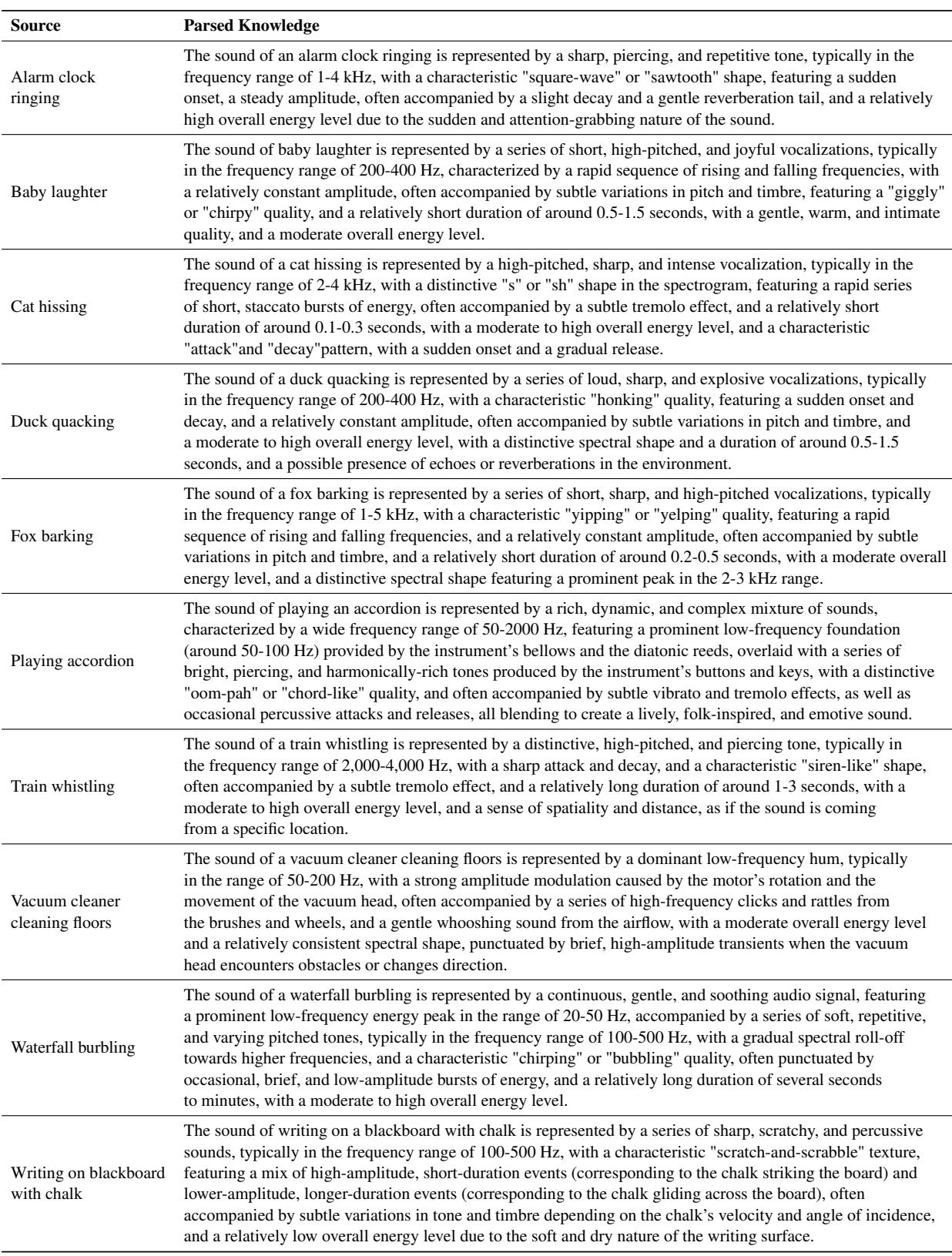
By enriching the prompt from a simple class label (“Cat”) to a detailed acoustic description, OpenSep provides the separation network with “anchors.” Even if the network has never seen a specific “cat” example, it likely understands “400 Hz” and “quasi-periodic,” allowing it to separate the sound based on its physical properties described in the text.
Phase 3: The Text-Conditioned Audio Separator
Armed with these rich, LLM-generated descriptions, OpenSep moves to the actual signal processing.
The separation model is a U-Net architecture, a standard choice for image and audio segmentation tasks. However, this U-Net is modified to be text-conditioned.
- Encoding: The detailed text description is encoded using a RoBERTa encoder. Because the descriptions are detailed, the model uses a longer context window (512 tokens) than typical systems.
- Attention Mechanisms: The U-Net doesn’t just process audio; it constantly checks the text. The researchers implemented Self-Attention (SA) and Cross-Attention (CA) layers within the U-Net blocks. The Cross-Attention layer specifically aligns the audio features (spectrogram) with the text features (embeddings of the acoustic description).
- Masking: The model predicts a “mask”—a filter that, when applied to the original noisy spectrogram, isolates the target sound.
Enhanced Training: The Multi-Level Mix-and-Separate Framework
The architecture is powerful, but deep learning models are only as good as their training strategy. The authors identified that standard training methods (like simple “mix-and-separate”) weren’t sufficient for aligning the complex text descriptions with the audio.
To fix this, they proposed a Multi-Level Extension of the mix-and-separate framework, illustrated in Figure 3.

Here is how the training logic works:
- Synthetic Mixing: The system takes four distinct clean audio sources (\(x_1, x_2, x_3, x_4\)).
- Hierarchical Mixtures:
- It creates two pairs of mixtures: \(y_1\) (mixing sources 1 & 2) and \(y_2\) (mixing sources 3 & 4).
- It creates a “Master Mixture” \(z\) by combining \(y_1\) and \(y_2\).
- Multi-Target Training: The model isn’t just asked to pull \(x_1\) out of \(z\). It is trained to perform tasks at different levels of hierarchy. It learns to separate the single source \(x_1\) and the sub-mixture \(y_1\) from the master mixture \(z\).
This hierarchical approach forces the model to learn a deeper alignment between the text and the audio. It learns what defines a single sound and what defines a composite sound, making it robust against the messy, variable-source nature of the real world.
Experiments and Results
The researchers evaluated OpenSep against several State-of-the-Art (SOTA) baselines, including MixIT (unconditional), CLIPSep, and AudioSep (conditional). They tested on three benchmark datasets: MUSIC (musical instruments), VGGSound (general open-world sounds), and AudioCaps (natural mixtures).
The primary metric used was SDR (Signal-to-Distortion Ratio). In simple terms, a higher SDR means the separated audio is cleaner and closer to the original recording.
Performance on Seen Classes
First, they tested scenarios where the model had seen the types of sounds during training (e.g., training on violins, testing on new violin clips).
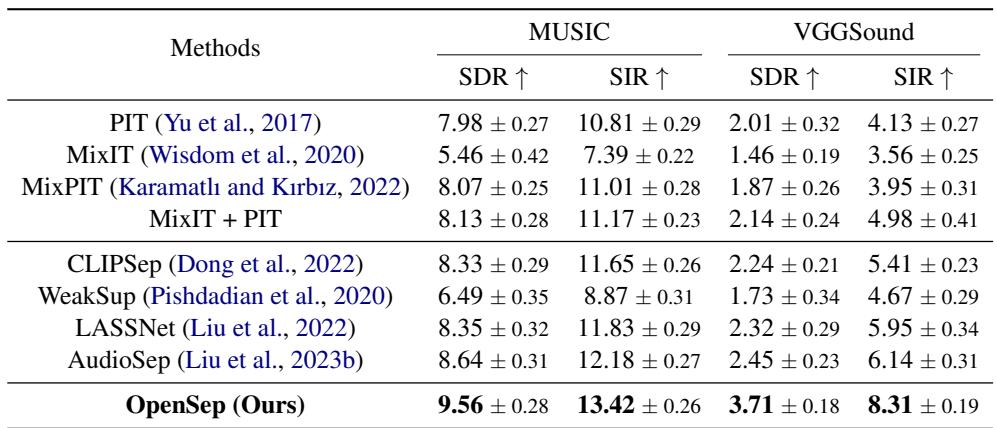
As seen in Table 1, OpenSep outperforms all baselines. In the VGGSound dataset, it achieved an SDR of 3.71, compared to 2.45 for AudioSep. This indicates that even for familiar sounds, the rich textual guidance helps the model do a better job.
The Real Test: Unseen Classes
The true power of OpenSep lies in its ability to generalize. The researchers trained the models on only 50% of the available classes and tested them on the remaining 50%. This simulates an “open world” where the model encounters entirely new sounds.
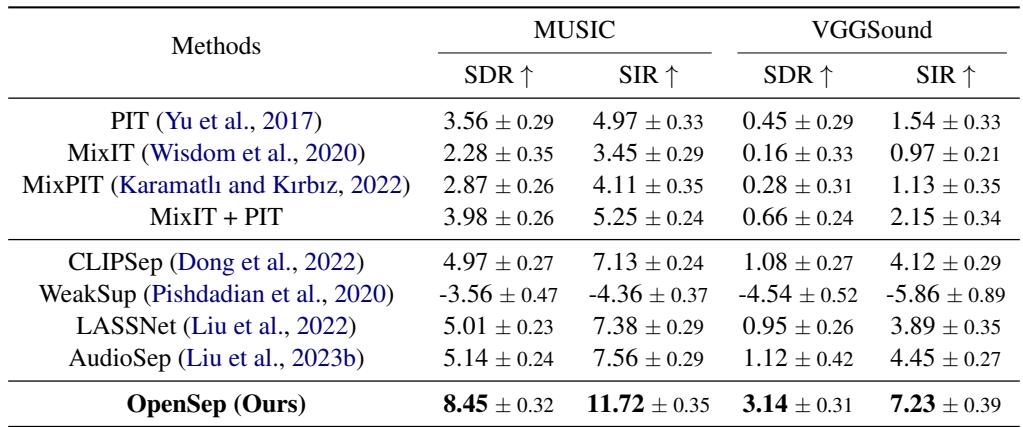
Table 2 shows dramatic results. While baseline models like CLIPSep and AudioSep saw their performance collapse (dropping by roughly 50%), OpenSep remained robust. On VGGSound, OpenSep achieved an SDR of 3.14, nearly triple the score of CLIPSep (1.08).
This confirms the hypothesis: Describing a sound allows the model to separate it, even if it has never “heard” it before.
Visualizing the Separation
Numbers are useful, but spectrograms tell the visual story of audio separation.
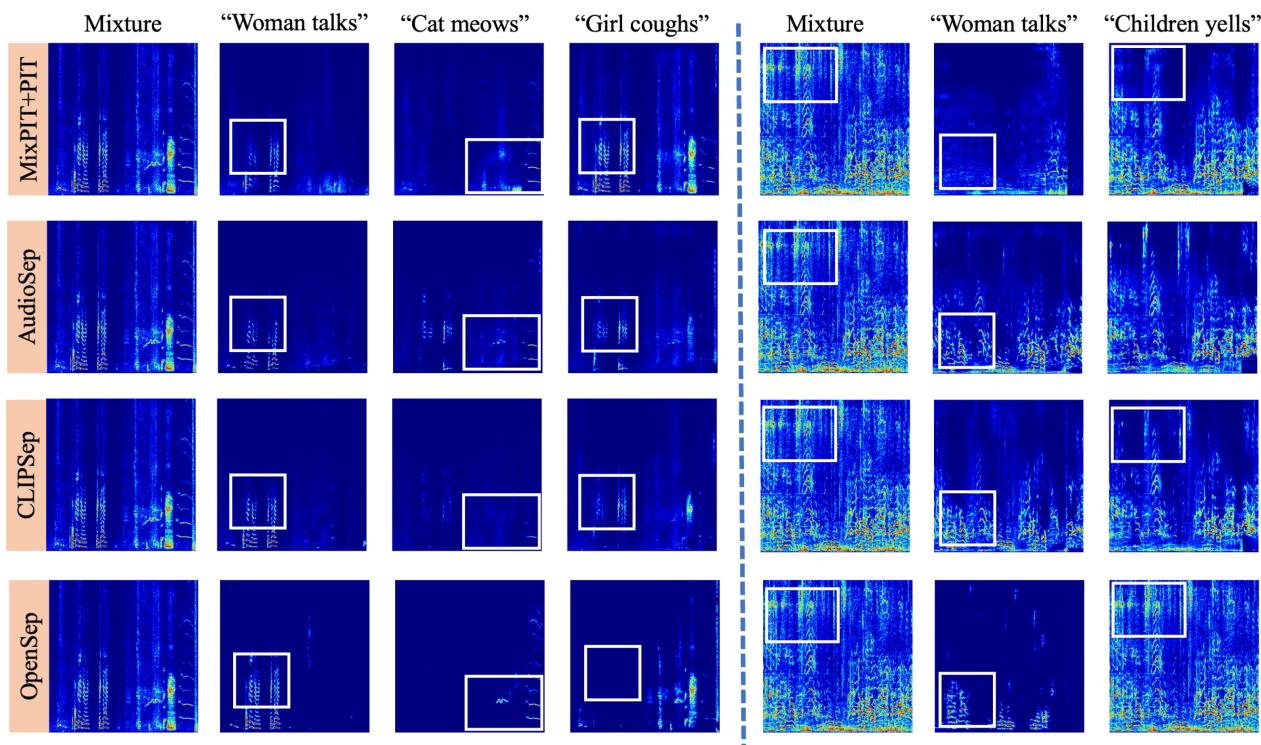
In Figure 4, look at the column for OpenSep compared to MixPT+PIT and CLIPSep.
- Left Panel: In a mixture of a woman talking, frying food, and music, other models show “spectral overlap” (the white blobs of one sound bleeding into another). OpenSep’s output is crisp, preserving the distinct frequency bands of the speech while removing the frying noise.
- Right Panel: Separating a woman’s voice from yelling children is incredibly hard because both are human vocalizations with similar frequency ranges. OpenSep manages to reduce the background noise significantly better than the competitors.
Ablation: Do We Really Need the LLM Knowledge?
You might wonder: is the detailed description actually helping, or is the model just really good? The researchers performed an ablation study (removing parts of the system to see what breaks).
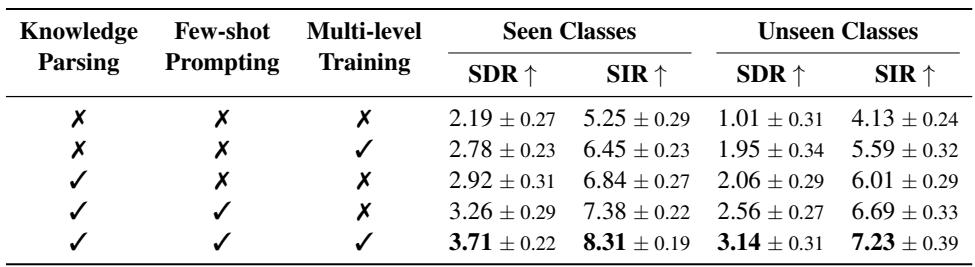
Table 4 confirms that every piece of the puzzle matters.
- Using simple class names (No Knowledge Parsing) results in an SDR of 2.19.
- Adding the LLM-generated descriptions (Knowledge Parsing) jumps the score to 2.92.
- Adding the multi-level training brings it to the final 3.71. This proves that the “verbose” descriptions provided by the LLM are carrying significant weight in the separation process.
Conclusion and Implications
OpenSep represents a significant step forward in audio processing. By integrating the semantic reasoning of Large Language Models with signal processing, the researchers have created a system that approaches audio separation much like a human does: by understanding the context and characteristics of what it hears.
Key Takeaways:
- Automation: Textual inversion allows the system to “listen” and categorize sources without human prompts.
- Generalization: Leveraging LLM “world knowledge” (describing frequencies and timbres) allows the model to separate sounds it has never encountered during training.
- Accuracy: The multi-level training framework ensures a tight alignment between the text descriptions and the raw audio, resulting in cleaner separation with less interference.
The implications for this are vast. From hearing aids that can dynamically tune into specific sounds described by the user, to automated video editing tools that can strip background noise from amateur footage, OpenSep paves the way for machines that don’t just record sound, but truly understand it.