](https://deep-paper.org/en/paper/2409.19627/images/cover.png)
In the digital age, audio is everywhere. From viral TikTok sounds to proprietary music tracks and AI-generated voiceovers, audio files are shared, remixed, and unfortunately, stolen at an unprecedented rate. This brings us to the crucial concept of Digital Watermarking.
Imagine writing your name in invisible ink on a valuable document. That’s essentially what digital watermarking does for media—it embeds hidden information (like copyright ownership) directly into the signal. The catch? It must be imperceptible to the human ear but robust enough to survive compression, noise, and editing.
While Deep Learning has given us powerful “Neural Watermarking” tools, they suffer from a major bottleneck: efficiency. Finding where a watermark starts in a long audio clip (a process called locating) is traditionally slow and computationally heavy.
In this post, we are diving deep into a recent paper, “IDEAW: Robust Neural Audio Watermarking with Invertible Dual-Embedding.” We will explore how the researchers used a clever “dual-stage” architecture to make watermarking not just robust, but incredibly fast to locate.
The Problem: The “Locating” Bottleneck
To understand why IDEAW is necessary, we first need to look at how neural audio watermarking usually works.
In a typical setup, a neural network (the Embedder) takes an audio segment and weaves a binary message (the watermark) into it. Another network (the Extractor) retrieves it. This works great if you know exactly where the watermark starts.
But in the real world, audio gets trimmed, spliced, or streamed. The extractor has no idea where the “start” is. To solve this, watermarking systems embed a Synchronization Code (or Locating Code)—a specific pattern of bits that signals “The message starts here!”
The Traditional Struggle
In existing methods, the synchronization code and the actual payload message are bundled together and embedded using one heavy neural network.
To find the watermark, the extractor has to slide a window across the audio, attempting to decode the entire heavy bundle at every single step just to check for the synchronization code. This is like trying to unlock a door by re-assembling the entire lock mechanism every second. It’s computationally expensive and slow.
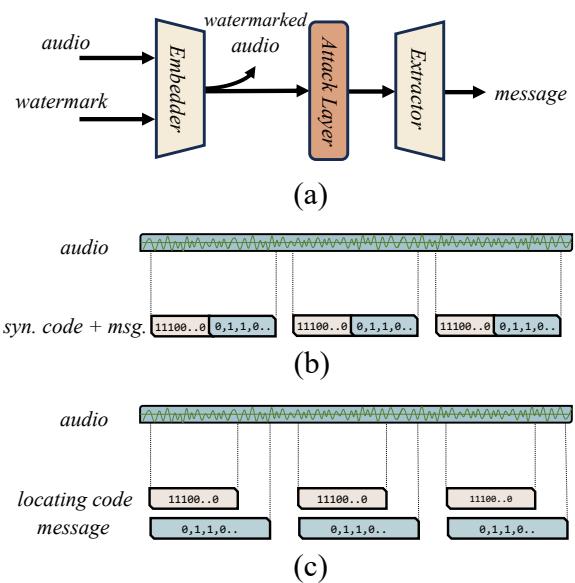
Figure 1 above illustrates this difference:
- (b) Existing Methods: You see the synchronization code (Sync) and Message combined. You have to process everything to find anything.
- (c) IDEAW Strategy: This is the new approach. They separate the Locating Code from the Watermark Message vertically.
The Solution: IDEAW
The researchers propose IDEAW (Invertible Dual-Embedding Audio Watermarking). The core philosophy is simple but effective: Don’t use a sledgehammer to crack a nut.
Instead of one giant network doing everything, they use a Dual-Stage Invertible Neural Network (INN).
- Stage 1 (Heavy Lifting): Embeds the complex Watermark Message.
- Stage 2 (Lightweight): Embeds the Locating Code on top of the result.
When extracting, the system only runs the lightweight Stage 2 extractor to scan for the locating code. Only when it finds a match does it trigger the heavier Stage 1 extractor to read the message. This drastically reduces the time it takes to find a watermark.
Deep Dive: The Architecture
Let’s look at the engine under the hood. IDEAW uses Invertible Neural Networks (INNs).
Why Invertible?
Standard neural networks are often “lossy”—information is lost as you move from input to output. INNs are different. They are mathematically designed so that if you run them forward, you get an output, and if you run them backward, you get the exact original input back. This is perfect for watermarking, where you want to retrieve the exact message you hid.
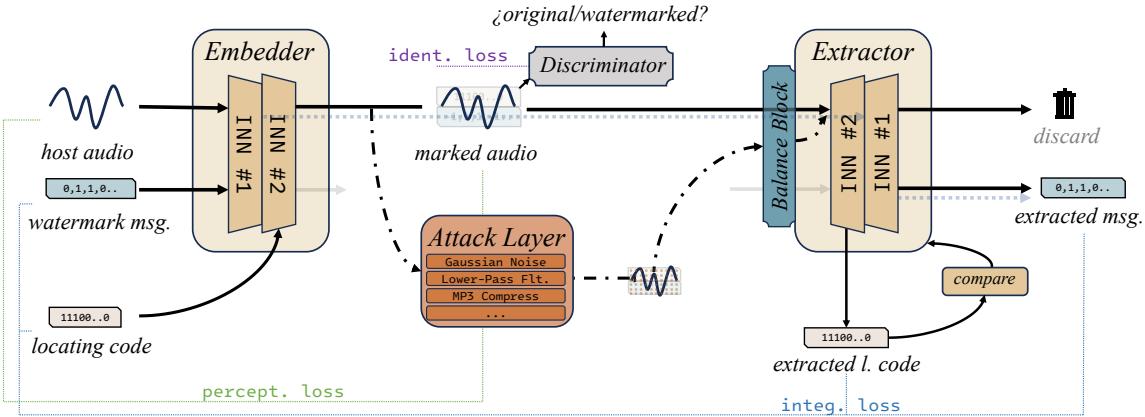
As shown in Figure 2, the architecture consists of:
- Embedder:
- Takes the Host Audio and the Watermark Message.
- Passes them through INN #1 (the message layer).
- Takes that result and the Locating Code.
- Passes them through INN #2 (the locating layer).
- Attack Layer: Simulates real-world damage (noise, MP3 compression) to train the model to be tough.
- Extractor: Reverses the process. First, it extracts the Locating Code using INN #2 (Reverse). If valid, it extracts the Message using INN #1 (Reverse).
The Invertible Block
At the microscopic level, these INNs are made of “Invertible Blocks.” These blocks split the data into two streams—an Audio Stream and a Watermark Stream—and mix them using mathematical functions that are easily reversible.
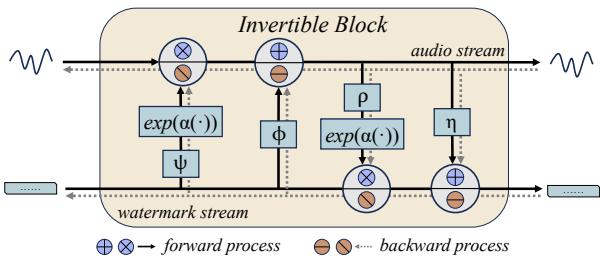
The math governing a single block looks like this:
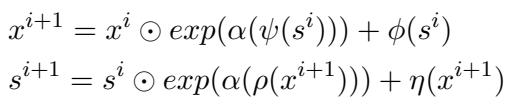
Here, \(x\) is the audio data and \(s\) is the secret message data. The functions \(\psi, \phi, \rho, \eta\) are neural networks. The beauty of this equation is that even though the neural networks inside can be complex, the overall structure allows us to mathematically solve for \(x^i\) and \(s^i\) given \(x^{i+1}\) and \(s^{i+1}\).
The Dual-Embedding Process
The embedding process can be formalized as passing the data through the two INNs sequentially:

Here, the inner function \(INN_{\#1}\) embeds the message (\(m\)) into the audio (\(x\)), and the outer function \(INN_{\#2}\) embeds the locating code (\(c\)) into the result.
Conversely, the extraction process peels the layers back in reverse order:

Notice how the extractor first handles the outer layer (Locating Code) and then the inner layer (Message). This hierarchy is what allows for the rapid scanning capability.
The Challenge: Robustness vs. Symmetry
One of the hardest parts of neural watermarking is surviving attacks. If someone compresses the audio into a low-quality MP3, the pixel-perfect math of the INN gets disrupted. The input to the extractor is no longer the exact output of the embedder.
This breaks the symmetry required for Invertible Networks to work perfectly.
The Balance Block
To fix this, the researchers introduced a Balance Block (visible in Figure 2 before the Extractor).
The Balance Block is a specialized module trained to “clean up” the attacked audio. It attempts to map the distribution of the damaged audio back to a distribution that the Invertible Network expects. It essentially acts as a bridge, restoring the symmetry so the INN can do its job of extraction, even after the audio has been messed with.
Training the Model
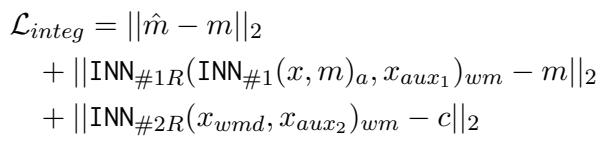
Training this beast requires balancing three different goals. The researchers used a composite loss function to guide the network:

Let’s break down the components:
Integrity Loss (\(\mathcal{L}_{integ}\)): This ensures the extracted message matches the original message. If the watermark is unreadable, the model fails.
Perceptual Loss (\(\mathcal{L}_{percept}\)): This ensures the watermarked audio sounds like the original. We don’t want the watermark to sound like static noise.

Identity/Discriminator Loss (\(\mathcal{L}_{ident}\)): The model uses a Discriminator (a separate AI) that tries to tell if audio is watermarked or not. The Embedder tries to fool this Discriminator.


Experiments and Results
So, does it actually work? The researchers tested IDEAW on speech (VCTK dataset) and music (FMA dataset).
1. Imperceptibility: Is it invisible?
The primary requirement is that the watermark shouldn’t ruin the audio quality.
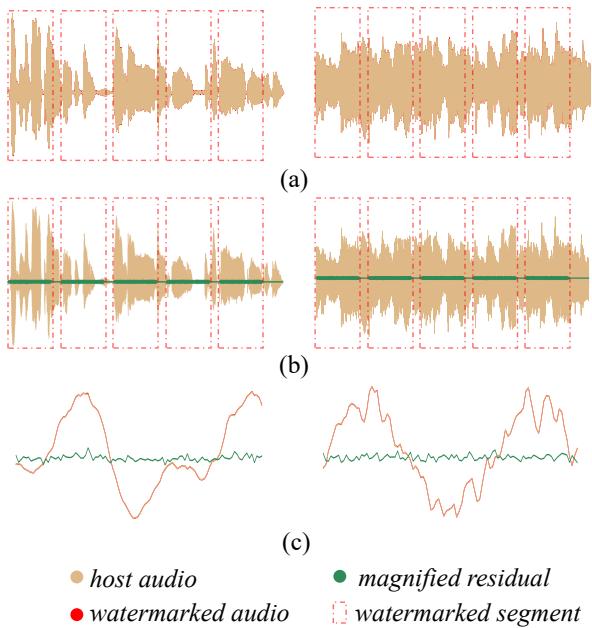
In Figure 4, you can see the waveforms. Panel (a) shows the original and watermarked audio overlapping almost perfectly. Panel (b) shows the “residual” (the watermark signal) magnified 10 times—it is tiny compared to the audio signal.
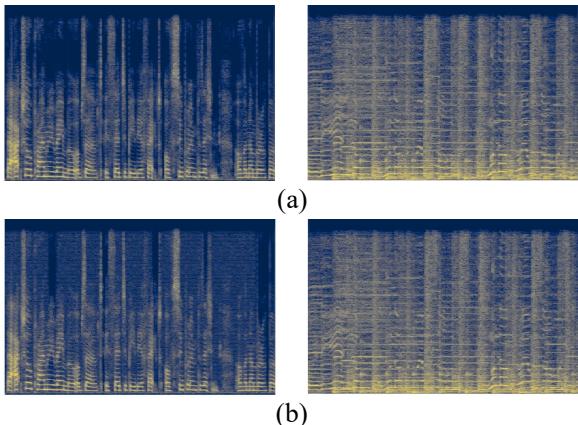
Figure 5 shows the spectrograms (visual representations of frequencies). The watermarked version (b) looks virtually identical to the original (a), confirming that the watermark is well-hidden in the frequency domain.
2. Robustness: Can it survive attacks?
The researchers subjected the watermarked audio to a battery of attacks, including Gaussian Noise, MP3 Compression, and Time Stretching.
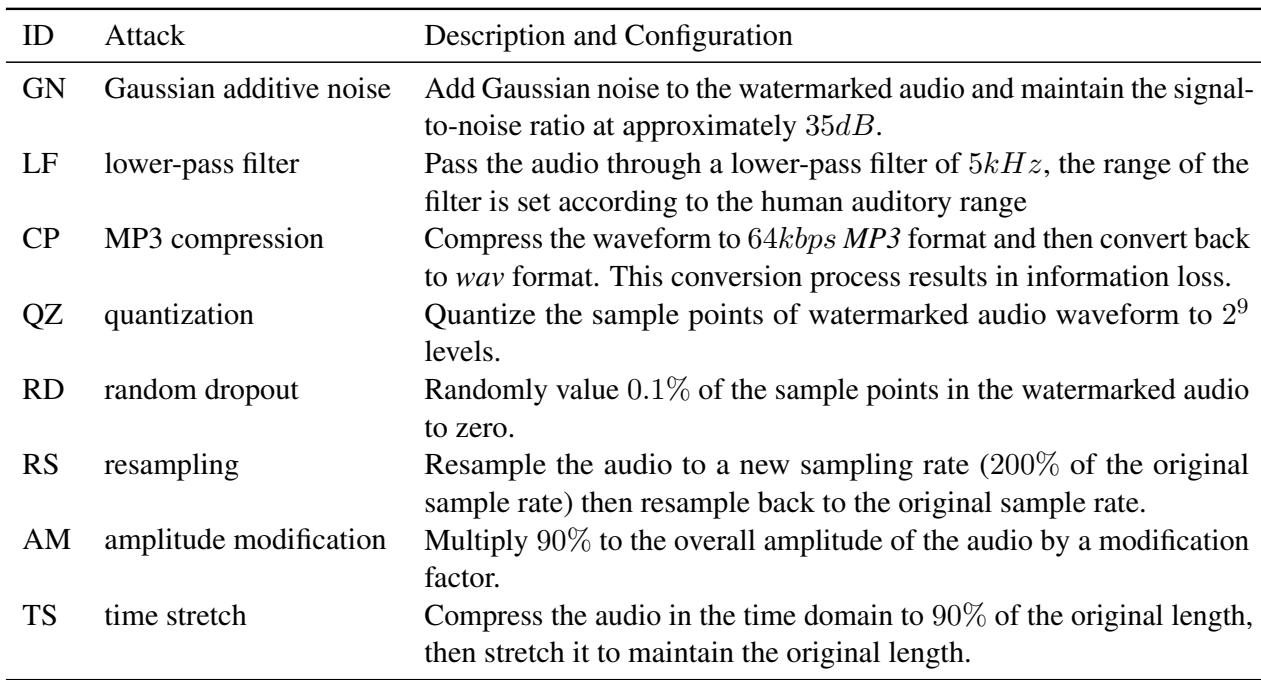
Table 5 (above) details these attacks. For example, “MP3 Compression” involved crushing the audio down to 64kbps—a quality level that usually destroys hidden data.
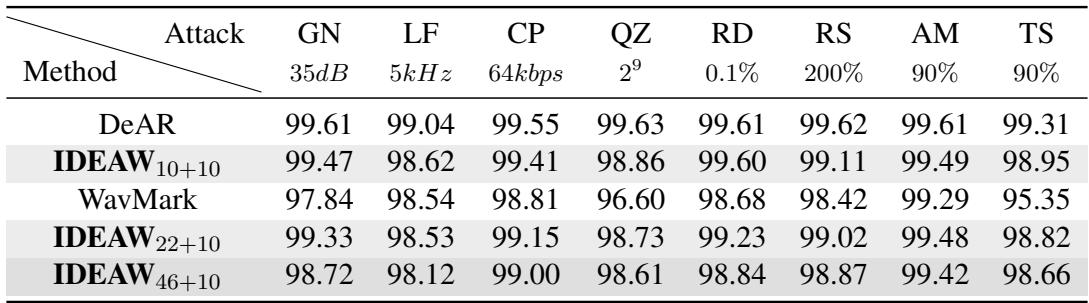
Table 2 (above) compares IDEAW against baselines like “DeAR” and “WavMark.”
- ACC (Accuracy): IDEAW maintains extremely high accuracy (over 98-99%) across almost all attacks.
- Capacity: Crucially, IDEAW achieves this robustness while carrying more data (up to 56 bits per second compared to DeAR’s 8.8 bits).
3. Efficiency: The Locating Speed
This is the main victory for IDEAW. Because of the dual-stage design, the locator only needs to run the lightweight network.
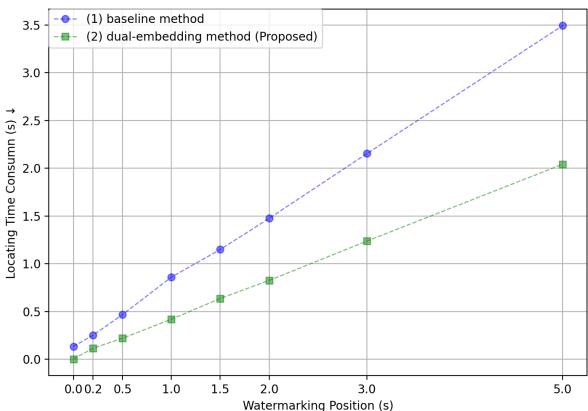
Figure 6 shows the time consumption. The Green Line (IDEAW) is significantly lower than the Blue Line (Baseline/Standard Method). As the search goes on, the gap widens. The proposed method reduces time overhead by approximately 40% to 50%.
4. Ablation Study: Did the components help?
The researchers removed parts of the model to see if they were actually necessary.
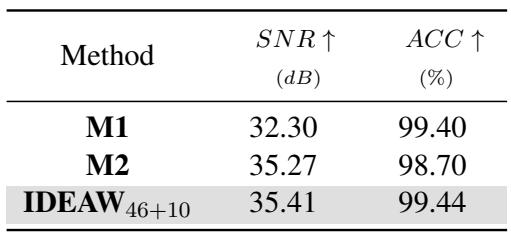
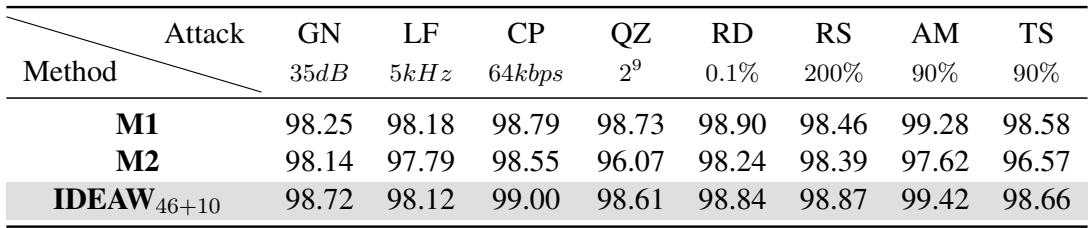
- M1 (No Discriminator): The audio quality (SNR) dropped significantly (Table 3), proving the Discriminator is needed for imperceptibility.
- M2 (No Balance Block): The robustness against quantization (QZ) and time stretch (TS) dropped (Table 4), proving the Balance Block is essential for surviving attacks.
Conclusion
The IDEAW paper presents a significant step forward in neural audio watermarking. By rethinking the architecture and splitting the “finding” task from the “reading” task, the authors created a system that is:
- Fast: Efficient locating via the Dual-Embedding strategy.
- Robust: Capable of withstanding heavy MP3 compression and noise thanks to the Balance Block.
- High Capacity: Able to store more data than previous state-of-the-art methods.
For students and researchers in signal processing, IDEAW demonstrates a powerful lesson: sometimes the best way to solve a complex problem is to break it into smaller, specialized stages rather than trying to force a single network to do it all. As generative AI continues to grow, efficient watermarking like this will become the standard for protecting intellectual property in the digital soundscape.