](https://deep-paper.org/en/paper/2409.19715/images/cover.png)
Introduction
We are living in the golden age of AI-assisted programming. Large Language Models (LLMs) like GPT-4 and DeepSeekCoder have become indispensable tools for developers, capable of generating complex functions and boilerplate code in seconds. However, anyone who has used these tools knows a painful truth: they are not perfect.
When an LLM generates buggy code, the natural next step is to ask it to fix it. This process—code editing—is crucial. But simply generating a fixed version of the code isn’t always enough, especially for educational purposes or complex debugging. We need the model to explain what went wrong and how to fix it. We need high-quality Natural Language (NL) Feedback.
Currently, there is a massive gap between closed-source giants (like GPT-4) and open-source models when it comes to providing helpful feedback. While GPT-4 can often act as a seasoned mentor, open-source models frequently hallucinate, give vague advice, or fix the code silently without explaining the logic.
This brings us to a significant research contribution: COFFEE-GYM.
As illustrated in Figure 1 above, the difference between “Incorrect Feedback” and “Correct Feedback” is the difference between a broken script and a working solution. The researchers behind COFFEE-GYM have developed a comprehensive Reinforcement Learning (RL) environment designed to teach open-source models how to provide that critical, correct feedback.
In this deep dive, we will explore how COFFEE-GYM solves the data scarcity problem, how it invents a new way to measure “helpfulness,” and how it uses RL to align models with actual debugging success.
The Problem with Current Feedback Models
Before we look at the solution, we need to understand why training open-source feedback models is so difficult.
The standard approach to training these models is Supervised Fine-Tuning (SFT). You take a dataset of buggy code and the corresponding corrected code, and you train the model to predict the fix. While this helps the model learn syntax, it doesn’t necessarily teach it to understand the causality of the error.
There are three main hurdles preventing SFT from producing great feedback models:
- Data Scarcity & Quality: Most datasets are machine-generated. They contain simple, repetitive errors that don’t reflect the complex, messy bugs humans actually write.
- Lack of Pairwise Data: To train a robust model (especially for RL), you need examples of good feedback and bad feedback for the same error. This data rarely exists in the wild.
- The Alignment Gap: The biggest issue is that SFT optimizes for probability, not helpfulness. A model might generate feedback that sounds linguistically plausible but doesn’t actually help a developer (or another model) fix the bug.
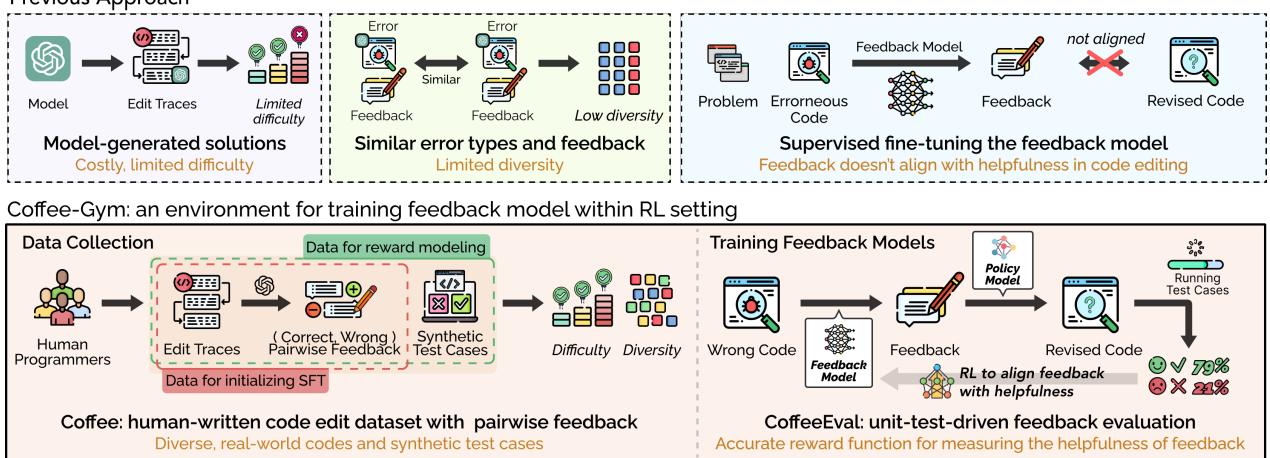
As shown in Figure 2, the previous approach relies on limited model-generated solutions and simple SFT. COFFEE-GYM proposes a radical shift: an RL-based environment that utilizes diverse human data and a reward function explicitly designed to measure debugging success.
Part 1: The COFFEE Dataset
The first pillar of this work is the dataset itself, aptly named COFFEE (which stands for Code Fixing with Feedback).
The researchers recognized that synthetic, machine-generated errors were too easy. To get real-world complexity, they turned to competitive programming platforms. In these environments, humans submit code, fail hidden test cases, edit their code, and submit again until they succeed. These “edit traces” are gold mines for learning how to debug.
The Data Collection Pipeline
Building COFFEE wasn’t just about scraping code; it required a sophisticated pipeline to transform raw submission histories into a training set for AI.
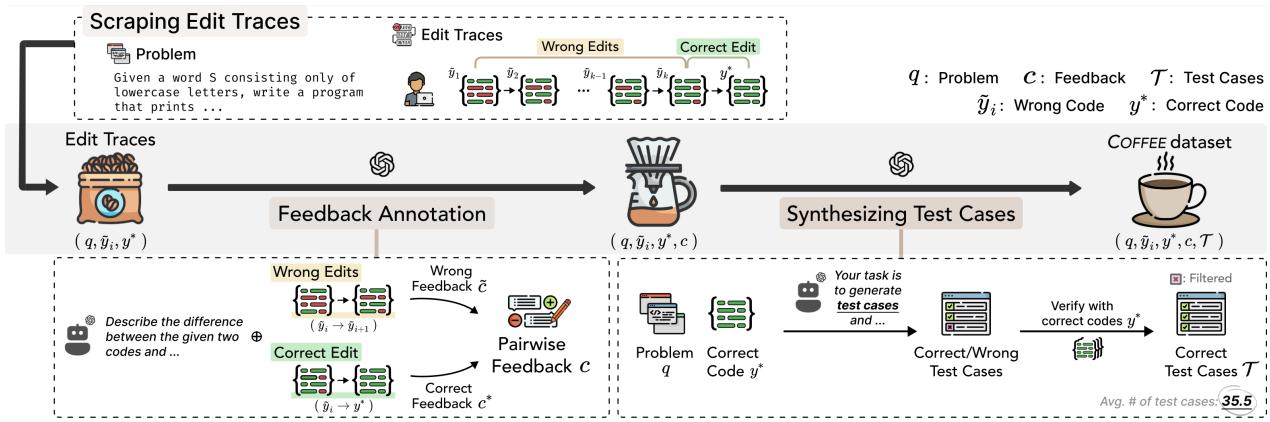
As detailed in Figure 3, the process involves three key steps:
- Scraping Edit Traces: They collected sequences where a user submitted incorrect code (\(\tilde{y}\)), followed by more attempts, eventually leading to a correct solution (\(y^*\)). This captures the human thought process during debugging.
- Annotating Feedback: This is crucial. Since the raw data doesn’t contain natural language explanations, the researchers used GPT-3.5 to generate feedback describing the transition from the wrong code to the correct code. Crucially, they also generated incorrect feedback (describing transitions between two wrong submissions) to create the positive/negative pairs needed for Reinforcement Learning.
- Synthesizing Test Cases: To objectively measure if code works, you need unit tests. The researchers generated roughly 35 test cases per problem to ensure robust evaluation.
Why Human Data Matters
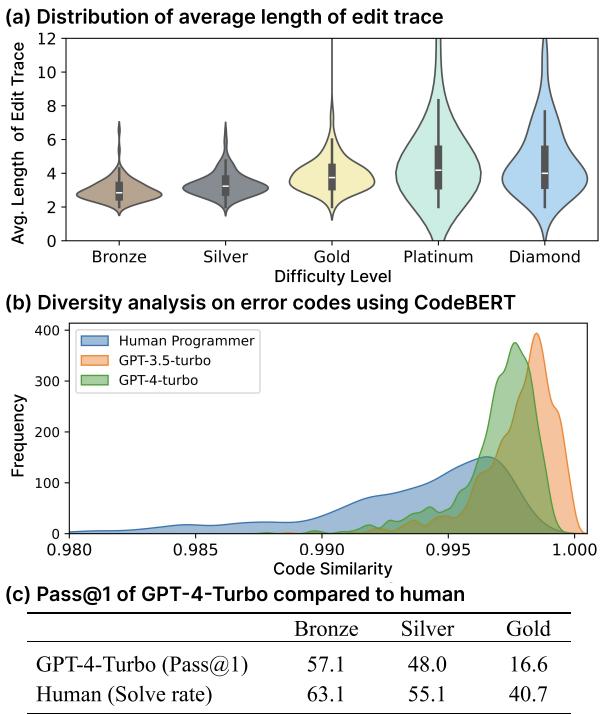
The resulting dataset is significantly more diverse than previous machine-generated sets.
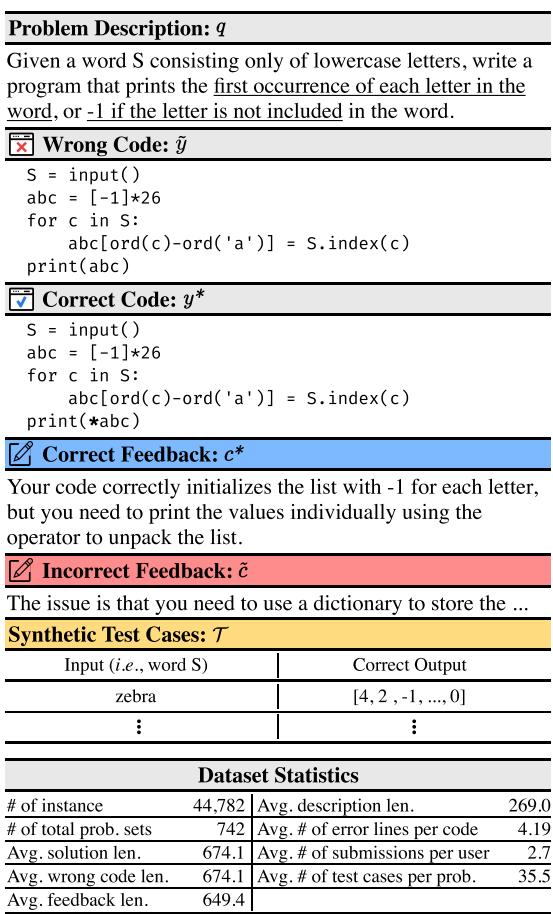
Figure 4 provides a concrete example. The “Wrong Code” correctly initializes a list but fails to print it correctly. The “Correct Feedback” identifies the specific logical gap (unpacking the list). The dataset contains nearly 45,000 such instances.
Analysis of the dataset (Figure 5 from the original paper, shown below) reveals that human errors are distributed across various difficulty levels and code structures, whereas machine-generated errors tend to cluster around specific patterns. This diversity ensures the model learns to handle the messy reality of programming.
Part 2: COFFEE-EVAL (The Reward Function)
Having a dataset is great, but how do you train a model to be “helpful”? In Reinforcement Learning, you need a Reward Function—a score that tells the model “good job” or “try again.”
Existing methods often use a powerful LLM (like GPT-4) to grade the feedback. This is known as “LLM-as-a-Judge.” While effective, it is expensive, slow, and subjective. It tells you if the feedback looks good, not if it works.
The researchers introduced COFFEE-EVAL, a unit-test-driven reward mechanism. The core philosophy is simple: Feedback is helpful if and only if it helps fix the code.
The Mechanics of COFFEE-EVAL
COFFEE-EVAL calculates a reward score by simulating the correction process. Here is how it works:
- Input: A problem description (\(q\)), wrong code (\(\tilde{y}\)), and the generated feedback (\(\hat{c}\)).
- The Editor: These inputs are fed into a separate “Editor Model” (\(\phi\)).
- The Fix: The Editor tries to fix the code based on the feedback.
- The Test: The fixed code is run against the synthetic test cases.
- The Score: The reward is the percentage of passed test cases.
Mathematically, the COFFEE-EVAL score is defined as:
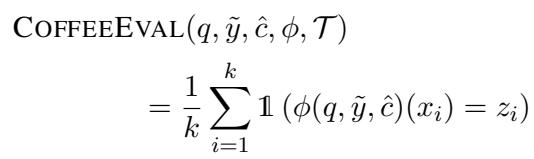
Here, \(\mathbb{1}\) is an indicator function that equals 1 if the edited code passes the test case (\(x_i, z_i\)) and 0 otherwise.
The “Faithful” Editor
There is a catch. Modern Code LLMs are so smart that they might fix the code ignoring the feedback. If the feedback is “delete everything,” but the model sees the bug and fixes it anyway, the feedback gets a high score it doesn’t deserve.
To prevent this, the researchers trained a Faithful Code Editor. This editor is fine-tuned to be obedient. It is trained on pairs of (Correct Code, Correct Feedback) AND (Wrong Code, Wrong Feedback).
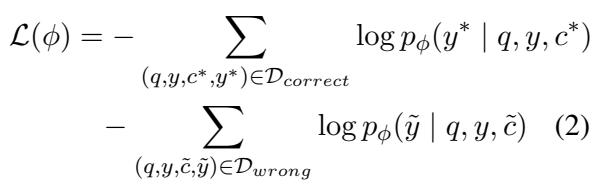
The equation above shows the loss function for the editor. It is penalized if it doesn’t produce the wrong code when given wrong feedback. This ensures that the editor relies heavily on the provided feedback, making it a reliable instrument for measuring feedback quality.
Validating the Reward Model
Does COFFEE-EVAL actually work? The researchers compared it against “G-Eval” (asking GPT-4 to rate feedback on a 1-5 scale).

Table 2 shows the correlation between the automated scores and ground-truth helpfulness. DeepSeek-COFFEE-EVAL (Ours) achieves the highest Pearson correlation (0.149) and the lowest Mean Squared Error. Interestingly, it correlates better with actual code fixing than even GPT-4-Turbo’s G-Eval. This proves that measuring execution results is a more reliable proxy for helpfulness than semantic analysis alone.
Part 3: Training with Reinforcement Learning
With the COFFEE dataset providing the training examples and COFFEE-EVAL providing the reward signal, the researchers built COFFEE-GYM.
This environment allows them to apply advanced Reinforcement Learning techniques, specifically PPO (Proximal Policy Optimization) and DPO (Direct Preference Optimization).
The Setup
The goal is to train a feedback model (\(\theta\)) that takes a problem and wrong code, and outputs helpful feedback.
- SFT Initialization: First, the model is supervised fine-tuned on the COFFEE dataset to learn the basic format of feedback.
- RL Optimization:
- PPO: The model generates feedback. COFFEE-EVAL scores it (by running the faithful editor). The model updates its weights to maximize this score.
- DPO: The model is trained on pairs of feedback where one is ranked higher than the other (based on COFFEE-EVAL scores), allowing the model to optimize its policy directly without an explicit reward model loop.
The PPO objective function used is the standard formulation:
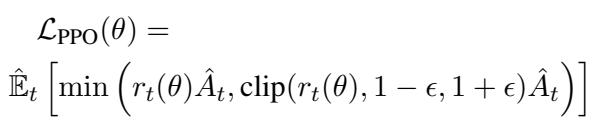
This process aligns the open-source model with the ultimate goal: fixing the bug.
Experimental Results
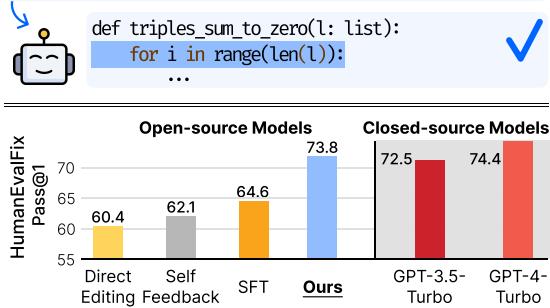
The researchers evaluated their PPO-trained feedback model (using DeepSeek-Coder-7B as a base) on HumanEvalFix, a standard benchmark for code repair.
Evaluation Metrics
The primary metric is Pass@1, which measures the percentage of problems where the model generated a correct fix on the first try.

Performance Comparison
The results, presented in Table 3 below, are striking.
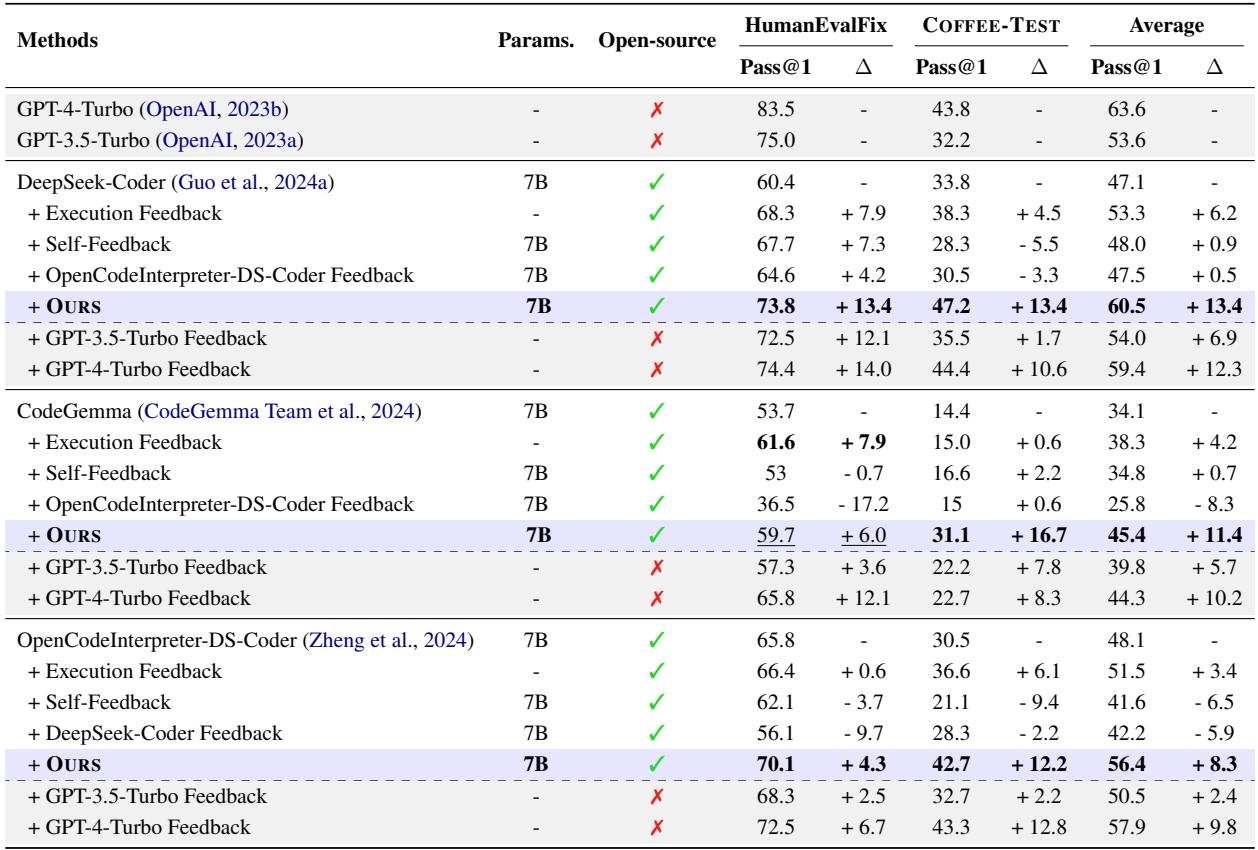
Let’s look at the “Ours” row under DeepSeek-Coder.
- The base model (DeepSeek-Coder) achieves 60.4% accuracy.
- Using simple execution feedback (error messages) bumps this to 68.3%.
- Using feedback from the PPO-trained COFFEE-GYM model jumps the score to 73.8%.
This 73.8% score is comparable to GPT-4-Turbo’s 74.4%. The open-source model, refined through COFFEE-GYM, has essentially closed the gap with the state-of-the-art closed-source model.
Analysis by Error Type
Is the model just fixing simple syntax errors, or is it solving logic bugs?
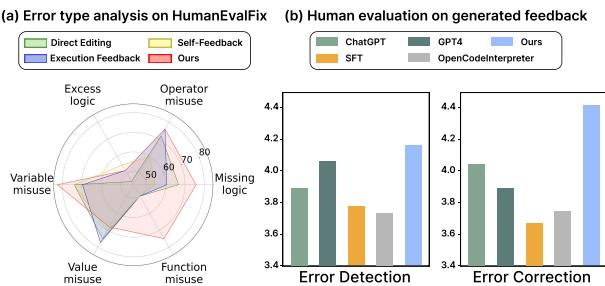
Figure 8(a) breaks down performance by error category. The red line (Ours) consistently outperforms baselines (like Self-Feedback), particularly in “Variable Misuse,” “Value Misuse,” and “Missing Logic.”
Figure 8(b) shows human evaluation results. Human annotators rated the feedback generated by the COFFEE-GYM model (Our method) higher than both ChatGPT and SFT baselines in terms of Error Detection and Correction clarity.
Conclusion & Implications
The COFFEE-GYM paper presents a compelling blueprint for the future of open-source coding assistants. It identifies that the bottleneck isn’t just model size or architecture, but the alignment of the training objective.
By moving away from simple text prediction (SFT) and moving toward reinforcement learning with a verified, execution-based reward (COFFEE-EVAL), the researchers demonstrated that 7B parameter models could rival the performance of GPT-4 in specific debugging tasks.
Key Takeaways:
- Human Data is King: Scraped edit traces provide the diversity needed to train robust debuggers.
- Execution > Semantics: Evaluating feedback by running the code (via a faithful editor) is more reliable than asking an LLM to rate the text.
- RL Works for Code: Reinforcement Learning isn’t just for robotics or games; it is the key to aligning code models with “helpfulness.”
As we look forward, environments like COFFEE-GYM will likely become the standard for training the next generation of developer tools, ensuring that when an AI tells you how to fix a bug, it actually knows what it’s talking about.