](https://deep-paper.org/en/paper/2409.19979/images/cover.png)
Large Language Models (LLMs) have revolutionized how we interact with information. From writing code to composing poetry, their reasoning capabilities are undeniable. Naturally, researchers have been eager to apply this power to Recommender Systems. After all, if an LLM can understand the semantics of a movie review, surely it can predict what movie you want to watch next, right?
The answer is “yes, but…”
While LLMs are fantastic at processing text, they often struggle with the fundamental structure of recommendation data: the Interaction Graph. A recommendation dataset isn’t just a list of sentences; it is a complex web connecting users to items, and users to other users. When we force this graph data into a linear text prompt for an LLM, we lose a massive amount of “high-order” information—the subtle ripples of influence that travel through the network.
In this post, we will deep dive into ELMRec (Enhanced LLM-based Recommender), a novel framework proposed by researchers from the University of Yamanashi. We will explore how they successfully injected graph awareness into an LLM without the need for expensive graph pre-training, and how they solved the specific biases that LLMs face when predicting sequential behaviors.
The Problem: When Text Prompts Miss the Big Picture
To understand why ELMRec is necessary, we first need to look at how current LLM-based recommenders work. Typically, these models convert recommendation tasks into text generation tasks.
For example, to recommend a product, we might prompt the model with: “User_123 has bought Item_A and Item_B. What should they buy next?”
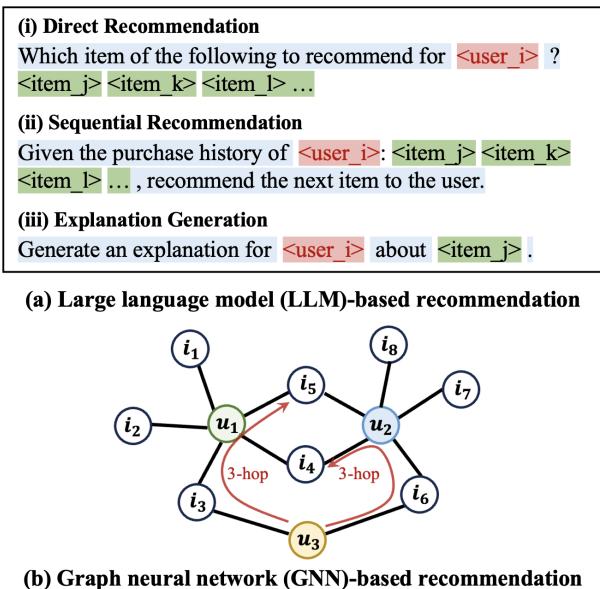
As shown in Figure 1(a) above, the LLM treats users and items as words in a sentence. It bridges the user (pink) and item (green) via text prompts (blue). While this captures semantic information (like the description of an item), it fails to capture high-order interactive signals.
What are high-order signals? Look at Figure 1(b). In a Graph Neural Network (GNN), information propagates. If User 1 and User 2 both bought similar items, they are connected by “hops” in the graph. A 3-hop neighbor (indicated by red arrows) might be a user who hasn’t interacted with you directly, but shares a similar taste profile through a chain of other users and items.
Standard LLMs are “graph-blind.” They see the text “User_123” but they don’t inherently “see” the web of connections that “User_123” has with the rest of the database.
The Tokenization Trap
There is a second, subtler problem: Token Decomposition.
When an LLM processes an ID like “User_1234”, it often splits it into sub-tokens: ["User", "_", "12", "34"].
- The token “User” is generic.
- The token “12” might appear in “User_1234” and “Item_8912”.
To the LLM, these entities might seem spuriously related because they share the token “12”, even though they are completely independent. The model struggles to treat “User_1234” as a singular, unique entity with a specific position in the interaction graph.
The Solution: ELMRec
The core innovation of ELMRec is Interaction Graph-aware Whole-word Embedding.
Instead of relying solely on the LLM’s standard word embeddings (which chop IDs into pieces), ELMRec introduces a special embedding layer that represents the entire ID as a single vector. Crucially, this vector isn’t just a random number; it is enriched with information about where that user or item sits in the interaction graph.
The authors tackle this via a three-step process:
- Direct Recommendation Enhancement: Using Random Feature Propagation.
- Sequential Recommendation Enhancement: Using Incremental Embeddings.
- Bias Correction: A Reranking strategy.
Let’s break these down.
1. Injecting Graph Awareness via Random Feature Propagation
How do we teach an LLM about the graph without training a massive GNN from scratch? The researchers utilized a technique inspired by LightGCN called Random Feature Propagation.
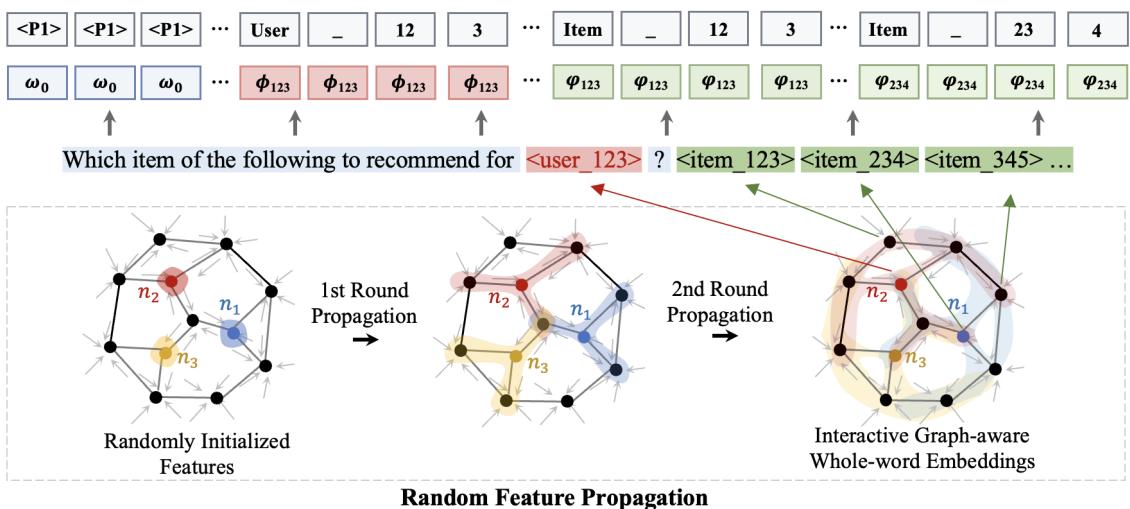
As illustrated in Figure 3, the process works like this:
- Initialization: Every user and item is assigned a random vector generated from a normal distribution. At this stage, the vectors are meaningless noise.
- Propagation (The “Magic” Step): The model performs graph convolution. It creates a “Whole-word Embedding” for a user by averaging the embeddings of the items they interacted with. Then, it updates item embeddings by averaging the users who bought them.
- Intuition: If User A and User B both bought the same gaming mouse, their embeddings will start to look similar after mixing.
- Integration: After several rounds (layers) of this mixing, the final embeddings capture the “high-order” structure. These “graph-aware” embeddings are then added to the standard text embeddings of the LLM.
The math behind the propagation is elegantly simple. The embedding update for a specific layer \(l\) is defined as:
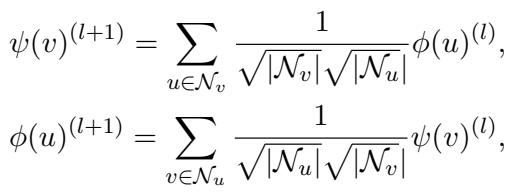
Here, \(\phi(u)\) is the user embedding and \(\psi(v)\) is the item embedding. The equation essentially says: “My identity is the weighted average of my neighbors.”
By the time these embeddings reach the LLM, “User_123” isn’t just a text string anymore; it is a vector that mathematically resembles “User_456” if they have similar shopping habits. This effectively creates a Whole-word Embedding that solves the tokenization split issue and the graph blindness issue simultaneously.
2. The Challenge of Sequential Recommendation
While graph embeddings are great for direct recommendations (e.g., “Find items similar to what I like”), they introduce a problem for Sequential Recommendation (e.g., “Predict what I will buy next based on my history”).
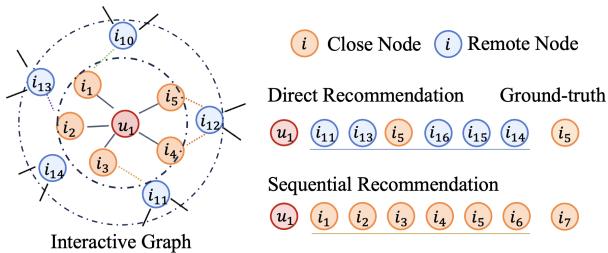
Figure 4 highlights this conflict.
- Top (Direct Rec): We want the target item (green circle) to be “close” to the user in the embedding space. Graph propagation does this perfectly.
- Bottom (Sequential Rec): The input is a timeline: \(Item_1 \rightarrow Item_2 \rightarrow \dots \rightarrow Item_N\). If we use strong graph embeddings, all the items the user has ever interacted with will look highly similar (they are all “close nodes”). This muddies the waters. The LLM loses track of the order of events because the graph compresses everything into a “cluster of interest.”
To fix this, ELMRec switches strategies for sequential tasks. Instead of graph-aware embeddings, it uses Incremental Whole-word Embeddings.
They assign indices to items based on their appearance order in the prompt:
\[ \text{User}_{123} (\#0) \rightarrow \text{Item}_{A} (\#1) \rightarrow \text{Item}_{B} (\#2) \dots \]This forces the LLM to pay attention to the recency and sequence of interactions, rather than just the general similarity.
3. Combating Recency Bias with Reranking
Even with the right embeddings, LLMs have a bad habit: they love the past.
During training, models are often fed random subsequences of history. For example, if a user’s history is \(A \rightarrow B \rightarrow C \rightarrow D \rightarrow E\), the model might be trained on \(A \rightarrow B \rightarrow C\) to predict \(D\).
The researchers found that because of this, LLMs tend to recommend items that appear earlier in the history (like \(C\) or \(D\)) rather than predicting the true next item (\(F\)).
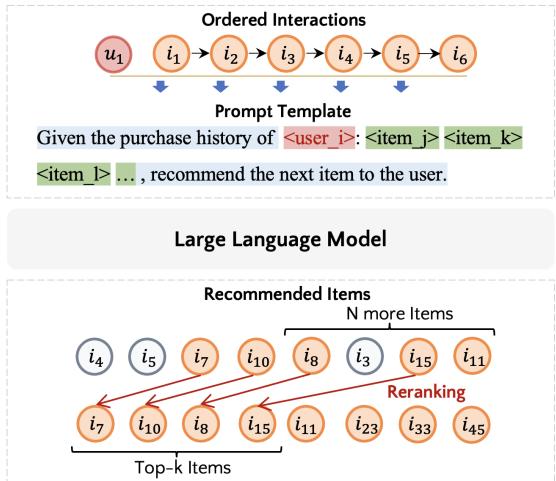
Figure 9 illustrates the solution: Reranking. Instead of asking the LLM for just the top-1 item, ELMRec asks for the top \(K+N\) items. It then actively filters out items that appear in the user’s interaction history (the gray nodes in the figure).
This is a training-free, “plug-and-play” solution. It forces the model to look for new items, correcting the LLM’s tendency to over-emphasize familiar, past interactions.
Experiments and Results
Does adding graph awareness actually help? The researchers tested ELMRec against several baselines, including traditional methods (like SimpleX), GNNs (like LightGCN), and other LLM-based models (like P5 and POD).
They used three standard datasets: Sports, Beauty, and Toys from Amazon.
Direct Recommendation Performance
The results for Direct Recommendation (finding the best item for a user) were staggering.
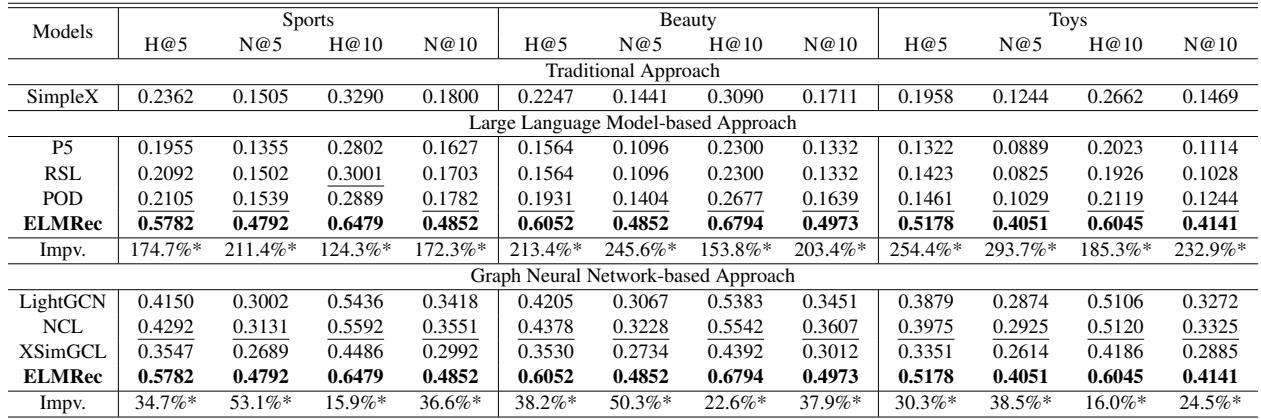
As shown in Table 2, ELMRec outperforms the best LLM-based competitor (POD) by margins ranging from 124% to 293%.
- Why such a huge gap? Pure LLM methods (P5, POD) only see text. They miss the structural clues that GNN methods (LightGCN) capture effortlessly.
- Why beat GNNs? ELMRec beats GNNs (like LightGCN and NCL) because it combines the structural awareness of GNNs with the semantic reasoning of LLMs. It’s the best of both worlds.
Sequential Recommendation Performance
For sequential tasks, the margins are tighter but still significant. ELMRec consistently outperforms state-of-the-art baselines.
The ablation studies provided deep insights into why it works. Look at the parameter sensitivity analysis in Figure 6:
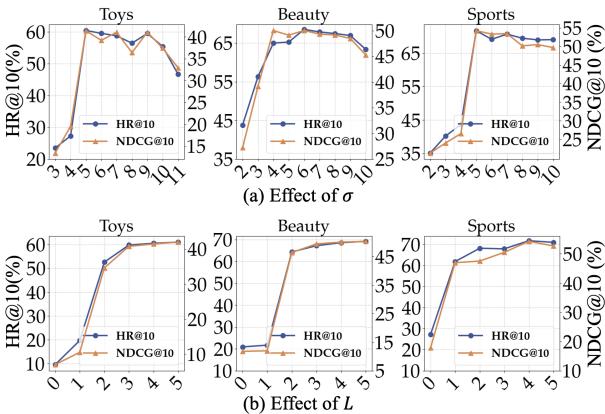
- Effect of \(\sigma\) (Sigma): This parameter controls the initialization variance of the random embeddings. The bell curve shape indicates there is a “sweet spot” for initialization—too little noise and the embeddings are too uniform; too much and they are chaotic.
- Effect of \(L\) (Layers): This is the number of propagation hops. Performance peaks around 3-4 layers. Beyond that, the “Over-smoothing” problem occurs (a common GNN issue where all nodes start looking identical), causing performance to drop.
Visualizing the Embeddings
Perhaps the most compelling proof comes from visualizing the embedding space. The researchers used t-SNE to plot the user and item embeddings.
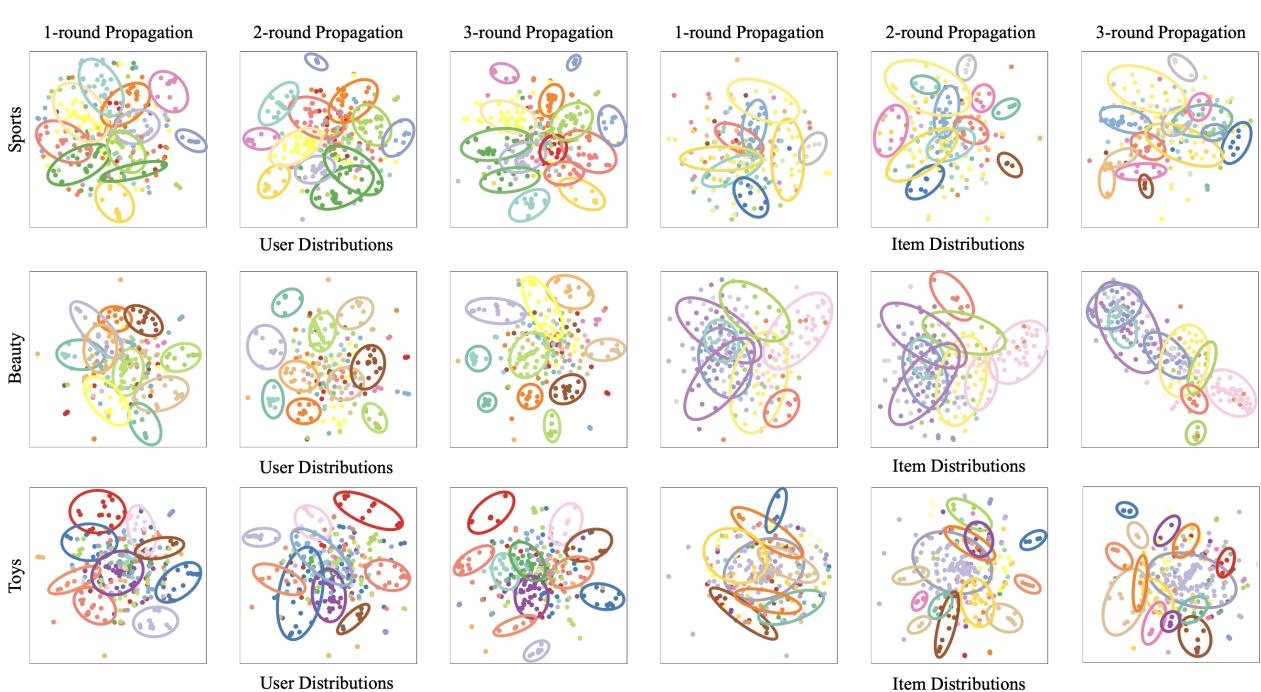
Figure 8 shows the evolution of embeddings over propagation rounds.
- Round 1 (Left): The dots are somewhat scattered.
- Round 3 (Right): Distinct clusters form.
- The Colors: Dots of the same color represent users who bought the same items (or items bought by the same users).
The fact that these dots cluster tightly in Round 3 proves that the Random Feature Propagation is successfully encoding collaborative signals. The LLM can now “see” these clusters. If a user embedding falls into the “Blue Cluster,” the LLM knows to focus on items within that same cluster, significantly narrowing down the search space.
Conclusion and Key Takeaways
The ELMRec paper bridges a critical gap in modern recommender systems. While LLMs are powerful reasoners, they are structurally handicapped when dealing with graph data. By manually injecting graph awareness through Whole-word Embeddings and Random Feature Propagation, ELMRec gives the LLM the structural context it needs.
Key Takeaways for Students:
- Modality Gap: Text is linear; relationships are graphs. Treating graph data as pure text prompts throws away valuable information.
- Whole-word Embeddings: This technique is a powerful way to handle IDs in LLMs. It prevents the tokenizer from chopping meaningful identities into meaningless sub-words.
- No Pre-training Required: You don’t always need to pre-train a massive GNN. Random feature propagation allows you to generate informative embeddings on the fly, which the LLM can then learn to use during fine-tuning.
- Task-Specific Logic: What works for Direct Recommendation (Graph Embeddings) might hurt Sequential Recommendation (where Order matters more than Similarity). ELMRec succeeds because it adapts its embedding strategy to the specific sub-task.
ELMRec demonstrates that the future of AI isn’t just about bigger language models, but about smarter ways to integrate them with structured data representation.