](https://deep-paper.org/en/paper/2410.00025/images/cover.png)
Introduction: The “Cocktail Party” Problem for AI
Imagine you are at a loud, crowded party. Your friend is telling you a story. Despite the background music, the clinking of glasses, and the dozens of other conversations happening around you, you can perfectly understand what your friend is saying. You can strip away the noise, ignore the specific pitch of their voice, and focus entirely on the words and their meaning.
This ability to abstract linguistic content from raw sound is natural for humans, but it is incredibly difficult for Artificial Intelligence.
In the rapidly evolving field of Spoken Language Modeling (SLM), researchers are trying to build systems that learn language directly from raw audio, without relying on text transcripts. The goal is to create models that capture the nuances of oral language—intonation, laughter, and emotion—that are lost in text-based systems.
However, there is a major hurdle: Efficiency.
Current speech-only models require up to three orders of magnitude more data to reach the same level of semantic understanding as text-based models. While a text model sees the word “apple,” a speech model hears a complex waveform that varies depending on who is speaking, how fast they are talking, and what background noise is present. The speech model wastes vast amounts of capacity trying to process these acoustic variations rather than learning the language itself.
In a fascinating paper titled “Improving Spoken Language Modeling with Phoneme Classification: A Simple Fine-tuning Approach,” researchers from ENS-PSL and Meta FAIR propose a deceptively simple solution. They demonstrate that by briefly teaching a model to recognize phonemes (the distinct units of sound in language), we can help it ignore irrelevant acoustic noise. This simple step allows models trained on small amounts of data to rival those trained on massive datasets.
But, as we will see, this newfound efficiency comes with a surprising trade-off.
Background: The Standard Pipeline and Its Flaws
To understand the innovation in this paper, we first need to understand how modern Spoken Language Models typically work. The standard pipeline usually involves three main stages:
- Self-Supervised Learning (SSL): A model (like HuBERT or wav2vec 2.0) looks at raw audio and learns to represent it as dense numerical vectors. This is done without human labels, purely by looking at patterns in the audio.
- Discretization (Quantization): Since language models (like GPT) work on discrete tokens (words or sub-words), the continuous audio vectors must be converted into a finite vocabulary. This is often done using an algorithm called k-means clustering, which groups similar sounds together into “units.”
- Language Modeling: A model (like an LSTM or Transformer) is trained to predict the next unit in the sequence, effectively learning the “grammar” of these audio tokens.
The Problem of Contextual Dependency
The weak link in this chain is usually the first step. Self-supervised models are great at capturing acoustic details, but they are too detailed. They struggle with context invariance.
In linguistics, a phenomenon called coarticulation occurs when the pronunciation of a sound is influenced by the sounds around it. For example, the ’t’ in “tool” sounds slightly different from the ’t’ in “tea” because your mouth is preparing for the next vowel.
For a raw speech model, these two ’t’ sounds might look like completely different tokens. If the model assigns them to different clusters, the Language Model downstream has a much harder time learning that they represent the same linguistic concept. The model gets bogged down processing the context (the surrounding sounds) rather than the content (the phoneme itself).
The Core Method: Supervised Fine-Tuning
The researchers hypothesized that if they could force the model to ignore context and focus on phoneme identity, the resulting representations would be much better for language modeling.
Their approach is straightforward but effective: Phoneme Classification Fine-tuning.
1. The Setup
They started with a pre-trained HuBERT Base model (a standard, powerful speech model). Instead of using it as-is, they added a small classification layer on top.
2. The Task
They fine-tuned this model on a task called frame-wise phoneme classification. Using a dataset with “gold” transcriptions (audio aligned perfectly with phonemes), they asked the model to look at a specific tiny slice of audio (a frame) and predict exactly which phoneme was being spoken.
This is different from the standard objective of simply predicting the next sound. By explicitly telling the model, “This frame is a /p/, regardless of what came before or after it,” they forced the neural network to discard information about coarticulation and speaker identity.
3. Efficiency
Crucially, they found that you don’t need massive amounts of labeled data for this. They experimented with fine-tuning on 100 hours, 10 hours, 1 hour, and even just 10 minutes of labeled data.
4. Quantization and Modeling
Once the model was fine-tuned, they peeled off the classification layer and used the internal representations of the model. They then ran the standard k-means clustering to create discrete units and trained a Language Model on those units.
Visualizing the Improvement
So, did this actually help the model ignore context? The researchers used a metric called the ABX error rate. In simple terms, this tests the model’s ability to tell that two different instances of the same sound (like the ‘a’ in “cat” spoken by two different people) are the same, while distinguishing them from a different sound.
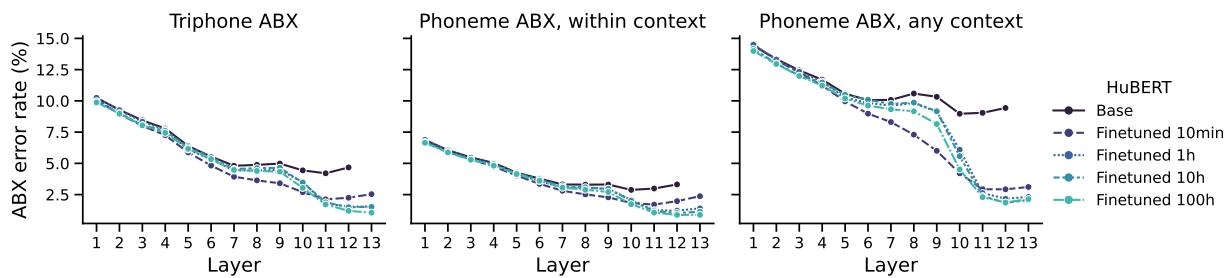
Figure 1 (derived from the paper’s image deck) shows the impact of fine-tuning on the ABX error rate across different layers of the model.
- The Top Lines (Base): The standard HuBERT model (the grey/brown lines) has a higher error rate, meaning it struggles to group similar phonemes together.
- The Bottom Lines (Finetuned): The fine-tuned models (purple/pink lines) show a dramatic drop in error rate, especially in the later layers (10-12).
Notice the chart on the far right, labeled “Phoneme ABX, any context.” This is the hardest setting, where the model has to recognize a phoneme even if the surrounding sounds are completely different. The Base model hovers around a 9% error rate. The model fine-tuned on just 10 minutes of data drops that error rate to around 2.4%. This confirms that the model has successfully learned to be “context-invariant.”
Experiments & Results: A Leap in Comprehension
The real test, however, is not just classifying sounds, but understanding language. Does this cleaner, more focused representation actually help the Language Model learn grammar and vocabulary?
The researchers evaluated their new Spoken Language Model on two distinct metrics:
- sWUGGY: A “spot-the-word” task. The model hears a real word (like “brick”) and a made-up word (like “blick”) and has to decide which one is real. This tests lexical (vocabulary) knowledge.
- sBLIMP: A syntax task. The model hears two sentences—one grammatically correct and one incorrect—and must identify the correct one.
Comparable Performance with Less Data
The results were striking. By using the representations from the fine-tuned model, the downstream Language Model achieved performance scores comparable to models trained on hundreds of times more data.

As shown in Table 3 above:
- The Base L11 (standard approach) achieves a sWUGGY score of roughly 64.26%.
- The FT 100h L13 (Fine-tuned on 100h) jumps to 73.37%.
- Perhaps most impressively, looking at the top rows, this fine-tuned approach begins to rival massive models like TWIST-7B, which was trained on 150,000 hours of data, despite the researchers here using a fraction of that compute and data budget.
The “Centroid Initialization” Trick
The researchers introduced another clever innovation mentioned in Table 3: “Init from centroids.”
Usually, when a Language Model is trained on discrete tokens (like “Unit 42”), it assigns a random starting vector to “Unit 42” and learns its meaning from scratch. In this paper, they realized that “Unit 42” corresponds to a specific cluster of audio sounds. So, instead of initializing randomly, they initialized the Language Model’s embedding using the mathematical center (centroid) of that audio cluster. This gave the Language Model a head start, further boosting performance (as seen in the “Init from centroids” rows in the table).
The Great Trade-off: Meaning vs. Expression
Up to this point, the fine-tuning approach seems like a “free lunch”—better performance with less data. But in the world of Deep Learning, there is almost always a cost.
While the model became excellent at understanding what was said (the text), it became worse at capturing how it was said (the expression).
To test this, the researchers tried to resynthesize speech from their discrete units. Ideally, if you turn an audio file into discrete units and then back into audio, it should sound identical to the original.
However, because the fine-tuning forced the model to ignore variations like pitch, tone, and speaker identity to focus on phonemes, those expressive details were discarded. When the model tried to speak, the audio quality degraded, and the expressive content was lost.
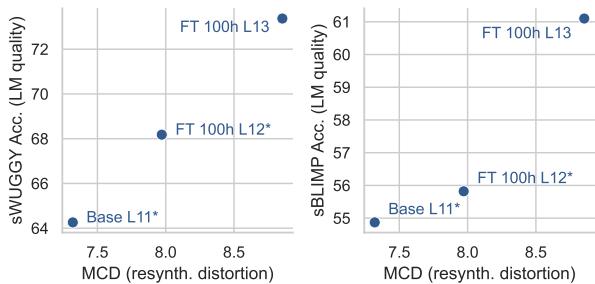
Figure 1 perfectly illustrates this trade-off.
- The Vertical Axis (LM Quality): Higher is better. You can see the Fine-Tuned (FT) models climbing higher, indicating better language understanding.
- The Horizontal Axis (Resynthesis Distortion - MCD): Lower is usually better (less distortion). However, here we see the FT models shifting to the right, meaning the distortion is increasing.
This reveals a fundamental tension in Spoken Language Modeling:
- High Abstraction: Good for understanding meaning (semantics/syntax), but bad for generating natural, expressive speech.
- Low Abstraction: Good for preserving the rich details of speech, but noisy and inefficient for learning language rules.
Visualizing the Loss of Style
The researchers went a step further to analyze exactly what was being lost. They utilized the EXPRESSO dataset, which contains speech in various styles (whispering, laughing, bored, etc.).
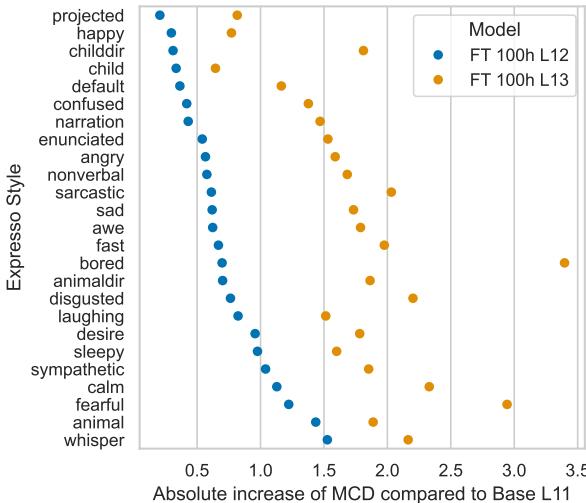
In Figure 4, we see the difference in distortion (MCD) between the fine-tuned model and the base model across different styles. The spikes are highest for styles like “Whisper” and “Bored.”
These styles rely heavily on non-phonemic cues—breathiness, pace, and intonation. Since the fine-tuned model was taught to aggressively hunt for phonemes and ignore “noise,” it treated these stylistic choices as irrelevant interference and discarded them. The result is a system that reads better but speaks with less “soul.”
Conclusion: A Step Forward, A New Challenge
This paper presents a significant advancement in the efficiency of Spoken Language Models. By introducing a simple, supervised fine-tuning step using phoneme classification, the authors demonstrated that we can drastically reduce the amount of data required to train competent language models.
Key Takeaways:
- Context is a Distraction: Raw audio models struggle because they get confused by coarticulation and acoustic environment.
- Supervision Helps: A tiny bit of supervision (even 10 minutes of labeled phonemes) can guide the model to learn robust, context-invariant representations.
- The Semantic-Acoustic Gap: There is a clear inverse relationship between a model’s ability to understand language and its ability to reproduce the rich, expressive details of speech.
For students and researchers in the field, this highlights an open problem for the future: How do we design models that can have their cake and eat it too? How can we build systems that possess the razor-sharp semantic understanding of these fine-tuned models while retaining the rich, human expressivity of raw audio?
The answer likely lies in future architectures that can disentangle these two streams of information, processing the what and the how separately but simultaneously. Until then, this paper stands as a strong proof-of-concept that sometimes, to learn complex language, you just need to start with the basics: your ABCs (or rather, your phonemes).