](https://deep-paper.org/en/paper/2410.00131/images/cover.png)
Introduction
The artificial intelligence landscape has been irrevocably changed by Large Language Models (LLMs) like ChatGPT and LLaMA. These models possess incredible capabilities, but they have a massive hunger for data. Traditionally, training or fine-tuning these giants requires aggregating massive datasets into a centralized server. However, in the real world, data doesn’t live in a single data center. It lives on our phones, our laptops, and in decentralized local servers—often protected by stringent privacy regulations like GDPR.
This creates a conflict: we want the intelligence of LLMs trained on diverse, real-world data, but we cannot move that data due to privacy and security concerns.
Federated Learning (FL) is the standard answer to this problem. In FL, instead of moving data to the model, we send the model to the data. Devices train locally and send only the model updates back to a central server. But when you try to apply standard FL to LLMs, you hit a wall. LLMs are simply too big. Transmitting billions of parameters back and forth between devices and a server crushes network bandwidth. Furthermore, the data on your phone is likely very different from the data on my laptop (a concept known as non-IID data), which confuses the model and slows down convergence.
In this post, we are diving deep into a new framework called FibecFed (Fisher Information-based Efficient Curriculum Federated Learning). This research proposes a sophisticated way to fine-tune LLMs efficiently across distributed devices by answering two critical questions: Which data should we learn from first? and Which parameters actually matter?
By the end of this article, you will understand how the researchers utilized Fisher Information—a concept from statistical theory—to create a “curriculum” for the model and to perform sparse updates, making the training process up to 98% faster.
Background: The Building Blocks
To understand FibecFed, we need to establish a few foundational concepts.
Federated Learning (FL) and Non-IID Data
In a typical FL setup, a central server sends a global model to multiple clients (devices). Each client trains the model on its own local data and sends the updates back. The server averages these updates (aggregation) and repeats the process.
The challenge is Non-Independent and Identically Distributed (non-IID) data. In a perfect world, every device would have a representative sample of all possible data. In reality, one device might only have medical text, while another has only legal text. When these devices try to pull the global model in different directions, training becomes unstable and slow.
Low-Rank Adaptation (LoRA)
You cannot retrain all 7 billion parameters of an LLM on a consumer laptop—it’s too computationally expensive. LoRA is a technique that freezes the pre-trained model weights and injects trainable rank decomposition matrices into each layer of the Transformer architecture.
If \(W\) is a weight matrix, LoRA represents the update \(\Delta W\) as the product of two smaller matrices, \(B\) and \(A\).

Here, \(W_{o}^{l}\) is the frozen weight, while \(B_{k}^{l}\) and \(A_{k}^{l}\) are the small, trainable matrices. This reduces the number of trainable parameters significantly. However, even with LoRA, in a Federated Learning setting, you are still transmitting these matrices for every layer, which is still too much data for efficient communication.
Curriculum Learning
Imagine teaching a child calculus. You don’t start with integrals; you start with arithmetic, then algebra, and finally limits. This is Curriculum Learning: ordering training examples from easy to hard. In centralized training, this speeds up convergence. But in Federated Learning, how does a central server know which data is “easy” when it can’t see the data?
Fisher Information
This is the mathematical heart of the paper. Fisher Information measures how much information a random variable (like your data) carries about an unknown parameter (like your model weights).
In the context of deep learning, the Fisher Information Matrix (FIM) essentially tells us the curvature of the loss landscape.
- High Fisher Information: The model is very sensitive to this specific data or parameter. The “slope” is steep.
- Low Fisher Information: The model doesn’t care much about this data or parameter; changing it doesn’t affect the outcome much.
FibecFed uses this metric to solve both the data selection problem and the parameter update problem.
The FibecFed Framework
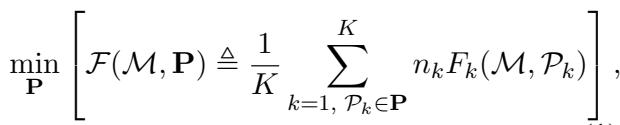
The researchers define the problem as minimizing a global loss function by finding the optimal LoRA parameters \(\mathbf{P}\).
The FibecFed framework tackles the inefficiencies of FL through two main engines:
- Adaptive Federated Curriculum Learning: Using Fisher Information to decide what data to train on.
- Efficient Sparse Parameter Update: Using Fisher Information and noise sensitivity to decide which parameters to update and transmit.
Let’s visualize the entire system architecture before breaking it down.
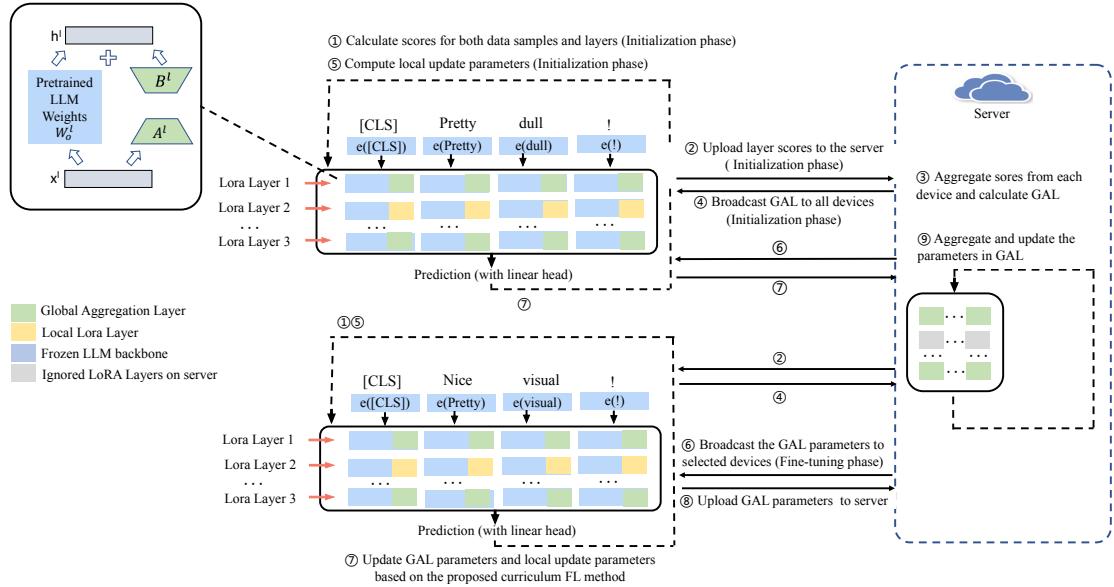
As shown in Figure 1, the process is split into an Initialization Phase and a Fine-tuning Phase.
- Initialization: The devices assess their local data difficulty and calculate which layers of the model are most important.
- Fine-tuning: The server coordinates the training, but devices only train on specific “curriculum” data and only update specific “sparse” parameters.
Part 1: Adaptive Federated Curriculum Learning
The first innovation addresses the data heterogeneity problem. Standard FL picks data batches randomly. FibecFed argues that devices should start by training on “easy” samples and gradually introduce “hard” ones.
Measuring Difficulty with Fisher Information
How does a device know if a sentence is “hard” to learn? The authors propose using the trace (the sum of diagonal elements) of the Fisher Information Matrix (FIM).
The FIM \(\mathbf{F}_i\) for a data sample \(s_i\) is defined as:

Calculating the full matrix is computationally impossible for LLMs. Therefore, the researchers approximate it using the empirical diagonal:

And further simplify it to just the diagonal elements to save memory:

The Logic: If the gradient of the loss with respect to the parameters is large (high Fisher Information), it means the model is struggling with this sample—it’s “hard” or “complex.” If the gradient is small, the model already “understands” this data—it’s “easy.”
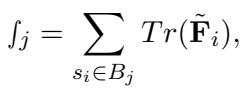
The difficulty score \(f_j\) for a batch of data is simply the sum of the traces of the FIM for samples in that batch:
The Curriculum Schedule
Once the batches are scored, they are sorted from easiest to hardest. The device doesn’t use all data immediately. Instead, it uses a pacing function to decide how much of the data to reveal to the model at each round \(t\).
The researchers tested Linear, Square, and Exponential pacing. The linear strategy is defined as:
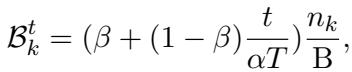
Here, \(\mathcal{B}_{k}^{t}\) represents the index threshold. The device only trains on batches where the difficulty index \(j\) is less than this threshold:
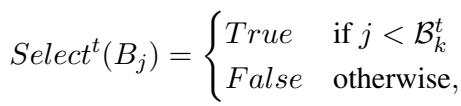
This ensures that in the early, volatile stages of Federated Learning, the model stabilizes using easy, high-confidence data. As training progresses, it tackles the difficult, noisy, or edge-case data.
Part 2: Efficient Sparse Parameter Update
The second, and perhaps more significant innovation, is reducing the communication and computation cost. Even with LoRA, sending updates for every layer is wasteful.
FibecFed splits the model parameters into three categories:
- Frozen Parameters: Most of the LLM (standard LoRA).
- Global Aggregation Layers (GAL): Important layers that are synchronized with the server.
- Local Update Parameters: Parameters that are updated locally but not synchronized, allowing for personalization.
Global Aggregation Layer Selection (Sensitivity Analysis)
To decide which layers are worth sending to the server (GAL), the researchers use a “sensitivity to noise” approach. If you add a small amount of noise to the input, does the layer’s output change significantly? If yes, that layer is important.
First, they calculate the optimal noise perturbation \(\epsilon_{i}\) that maximizes the loss (an adversarial attack concept):
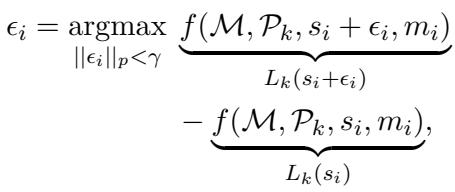
This is approximated using a Taylor expansion:
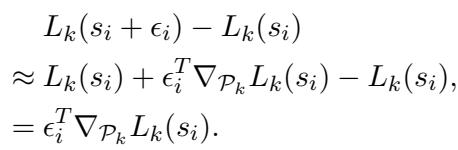
Solving this, they find the exact noise vector to apply:

Once they have this noise, they feed both the clean input \(s_i\) and the noisy input \(s_i + \epsilon_i^*\) into the model. They measure the Relative Difference of the Frobenius Norm of the output embeddings \(h^l\) at layer \(l\):

Layers with a high relative difference score (\(\mathcal{I}^l\)) are highly sensitive. These are the layers that capture the most critical features and therefore must be synchronized globally across all devices. The server aggregates these scores and selects the top \(N^*\) layers to be the GAL.
Local Update Parameter Selection
What about the layers that aren’t selected for global aggregation? Should we just freeze them? No. To handle the non-IID data (personalization), devices should still update some parameters locally.
But updating everything is slow. The researchers return to Fisher Information to pick the specific neurons that matter most. They calculate an importance score for each neuron \(\mu\) in layer \(l\):
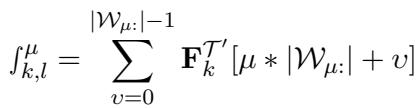
This formula sums the diagonal Fisher Information values corresponding to a specific neuron’s weights. If a neuron has a high Fisher score, it’s critical for the local data. The device selects a subset of these high-importance neurons to update locally, freezing the rest.
Summary of the Method
- Curriculum: Sort data by Fisher score. Train on easy data first.
- Global Layers: Identify sensitive layers. Send only these to the server.
- Local Neurons: Identify high-Fisher neurons in non-global layers. Update them locally for personalization.
Experiments and Results
The researchers validated FibecFed using RoBERTa-Large (355M parameters) and LLaMA-7B. They tested on 10 different Natural Language Processing (NLP) tasks (like QNLI, SST-2, CoLA) with 100 simulated devices.
They compared FibecFed against 17 baseline methods, including standard LoRA, prompt tuning methods (like P-tuning v2), and other federated strategies.
Convergence Speed and Accuracy
The most striking result is the speed of convergence. Because the devices are processing less data (due to the curriculum) and updating fewer parameters (due to sparse updates), the training is drastically faster.
Look at the convergence curves below. The red line (FibecFed) consistently reaches high accuracy much faster than the baselines.
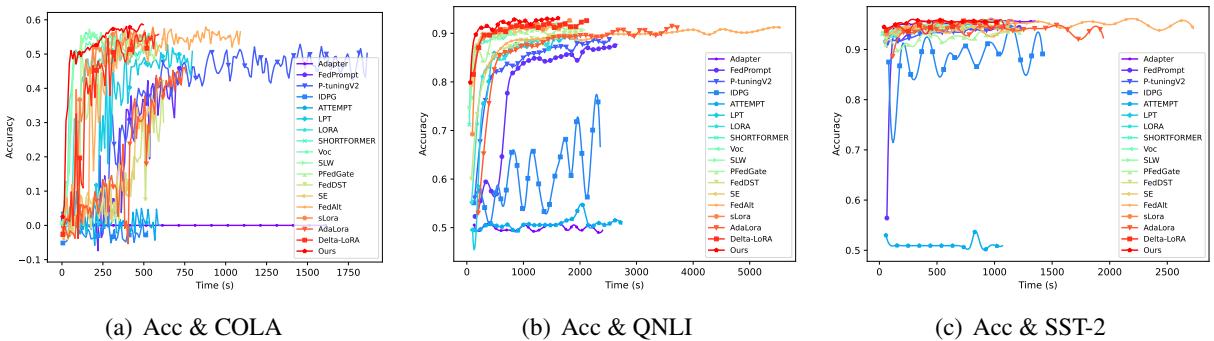
In Figure 2(a) (COLA dataset), note how the red line shoots up and stabilizes while other methods struggle or rise slowly. This demonstrates the efficiency of the curriculum—the model isn’t wasting time on confusing data early on.
The trend continues across other datasets like MRPC and RTE:
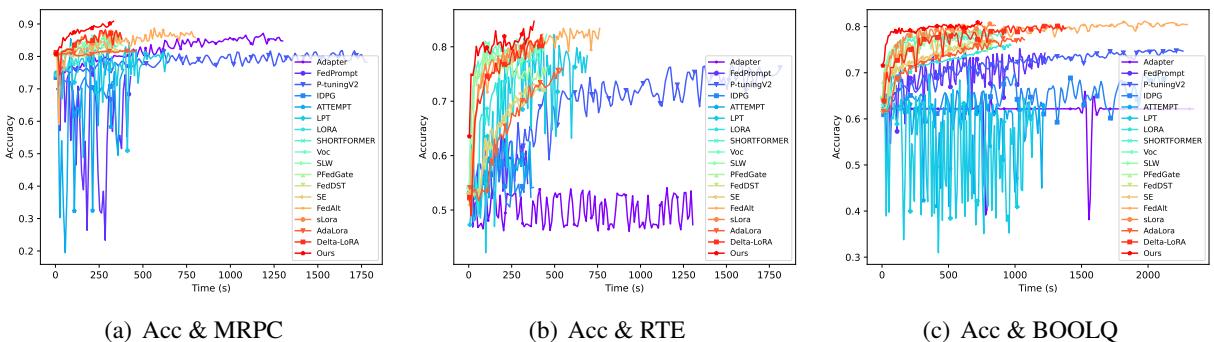
In Figure 3(a) (MRPC), FibecFed achieves a higher final accuracy than almost all competitors.
Quantitative Wins
The paper reports massive gains:
- Accuracy: Up to 45.35% higher convergence accuracy compared to baselines.
- Speed: Up to 98.61% faster fine-tuning speed.
This is a “have your cake and eat it too” scenario. Usually, sparse updates (dropping parameters) lead to a drop in accuracy. Here, because the selection of parameters is intelligent (based on Fisher Information and Noise Sensitivity), the accuracy actually improves because the model focuses on what truly matters.
Robustness
The team also checked if their method holds up under different conditions.
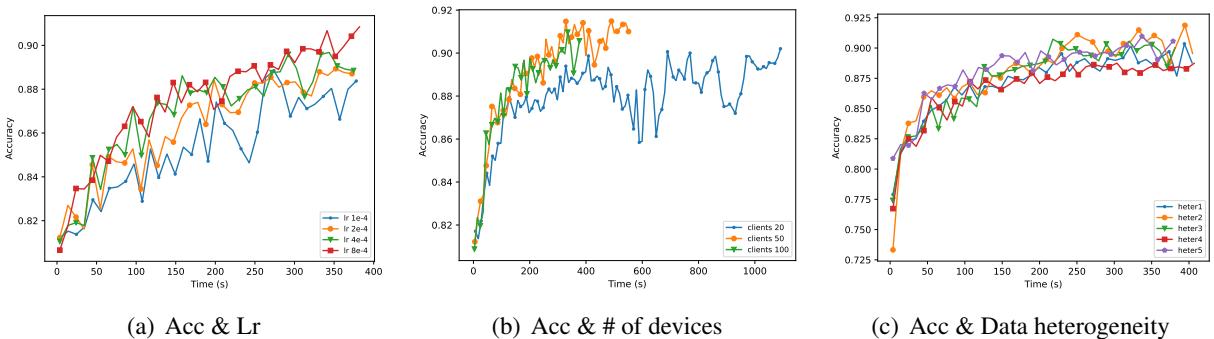
- Figure 6(b): Shows that increasing the number of devices (from 20 to 100) actually helps the model converge slightly faster and more stably, proving scalability.
- Figure 6(c): Tests different levels of data heterogeneity (“heter1” to “heter5”). While highly heterogeneous data is harder to learn from, FibecFed handles the stress test remarkably well, maintaining high accuracy.
Impact of Curriculum Strategy
Does the pacing function matter? The researchers compared Linear, Exponential, and Square pacing functions.
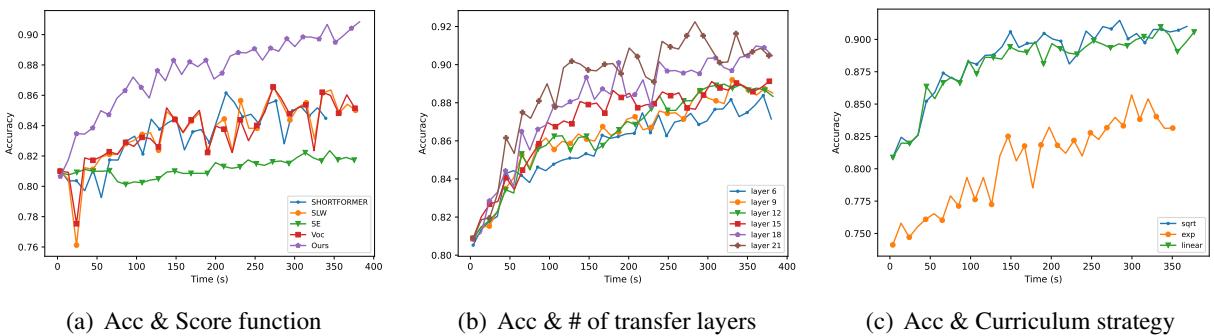
In Figure 7(c), we see the comparison. While they all eventually converge, the Linear strategy (green line) offered the best balance of stability and speed, which is why it was chosen as the default.
Conclusion & Implications
The FibecFed framework represents a significant step forward for Federated Learning. It moves away from the “brute force” approach of trying to train everything on everything. Instead, it introduces intelligence into the training loop itself.
By using Fisher Information, the framework acts like a smart student:
- It assesses the study material and starts with the basics (Curriculum Learning).
- It identifies which concepts are crucial and focuses its mental energy there (Global Aggregation Layers).
- It personalizes its knowledge based on its specific environment (Local Sparse Updates).
For students and researchers in AI, this paper highlights the power of metric-based selection. We often focus heavily on model architecture (Transformers, Mamba, etc.), but FibecFed shows that how we train—specifically how we select data and parameters—can yield performance gains just as massive as architectural changes.
As privacy regulations tighten and LLMs grow larger, frameworks like FibecFed will be essential for enabling the next generation of AI applications that live on our devices, learning from us without compromising our privacy.