](https://deep-paper.org/en/paper/2410.00316/images/cover.png)
Introduction
Consider the famous Shakespearean line: “To be, or not to be.”
Read that text again. How did it sound in your head? Was it whispered in despair? Was it spoken with philosophical contemplation? Or perhaps shouted in defiance?
The text itself is ambiguous. In human communication, the words are only half the story; the vocal inflection—the prosody—carries the rest. This is the current frontier in Text-to-Speech (TTS) and voice cloning technology. While modern models like those from OpenAI or ElevenLabs can generate voices that sound hyper-realistic, they suffer from a significant limitation: rigidity.
As a user, you cannot easily tell an AI model, “Say this sentence, but say it with 40% more sarcasm,” or “Speak this like a charismatic leader.” The emotion is usually inferred from the text itself, leaving the user without control over the tone or intensity.
This is the problem addressed by EmoKnob, a new framework developed by researchers at Columbia University. EmoKnob introduces a method to apply fine-grained emotion control to voice cloning models. By treating emotion as a direction in a mathematical space, this framework allows users to turn a “knob” to adjust emotional intensity for any voice, without needing to retrain massive neural networks.
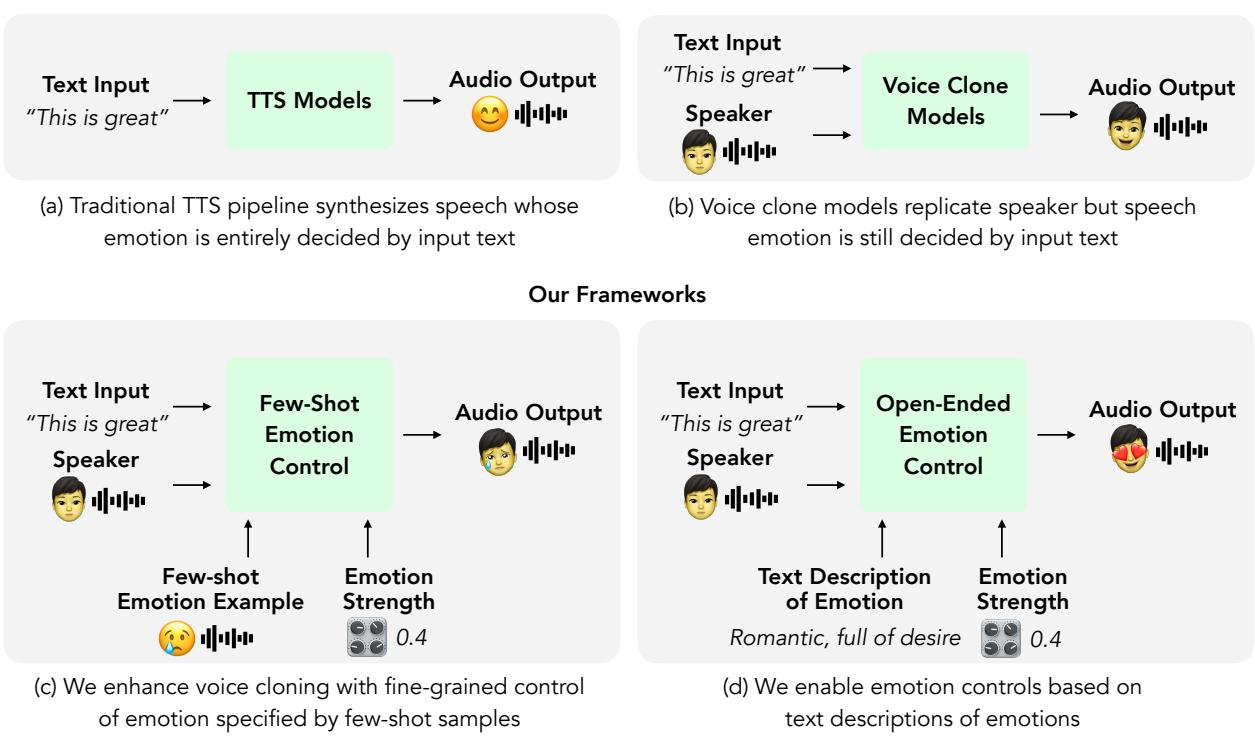
In this post, we will deconstruct how EmoKnob works, the vector mathematics behind it, and how it enables the synthesis of complex emotions—like empathy and charisma—that previous systems struggled to capture.
Background: The State of Voice Synthesis
To understand why EmoKnob is a breakthrough, we first need to look at how modern voice cloning works.
Recent advancements in Generative AI have led to “Foundation Models” for speech (such as MetaVoice, XTTS, or Vall-E). These models are trained on massive datasets (hundreds of thousands of hours of speech). They work by taking a short audio clip of a person (a reference), encoding it into a Speaker Embedding, and then using that embedding to generate new speech in that person’s voice.
Think of a Speaker Embedding as a complex digital fingerprint. It is a vector (a list of numbers) that represents everything about your voice: your pitch, accent, timber, and cadence.
The Limitation of Current Controls
While these foundation models produce high-quality audio, they treat the speaker embedding as a static block of information. Previous attempts to add emotion control usually fell into two categories:
- Limited Categories: You could choose from a preset list (e.g., Happy, Sad, Angry). If you wanted “Sarcastic” or “Grateful,” you were out of luck.
- Retraining Required: To add new emotions, you often had to train a style encoder from scratch or fine-tune the whole model, which is computationally expensive and data-hungry.
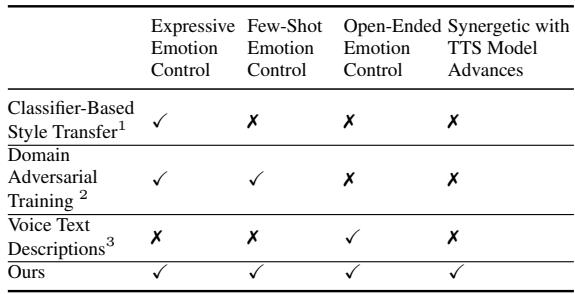
As shown in the comparison table below, EmoKnob stands out because it allows for few-shot control (it only needs one or two examples) and open-ended control (it can do emotions not present in the training data), all while working synergistically with existing pre-trained models.
The Core Method: Emotion as a Vector
The researchers hypothesized that the “Speaker Embedding” space in foundation models is actually rich enough to contain emotional data, even if the model wasn’t explicitly told to label it.
The core insight of EmoKnob is that we can disentangle the Speaker Identity (who is talking) from the Emotion (how they are feeling) using simple vector arithmetic.
Step 1: Extracting the Emotion Direction
Imagine a 2D map. If you are standing at point A and want to go to point B, you need a direction vector.
In the EmoKnob framework, the researchers take two audio samples from the same speaker:
- A Neutral Sample (\(x_n\)): The speaker reading a boring fact.
- An Emotional Sample (\(x_e\)): The speaker crying, laughing, or shouting.
The voice cloning model encodes both of these into embeddings (\(u_n\) and \(u_e\)). Because the speaker is the same in both clips, the difference between these two embeddings represents the emotion itself.
By subtracting the neutral embedding from the emotional embedding, we get an Emotion Direction Vector (\(v_e\)).
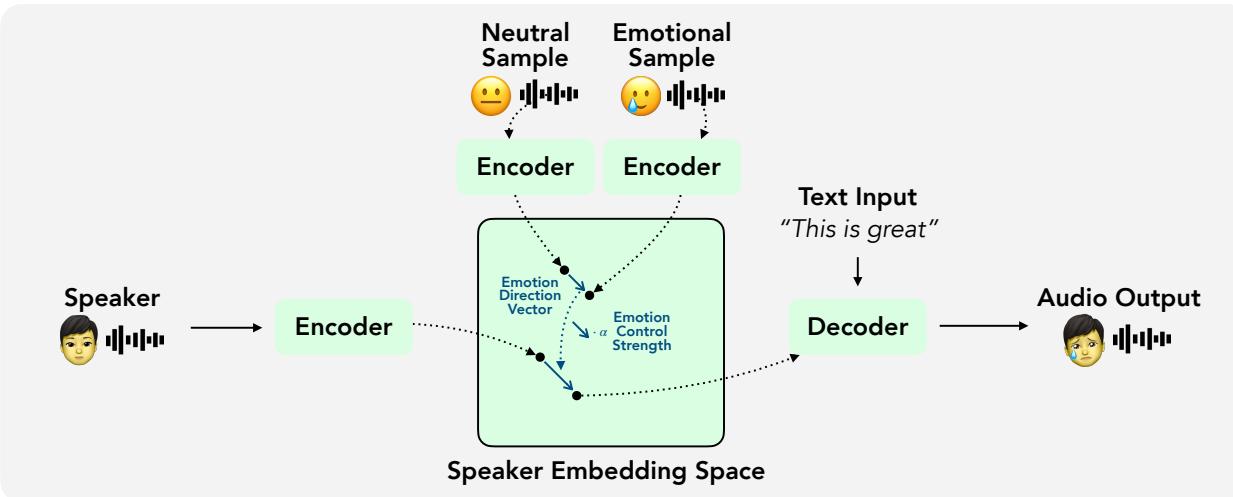
To make this statistically robust, the researchers calculate the average difference over a few pairs of samples (few-shot), though they found that even a single pair (one-shot) often works well. They also normalize the vector so they can control the scale later.
The mathematical formulation for finding this emotion vector is:
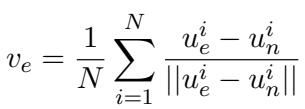
Here, \(N\) is the number of sample pairs (shots). The result, \(v_e\), is a pure “distilled” representation of that specific emotion (e.g., “Sadness”) in the language of the AI model.
Step 2: The EmoKnob (Applying the Control)
Now that we have the “Sadness Vector,” we can apply it to any speaker, even one who has never recorded a sad sentence in their life.
Let’s say we have a target speaker, Alice. We get her neutral speaker embedding (\(u_s\)). To make Alice sound sad, we simply add the Sadness Vector (\(v_e\)) to her embedding.
Crucially, we multiply the vector by a scalar value, \(\alpha\). This is the “Knob.”
- If \(\alpha = 0\), the voice is neutral.
- If \(\alpha = 0.4\), the voice sounds moderately sad.
- If \(\alpha = 0.8\), the voice sounds devastated.
The formula for the new, modified speaker embedding (\(u_{s,e}\)) is elegant in its simplicity:

This modified embedding is then fed into the decoder to generate the final speech. The result is Alice’s voice, reading whatever text you provided, but infused with the emotion extracted from the reference samples.
Expanding Horizons: Open-Ended Emotion Control
The method described above requires a “reference pair”—a recording of someone being neutral and someone being emotional. But what if you want an emotion for which you don’t have a recording? What if you want to synthesize a voice that is “Romantic, full of desire” or “Grateful and indebted”?
The researchers proposed two clever methods to generate these emotion vectors from scratch, utilizing the power of Large Language Models (LLMs).
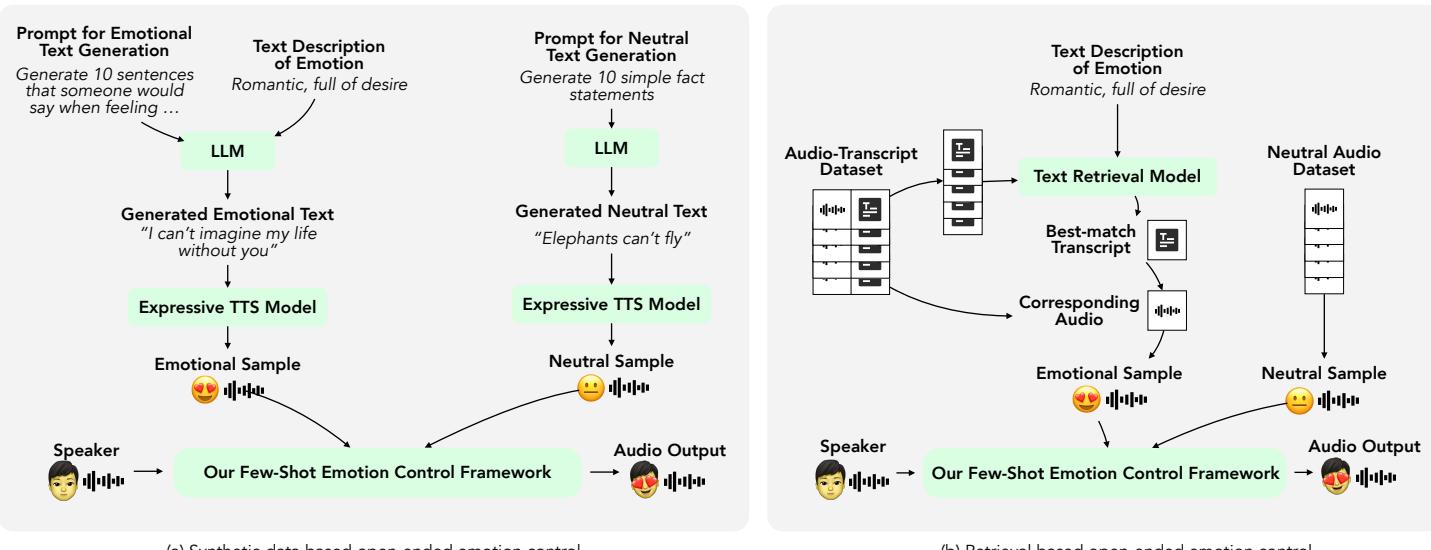
Method A: Synthetic Data Generation
This approach uses the fact that commercial TTS systems (like OpenAI’s voice mode) are already quite expressive, even if they aren’t controllable.
- Prompt an LLM: Ask GPT-4 to write 10 sentences that clearly convey a specific emotion (e.g., “Write 10 sentences a jealous person would say”).
- Generate Audio: Feed those sentences into a high-quality commercial TTS engine. The TTS will naturally infuse the audio with jealousy because the text demands it.
- Extract Vector: Treat these generated clips as your “Emotional Samples.” Compare them to neutral clips from the same TTS voice to calculate the Emotion Direction Vector.
You now have a “Jealousy Vector” that you can apply to your own voice cloning tasks.
Method B: Transcript Retrieval
This approach mines existing datasets. There are massive libraries of audio with accompanying transcripts (text).
- Text Embedding: The user types a description: “Romantic, full of desire.”
- Retrieval: The system searches the dataset for transcripts that semantically match that description using a text embedding model.
- Extraction: Once it finds a line of text that matches the vibe, it pulls the corresponding audio. It assumes that if the text is romantic, the actor likely spoke it romantically. This audio becomes the emotional reference.
Experiments and Results
To prove this works, the researchers had to measure something notoriously difficult: human perception of emotion. They devised a suite of subjective tests where human listeners had to rate the audio.
1. Simple Emotions
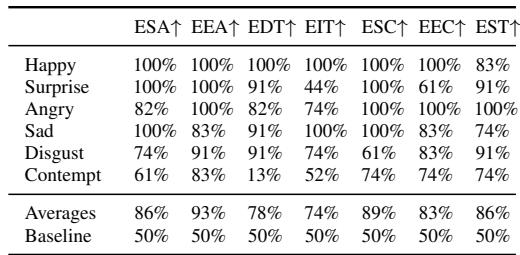
First, they tested the “Big Six” basic emotions: Happy, Surprise, Angry, Sad, Disgust, and Contempt. They used a single reference pair (1-shot) and set the strength knob (\(\alpha\)) to 0.4.
The results were impressive. The Emotion Selection Accuracy (ESA)—the percentage of listeners who agreed the generated audio sounded like the target emotion—was remarkably high.
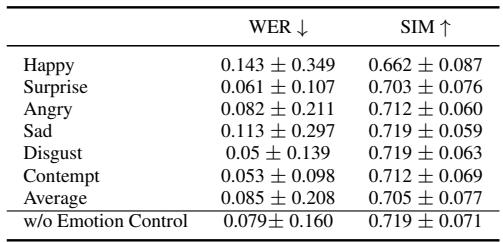
They also ran Objective Evaluations. It is vital that while adding emotion, we don’t destroy the speaker’s identity or make the words unintelligible.
- WER (Word Error Rate): Measures if the speech is still clear.
- SIM (Speaker Similarity): Measures if it still sounds like the original speaker.
The table below shows that the WER and SIM remained very close to the baseline (no emotion control). This means EmoKnob changes how the person speaks without changing who they sound like or what they are saying.
2. Complex Emotions: Charisma and Empathy
This is where EmoKnob shines. “Charisma” isn’t a single emotion; it’s a mix of confidence, leadership, and persuasion. “Empathy” is a mix of sadness, understanding, and warmth. Most TTS systems fail here.
Using the EmoKnob framework, the researchers successfully cloned these nuanced states.

3. Open-Ended Control
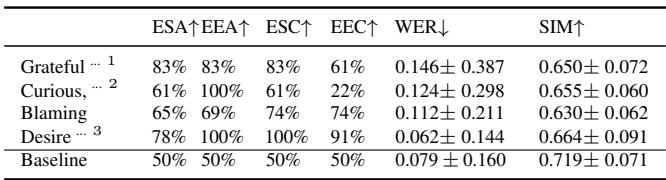
Finally, they tested the text-description methods (Synthetic and Retrieval). They tried to generate voices for Desire, Envy, Sarcasm, and Gratitude.
For the Synthetic method (using LLM-generated references), the results showed that the system could successfully transfer these subtle emotions to new speakers.
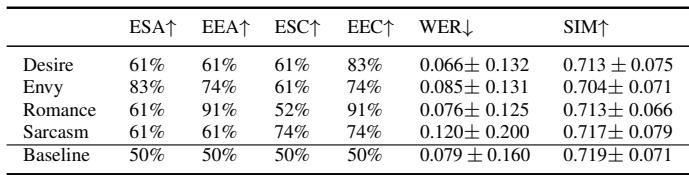
For the Retrieval method (finding real clips based on text descriptions), they tested highly specific prompts like “Curious, intrigued” and “Grateful, appreciative, thankful, indebted, blessed.”
Ablation Study: The Trade-off
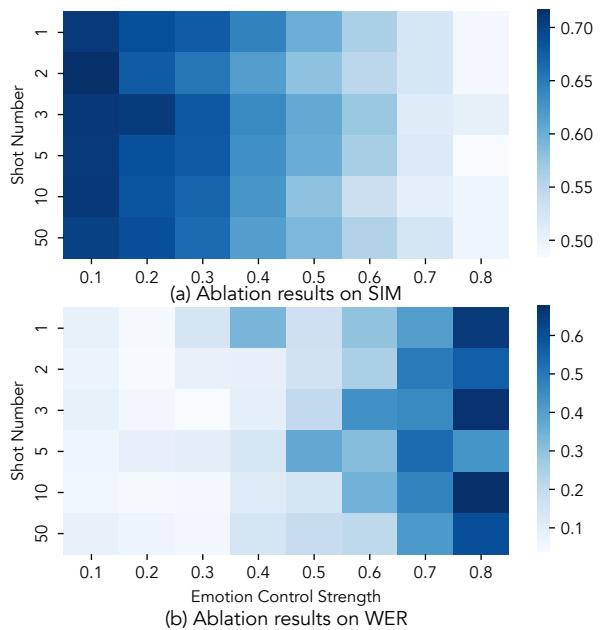
The researchers also explored the limits of the “Knob.” What happens if you turn the intensity (\(\alpha\)) up too high?
The heatmaps below illustrate a classic trade-off.
- Graph (a) SIM: As you increase the Emotion Strength (X-axis), the Speaker Similarity (darker blue is better) decreases slightly. If you make a voice extremely angry, it sounds less like the original speaker.
- Graph (b) WER: As Emotion Strength goes up, the Word Error Rate increases (darker blue is worse). If the emotion is too intense, the words become harder to understand.
This confirms that users need to find a “sweet spot” for \(\alpha\), typically around 0.4 to 0.6.
Conclusion
EmoKnob represents a significant step forward in making AI voices more human. By identifying that emotions exist as “vectors” within the mathematical space of speaker embeddings, the researchers have created a tool that is both powerful and lightweight.
It does not require retraining massive models. It does not require thousands of labeled emotional datasets. It simply requires a “map” of where the emotions live in the data.
The implications are vast. From audiobooks that can dynamically adjust the narrator’s tone to match the scene, to empathetic AI assistants that can sound genuinely concerned when you are distressed, fine-grained emotion control is the key to the next generation of conversational AI.
The ability to control the “soul” of a synthetic voice is no longer just a possibility—it’s just a matter of turning the knob.