](https://deep-paper.org/en/paper/2410.00513/images/cover.png)
Imagine you have built a sophisticated AI assistant capable of querying a complex database. When you ask it, “Show me the nearest hotel to Melania,” it converts your English request into a precise database query (like SQL) and retrieves the answer. This technology is called Semantic Parsing (SP).
Now, imagine you want to deploy this same system in Korea, Turkey, or Finland. You immediately face a bottleneck: the lack of labeled training data. Collecting thousands of pairs of “Natural Language Question” and “Database Query” for every new language is incredibly expensive and time-consuming.
Traditionally, researchers have relied on machine translation or large multilingual models to bridge this gap. However, these methods often fail to align specific entities (like table names or values) or simply lack the performance required for complex tasks.
In this post, we will deep dive into a new research paper titled “Cross-lingual Back-Parsing (CBP)”. This paper proposes a clever way to synthesize high-quality training data for target languages using only English labeled data and unlabelled text from the target language. It essentially teaches a model to “back-translate” from a universal logical code into a new language it has never explicitly learned to parse.
The Core Problem: The Data Gap
Semantic Parsing is the task of mapping a natural language utterance (\(u\)) to a meaning representation (\(mr\)).
- Input (\(u\)): “How many workers are there?”
- Output (\(mr\)):
SELECT count(*) FROM employee
In English, we have abundant datasets (like Spider or WikiSQL). In low-resource languages, we have next to nothing. This creates a “Zero-Resource” setting where we have no translators, no parallel corpora (sentences aligned between languages), and no labeled examples in the target language.
Current state-of-the-art approaches use Multilingual Pretrained Language Models (mPLMs) like mBERT or mT5. These models are pre-trained on text from 100+ languages. Theoretically, if you fine-tune them on English data, they should work in other languages. In practice, however, there is a significant performance drop—a “transfer gap”—between the source language (English) and the target language.
Enter Cross-lingual Back-Parsing (CBP)
The researchers propose a data augmentation strategy. If we don’t have training data for the target language, let’s create it.
The goal of CBP is to take a meaning representation from the source language (\(mr_{src}\)) and synthesize a corresponding natural language utterance in the target language (\(u_{tgt}\)). If we can do this effectively, we can generate a massive synthetic dataset to train a parser for the target language.
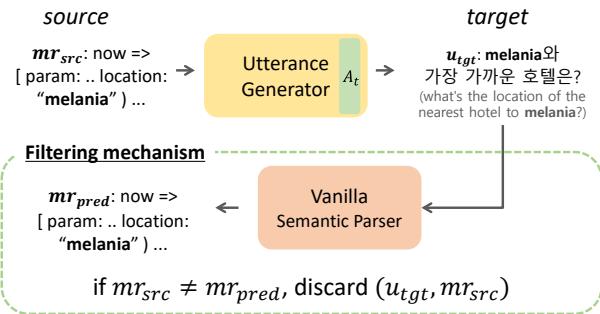
As shown in Figure 1, the process involves three main stages:
- Utterance Generator: A model synthesizes a target language question (e.g., Korean) from a source logical form (e.g., English-based Schema).
- Filtering Mechanism: A “Vanilla Semantic Parser” checks if the generated question actually makes sense by trying to parse it back to the original logic.
- Result: If the logic matches, the generated pair is added to the training set.
The genius of this paper lies in how they build the Utterance Generator without having any examples of “Target Language \(\rightarrow\) Logic” pairs.
The Methodology: Tricking the Model
To build the Utterance Generator, the authors use a sequence-to-sequence model (specifically mT5). The challenge is that the model only knows how to generate English utterances from logic because that’s the only labeled data available. How do we force it to generate Korean, German, or Italian?
The authors introduce a technique involving Language Adapters and a novel Source-Switched Denoising objective.
1. The Language Adapters
Instead of fine-tuning the entire massive neural network, the researchers insert small “Adapter” layers into the model. These are tiny neural networks sandwiched between the layers of the larger Transformer model. They allow the model to learn language-specific features efficiently.
2. Source-Switched Denoising
This is the most technical and innovative part of the paper.
Research in multilingual models suggests that neural representations can be split into two parts:
- Semantic content: What the sentence means.
- Language identity: Which language the sentence is in.
The authors devise a training scheme where they “trick” the adapter into learning how to convert “English-looking” semantics into “Target-language” text, using only monolingual data (unlabeled text like Wikipedia).
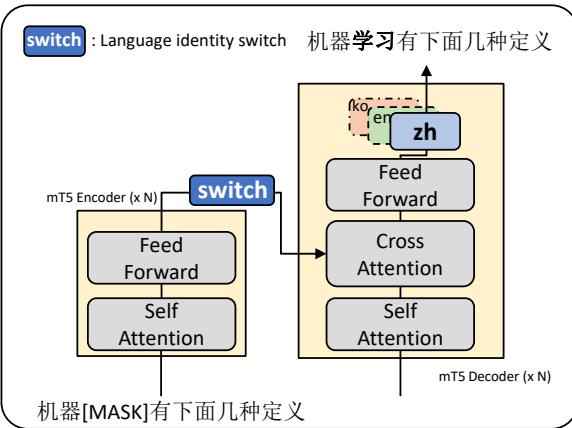
Here is the step-by-step logic:
- Take a sentence in the target language (e.g., Korean). Mask parts of it (add noise).
- Encode it using the model.
- The Switch: Mathematically subtract the “Korean” language vector and add the “English” language vector to the internal representation.
- Force the decoder (equipped with a Korean Adapter) to reconstruct the original Korean sentence from this modified “English-looking” representation.
This process is visualized below:
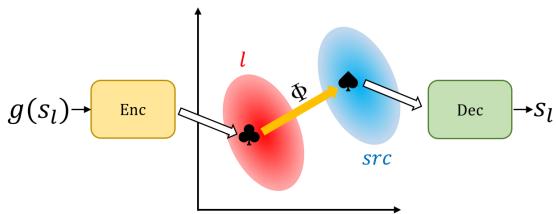
The mathematical operation for the switch (\(\Phi\)) is defined as:

Here, \(\mu_l\) is the average vector for language \(l\) (target), and \(\mu_{src}\) is the average vector for the source (English). By swapping these centroids, the encoder output “looks” like English to the decoder, but the decoder is trained to produce the target language.
The loss function used to train these adapters maximizes the probability of reconstructing the original sentence (\(s_l\)) given the switched representation:

3. Fine-Tuning and Inference
Once the adapters are trained to generate target languages from “English-like” representations, the rest of the model is fine-tuned on the actual labeled English dataset.
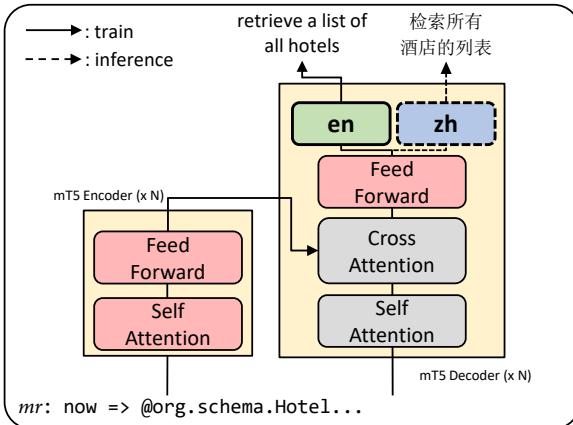
During inference (generation), the model takes a real English Meaning Representation. Because the adapters were trained on “fake” English representations (created via the switch), they successfully interpret the real English representation and output the target language.
4. The Filtering Mechanism
Not all synthesized sentences are perfect. To ensure quality, the authors use Round-Trip Consistency.
- Generate a target utterance (\(u_{tgt}\)) from a meaning representation (\(mr_{src}\)).
- Feed \(u_{tgt}\) into a standard semantic parser trained on English.
- If the parser outputs the original \(mr_{src}\), the data is good. If not, it’s discarded.
Experimental Results
The researchers tested CBP on two major cross-lingual benchmarks: Mschema2QA (11 languages) and Xspider (Text-to-SQL in Chinese and Vietnamese).
Accuracy Performance
The results were impressive. CBP outperformed standard translation-based methods and zero-shot baselines.
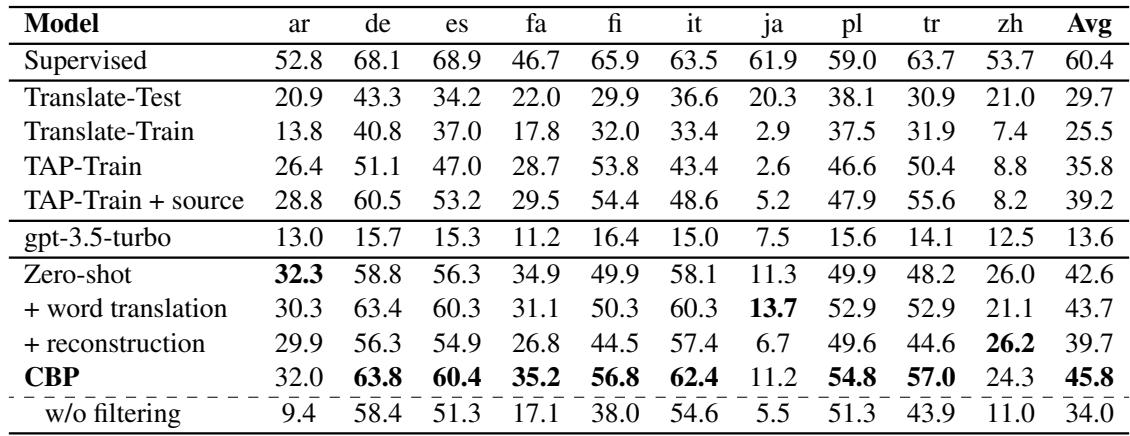
In Table 2, looking at the Mschema2QA dataset, CBP achieved an average Exact Match score of 45.8, significantly higher than the standard Zero-shot approach (42.6) and far superior to translation-based training (25.5). It even outperformed models that used dictionaries for word-for-word translation.
Similar success was observed on the Xspider benchmark:
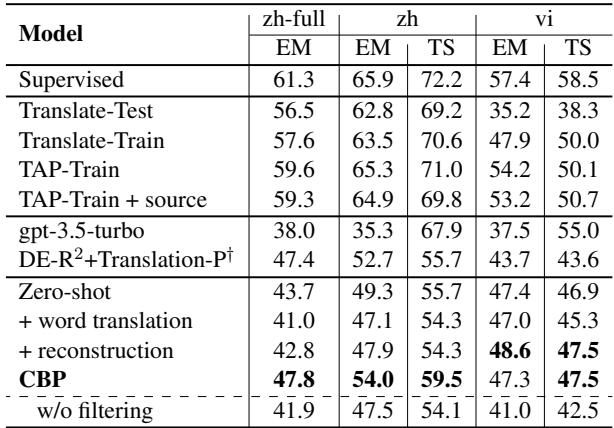
As seen in Table 3, CBP pushed the state-of-the-art for Chinese (zh) Text-to-SQL parsing to 59.5, beating the previous best model (DE-R\(^2\) + Translation) which scored 55.7.
Why does it work better? Slot Alignment.
One of the biggest headaches in cross-lingual semantic parsing is slot value alignment. If a user asks for “hotels in Paris”, the SQL query must contain "Paris". If a machine translation system translates the sentence loosely, the specific entity might get lost or morphed, breaking the query.
CBP excels here because it generates the sentence from the query, rather than translating a sentence into a query.
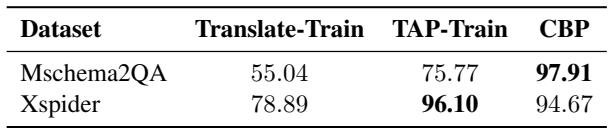
Table 4 shows that CBP achieves near-perfect slot value alignment (97.91% on Mschema2QA), whereas translation-based methods (Translate-Train) drop to around 55%. This difference is crucial for functional database queries.
Did the “Switch” actually work?
You might wonder if the complicated “Source-Switched Denoising” is necessary. Could we just train the adapters normally?
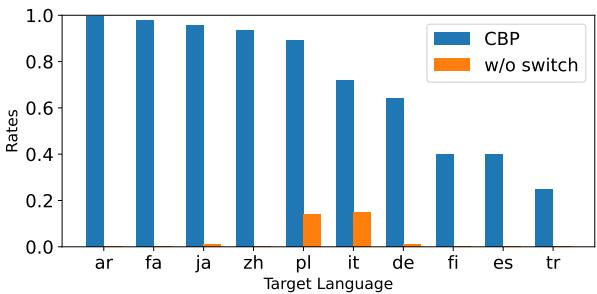
Figure 4 proves the necessity of the switch. The orange bars (w/o switch) show that without the identity swap, the model essentially fails to generate target language characters (near 0 rate). With the switch (blue bars), the model successfully generates output in the correct script (Arabic, Chinese, etc.) almost 100% of the time for distinct scripts.
Data Efficiency
Finally, a major advantage of CBP is that it doesn’t require massive amounts of data.
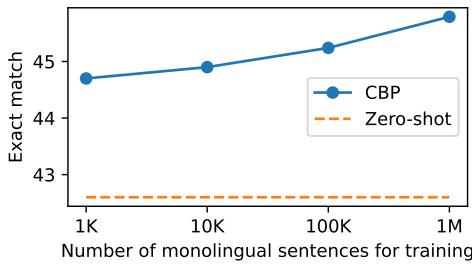
Figure 6 demonstrates that CBP outperforms the baseline even when trained with only 1,000 (1K) sentences of unlabelled text in the target language. This makes the method highly viable for true low-resource languages where even Wikipedia dumps might be small.
Conclusion
The Cross-lingual Back-Parsing (CBP) paper presents a sophisticated solution to the data scarcity problem in semantic parsing. By cleverly manipulating the internal representations of multilingual models—separating the “what” (meaning) from the “how” (language)—the authors created a system that can synthesize its own training data.
Key Takeaways:
- Zero-Resource Viability: CBP works without translators or labeled target data.
- Geometric Intuition: It leverages the geometric properties of vector spaces in mPLMs (subtracting language centroids).
- High-Quality Synthesis: It preserves crucial slot values (entities) better than translation based methods.
This approach opens exciting doors for AI accessibility, allowing complex database interaction tools to be ported to new languages rapidly, ensuring that the benefits of semantic parsing aren’t limited to English speakers alone.