](https://deep-paper.org/en/paper/2410.00593/images/cover.png)
Large Language Models (LLMs) like LLaMA-3 are often described as “stochastic parrots”—they are incredibly good at mimicking the patterns they have seen during training. Usually, this is exactly what we want. However, when it comes to Text Style Transfer (TST), this mimicry becomes a hurdle.
Imagine you want to rewrite a rude email to be polite, or turn a Shakespearean sonnet into modern English. You ask an LLM to do it. Ideally, the model should keep the meaning (semantics) but completely swap the vibe (style). In practice, however, LLMs often struggle in zero-shot settings. They tend to prioritize the original meaning so heavily that they simply copy the input words, or conversely, they change the style but produce gibberish that lacks fluency.
In this deep dive, we are exploring a fascinating paper, “Style-Specific Neurons for Steering LLMs in Text Style Transfer,” which proposes a method to perform “brain surgery” on an LLM. By identifying specific neurons responsible for style and selectively turning them off, the researchers developed a framework called sNeuron-TST. This method steers the model toward the desired style without needing expensive fine-tuning or finicky prompt engineering.
The Problem: The “Copy” Trap
Text Style Transfer (TST) is a balancing act. You have a source text \(x\) with style \(s_1\) (e.g., “toxic”), and you want a target text \(\hat{x}\) with style \(s_2\) (e.g., “neutral”).
Current LLMs are risk-averse. When tasked with TST, they often suffer from the copy problem. Because the model is trying to preserve the semantic content of the sentence, it often defaults to copying the original words, even if those words carry the wrong style.
As shown in the analysis by the researchers, a significant portion of outputs from standard models like LLaMA-3 are identical to the input text. The model “knows” what you want, but its internal activations for the original words are just too strong to resist. To fix this, we need to look under the hood—specifically at the neurons inside the Feed-Forward Networks (FFN) of the Transformer architecture.
Background: Neurons as Knowledge Keepers
To understand the solution, we first need to understand how LLMs store information. The dominant architecture for LLMs is the Transformer. Within each layer of a Transformer, there is a Multi-Head Attention mechanism and a Feed-Forward Network (FFN).
Research suggests that FFNs act as “key-value” memories. They hold a massive amount of the model’s knowledge. Previous studies have successfully identified “language neurons”—specific neurons that light up when processing Chinese versus English. By manipulating these, researchers can steer models to output specific languages.
The authors of this paper posed a critical question: Do LLMs also have “style-specific” neurons?
If we can find neurons that specifically activate for “politeness” or “toxicity,” we might be able to manually suppress the source style and boost the target style directly during the decoding process.
The Core Method: sNeuron-TST
The proposed framework, sNeuron-TST, is a three-stage process. It involves identifying the right neurons, deactivating the ones holding us back, and then using a clever decoding strategy to fix the resulting grammar.
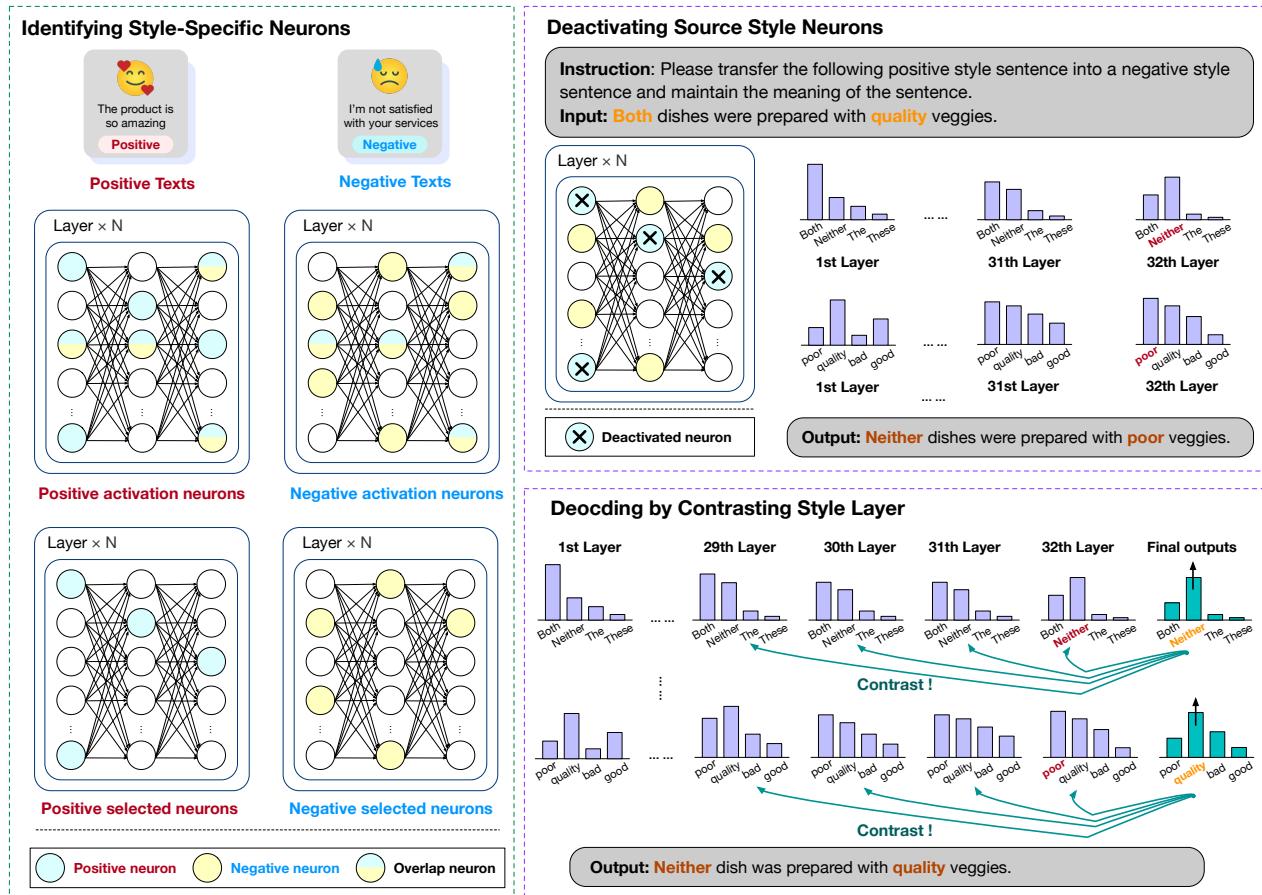
Let’s break down the architecture shown in Figure 1 above.
1. Identifying Style-Specific Neurons
First, the researchers feed the LLM two sets of texts: one in the source style (e.g., informal) and one in the target style (e.g., formal). They look at the activation values of the neurons in the FFN layers.
The activation of a layer \(j\) is calculated as:

Here, act_fn is the activation function (like GLU in LLaMA). A neuron is considered “active” if its value is greater than zero.
The Overlap Challenge
A naive approach would be to simply find all neurons active during the “informal” text and turn them off. However, the researchers discovered a major pitfall: Overlap.
Many neurons are polysemantic—they do multiple jobs. A neuron might encode “informality,” but it might also encode “sentence structure” or “English grammar.” If you turn off all neurons associated with the source style, you might accidentally lobotomize the model’s ability to speak English.
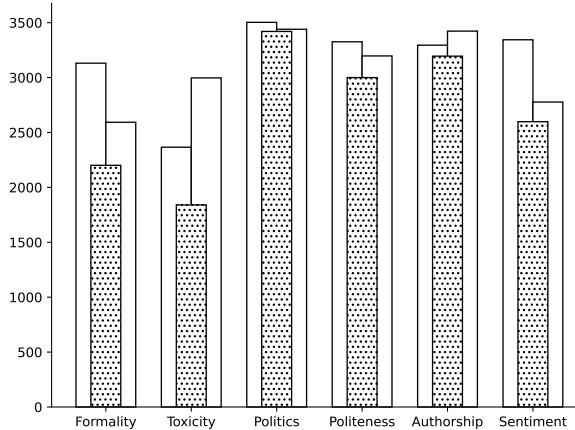
As Figure 2 shows, the overlap between styles is massive. In the “Politics” benchmark (Democratic vs. Republican), nearly 95% of neurons overlap.
To solve this, the authors strictly filter the neurons. They identify:
- \(N_A\): Neurons active only in the source style.
- \(N_B\): Neurons active only in the target style.
- Overlap: Neurons active in both.
Crucial Step: They discard the overlap. They only target the neurons that are exclusive to the source style (\(N_A\)) for deactivation. This ensures that the foundational capabilities of the model (like grammar and general knowledge) remain intact.
2. Deactivating Source Style Neurons
Once the unique source-style neurons are identified, the method sets their activation values to zero during the forward pass.
This forces the model to look for alternatives. Since the “informal” neurons are silent, the model’s probability distribution shifts. Words associated with the “formal” style suddenly become the most probable candidates.
However, as illustrated in the “Deactivating Source Style Neurons” section of Figure 1, this creates a new problem: Fluency degradation.
When you forcefully shut down neurons, the model gets confused. It might generate target-style words, but the sentence structure falls apart. In Figure 1, the model transforms “Both dishes were prepared with quality veggies” (positive) into “Neither dishes were prepared with poor veggies” (negative). While it successfully found the negative words (“Neither,” “poor”), the grammar is clunky (“Neither dishes…”).
3. Contrastive Decoding: The Fluency Fix
To repair the fluency while keeping the style, the authors adapt a technique called Contrastive Decoding. Specifically, they modify a state-of-the-art method called DoLa (Decoding by Contrasting Layers).
The Intuition: In an LLM, lower layers typically handle syntax and grammar (fluency), while higher (later) layers handle semantic meaning and style.
The researchers analyzed where style neurons live and found a distinct pattern:
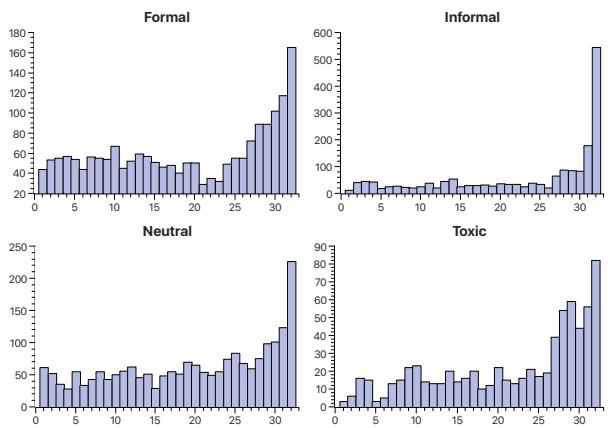
As shown in Figure 3, style-specific neurons are heavily concentrated in the final layers of the model (around layers 28-30 in LLaMA-3).
The Mechanism: The method compares the output probabilities of the final layer (which is heavily influenced by our neuron deactivation) against an earlier “premature” layer.
The probability of a token in a specific layer \(j\) is:

The final prediction is derived by contrasting the final layer \(N\) with a premature layer \(M\):

The contrast function \(\mathcal{F}\) calculates the log-difference between the layers:

This effectively subtracts the “generic” information (from the early layer) from the “stylized” information (from the final layer). If a word has high probability in both layers (like “the” or “is”), it is likely just a function word required for grammar. If a word spikes in probability only in the final layer (where we deactivated the source neurons), it is likely a style-specific choice.
By amplifying the difference, the model prioritizes words that are stylistically correct (from the final layer) but ensures they fit the general grammatical structure predicted by earlier layers.
Experiments and Results
The researchers tested sNeuron-TST on six diverse benchmarks:
- Formality (Informal \(\leftrightarrow\) Formal)
- Toxicity (Toxic \(\leftrightarrow\) Neutral)
- Politics (Democratic \(\leftrightarrow\) Republican)
- Politeness (Impolite \(\leftrightarrow\) Polite)
- Authorship (Shakespeare \(\leftrightarrow\) Modern)
- Sentiment (Positive \(\leftrightarrow\) Negative)
They compared their method against standard LLaMA-3 and other neuron-based editing methods (APE, AVF, PNMA).
Key Findings
1. Reduced Copying, Higher Style Accuracy The most significant win for sNeuron-TST is the reduction in the “copy problem.” Because the source neurons are deactivated, the model simply cannot easily reproduce the input style.
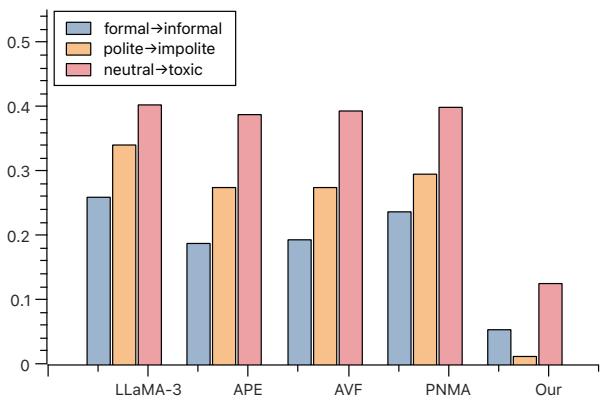
Figure 4 demonstrates this clearly. The “Copy Ratio” (how often the output mimics the input) drops dramatically for the “Our” method (green bars) compared to LLaMA-3 (blue bars). This leads to much higher transfer accuracy.
2. Qualitative Success Numbers are great, but text generation is about readability. The case studies provided in the paper highlight how the method actually changes the text.
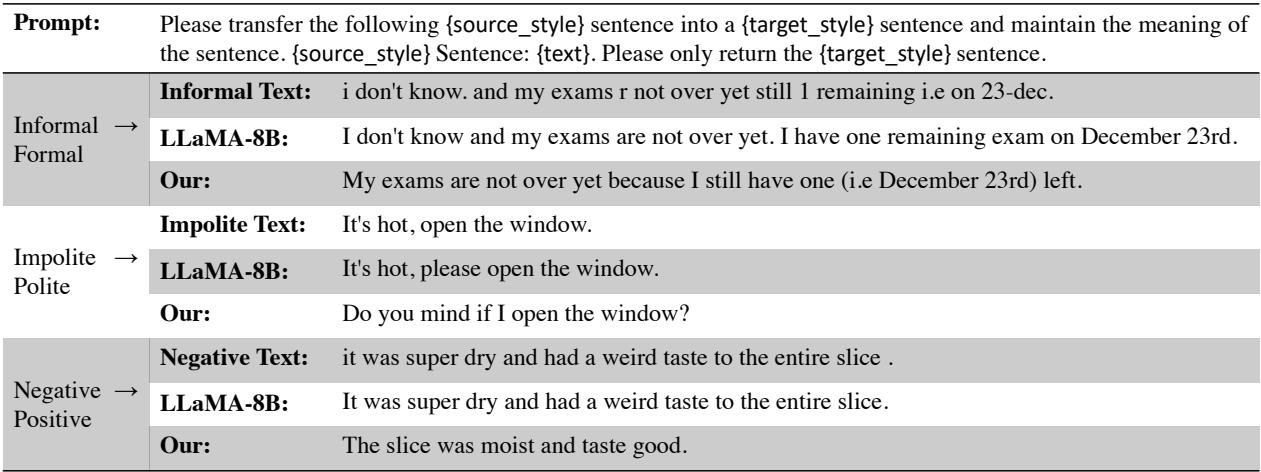
Look at the Impolite \(\rightarrow\) Polite example in Table 5:
- Input: “It’s hot, open the window.”
- LLaMA-3: “It’s hot, please open the window.” (A lazy edit).
- sNeuron-TST: “Do you mind if I open the window?” (A complete stylistic restructure).
3. The Ablation Study: Why Contrastive Decoding Matters The researchers performed an ablation study to prove that both steps (Deactivation + Contrastive Decoding) are necessary.
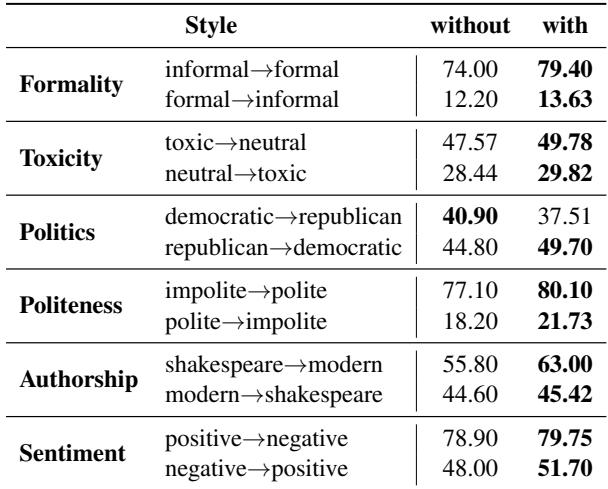
Table 3 confirms that removing the “Overlap” neurons is essential. If you don’t remove them (the “without” column), accuracy drops significantly because you are damaging the model’s general language capabilities. Furthermore, results in the paper (not shown here) confirmed that using Deactivation without Contrastive Decoding resulted in high style scores but terrible fluency (perplexity scores went through the roof). The combination is key.
Conclusion and Implications
The sNeuron-TST paper offers a compelling glimpse into the interpretability of Large Language Models. It moves beyond treating LLMs as “black boxes” where we just hope the prompt works. Instead, it treats them as transparent machines with specific levers we can pull.
Key takeaways for students and practitioners:
- Neurons are specialized: Even in dense models, specific neurons encode high-level concepts like “politeness.”
- Overlap is the enemy: When editing models, identifying what not to touch (overlapping neurons) is just as important as identifying the target.
- Layers matter: Style is a “late-stage” feature in Transformer processing, appearing mostly in the final layers.
- Steering > Prompting: For tasks like style transfer where models are stubborn, mechanical steering (neuron deactivation) can outperform surface-level prompting.
While this paper focused on text style, the implications are broad. Could we use similar techniques to identify “hallucination neurons” or “bias neurons”? The framework of finding, filtering, and contrasting offers a robust path forward for making LLMs more controllable and reliable.